
A led lamp car headlight should be judged from the driver’s seat, not from a product box. Yet much of the automotive lighting market still sells LEDs through giant wattage claims, oversized lumen numbers, and dramatic workshop photos. These figures may help a product attract attention, but they do not always predict how well a driver can see a pedestrian, curve, road sign, or obstacle at night.
For automotive distributors, wholesalers, retrofit chains, and professional installers, this creates a commercial problem as much as a technical one. A lamp can look impressive during a five-minute demonstration and still produce an average road experience. When that happens across hundreds of installations, the consequences may include customer complaints, returns, poor reviews, and lost dealer confidence.
This article uses a different method. Instead of ranking headlights by the biggest specification, we will evaluate them through a road-performance scorecard: beam reach, optical precision, thermal endurance, installation quality, electrical behavior, and market suitability.
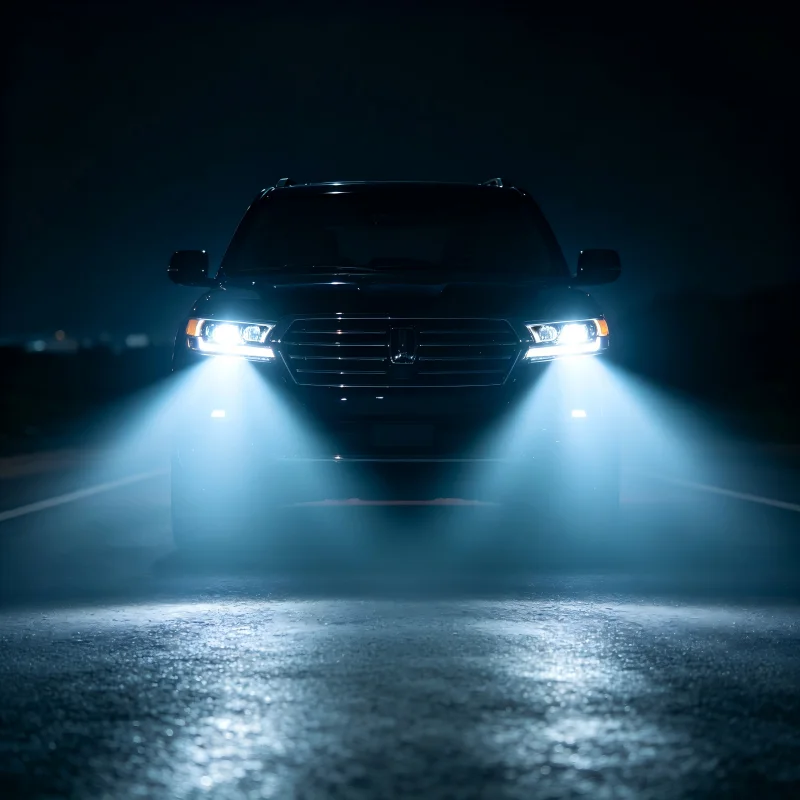
What Makes an LED Car Headlight Good on a Real Road?
A good LED car headlight should place enough light in useful road zones, maintain a controlled beam pattern, remain stable after heating up, fit the original lamp correctly, and work reliably with the vehicle’s electrical system. High wattage alone cannot guarantee these results.
Think about what happens during a normal night drive.
You do not need maximum light in every direction. You need enough controlled illumination to recognize the road ahead without creating excessive glare or bright foreground areas that make distant objects harder to see.
This is why an effective led light car headlight should be evaluated as part of an optical system rather than as a stand-alone bulb.
The Six-Zone Road Test
When we evaluate automotive lighting, it is useful to divide road performance into six practical zones:
- Near field: the area directly in front of the vehicle.
- Lane center: the primary driving path.
- Distance zone: where earlier obstacle detection becomes valuable.
- Roadside zone: where pedestrians, animals, signs, or road edges may appear.
- Cutoff zone: where controlled low-beam distribution helps manage glare.
- High-beam hotspot: where concentrated distance lighting is most useful.
A product that dominates only the near field may look spectacular against a wall. On an open road, however, the driver may still want more useful distance.
The Headlight Specification Scorecard
The safest way to compare LED headlights is to score several technical factors together instead of buying according to one number. Optical compatibility, beam distribution, sustained output, cooling, driver electronics, fitment, and manufacturing consistency should all influence the final purchasing decision.
| Evaluation Area | Basic Product | Better Product | Professional Buying Standard |
|---|---|---|---|
| Beam Pattern | Simply looks bright | Reasonable light distribution | Controlled cutoff and useful road coverage |
| LED Position | Large chip area | Closer to original light source | Designed for optical focal accuracy |
| Power | Marketing wattage | Measured startup power | Verified operating power after stabilization |
| Cooling | Fan or heat sink included | Functional heat management | Complete thermal-path engineering |
| Driver | Basic power conversion | Stable current control | Stable electrical and thermal behavior |
| Fitment | Socket fits | Fits most applications | Installation clearance and orientation verified |
| Consistency | Good sample | Acceptable batch | Repeatable mass-production performance |
The Wattage Race: 150W, 200W, 220W or 300W?
A large part of today’s LED headlight market is built around power labels.
Searchers regularly compare:
- led light for car headlight 150 watt;
- led light for car headlight 200 watt;
- led light for car headlight 220 watt; and
- led light for car headlight 300 watt.
These numbers can be useful only when they are measured under comparable conditions.
A 300W claim could describe a pair of lamps rather than one lamp. Another manufacturer may use theoretical chip capability. A third supplier may report measured electrical consumption.
So the labels may look comparable while describing different things.
A Better Question Than “How Many Watts?”
Ask the supplier:
- Is the stated wattage for one bulb or one pair?
- Is it theoretical, peak, or continuous measured power?
- What voltage was used during testing?
- How much power remains after the lamp reaches normal operating temperature?
- What beam-performance data supports the power claim?
This simple process can eliminate many misleading comparisons before you even begin road testing.
Why a 150W LED May Outperform a “300W” Product
Imagine two lamps.
Product A is marketed as a led light for car headlight 300 watt. It creates a huge amount of light near the vehicle, but some of that light is scattered outside useful road areas.
Product B has a more modest rating. Its optical geometry produces a cleaner concentration of light farther down the road.
Which one provides the better driving experience?
Potentially Product B.
The reason is simple: the driver’s goal is not to illuminate the largest possible area. The goal is to see relevant objects early and clearly.
That requires controlled intensity.
The Forgotten Specification: Light-Source Geometry
This is one of the most important concepts in replacement LED lighting and one of the least understood.
A reflector or projector does not randomly redirect light. Its optical surfaces were designed around a specific light-source location.
If an LED replacement places its emitting chips too far forward, too far backward, too wide, or too far apart, the reflector receives light from the wrong geometry.
The effect may include:
- a fuzzy cutoff;
- weak center intensity;
- unwanted scattered light;
- inconsistent road coverage;
- dark zones between illuminated areas;
- reduced high-beam effectiveness.
This explains why two bulbs using similar LED chips may behave very differently in the same vehicle.
Why H4 LED Headlights Are Especially Difficult to Engineer
An H4 LED replacement must manage both low-beam and high-beam functions within one bulb architecture. For that reason, chip position, light shielding, orientation, cooling, and reflector compatibility may matter more than raw wattage when selecting an H4 LED headlight.
Customers searching for led light for car headlight H4 often focus on brightness because it is easy to compare.
But H4 performance depends strongly on how the light source interacts with the original reflector.
A high-powered LED that produces a weak low-beam cutoff or unfocused high beam could be less useful than a lower-powered product with better source geometry.
How We Would Evaluate an H4 Sample
Based on our automotive lighting manufacturing experience, a professional test should include more than switching the bulb on.
- Install the H4 LED in a representative reflector.
- Confirm that the lamp locks into the correct position.
- Project the low beam onto a controlled test surface.
- Check cutoff shape and unwanted light above the intended zone.
- Switch to high beam and examine hotspot location.
- Run the lamp long enough for temperatures to stabilize.
- Repeat the beam observation after the lamp is hot.
The last step can reveal weaknesses that are invisible during a short sales demonstration.
What Happens After 30 Minutes?
Many buyers evaluate headlights during the first few minutes of operation.
That may favor products optimized for impressive startup performance.
But headlights may operate continuously for hours.
As LED temperature rises, the thermal system has to move heat away from the LED board, electronics, and surrounding components.
If the thermal design cannot keep up, the driver circuit may reduce operating power to protect the LED.
The customer then receives one level of brightness when the lamp is switched on and another after extended driving.
For commercial buyers, this makes sustained output more valuable than a spectacular startup measurement.
Fan Speed Does Not Equal Cooling Quality
A fast-spinning fan sounds technical, but cooling performance is a system.
Heat has to travel through several stages:
LED junction → circuit board → thermal interface → lamp body → heat sink → surrounding air.
If one stage has high thermal resistance, the entire cooling system can suffer.
That is why experienced buyers may examine:
- PCB thermal conductivity;
- heat-sink mass and surface design;
- metal quality;
- airflow path;
- fan durability;
- driver placement;
- thermal protection strategy.
A product should be evaluated as a complete thermal structure, not simply as “fan cooling” versus “no fan.”
LED Light Car Headlight Price: Build a Cost-per-Sale Model
The search term led light car headlight price sounds simple, but wholesale economics rarely are.
Imagine Supplier A sells an LED for $5 less per set than Supplier B.
Supplier A appears more profitable.
Now add several possible costs:
- replacement units;
- technician labor;
- dealer complaints;
- international freight;
- warranty administration;
- negative customer reviews;
- lost repeat orders.
The $5 saving can disappear quickly.
A distributor should therefore calculate cost per successful installation, not just purchase price per box.
A Simple B2B Buying Formula
Real Product Cost = Purchase Cost + Warranty Cost + Service Cost + Failure Risk + Reputation Risk
This mindset often separates short-term buying from professional category management.
Why Color Temperature Can Fool the Eye
Very cool white light can create a strong visual impression. It may look modern, clean, and powerful.
But the whitest-looking lamp is not automatically the best choice for every environment.
Road surface, rain, fog, driver preference, vehicle optics, and local market expectations may all influence the ideal product positioning.
For wholesalers, this matters because different markets may prefer different lighting characteristics.
A successful product range may therefore require more than one performance profile.
Is LED Light for Car Headlight Legal in India?
Whether an LED headlight conversion is legal in India may depend on the vehicle, original lighting system, approved configuration, installation, and applicable vehicle regulations. A bulb fitting an H4 or another socket does not automatically mean the modified headlamp system is legally compliant.
The keyword led light for car headlight legal in India reflects an important concern for both consumers and automotive businesses.
The issue should not be reduced to “LED is legal” or “LED is illegal.”
Vehicle-lighting compliance can involve approval standards, photometric requirements, headlamp design, installation, and vehicle classification.
Because rules may be revised, buyers and distributors should confirm current requirements through authoritative sources such as the Ministry of Road Transport and Highways and relevant automotive standards before making compliance claims.
“LED Light for Car Headlight Near Me” Is a Quality Question Too
A customer typing led light for car headlight near me may be ready to buy immediately.
But location alone should not determine the installer.
A professional retrofit shop should be able to answer questions such as:
- Does this LED suit my reflector or projector?
- Will the dust cover still close properly?
- Can the lamp be installed at the correct orientation?
- Does the vehicle require additional electrical compatibility solutions?
- Will you check headlight alignment after installation?
The installation process can influence performance almost as much as the product itself.
The 10-Minute Distributor Sample Inspection
Before sending a sample to a full laboratory or road test, an experienced buyer can learn a surprising amount in ten minutes.
- Read the specification sheet. Look for definitions instead of big numbers.
- Inspect the LED position. Check symmetry and chip placement.
- Inspect the base. Determine whether installation orientation is fixed or adjustable.
- Check the cooling structure. Look at the airflow path and heat-sink design.
- Examine the driver. Note size, construction, wiring, and connectors.
- Install the lamp. Confirm actual clearance.
- Observe the beam. Do not stare directly at the LED.
- Leave it running. Recheck performance after temperature rises.
This does not replace laboratory validation, but it can quickly identify products that deserve deeper testing.
Three Products Can Share a Specification and Still Be Completely Different
Consider three hypothetical led light for car headlight 200 watt products.
| Feature | Product A | Product B | Product C |
|---|---|---|---|
| Advertised Power | 200W | 200W | 200W |
| Chip Geometry | Large emitting area | Compact source | Application-optimized source |
| Thermal Control | Basic | Improved | Engineered thermal path |
| Beam Quality | Bright foreground | Balanced distribution | Controlled useful illumination |
| Supplier Focus | Price | General aftermarket | Professional lighting applications |
The point is not that one specification has no value.
The point is that a specification must be interpreted inside the complete product design.
What Professional Installers Tend to Care About After the Sale
Enthusiast communities and installer discussions often reveal a pattern that product listings overlook.
Before purchase, people talk about wattage and lumens.
After installation, they talk about very different things:
- “Can I actually see farther?”
- “Why are cars flashing me?”
- “Why does one side look different?”
- “Why did the fan become noisy?”
- “Why does the light look weaker after driving?”
- “Why is there a dark area in the middle?”
These questions reveal the gap between buying specifications and ownership experience.
For background on how automotive headlamps control and distribute light, see this overview of vehicle headlamp systems.
Where GTR Fits in a Professional Lighting Program
At GTR, we believe a successful automotive lighting product should survive three tests.
Test 1: Can It Perform?
The product has to deliver useful lighting performance, not only attractive laboratory or packaging figures.
Test 2: Can It Be Manufactured Consistently?
A distributor does not buy one engineering sample. A distributor may buy hundreds or thousands of units.
That means consistency between production batches becomes critical.
Test 3: Can It Fit the Market?
Automotive lighting markets are not identical.
Vehicle applications, customer budgets, preferred specifications, installation practices, branding strategies, and channel structures can vary significantly between countries.
Based on our manufacturing experience, this is why GTR works with professional automotive aftermarket partners from a broader product-development perspective.
Wholesalers and distributors may need more than an existing catalog item. They may need application selection, product positioning, branding support, packaging customization, or specifications better suited to their target market.
FAQ: Fast Answers Before You Buy
Is a 300W LED car headlight extremely bright?
It may be, but the advertised wattage should be verified. Ask whether the figure represents one bulb or a pair and whether it is actual continuous operating power.
Is a 220W LED better than a 200W LED?
Not automatically. A led light for car headlight 220 watt should be compared with a 200W product through beam quality, heat control, real power, optics, and sustained output.
Can a 150W LED provide enough light?
A well-designed led light for car headlight 150 watt may provide strong usable performance when optical efficiency and beam control are good. Power should be considered together with the complete lighting system.
What should I check before buying an H4 LED?
Check low- and high-beam geometry, bulb orientation, reflector compatibility, cooling clearance, electrical fitment, and performance after extended operation.
Why are LED headlight prices so different?
Led light car headlight price can vary because of LED components, thermal structure, driver electronics, materials, quality control, manufacturing consistency, brand positioning, customization, and after-sales support.
Do higher lumens always mean better night visibility?
No. Total light output and useful road illumination are different concepts. Optical distribution determines where that light reaches.
Can I install an LED headlight myself?
Some replacements are mechanically simple, but correct orientation, fitment, beam alignment, electrical compatibility, and local regulations should still be considered.
Where can I buy LED lights for car headlights near me?
Searches for led light for car headlight near me can identify local dealers and installers. Choose a supplier that can also evaluate fitment and beam alignment rather than selling solely on wattage.
For B2B Buyers, the Best Headlight Is the One Customers Reorder
An automotive lighting distributor does not make money because a product claims 150W, 200W, 220W, or 300W.
The business succeeds when dealers can install the product with confidence, drivers appreciate the improvement, warranty problems remain manageable, and customers come back for the next order.
That is the commercial definition of a good led lamp car headlight.
If you are building an LED headlight range for India or another automotive aftermarket, do not begin with the biggest number in a supplier catalog. Begin with the vehicles you serve, the road conditions your customers face, the product level your dealers need, and the performance you want your brand to represent.
Explore professional GTR automotive lighting solutions at www.rhgtr.in. Share your target applications, price segment, sales channel, and expected volume with our team. We can help you move from comparing specifications to building a headlight program designed for repeatable road performance and long-term B2B sales.