
Walk into any auto parts store or scroll through Amazon, and you will see dozens of h11 headlight bulbs claiming to be the brightest, the longest-lasting, or the most advanced. Almost all of them use the same off-the-shelf LED chips from Philips or CREE. Almost all of them deliver the same disappointing results.
GTR Lighting took a different path. Instead of buying generic components and slapping them into a housing, they engineered a custom solution from the ground up. This is the story of why that matters — and why the GTR Ultra 3 H11 headlight bulbs outperform everything else in their class.
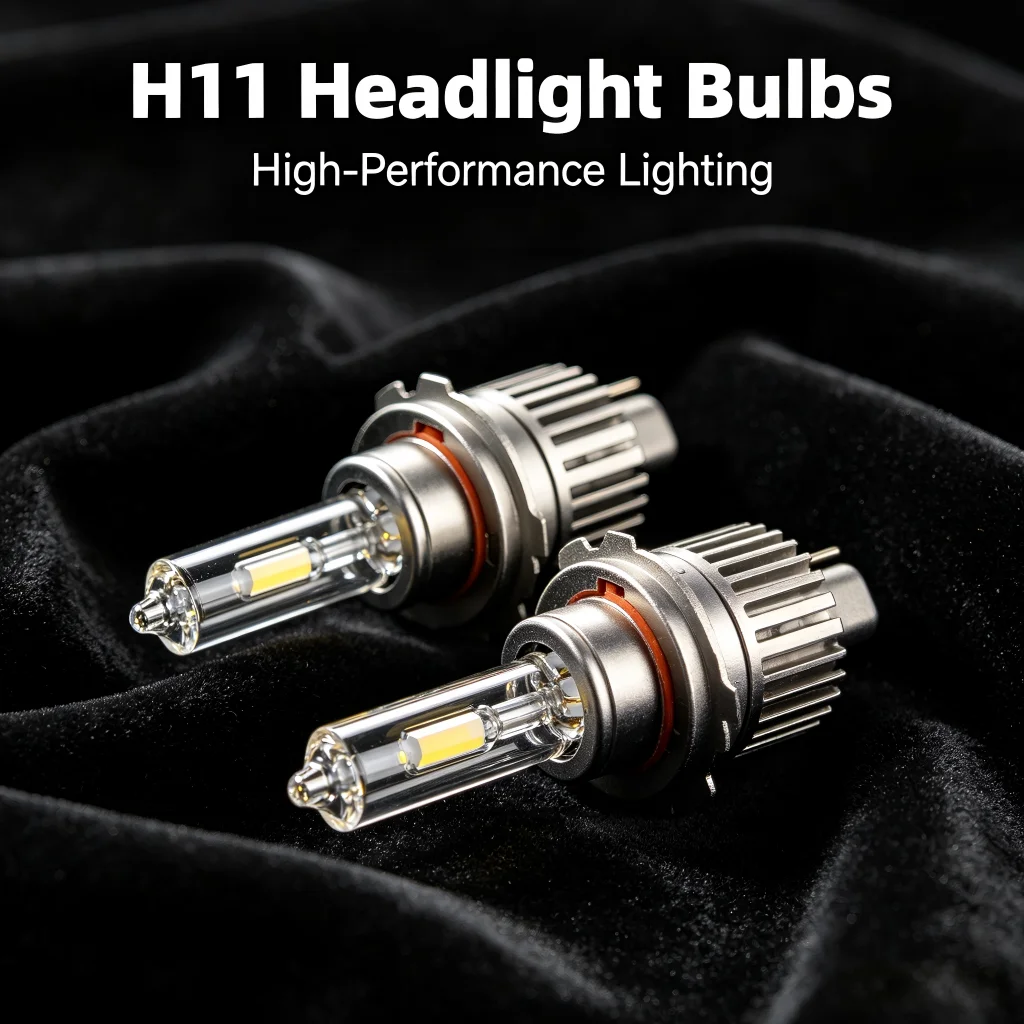
The Custom Chip Advantage: Why GTR Said No to Philips and CREE
When you buy most LED h11 headlight bulbs, you are getting the same LED chips that every other brand uses. Philips ZES. CREE XHP. These are good chips. They are reliable. But they were not designed specifically for automotive headlight applications.
GTR Lighting went a different direction. They developed their own TST 7045 chipset — a custom solution engineered specifically for the unique demands of headlight housings.
Why does this matter? A generic chip is designed for general illumination. It prioritizes raw output over beam control. In a headlight housing, raw output without precision creates scattered light — bright spots that blind oncoming drivers and dark spots that leave you guessing.
The TST 7045 chipset solves this with digitally optimized LED positioning that matches the original halogen filament tolerances more closely than any off-the-shelf alternative. The result is a beam pattern that actually works in your vehicle’s housing — not a scattered mess that looks impressive on a spec sheet but fails on the road.
Thermal Separation Technology: The Cooling Breakthrough
Heat is the silent killer of LED h11 headlight bulbs. Every LED chip generates heat. If that heat cannot escape, the chip degrades. Brightness drops. Color shifts. The bulb fails.
Most manufacturers address this with a basic heat sink and a fan. It works — barely. The problem is that the LED die and the driver circuit share the same thermal plane. Heat from the driver migrates to the die, and heat from the die migrates to the driver. Neither operates at peak efficiency.
GTR’s Thermal Separation Technology changes this equation. The LED die sits on a separate thermal plane from the driver circuit. Heat from the driver does not affect the die. Heat from the die does not affect the driver. Each component operates at its optimal temperature.
This is not a marketing gimmick. Independent testing confirms that the GTR Ultra 3 runs cooler than competitors drawing the same wattage. Cooler operation means longer life, consistent brightness, and no performance degradation over time.
Real Performance: What the Numbers Actually Mean
Spec sheets are easy to manipulate. Real-world testing is not. Multiple independent sources have put the GTR Ultra 3 H11 headlight bulbs through rigorous testing — and the results speak for themselves.
Projector Housing Performance
Projector housings demand precision. A bulb that scatters light in a projector housing creates glare and reduces usable output. The GTR Ultra 3 delivers.
In projector testing, the Ultra 3 produced 920 max lux at the brightest point — a 475% increase over stock halogen. The beam pattern retained the sharp cutoff line that projector housings are designed to produce. More usable light. Less glare. Safer driving.
BulbFacts, an independent testing lab that purchases every product it tests (no freebies, no sponsored content), recorded 830 lux in the low beam setting — a 261% improvement over stock. The beam quality impressed the testing team, with well-controlled glare that stays within safe limits for oncoming drivers.
Reflector Housing Performance
Reflector housings are even more demanding. The bulb must distribute light across a reflector surface, and any misalignment creates hot spots and dark areas. The Ultra 3 handles this challenge with ease.
BulbFacts recorded 1,498 lux in reflector low beam testing — a 302% increase over standard halogen. High beams peaked at 2,456 lux, an 180% increase. Glare measured just 380 lux, comfortably within safe limits.
In the Honda Civic’s reflector high beam housing, the Ultra 3 produced the highest lux readings ever recorded by the testing team — 3,960 max lux, a staggering 742% increase over stock.
Consistent Performance Over Time
Brightness at startup is one thing. Brightness after driving for 27 minutes is another. The GTR Ultra 3 retains 87% of its initial brightness after a typical drive. That means consistent performance mile after mile, not a bulb that starts bright and dims as it heats up.
Why Most H11 Headlight Bulbs Fail — And How GTR Fixes It
The LED headlight market is flooded with products that look good on paper but fail in practice. Here is why — and how GTR addresses each failure point.
Failure Point #1: Poor Beam Pattern
Most LED h11 headlight bulbs scatter light. The LED chips are positioned incorrectly, or the housing is not designed for the chip layout. The result is glare for oncoming drivers and reduced visibility for you.
GTR’s fix: Digitally optimized LED positioning that matches OEM filament location. The beam stays focused. The cutoff stays sharp. You get light on the road, not in the eyes of other drivers.
Failure Point #2: Overheating and Degradation
Cheap bulbs use inadequate heat sinking. The LED chips overheat, dim, and fail. This is why so many budget H11 bulbs die within months.
GTR’s fix: Thermal Separation Technology with aerospace-grade materials. The chips stay cool. The output stays consistent. The bulb lasts.
Failure Point #3: Incompatibility with Vehicle Electronics
Modern vehicles use CANBUS systems that monitor bulb performance. LED bulbs draw less power than halogens, triggering error messages, flickering, or complete shutdown.
GTR’s fix: Built-in compatibility across a wide voltage range (9–40V DC). The Ultra 3 works with most vehicles without additional modules, though some sensitive applications may still benefit from CANBUS solutions.
Failure Point #4: Installation Nightmares
Many LED bulbs are too large to fit in tight headlight housings. Others require external drivers that complicate installation.
GTR’s fix: An all-in-one design with the driver integrated into the bulb. The compact body fits tight spaces, and the cord design allows installation in vehicles with limited clearance.
What Real Users and Experts Say
Professional installers and testing labs consistently rank the GTR Ultra 3 among the top performers for H11 applications. HID Nation, with 25 years in automotive lighting and over 50,000 orders shipped, recommends the GTR Lighting Ultra 3 for premium H11 performance — not because of affiliate commissions, but because of real customer feedback.
The Retrofit Source, another trusted name in automotive lighting, backs the Ultra 3 with a lifetime warranty and verified plug-and-play performance. They note that the bulb’s smaller size is often mistaken for weakness — but thanks to Thermal Separation Technology, it dissipates heat more effectively than larger competitors while delivering 4,700 lumens of output.
Drivers report the same experience: better visibility, cleaner beam patterns, and reliable performance night after night. As one reviewer put it, the Ultra 3 strikes a “perfect balance between raw brightness and responsible beam control”.
H11 Headlight Bulb FAQ: Quick Answers
What makes GTR Ultra 3 different from other H11 LED bulbs?
GTR uses a custom TST 7045 chipset instead of off-the-shelf Philips or CREE chips, combined with Thermal Separation Technology that keeps the LED die and driver circuit on separate thermal planes for cooler operation and longer life.
How bright are GTR Ultra 3 H11 headlight bulbs?
The Ultra 3 produces 4,700 raw lumens per bulb at 43 watts of power. Independent testing shows 475% brighter low beams and up to 742% brighter high beams compared to stock halogen.
Will GTR Ultra 3 H11 bulbs fit my vehicle?
H11 bulbs fit a wide range of vehicles including Toyota, Honda, Ford, Chevrolet, Nissan, Subaru, and Mazda models. The Ultra 3’s compact design fits tight housings, and the all-in-one driver eliminates the need for external modules.
Do GTR Ultra 3 bulbs require CANBUS decoders?
Most vehicles do not require additional decoders, but some sensitive applications may benefit from CANBUS or anti-flicker modules. The Ultra 3 is designed for broad compatibility across 9–40V DC systems.
How long do GTR Ultra 3 H11 bulbs last?
The Ultra 3 is backed by a lifetime limited warranty. With proper thermal management and high-quality components, these bulbs are designed to outlast your vehicle.
Where can I buy GTR Ultra 3 H11 headlight bulbs?
GTR Ultra 3 bulbs are available through authorized dealers and directly from the manufacturer. Purchasing from authorized sources ensures warranty coverage and authentic products.
The Bottom Line: Engineering Matters
When you buy h11 headlight bulbs, you are not just buying light. You are buying visibility. Safety. Reliability. The difference between a bulb that works and a bulb that fails is not luck — it is engineering.
GTR Lighting invested the time and resources to develop a custom chipset, engineer a superior cooling system, and optimize every detail of the beam pattern. The result is an H11 LED bulb that delivers on every promise — brightness, beam control, longevity, and compatibility.
Generic bulbs use generic components and deliver generic results. The GTR Ultra 3 uses proprietary engineering and delivers something far better.
Experience the difference that custom engineering makes. Visit https://www.rhgtr.in to find the GTR Ultra 3 H11 headlight bulbs for your vehicle. Your night driving deserves more than generic.