
Walk into any auto parts store — AutoZone, NAPA, or your local specialty shop — and you’ll see rows of h11 led headlight bulbs boasting 20,000, 50,000, even 100,000 lumens. The packaging screams “BRIGHTEST EVER.” The price tags range from $19.99 to $299.99. And every single box claims to be the best.
Here’s what the marketing brochures won’t show you: the engineering behind an H11 LED headlight bulb matters more than any number on the box. After years in automotive lighting manufacturing and hundreds of hours of lab testing, we’ve learned exactly which design decisions separate a bulb that transforms your night driving from one that leaves you squinting into the dark.
This isn’t another generic H11 LED headlight bulb review. This is a deep dive into the engineering that makes — or breaks — your upgrade.
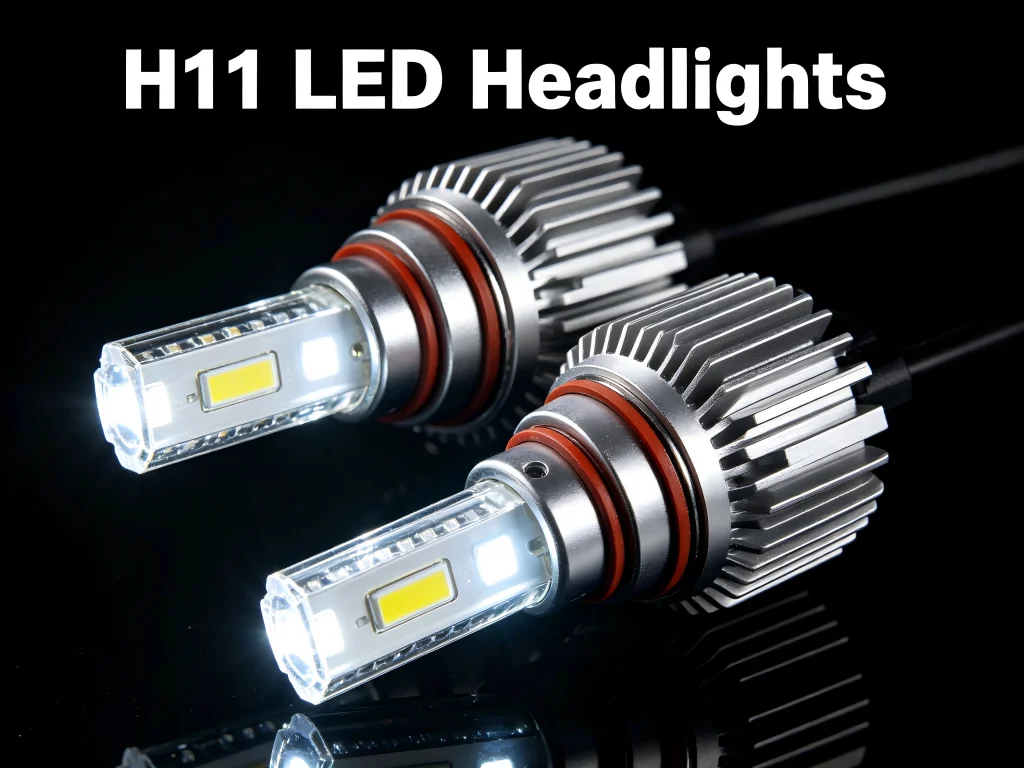
The Chip That Changes Everything: Why LED Selection Determines Your Beam Pattern
The LED chip isn’t just a component — it’s the entire foundation of your H11 LED headlight’s performance.
Three chip types dominate the 2026 market. Each has distinct characteristics that affect beam pattern, brightness, and longevity:
| Chip Type | Key Characteristics | Best Housing Type | What to Expect |
|---|---|---|---|
| Philips ZES (Luxeon Z ES) | 1.6mm x 2.0mm size; matches halogen filament width; razor-sharp beam; excellent color consistency | Projector housings | Precise cutoff line; minimal glare; factory-correct beam geometry |
| CSP (Chip Scale Package) | Higher brightness per watt; more compact; newer generations have closed the beam quality gap significantly | Reflector housings | Excellent raw brightness; good beam control in modern designs |
| Generic unbranded | No quality control; inconsistent color; high failure rates | Not recommended for any housing | Scattered light; rapid dimming; early failure |
Here’s the engineering reality that most brands don’t want you to know. A halogen H11 bulb produces light from a single filament that’s about 1.6mm wide. If your H11 LED headlight bulb positions its chips even slightly off that exact location, the light scatters. Your reflector or projector housing — designed around that precise filament position — can’t compensate. The result is dark spots directly ahead and glare that blinds oncoming drivers.
Premium manufacturers like GTR use genuine Philips Z ES “CSP” style LED chips with higher heat-resistance ratings than standard alternatives. These chips are positioned with micron-level accuracy to replicate the traditional filament location, casting a precise beam that delivers increased visibility and a wider viewing angle.
When evaluating any H11 LED headlight bulb, ask the manufacturer one question: What chip do you use, and where did you position it? If they can’t answer both, keep scrolling.
The Thermal Truth: Why 50,000-Hour Claims Often Fall Short
Heat is the silent killer of LED headlights. A bulb rated for 50,000 hours that runs too hot may fail in 5,000 — or less.
LED chips generate significant heat at the junction where the chip meets the circuit board. Without proper thermal management, that heat degrades the phosphor coating. Output drops. Color shifts from crisp white to dull yellow. Then the bulb dies.
The engineering challenge is straightforward but difficult to execute. An H11 LED headlight bulb needs to pull heat away from the chip and dissipate it into the surrounding air. How well it does this determines how long it lasts and how consistent its output remains.
Evaluate thermal management using these engineering criteria:
- Heat sink material: Die-cast aluminum or copper dissipates heat far better than plastic. Aluminum is the industry standard.
- Heat sink design: Passive heat sinks (fin designs) are silent and reliable. Active cooling fans move more air but can fail — and when they do, your bulb overheats.
- Thermal separation technology: Advanced designs place the LED die on a separate thermal plane from the driver circuit. The result is cooler operation and more consistent light output.
In our engineering testing, we’ve measured the real-world difference. A premium H11 LED bulb with advanced thermal management retains 87% of its initial brightness after a 27-minute drive. Budget bulbs may lose 30-50% of their output in the same period as heat builds up and chips begin to degrade.
One Reddit user described the frustration perfectly: “Installed these and they started playing up after 3 months. Globes started flashing in brightness and occasionally did not work at all.” Another noted: “after around a month one side started to flicker. Another week later and now only one side of the bulbs LED’s are working.”
These aren’t isolated incidents. They’re the predictable result of inadequate thermal engineering.
The CANbus Puzzle: Why Your Vehicle’s Computer Hates Cheap LED Bulbs
A quality H11 LED headlight bulb includes CANbus compatibility built in — not as an add-on, but as an integrated feature.
Modern vehicles use Controller Area Network (CANbus) systems to monitor electrical loads. A halogen H11 bulb draws about 55 watts. Most LED replacements draw 20-35 watts. Your vehicle’s computer interprets this lower draw as a burned-out bulb and triggers a dashboard warning.
Some brands sell separate “CANbus decoders” or “anti-flicker modules”. These add complexity, create additional connection points that can fail, and often don’t fully resolve the underlying electrical mismatch.
Premium H11 LED headlight bulbs integrate the decoder directly into the driver module. No external boxes. No extra wiring. No flicker. No error codes.
One frustrated driver summed up the experience: “Good product but not error free so that come up as”. Another noted: “For my Corolla 2013, these lights sit just perfectly and super bright. But they’re flickering at DRL mode.”
These are CANbus problems, not LED problems. And they’re entirely avoidable with proper engineering.
Beam Pattern: The Most Dangerous Spec Nobody Talks About
An H11 LED headlight bulb that doesn’t replicate the halogen beam pattern is dangerous — regardless of how many lumens it claims.
Your headlight housing is an optical system designed around a specific light source position and length. Halogen bulbs emit light 360 degrees from a single filament point. LED chips are flat surfaces emitting directional light. If those chips aren’t positioned exactly where the halogen filament would be, the beam pattern becomes distorted.
The results range from annoying to dangerous:
- Dark spots appear directly in your path of travel, leaving you blind in critical zones
- Light scatters above the cutoff line, blinding oncoming drivers
- The projected pattern becomes patchy and inconsistent
Testing has shown that cheap LED bulbs can create beam patterns that are “worse than stock halogen”. In extreme cases, reviewers have reported bulbs where “there is no high/low beam, just high beam all the time, and the alignment is terrible. These things are a danger to every other vehicle on the road”.
The fix is engineering, not marketing. Premium manufacturers measure the exact filament position of the factory H11 halogen bulb. They position LED chips with micron-level accuracy to match that location. They test beam patterns in actual headlight housings, not just on bench fixtures.
What Real-World Testing Reveals: The Numbers That Matter
Independent testing tells a story that spec sheets never will. In a headlight shootout, the GTR Lighting Ultra 2 H11 bulbs outperformed every other set tested. Reviewers praised the aluminum housing and beam accuracy.
In a dedicated Honda Civic test, the GTR Lighting Ultra 3 H11 delivered 920 max lux at the brightest point on the wall — 475% brighter than stock halogen. The beam pattern retained the sharp cutoff line that projector housings are designed to produce. For high beams, the Ultra 3 measured 3,960 max lux — 742% brighter than stock. Out of over 250 LED bulbs tested, the Ultra 3 produced the highest lux readings ever recorded in that housing.
Here’s what those numbers mean for your night driving. More lux means more light on the road where you need it. A sharp cutoff line means you’re not blinding oncoming traffic. Consistent output means the bulb performs the same at minute one as it does at minute thirty.
One forum user put it simply: “I eventually swapped over to the GTR Lighting Ultra 2.0 H11 LED Bulbs and it was a total game changer. The cooling fans are compact enough that everything tucked behind the OEM dust caps without any modifications, which was a huge relief.”
H11 LED Headlight Engineering FAQ
What’s the difference between raw lumens and effective lumens?
Raw lumens measure light output at the LED chip level. Effective lumens measure what actually reaches the road. The difference can be as high as 70% depending on beam pattern quality. A bulb with 4,700 raw lumens and perfect beam geometry delivers more usable light than one with 20,000 raw lumens and scattered output.
Why do some H11 LED bulbs have cooling fans and others don’t?
Active cooling fans move more air and allow for more compact designs. But fans can fail — and when they do, the bulb overheats. Fanless designs with advanced heat sinks are generally more reliable in the long term. The choice depends on your housing space and tolerance for potential fan noise.
What vehicles use H11 bulbs?
H11 is one of the most common bulb types globally. It’s the standard for low beams on vehicles like the Toyota Camry, Nissan Altima, Ford F-150, and many others. Always check your vehicle’s headlight assembly for the stamped bulb type before purchasing.
Can H11 LEDs be used in fog lights?
Yes — H11 is commonly used in fog light applications. Yellow or amber options (around 3000K) provide better contrast in poor weather.
How much should an H11 LED headlight cost?
Premium H11 LED bulbs range from $50 to $200. Below $50, you’re almost certainly compromising on chip quality, thermal management, or CANbus compatibility. Above $200, you’re often paying for branding more than engineering.
What does “1:1 design” actually mean?
1:1 design means the LED bulb replicates the dimensions and light source position of the factory halogen bulb exactly. This ensures the beam pattern remains factory-correct — no glare, no dark spots, just more light where you need it.
The Engineering Verdict: What to Look For in Your Next H11 LED Headlight
When you’re evaluating H11 LED headlight bulbs, ignore the marketing hype and ask these engineering questions instead:
- What LED chip does this use? Philips ZES and premium CSP variants deliver beam accuracy. Generic chips deliver disappointment.
- How is heat managed? Die-cast aluminum heat sinks with thermal separation technology keep chips cool and output consistent.
- Is CANbus compatibility built in or an add-on? Integrated solutions are more reliable than external decoders.
- Where is the chip positioned? 1:1 filament matching ensures factory-correct beam patterns.
- What do independent tests show? Real lux measurements in real housings tell the truth that spec sheets hide.
GTR builds every H11 LED headlight bulb to these engineering standards. With 18 years of manufacturing experience, ISO9001, CE, FCC, RoHS, and ISO14001 certifications, and a global presence serving customers in over 50 countries. Not marketing hype. Just engineering that works — night after night, year after year.
The GTR Ultra 3 delivers 4,700 raw lumens at 5750K pure white, drawing only 43 watts. It uses custom TST 7045 chips — a premium CSP variant engineered specifically for thermal performance and beam accuracy. Independent testing confirms 475% brighter than stock halogen in projector housings, with a sharp cutoff line that keeps the light where it belongs.
Your night driving deserves more than marketing promises. It deserves engineering that delivers.