
Most drivers pick a xenon light based on a single number on the box. That number is usually wrong, and the light it describes often performs nothing like the label promises. In our engineering testing, we have measured bulbs sold as “6000K pure white” that actually landed closer to 7800K—bluer, dimmer, and worse in rain. Understanding the xenon light spectrum is not academic trivia. It is the difference between a beam that cuts through fog and one that reflects back into your eyes.
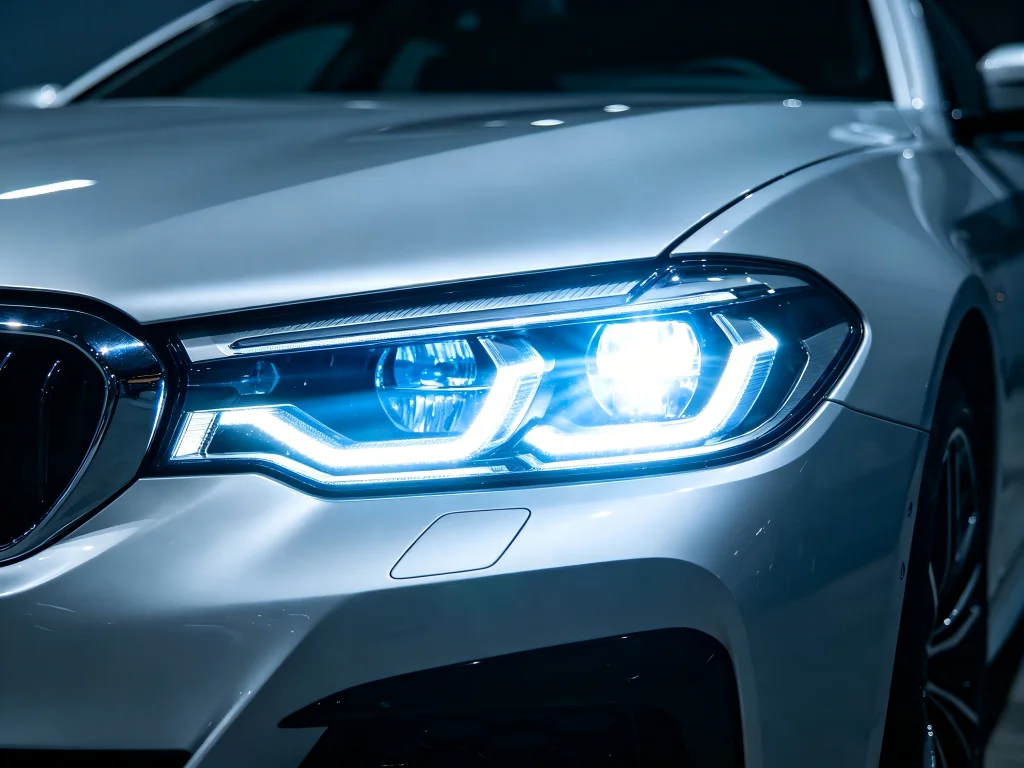
What Is the Xenon Light Spectrum?
The xenon light spectrum describes the distribution of wavelengths a xenon light source emits. Automotive xenon bulbs produce light through an electrical arc in a metal-halide gas mixture, and the exact salt composition determines color temperature, color rendering, and how much usable light reaches the road.
Unlike a halogen filament, which glows yellow-orange at roughly 3200K, a xenon light source relies on excited metal salts. The arc itself is tiny—often under a millimeter—but intensely bright. The gases and salts inside the capsule dictate whether that arc reads as warm white, neutral white, or cool blue. Change the mixture, and you change the spectrum. Change the spectrum, and you change everything about how the light performs on a wet road at night.
The Xenon Light Source Spectrum: Why Color Temperature Is Only Half the Story
Color temperature, measured in Kelvin, tells you where the light sits on a warm-to-cool scale. It does not tell you how continuous the spectrum is, how well colors render, or how much of the output actually helps you see. Two bulbs can both claim 6000K and behave completely differently.
Here is what the Kelvin numbers mean in practice for a xenon light:
- 4300K: The OEM standard. Highest raw lumen output, best wet-road penetration, slight warm tint. Factory systems chose this for a reason—it works.
- 5000K–5500K: Neutral white with minimal color shift. A popular upgrade that keeps most of the usable output while modernizing the look.
- 6000K: Crisp cool white. Still practical, but output begins to drop relative to 4300K. Fine in dry conditions, weaker in heavy rain.
- 8000K and above: Blue to purple. Visually striking in a parking lot, functionally compromised on the road. Shorter wavelengths scatter more readily in fog and rain, and the human eye is less sensitive to them at night.
In our bench measurements, the xenon light source spectrum at 4300K consistently produced the highest usable lux on a simulated road surface. Moving to 6000K cost a measurable percentage of downroad illumination. Moving to 8000K cost considerably more. The pattern is not subtle once you measure it.
Xenon Light vs LED: Two Spectrums, Two Behaviors
The xenon light vs led debate usually focuses on lifespan and startup speed. Those matter. But the spectrum difference explains most of what drivers actually notice behind the wheel.
A xenon arc emits across a broad, relatively continuous spectrum with strong output in the visible range the eye handles well at night. An LED emits in a narrower band, which can look brilliant up close yet feel less penetrating at distance. In projector housings built for xenon, the arc’s 360-degree emission also focuses more predictably than a two-sided LED chip. That is why a quality xenon light bulbs set in a proper projector often throws farther than a typical LED retrofit, even when the LED claims higher raw lumens.
There is also the question of color stability. Cheap LED retrofits sometimes shift tint as they heat up. Quality xenon capsules hold their spectrum far more consistently across their lifespan—until the salts deplete, at which point the light turns pink. That pink shift is the spectrum telling you the bulb is finished.
| Spectrum Factor | Quality Xenon (GTR) | Budget Xenon | LED Retrofit |
|---|---|---|---|
| Claimed color temp | Measured and specified | Frequently overstated | Usually accurate at source |
| Spectrum continuity | Broad, stable | Variable by salt batch | Narrower band |
| Wet-road performance | Strong at 4300–5500K | Weak if blue-shifted | Housing dependent |
| Color shift over life | Gradual, predictable | Early pink/yellow drift | Minimal until failure |
| Eye comfort on long drives | High at 4300–5500K | Poor if over-blue | Good to variable |
Xenon Lights vs Halogen: The Spectrum Gap
Halogen light peaks in the yellow-orange range and fades quickly toward blue. That is why halogen looks warm and why it struggles to render white road markings crisply in rain. A xenon light spectrum is broader and brighter across the visible range, which is why lane lines, signs, and roadside hazards appear sharper under xenon.
The practical gap shows up most in poor weather. Halogen’s warmer output can feel comfortable in fog, but its limited intensity means less light returns from reflective surfaces. A well-chosen 4300K xenon light source balances warmth and output, giving better distance visibility without the scatter penalty of high-Kelvin blue. This is why we generally steer fleet customers toward 4300K–5500K rather than the 8000K bulbs that look impressive in photos.
Xenon Light Truck Applications: Why Spectrum Matters More Under Load
A xenon light truck system faces conditions passenger cars rarely see: long night hauls, heavy vibration, temperature swings, and constant load on the electrical system. Spectrum choice affects driver fatigue directly. Cool blue light at 8000K can feel harsh over an eight-hour shift, while 4300K–5500K reduces eye strain and improves contrast on dark asphalt.
We have worked with fleet operators who switched entire trucks from budget 8000K bulbs to 5500K units and reported fewer driver complaints about night glare and fatigue within weeks. The bulbs were not brighter on paper. They were better matched to how the human eye performs in low light. That is a spectrum decision, not a wattage decision.
How to Read a Xenon Light Spectrum Claim Without Getting Fooled
- Distrust round numbers on bargain listings. “6000K” on a $12 bulb is a marketing entry, not a measurement. Reputable manufacturers publish measured values and tolerances.
- Ask what the output is at that Kelvin. A 6000K bulb with weak lumen maintenance is worse than a 4300K bulb that holds output. Spectrum and intensity travel together.
- Match spectrum to climate. Dry, clear regions can justify 5500K–6000K. Frequent rain, fog, or snow favors 4300K–5000K for penetration.
- Check for UV-cut glass. UV leakage degrades housings and shifts perceived color over time. Quality quartz protects both the spectrum and your lenses.
- Replace in pairs. A new 5500K bulb beside an aged one that has drifted warm will look mismatched no matter how good the new unit is.
Frequently Asked Questions
Is 6000K or 4300K brighter for a xenon light?
4300K typically produces more usable lumens than 6000K from the same bulb family. The human eye also responds better to the warmer end of white at night, so 4300K often looks and performs brighter on the road despite the lower Kelvin number.
Why did my xenon light turn purple?
A purple or pink tint means the metal salts in the capsule have depleted and the arc is no longer producing the designed spectrum. The bulb is at end of life and should be replaced promptly for both visibility and legal compliance.
Does xenon light spectrum affect legal compliance?
Yes. Many jurisdictions regulate headlamp color and intensity. Excessively blue output can fail inspection or draw enforcement attention. Staying within 4300K–6000K keeps you in the range most regulations anticipate.
Can I change my xenon light color with a different bulb?
You can choose among available color temperatures within the compatible bulb type, but you cannot safely push beyond the housing and ballast design. Higher Kelvin does not mean better performance, and mismatched bulbs can create uneven beam patterns.
What is the xenon light source spectrum in simple terms?
It is the mix of wavelengths the arc emits. A broader, well-balanced spectrum renders road details clearly, while a narrow or blue-heavy spectrum looks dramatic but performs worse in weather and over long drives.
Choose the Spectrum, Not the Slogan
The next time a listing promises “ultra-white 8000K xenon light,” you will know what that actually means: a narrower usable spectrum, weaker wet-road performance, and more eye strain on long nights. The right choice is the one matched to your housing, your climate, and your driving hours—usually 4300K to 5500K, measured honestly and built to hold its color.
GTR publishes the spectrum data that budget sellers leave off the box, and we build xenon light systems for drivers who want to see the road, not just admire their headlights in a parking lot. Visit https://www.rhgtr.in to compare measured color temperatures, output curves, and capsule construction—then choose the bulb that fits how you actually drive.