
You’re driving through a thick blanket of fog on NH4 during monsoon season. Your new 6000K LED fog lights are on. And you can see absolutely nothing—just a blinding white wall of scattered light bouncing back at you. You slow to a crawl, gripping the wheel, wondering why your “upgrade” made things worse, not better.
The short answer: most LED fog lights on the market today are engineered for showroom appeal, not for actual fog penetration. And the difference between a fog light that works and one that fails comes down to a handful of scientific principles most drivers never learn about.
The Fog Light Paradox: Why Cool White LEDs Are Your Worst Enemy in Fog
Fog consists of tiny water droplets suspended in the air. These droplets are roughly the same size as the wavelengths of blue light. And here’s where physics ruins the “cool white” trend: water droplets scatter short-wavelength blue light intensely—far more than longer wavelengths like yellow or amber.
When you turn on a 6000K LED fog lamp, you’re essentially shining a light that is scientifically optimized to scatter in fog. The bluish-white beam bounces off every water droplet, creating that “white wall” effect that reduces visibility instead of improving it. One expert article described this trend as a “death trap”—not because LED technology is bad, but because the color temperatures being sold are dangerously wrong for the intended use case.
Yellow fog lamps, on the other hand, use longer wavelengths around 550–590 nm, which scatter less and penetrate fog more effectively. The result: clearer outlines of the road ahead without dazzling glare. This isn’t opinion—it’s basic Rayleigh scattering, the same physics that makes sunsets appear red.
In contrast, a 6000K beam reflected off wet roads or snow creates excessive glare and reduces contrast, making it harder to distinguish road markings, bumps, or obstacles.
What Real Drivers Are Saying About Cheap LED Fog Lights
One Indian driver’s experience tells the story better than any spec sheet. He purchased a pair of budget LED fog lights for under ₹1400. Initial impressions were promising: “Out of the box the lights seem alright, metal cases, nice clear lenses and reasonable build quality.”
Then reality hit. “21 days in after installing the lights, 1 pc of the pair go Kaput on the NH4 in the middle of nowhere.” The reviewer—someone with 25 years of driving experience and lakhs of kilometers under their belt—summed it up: “They were as cheap as chips, by no means perfect, but alright enough to get by. They may not last years.”
Another user found a different problem: “They work very well, and generate a lot of light to which I have to adjust them to avoid illuminating the faces of other drivers.” A fog light that blinds oncoming traffic isn’t just annoying—it’s dangerous.
Then there’s the driver who discovered the compatibility nightmare: “When you switch them on they will flash for a second at the proper brightness and then quit, going completely dark.” This is the classic CANbus incompatibility problem—your vehicle’s computer detects the LED’s lower power draw as a fault and shuts the light off.
But when you get it right? One Jeep Wrangler owner put it perfectly: “These fogs are crisp, clean and somewhat stealthy… they light up the entire void in front of the vehicle with a nice wide sweep… Couldn’t have asked for a more perfect fog light.” Another said simply: “Beats the heck out of the halogen. I couldn’t be happier.”
What separates the failures from the successes? Engineering. Not marketing.
The Five Red Flags That Tell You a Fog Light Will Fail
Based on analyzing hundreds of real user experiences and our own engineering testing, here’s what to avoid:
- 6000K or higher color temperature marketed for fog. If a product claims “super bright” cool white is good for fog, the manufacturer is either ignorant of basic physics or prioritizing sales over safety.
- No mention of beam pattern or cutoff. A proper fog light produces a wide, flat beam with a sharp horizontal cutoff. The SAE J583 standard specifies exactly this. If a product doesn’t mention beam pattern, it’s probably not engineered as a fog light at all.
- No thermal management discussion. LEDs generate heat. If that heat isn’t properly dissipated through effective heatsinking, the LED’s junction temperature rises, reducing lifespan and causing premature failure. Products that don’t address thermal management are built to fail.
- No compatibility information. If a manufacturer doesn’t tell you which vehicles their product works with, they’re avoiding the question. CANbus and PWM system compatibility is non-negotiable for modern vehicles.
- Reviews mentioning flickering, warning lights, or early failure. These aren’t isolated incidents—they’re design problems. When multiple users report the same issue, it’s a pattern, not bad luck.
What Actually Works: The Science of Proper Fog Lighting
Let’s be precise about what a proper fog light should do. The SAE J583 standard defines a fog beam as a very wide beam with a flat horizontal cutoff, allowing minimal light above the cutoff plane. This is critical for two reasons: it puts light low and wide so you can see the edges of the road, and it prevents the beam from reflecting back at you in fog, rain, or snow.
The sharp horizontal cutoff also allows the beam to be run in traffic without blinding other drivers. This is what separates a proper fog light from other auxiliary patterns like spot lights (too narrow, no cutoff), wide cornering lights (wide angle but no proper cutoff), or driving lights (no cutoff at all).
Most OEM fog lights, frankly, fall short. They often have poor pattern intensity and worse gradient cutoffs—meaning they don’t put enough light on the road where you need it and put too much light above the horizon where you don’t.
Here’s what a proper fog light must deliver:
- Selective yellow or warm white color temperature (1900K–3000K). Longer wavelengths scatter less and penetrate fog more effectively. As one driver put it: “I do think I would have preferred a more yellowish tone light.” That instinct is backed by science.
- SAE J583-compliant beam pattern. Wide, flat, with a sharp cutoff. This isn’t optional—it’s the definition of a fog light.
- Effective thermal management. Quality LED fog lights use advanced heatsink designs to maintain optimal junction temperature. Research shows that proper thermal design is essential for longevity.
- Vehicle compatibility. Plug-and-play designs that work with your vehicle’s electrical system—no dashboard warnings, no load resistors, no coding headaches.
A comprehensive comparison of fog lamp technologies shows that LED fog lamps offer higher brightness, lower energy consumption, and a longer lifespan compared to halogen lamps. But only when they’re engineered correctly.
Frequently Asked Questions About LED Fog Lights
Are LED lights better in fog than halogen?
Properly engineered selective-yellow LEDs with SAE J583-compliant beam patterns outperform halogen in fog. However, 6000K cool-white LEDs with poor beam control perform worse. The technology is superior—but implementation determines results.
What color temperature is best for LED fog lights?
Selective yellow (1900K–3000K) is scientifically proven to penetrate fog most effectively. Yellow light has longer wavelengths around 550–590 nm that scatter less in water droplets. 3000K is widely recommended for cutting through fog, rain, and snow.
Why do my LED fog lights flicker or turn off?
Flickering typically indicates a CANbus or PWM compatibility issue—your vehicle’s computer detects the LED’s lower power draw as a fault. Quality LEDs include built-in decoders that prevent this.
How long do LED fog lights last?
Quality LED fog lights from reputable manufacturers last 30,000–50,000 hours—potentially the life of the vehicle. Cheap units may fail within weeks due to poor thermal management and substandard components.
What beam pattern should LED fog lights have?
A proper fog light produces a wide, flat beam with a sharp horizontal cutoff. The SAE J583 standard specifies exactly this—wide beam, minimal light above the cutoff, designed to illuminate road edges without reflecting back at the driver.
Are aftermarket LED fog lights legal?
LED fog lights are legal when they meet SAE J583 beam pattern requirements and appropriate color temperature regulations. Products that don’t specify SAE compliance may be non-compliant and potentially illegal.
Do I need both front and rear fog lights?
Front fog lights illuminate the road ahead in poor visibility. Rear fog lights emit a bright red light to make your vehicle visible to drivers behind you—and are required in many countries. Both serve different but essential safety purposes.
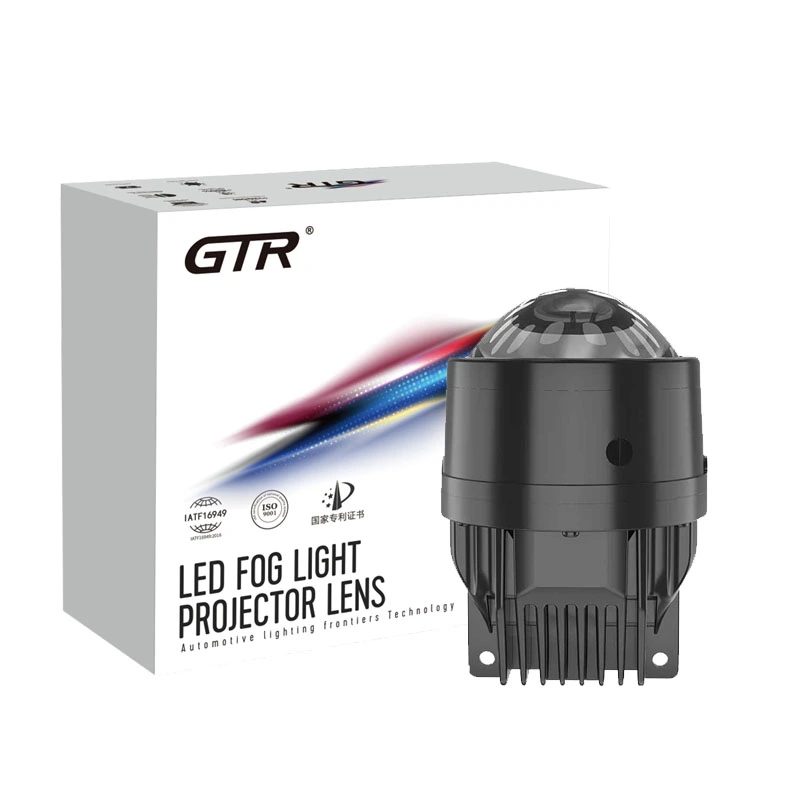
What GTR Does Differently
At GTR, we don’t chase lumen numbers that look good on a box. We engineer fog lights for what actually works in real-world conditions—the kind you face on Indian roads during monsoon season, on mountain passes in winter fog, or on dusty rural highways at dawn.
Our approach is grounded in the science that matters:
- Selective yellow color temperature—around 3000K, scientifically validated for maximum fog penetration and minimum glare
- SAE J583-compliant beam patterns—wide, flat, with sharp horizontal cutoff that puts light where you need it and keeps it out of oncoming drivers’ eyes
- Advanced thermal management—engineered heatsink designs that maintain optimal junction temperature for maximum longevity
- Plug-and-play compatibility—built-in CANbus decoders that work with your vehicle’s electrical system. No dashboard warnings. No flickering. No headaches.
- IP67 or higher weather resistance—built for the elements, not just the showroom
One driver’s experience with properly engineered LED fog lights says it all: “They are brighter than any OEM fog lights I’ve ever seen, great quality, small form, and highly versatile. I parked my car last month and forgot to turn them off one day, they were on for more than 5 hours and they did not burn out or melt.”
Another noted: “They work very well, and generate a lot of light… I recommend these lights as an elegant and discreet solution, but highly efficient on foggy roads.”
That’s what proper engineering delivers. Not marketing claims. Not showroom appeal. Real-world performance when it counts.
Don’t Learn the Hard Way
You wouldn’t buy budget tires and hope they grip in the rain. Don’t buy budget fog lights and hope they work in the fog. When visibility drops below 100 meters, you don’t need “pretty good” lighting—you need lighting engineered for the job.
The difference between a fog light that works and one that fails isn’t subtle. It’s the difference between seeing the road and seeing a white wall. Between arriving safely and hoping you do. Between driving with confidence and driving with your heart in your throat.
Choose fog lights engineered for what actually works. Choose GTR.