
Search for yellow headlights and you will drown in contradictions. One forum swears they cut through fog like a laser. Another says they are illegal everywhere. A product page claims 10-minute restoration. A mechanic says nothing short of replacement works. Somewhere in that noise, the actual answer gets lost. This article cuts through it.
We build lighting systems for a living. Our work ends up on vehicles in Europe, North America, and the Middle East. That gives us a ground-level view of what fails, what lasts, and what drivers actually experience after the purchase. What follows is not a sales pitch dressed as advice. It is the unfiltered version.
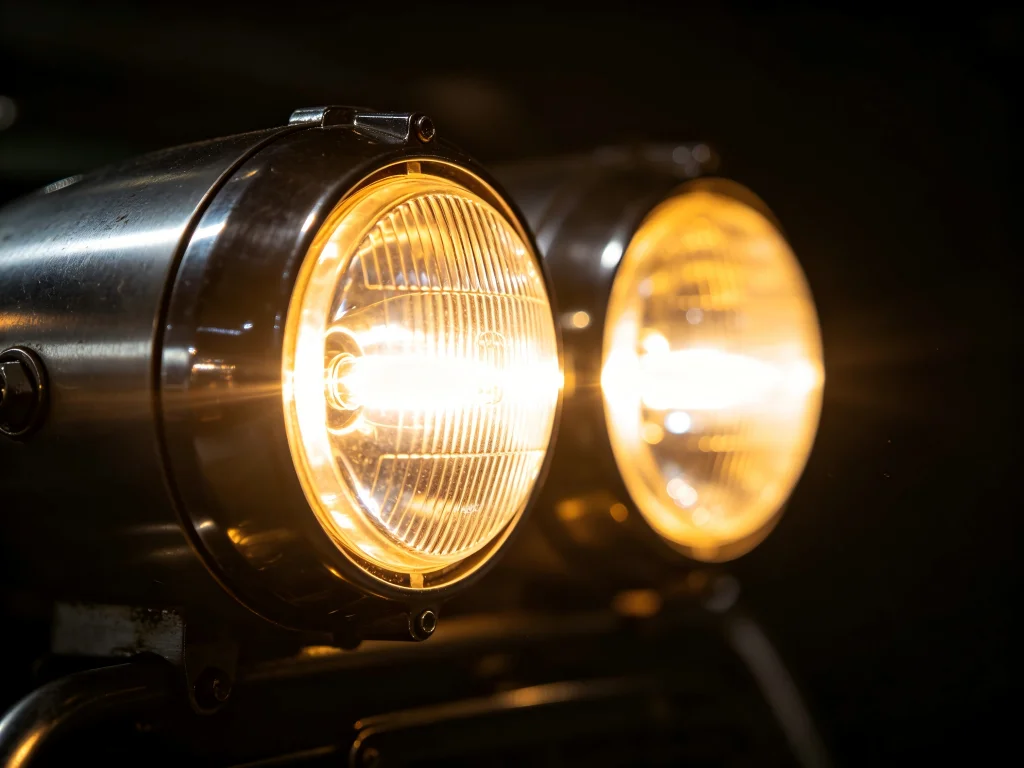
The Yellow Headlights Myth That Refuses to Die
Yellow headlights do not improve night vision in clear weather; they reduce total light output by filtering blue wavelengths, and their fog advantage is smaller than most drivers assume.
Let us start with the most repeated claim. Yellow light cuts fog. There is a kernel of truth here, and it has been stretched far beyond what the physics supports.
Fog is made of water droplets. Those droplets scatter light. Short wavelengths scatter more. Blue light scatters the most. That is why the sky is blue and why fog looks like a glowing wall when you hit it with white lights. Yellow light scatters less. So you get less backscatter. Less glare bouncing back into your eyes.
That part is real. What gets left out is the cost. A yellow filter removes blue light from the beam. Blue light is part of the spectrum your eyes use. Remove it, and you have less total light on the road. You trade glare for reach. In dense fog at low speed, that trade can make sense. At highway speed on a clear night, it is a straight loss.
There is also a perception trap. Yellow light feels softer. Softer feels easier on the eyes. Drivers often report better visibility with yellow lights even when measured light output is lower. The feeling is real. The improvement is not.
Why Yellow Lenses Appear on Race Cars
Endurance racing made yellow lights famous. Teams used them to tell cars apart at night. Then drivers started reporting they could see better in rain and spray. That reputation crossed over into consumer culture.
But race conditions are not street conditions. Racers deal with spray from other cars at speed. Yellow cuts that glare. They also run enormous light bars and multiple lamp arrays. Losing some output to a filter does not hurt them. A street car with one pair of headlights does not have that margin.
The Legal Map Nobody Explains Properly
Yellow headlights legal status depends on the specific lamp function, not the color alone; fog lamps may be amber in many regions while main driving lamps must be white.
This is where most articles get lazy. They say “check your local laws” and move on. That is useless. Here is the actual pattern.
Regulations separate lamp functions. A fog lamp is not a headlamp. A daytime running lamp is not a headlamp. Each has its own color rules. Amber and yellow are commonly allowed for fog lamps, turn signals, and side markers. They are rarely allowed for the main forward driving beam.
California is a good example. The state allows amber for fog lamps. It requires white for headlamps. That means a yellow tint on your low beams is a problem. Yellow fog lights are usually fine.
The UK follows a similar logic. Pre-1965 vehicles get an exemption for yellow headlamps. Modern vehicles do not. France mandated yellow headlamps for decades, then dropped the rule in 1993. Anyone importing an older French car needs to understand that history before assuming the lights are street legal.
The BMW Question
BMW owners ask about yellow headlights more than any other group. The appeal is obvious. Yellow lenses on a modern BMW look purposeful. They echo the GT racing cars. Many owners install yellow film or tinted lenses purely for appearance.
The catch is that appearance and legality are separate questions. A film overlay that changes the output color of a low beam can fail inspection in many jurisdictions, even if the film itself is perfectly legal to sell. The rules target the light output, not the product.
Quick Reference by Region
- California: White required for headlamps. Amber allowed for fog lamps.
- United Kingdom: Yellow headlamps only on vehicles first used before January 1, 1965.
- France: Yellow headlamps phased out in 1993. White required for modern vehicles.
- Most Canadian provinces: White or amber for forward lighting. Yellow headlamps not approved.
- Germany: White required. Yellow restricted to specific auxiliary functions.
- Australia: White required for headlamps. Amber allowed for fog and signal lamps.
For the underlying regulatory framework, the UN World Forum for Harmonization of Vehicle Regulations publishes the standards many countries build on.
Oxidation, Not Color, Is the Real Enemy
Most yellow headlights on the road are not yellow by design; they are clear lenses that have oxidized, and the fix is restoration rather than replacement.
Here is the uncomfortable truth. When a driver complains about yellow headlights, they are usually not talking about a styling choice. They are talking about a lens that has gone bad. Polycarbonate yellows with UV exposure. The clear coat fails. Oxidation takes over. The result looks yellow and performs worse than yellow.
The distinction matters because the solutions are completely different. If you want yellow light for aesthetic or fog reasons, you buy a lamp designed for it. If your lens has oxidized, you restore it. Mixing these two problems leads to bad decisions. Drivers buy yellow bulbs to “fix” a yellow lens. That makes the output worse, not better.
How to Tell the Difference
- Look at the lens in daylight. Oxidation is patchy, cloudy, or brownish. A designed yellow lens is uniform.
- Feel the surface. Oxidized polycarbonate feels rough or chalky. A factory lens feels smooth.
- Check the edges. Oxidation often starts at the top and edges where UV hits hardest.
- Compare both sides. Oxidation rarely progresses at exactly the same rate. A designed color will match.
If the lens is oxidized, no bulb change will help. You need to remove the damaged layer and seal the plastic. If the lens is intentionally yellow, and you want white light, you need a different lens or a clear replacement.
Yellow Headlights vs White: A Practical Breakdown
Yellow headlights vs white comes down to conditions: white wins for general night driving, while yellow may reduce glare in fog and heavy spray at the cost of total output.
| Condition | White Light | Yellow Light |
|---|---|---|
| Clear night, open road | Best reach and detail | Noticeably less reach |
| Dense fog, low speed | More backscatter glare | Less glare, easier on eyes |
| Heavy rain, highway | More light, more spray glare | Less glare, less total light |
| Snow-covered roads | Better contrast on white surfaces | Warm tone can reduce eye strain |
| City driving, lit roads | Neutral, blends with ambient | Distinct look, no real benefit |
Read that table honestly and the conclusion is hard to avoid. Yellow is a specialist tool. White is the generalist. Most drivers spend most of their time in generalist conditions.
What Actually Works: Lessons From the Shop Floor
Durable results come from removing oxidation completely and sealing the lens with a UV-stable coating; anything less re-yellows within months.
We have watched thousands of restoration attempts. The failures cluster around a few predictable mistakes.
The first mistake is stopping at polish. A polished lens looks clear for a few weeks. Then the oxidation returns, often faster than before, because the protective layer is gone and the surface is now slightly rougher at a microscopic level.
The second mistake is using a coating that was never designed for polycarbonate. Wax-based products sit on the surface. They wash away. Silicone products break down under heat. Neither bonds to the plastic. Neither blocks UV for long.
The third mistake is skipping surface prep. A coating applied over contamination will fail early. The lens must be clean, sanded uniformly, and free of polish residue before the coating goes on.
Field Notes From Real Owners
“I polished my lights three times in two years. Each time they looked great for a month. I finally paid a shop to do it properly. Two years later, still clear.” — Owner of a 2014 Audi A4, posting in a detailing forum.
“I bought yellow tint film for the look. Loved it for a week. Then I got pulled over. The officer was polite but clear. White only for headlights in my state. I peeled it off that night.” — Owner of a 2018 BMW 340i.
“My fog lights are yellow from the factory. They help in bad weather. My headlights are white. I do not understand why people try to make everything yellow.” — Owner of a 2019 Subaru Forester.
Three different drivers, three different lessons. Intended color and legality are separate. Restoration and styling are separate. Function-specific lighting is not a compromise; it is how vehicles are designed.
Frequently Asked Questions
Are yellow headlights better in fog?
They can reduce glare from backscatter, but they also reduce total light output. The benefit is real but limited to specific conditions and low speeds.
Why do my clear headlights look yellow?
UV exposure breaks down the polycarbonate lens and its clear coat, causing oxidation. The yellow appearance is damage, not design.
Can I make my headlights yellow legally?
In most regions, no, not for the main driving beam. Amber and yellow are typically allowed only for fog lamps and signal functions.
Does yellow headlight film actually work?
It changes the output color. It does not improve general night visibility. It may reduce glare in fog. Check local rules before installing.
How often should I restore my headlights?
With a quality UV coating, every 2 to 3 years. Without a coating, every 3 to 6 months, which is why the coating matters.
Are yellow headlights legal in France?
No. France phased them out in 1993. Modern vehicles must use white forward lighting.
What is the best fix for oxidized headlights?
A full restoration: wet sanding, polishing, and a UV-stable clear coat. Replacement is only necessary if the housing or lens is physically damaged.
Where We Fit In
We are not here to tell you yellow is wrong or white is right. We are here to help you get lighting that performs. That means understanding the difference between a styling choice and a maintenance problem. It means knowing your local rules before you spend money. It means using products that hold up after the first rain.
Our team manufactures lighting components and coating systems used by brands that cannot afford field failures. That experience shapes what we sell and what we recommend. If you want a restoration solution that lasts, or a lighting upgrade built to spec, we can help.
Visit www.rhgtr.in to see the range. Bring your questions. We would rather talk you out of a bad purchase than sell you something that disappoints.
Clear lights, correct rules, durable coatings. That is the whole game. Start today.
For background on vehicle lighting standards, see SAE International. For a deeper look at how UV affects plastics, refer to this overview of UV degradation.