
If you have been shopping for an LED headlight conversion kit recently, you have probably noticed something unusual. The market is changing faster than it has in the past decade. New regulations, better optics, and smarter electronics are reshaping what a good conversion kit actually looks like. Here is what is happening — and what it means for your next upgrade.
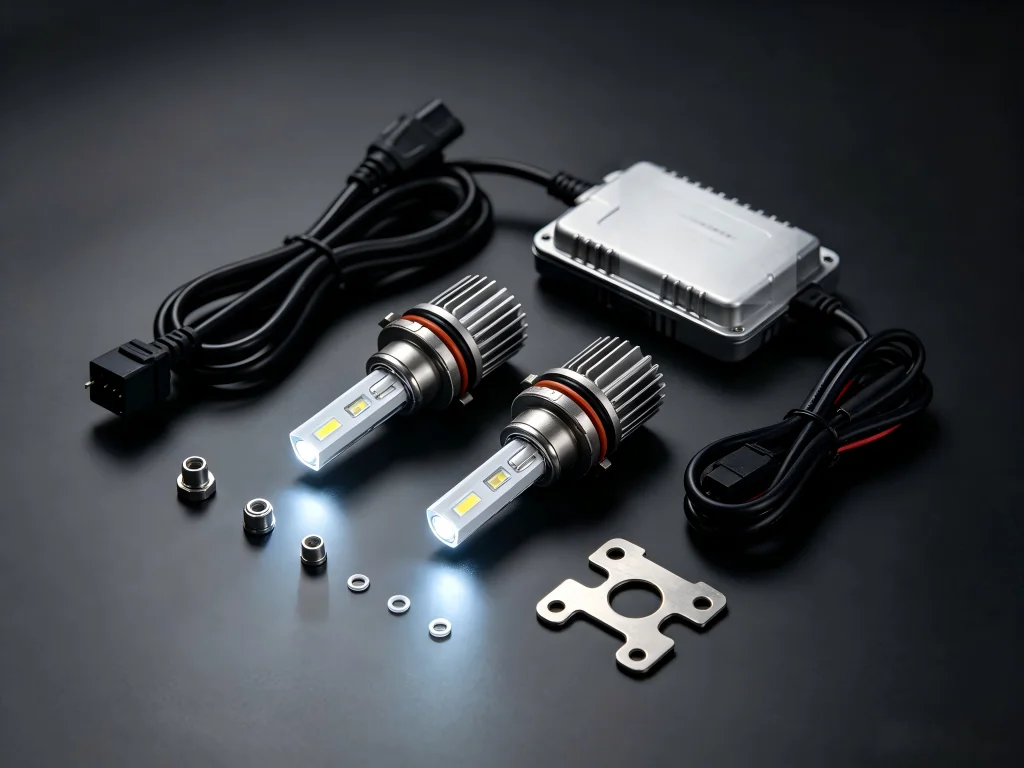
The 2026 Tipping Point: Why LED Headlight Conversion Kits Are Different Now
The LED headlight conversion kit market is projected to grow from $1.8 billion in 2025 to $4.1 billion by 2034, representing a 9.4% compound annual growth rate. But growth alone does not tell the full story. The real shift is in how these kits are engineered and regulated.
For years, the aftermarket upgrade path was straightforward: swap a factory halogen bulb for a higher-output LED unit. It was fast, inexpensive, and delivered an immediately noticeable brightness boost. But in 2026, this approach is hitting a hard ceiling. Regulatory bodies — including DOT in North America and ECE across Europe and Asia — are enforcing stricter limits on scattered light and glare. At the same time, consumers are discovering that “brighter” does not automatically mean “better visibility”.
The industry’s answer is a fundamental rethinking of how LED retrofit technology works. The shift is moving from brightness competition to beam-pattern competition, where precision optics outperform raw lumens.
The Technical Ceiling: Why Some LED Kits Simply Cannot Perform
The Scattered Light Problem
Drop-in LED bulbs produce uncontrolled glare when placed inside reflector housings designed for halogen filaments. Here is why this happens: a halogen filament emits light from a small, omnidirectional point source. The reflector bowl behind it is precision-shaped to capture and redirect that specific light pattern onto the road.
An LED chip, however, emits light from a flat surface with a fundamentally different angular distribution. When installed in the same reflector, a significant portion of the light escapes at unintended angles — creating dangerous glare for oncoming traffic and poor foreground illumination for the driver.
In 2026, this is no longer just an inconvenience. Updated enforcement protocols under ECE R148 and DOT FMVSS 108 make excessive scattered light a measurable compliance failure. Vehicles that produce glare above threshold values risk failing periodic inspections in markets such as Germany, Japan, Australia, and an increasing number of U.S. states.
The Thermal Rollback Trap
Sealed headlight housings impose a hard limit on how much heat a single LED bulb can dissipate. Higher-wattage LED chips generate more lumens — but also substantially more heat. Inside an enclosed factory headlamp, there is no airflow. The bulb’s small built-in heat sink must transfer all thermal energy through conduction alone.
Once the junction temperature exceeds the LED’s safe operating range, the driver circuit automatically reduces power to prevent damage — a process called thermal rollback. In practice, many high-power LED replacement bulbs lose 20–30% of their initial output within the first 15 minutes of operation.
That means the kit that looked impressively bright in your garage is significantly dimmer by the time you reach the highway.
The “Bright but Blind” Illusion
Without a lens to shape the beam, raw lumen output does not translate into usable visibility. Drivers who install high-output LED bulbs often perceive a dramatic improvement at first glance — the road surface directly ahead appears flooded with light. However, without an optical element to distribute that light properly, the beam lacks the forward throw needed for safe night driving.
What the New ECE Regulations Mean for LED Conversion Kits
A major development occurred in 2022 when the United Nations Regulation No. 37 was formally amended to make LED replacement solutions possible. In May 2025, ams OSRAM launched the first ECE-approved LED replacement light source.
Here is the timeline that matters for anyone buying an LED headlight conversion kit:
- 2020: Road-legal LED replacement light sources first reached the market under German national and vehicle-specific approvals (starting with H7, followed by H4, H1, and others)
- 2025: ECE-approved halogen LED replacement sources became available for H11 bulbs
- 2026: Approval expands to fog light sources (H8, H16, HB4)
- 2027: High beam sources (H9, HB3, etc.)
- 2028 and beyond: Low beam sources (H1, H4, H7)
This regulatory evolution matters because it establishes a clear path toward LED retrofit solutions that are both safe and legal. The benefits are substantial: LED replacement sources offer up to six times longer lifespan than halogen, five times lower power consumption, and daylight color temperature (cool white, 6000K).
Real-World Performance: What Users Are Actually Experiencing
Forum discussions reveal the gap between marketing claims and real-world results. One owner of a 2021 Kia Stinger GT-Line described his experience with a premium LED conversion kit: “I assumed I could swap out my halogens over a lunch hour… I was wrong: the LED unit simply does not have room to fit in the headlight housing, bumping into a plastic bump and preventing it from reaching the metal ring that holds the 3 tabs of the light unit.”
He ended up removing the bumper and headlight assembly, then using a Dremel to modify the housing. That is not a plug-and-play experience. That is a weekend project with power tools.
Another owner of a 2016 Lincoln MKX had a different outcome after switching to GTR Lighting Ultra 2.0 H11 LED bulbs: “The cooling fans are compact enough that everything tucked behind the OEM dust caps without any modifications, which was a huge relief.” The difference? Engineering that accounts for real-world fitment constraints.
On a Corvette forum, one user reported that GTR Carbide 2.0 “resistor-free” anti-hyperflash lights did actually hyperflash on their vehicle. This highlights a critical point: even well-engineered kits can encounter compatibility issues with specific vehicle electrical systems.
The lesson is clear: compatibility, fitment, and beam pattern matter more than advertised lumen numbers.
What to Look for in a 2026-Ready LED Headlight Conversion Kit
Optical Precision Over Raw Lumens
Headlight housings are designed around specific light source geometry. A reflector housing is shaped to direct light from a specific filament position in a specific direction. A projector housing focuses light through a lens from a specific arc or emitter position.
When you put a different light source — an LED emitter or HID arc — in a position that differs from the original filament location, the beam pattern breaks. A well-designed LED retrofit with the correct emitter geometry for the housing can genuinely improve output. Poorly designed ones produce scatter and glare worse than the halogen they replaced.
Look for: Kits that explicitly state 1:1 filament-matching chip placement. Some manufacturers achieve this through vertical-aligned LED component design. Others use precision-machined bases that lock the emitter into the correct position.
Thermal Management That Actually Works
Heat is the enemy of LED performance. As junction temperature rises, light output drops and lifespan shortens. Copper PCBs and active cooling systems — not passive heat ribbons — are essential for maintaining stable output.
Look for: Kits with copper PCBs and active cooling. Some premium kits use dual copper heat pipes with high-performance fans. These systems maintain stable temperatures even during extended night driving.
Built-In CAN-Bus Compatibility
Modern vehicles use CAN-Bus systems to monitor electrical loads. When you replace a 55W halogen with a lower-wattage LED, the system detects the difference and may trigger error messages, flickering, or hyperflash. Kits with built-in CAN-Bus compatibility — like GTR’s integrated driver circuitry — eliminate the need for external resistors or decoders.
Look for: Kits that state built-in CAN-Bus compatibility with no external resistors required.
Color Temperature That Enhances Visibility
Color temperature is measured in Kelvin (K). Halogen bulbs produce a warm yellow light around 3000K. LED kits typically range from 5000K to 6500K.
- 5000-5500K (pure white): Closest to natural daylight. Provides the best contrast and color recognition. Reduces eye strain during extended night driving.
- 5500-6000K (cool white): Slightly blue-white. Popular for its modern appearance. Still provides good visibility.
- 6000-6500K (blue-white): Noticeably blue. May reduce contrast in wet conditions. Often associated with cheaper kits that prioritize appearance over performance.
Look for: 5000-6000K for optimal visibility. Higher is not better — above 6000K, light output in the visible spectrum actually decreases.
Fitment and Clearance
LED conversion kits are physically larger than halogen bulbs. The heat sink, fan, and driver add bulk behind the headlight housing. Many vehicles have limited clearance — the dust boot may not close, or the bulb may not fit at all.
Look for: Compact designs that fit standard halogen bulb dimensions. Check the kit’s physical dimensions against your vehicle’s headlight clearance.
The GTR Approach: Engineering for the New Reality
Based on years of manufacturing expertise in automotive lighting, GTR has engineered its LED headlight conversion kits around the factors that actually determine real-world performance — not marketing numbers.
Optical precision: 1:1 filament-matching chip placement ensures proper beam pattern in both reflector and projector housings. The GTR CSP Mini LED bulb was designed with two main ideas: perfect fitment into any headlight housing and closely mimicking the size and shape of the original halogen bulb for maximum capability.
Thermal stability: Copper PCB with active cooling maintains stable temperatures and consistent light output. The GTR Ultra series sets a new standard for what products in their class should be — brighter, better beam pattern, longer lasting, and easier to install.
CAN-Bus compatibility: Built-in driver circuitry eliminates the need for external resistors or decoders. The GTR Ultra 2.0 Anti-Flicker modules are specifically sized to match your original wiring, simply plugging in between.
Compact design: Fits vehicles with limited headlight clearance without modification. Users report the GTR Lighting Ultra 2.0 has a “super slim design that fits perfectly behind the dust covers without any modification”.
Genuine power ratings: Stable wattage output, not inflated peak numbers. The GTR Lighting CSP Mini delivers 2500 lumens raw per bulb at 16W — efficient, stable, and reliable.
Frequently Asked Questions About LED Headlight Conversion Kits in 2026
Are aftermarket LED conversion kits legal now?
It depends on your jurisdiction and the specific kit. The UN Regulation No. 37 was amended in 2022 to allow LED replacement solutions. The first ECE-approved LED replacement light sources launched in May 2025 for H11 bulbs, with approvals expanding through 2028. However, many aftermarket kits still lack approval and are labeled “off-road use only.” Always check local regulations before purchasing.
Why do some LED conversion kits cause glare?
Glare occurs when the LED chip’s emission pattern does not match the reflector or projector housing’s design. Halogen housings are engineered around a specific filament position. LED chips emit light from a flat surface with a different angular distribution. Kits with 1:1 filament-matching chip placement minimize this problem.
How much brightness do LED conversion kits actually lose over time?
Many high-power LED replacement bulbs lose 20–30% of their initial output within the first 15 minutes of operation due to thermal rollback. Quality kits with proper thermal management — copper PCBs and active cooling — maintain stable output over extended use.
What is the difference between an LED conversion kit and replacing the entire headlight assembly?
A conversion kit replaces only the bulb — it is cheaper and easier but may face legal restrictions. Replacing the entire headlight assembly with an LED-specific unit is more expensive but is generally street-legal and provides optimal optical performance.
Will LED conversion kits work with my vehicle’s daytime running lights?
Some vehicles use the headlight bulb at reduced power for DRL function. LEDs may flicker or behave unpredictably in this mode. Kits with built-in CAN-Bus compatibility typically handle DRL operation correctly.
How do I know if an LED conversion kit will fit my vehicle?
Check the bulb size (H4, H7, 9005, 9006, etc.) and measure the clearance behind your headlight housing. Some vehicles — like the Kia Stinger GT-Line — have limited space that may require modification. Look for kits with compact designs that specify fitment compatibility.
Make Your Upgrade Count in 2026 and Beyond
The LED headlight conversion kit market is evolving rapidly. Regulations are tightening. Technology is improving. And the gap between good kits and bad kits is widening. A kit that simply swaps a halogen bulb for an LED chip is no longer enough. You need optical precision, thermal stability, vehicle compatibility, and regulatory awareness.
GTR engineered its LED headlight conversion kits to meet these new standards — not just for today, but for the regulatory environment of 2026 and beyond.
Visit https://www.rhgtr.in to find the right LED headlight conversion kit for your vehicle. See the difference that proper engineering makes — and drive with the confidence that your upgrade is built for the road ahead.