
You ordered an h1 led bulb kit. You watched the installation video. You popped the hood, swapped the bulb, and turned on your headlights. And then — nothing. Or worse: flickering. A dashboard warning light. A beam pattern that looks like a scattered mess. Or a bulb that burns out in three weeks.
This isn’t bad luck. It’s bad engineering. And after years of manufacturing h1 led bulbs for projector headlights, we’ve seen the same mistakes play out over and over again.
Here’s the uncomfortable truth: most h1 led bulb replacements fail because the bulb you bought wasn’t designed for your headlight. It was designed for a generic “one size fits all” approach that doesn’t account for the physics of light, the electronics of your vehicle, or the physical constraints of your housing.
Let’s break down exactly why upgrades go wrong — and what actually works.
Failure #1: The Bulb Doesn’t Physically Fit
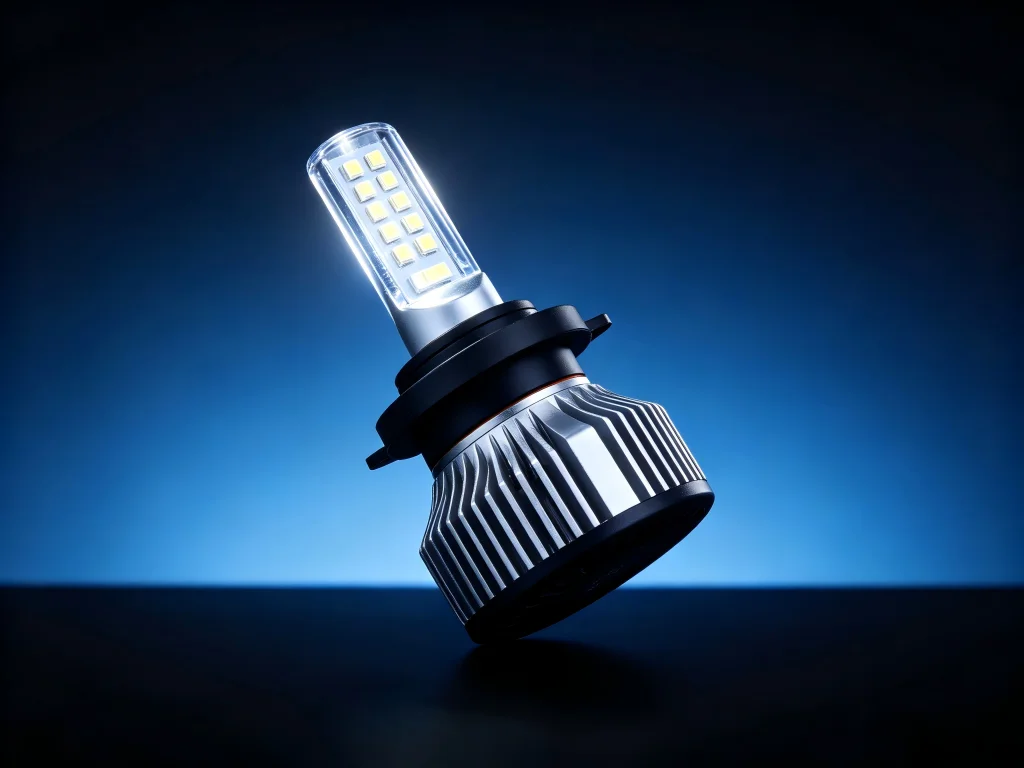
An H1 LED bulb fails to install when the LED body, heat sink, or fan assembly exceeds the available space inside the headlight housing — preventing the dust cover from sealing or the factory retaining clip from locking.
The H1 bulb has a simple P14.5s base and a single filament. In theory, replacement should be straightforward. But LED bulbs aren’t halogens. They carry heat sinks, cooling fans, and driver circuitry — all of which add bulk.
One Amazon reviewer reported: “Purchased h1 led bulbs, the bulb is nearly as large as the base. The bulb is too large for the housing.” Another found that even after forcing the bulb in, the dust cover wouldn’t close — leaving the electronics exposed to moisture and dirt.
Some vehicles require specific adapter rings to secure the bulb properly. Philips sells Type 1 and Type 2 adapter rings specifically for vehicles where the standard holder doesn’t provide stable fitting. If your kit doesn’t include the right adapter, you’re left with a bulb that wobbles, vibrates, or simply won’t lock in.
The fix: Before buying, measure your housing depth and check whether your vehicle requires an adapter ring. Look for bulbs that explicitly state a “1:1 mini size” — but verify that this claim applies to your specific housing, not just the base diameter.
Failure #2: The Beam Pattern Is Wrong
Your projector headlight was engineered around a halogen filament positioned at a very specific focal point — down to the millimeter. When you drop in an h1 led bulb, the light doesn’t come from a single filament anymore. It comes from one or two LED chips mounted on a circuit board.
If those chips sit even slightly forward, backward, or off-center from where the filament used to be, the optics break. The reflector bowl and projector lens can’t focus the light properly.
The result: a beam pattern that’s either too narrow, too scattered, or full of dark spots. You can’t see the road clearly, and everyone else on the road can’t see past your glare.
One Philips Ultinon Pro9000 user noted: “Too much gap between the 2 chips on each side makes for 2 weekly lit lines in front of my car.”
Lumens don’t fix this. A 40,000-lumen bulb with poor chip alignment will produce worse visibility than a 10,000-lumen bulb with perfect alignment.
The fix: Look for bulbs that explicitly state a 1:1 filament-to-chip position match. Some manufacturers achieve this through a 1:1 mini size design. Others use adjustable locking rings that let you rotate the bulb to fine-tune the beam pattern. SEALIGHT, for example, emphasizes a 1:1 light design specifically to replicate stock beam patterns and reduce hot spots and glare.
Failure #3: Your Car’s Computer Rejects the Bulb
Modern vehicles use CANbus (Controller Area Network) systems to monitor every electrical component. When you replace a 55W halogen with a 20W LED, the computer sees the lower power draw and assumes the bulb is burned out.
The result: flickering, dashboard warnings, or bulbs that randomly shut off while you’re driving.
One Fiat Bravo owner discovered that their low and high beams weren’t on the CANbus system at all — but side lights, brakes, and indicators were. Others have found that even “CANbus-ready” bulbs don’t work with every vehicle. Some exceptions include Chrysler and Dodge vehicles, where standard decoders may fail entirely.
And then there’s the PWM (Pulse Width Modulation) issue. Some vehicles use PWM to dim headlights for daytime running light functionality. LEDs don’t respond to PWM the same way halogens do, resulting in flickering that no amount of CANbus decoding can fix without specific hardware.
The fix: Choose a bulb with integrated CANbus decoding that’s been tested with your vehicle’s make and model. If you drive a German vehicle (BMW, Audi, Mercedes, Volkswagen), you may need additional anti-error modules — these vehicles tend to be the most sensitive. For particularly sensitive systems, some manufacturers offer advanced anti-error modules that guarantee error-free operation.
What Real Drivers Are Saying
We’ve combed through thousands of forum discussions and reviews to understand what actually works. Here’s what we’ve found:
“After 5 months one bulb started flickering while the car is running and they are not as bright as they used to be.” — Zethors H1 user
“Ordered June 30, installed July 4. 1 bulb already burnt out… 3 weeks for an LED bulb shows the poor quality and workmanship.” — Amazon.ca reviewer
“I bought this for the price of my previous high beam + low beam led lights combined, and the result is weaker light.” — Philips Ultinon Pro9000 user
“Installed these in my 2010 Xterra. The cutoff is very good with minimal chromatic aberration. There were no fitment issues in my case.” — Subaru Outback forum user
“I had my doubts seeing as the unit has no fan but these lights are absolutely insane for output.” — CEUK Enhanced H1 user
The pattern is clear: success depends on getting the right h1 led bulb for your specific application — not just the cheapest or brightest one.
How to Choose an H1 LED Bulb That Actually Works
Based on our years of manufacturing expertise, here’s what separates a successful h1 led bulb upgrade from a frustrating failure:
1. Chip Technology Matters
Chip Scale Package (CSP) LEDs are the current gold standard. They’re smaller, more efficient, and produce a more focused beam than traditional LED packages. Bulbs using CSP chips tend to have better beam control and fewer dark spots.
CSP technology also reduces heat by up to 40% compared to traditional LEDs, extending bulb longevity. When comparing h1 led bulbs, look for “CSP chips” in the specifications. Bulbs that don’t specify their chip technology may be using older, less efficient designs.
2. Cooling Design Determines Lifespan
LEDs generate significant heat at the chip level. Without proper cooling, the chips degrade rapidly — light output drops, color shifts, and lifespan plummets.
- Fanless (passive) cooling: Uses a large aluminum heat sink. Silent, no moving parts to fail, but requires adequate space. NOVCAPAR offers a fanless option with a 1:1 mini halogen size.
- Fan (active) cooling: Uses a small fan to force air over the heat sink. More effective in tight spaces but the fan can fail or become noisy over time.
Bulbs with aviation-grade aluminum housings and copper heat pipes offer superior heat dissipation. The Termitor H1, for example, features a robust aluminum housing and a 22,000 RPM cooling fan.
3. CANbus Compatibility Isn’t Optional
Some bulbs are “CANbus-ready” with built-in resistors. Others require external decoders or load resistors. If you’re not comfortable wiring external components, choose a bulb with integrated CANbus compatibility.
For particularly sensitive vehicles, dedicated decoder harnesses like the ARC Lighting Super Decoder are engineered specifically for sophisticated CANbus systems where standard decoders fail.
4. Voltage Range Matters for Your Application
Most passenger cars run on 12V systems. But if you drive a truck, bus, or commercial vehicle, you need an h1 led bulb that supports 24V.
Quality h1 led bulbs offer a wide voltage range of 9-32V DC, making them suitable for passenger cars, vans, and trucks alike. Some are explicitly designed for 12V and 24V compatibility, ensuring they can be fitted to everything from compact cars to heavy-duty trucks.
5. IP Rating Protects Against the Elements
Headlights face moisture, dust, and extreme temperatures. An IP68 rating (dust-tight and waterproof beyond 1 meter) indicates robust protection. Bulbs without an IP rating may not survive harsh conditions.
Frequently Asked Questions About H1 LED Bulbs
Will an H1 LED bulb fit in any car that uses H1?
Not necessarily. While the base and connector are standardized, the bulb body, heat sink, and fan may be too large for some housings. Always check physical dimensions and read vehicle-specific reviews before purchasing.
Why is my H1 LED bulb flickering?
Flickering usually indicates a CANbus compatibility issue. Install a CANbus decoder or load resistor. If that doesn’t work, check your electrical connections and apply dielectric grease to contact points.
Are H1 LED bulbs legal for road use?
In many regions, LED retrofit bulbs are only legal for off-road use or fog lights unless they’re DOT-approved or ECE-certified. Check your local regulations before upgrading.
How bright should an H1 LED bulb be?
Quality h1 led bulbs range from 10,000 to 40,000 lumens per pair. But brightness isn’t everything — beam pattern and chip alignment matter more for actual visibility.
How long do H1 LED bulbs last?
Quality h1 led bulbs typically last 30,000 to 60,000 hours. However, poor cooling, voltage fluctuations, or cheap components can dramatically shorten this. A bulb that burns out in weeks (as some users report) indicates poor quality.
What’s the difference between H1 and H7 LED bulbs?
H1 bulbs are single-filament with a P14.5s base, commonly used for high beams and fog lights. H7 bulbs are also single-beam but have a different base design and are more commonly used for low beams. They are not interchangeable — always use the bulb type specified for your vehicle.
Do I need a decoder for H1 LED bulbs?
If your vehicle has CANbus monitoring (most vehicles built after 2005), you’ll likely need a decoder or a CANbus-ready bulb. Some vehicles are more sensitive than others — German cars (Audi, BMW, Mercedes) tend to be the most finicky.
Stop Gambling With Your Night Driving Safety
You’ve read the reviews. You’ve seen the forums. You know that buying the cheapest h1 led bulb on Amazon is a gamble — one that usually ends with flickering, poor beam patterns, or a bulb that burns out in weeks.
Don’t gamble with your night driving safety. Choose an h1 led bulb engineered for your specific headlight — one that fits right, shines right, and lasts.
At GTR, we engineer our h1 led bulbs with precision chip placement, robust cooling, integrated CANbus decoding, and true 1:1 sizing. We test across dozens of vehicle models to ensure real-world performance — not just lab numbers.
Shop GTR H1 LED Bulbs at rhgtr.in → Engineered for your headlight. Built for the road ahead.