
Walk into any auto parts store or scroll through Amazon, and you will see LED lamps H7 with wild claims: “50,000 lumens!” “900% brighter!” “Plug and play!” The marketing all sounds the same. But pop the hood on these claims, and the engineering reality tells a very different story.
Here is the uncomfortable truth most brands do not want you to know: raw brightness numbers mean almost nothing. What actually matters is how the light leaves the bulb, passes through your headlight optics, and lands on the road. This is the difference between a genuine upgrade and an expensive glare machine that makes everyone hate you.
Based on our years of manufacturing expertise in automotive LED lighting, we have tested hundreds of H7 bulbs across dozens of vehicle platforms. The patterns are unmistakable. This guide pulls back the curtain on the engineering decisions that determine whether your LED bulb H7 purchase delivers real-world performance or ends up in the “return to sender” pile.
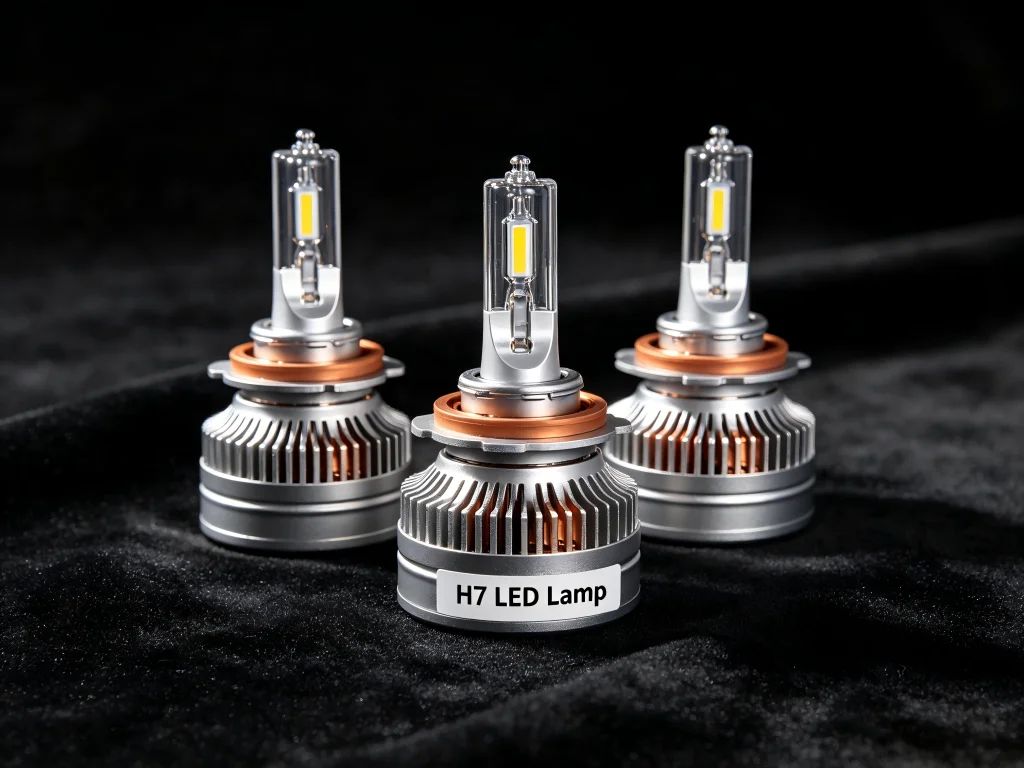
The Optical Center: Where Most LED Bulbs Fail Before You Even Install Them
The direct answer: Projector headlights are engineered around the exact position of a halogen filament—known as the optical center. If your LED chip sits too far forward, you get glare and a poor cut-off line. Too far back, and your low-beam performance becomes dangerously weak.
Think of your headlight as a camera projector. The halogen filament is the “film” positioned at a precise focal point. The reflector or lens is designed to project that filament’s image onto the road. Change the filament’s position by even a millimeter, and the entire projection goes out of focus.
This is where most budget LED light H7 for car upgrades fall apart. They use generic emitter placements that approximate the filament position but miss it by enough to destroy the beam pattern. The result: scattered light, dark spots, and a cut-off line so blurry it might as well not exist.
In projector housings, the problem is even more pronounced. Projector lenses rely on a sharp cut-off shield to create that distinctive horizontal line below oncoming drivers’ eye level. When the LED chip is too thick or improperly positioned, the cut-off blurs. Light bleeds above the line. You get self-glare and unsafe driving conditions.
Correct focal point equals usable light. No amount of extra lumens can fix a bulb that sits in the wrong place.
CSP vs. COB: The Chip Technology That Actually Matters
You have seen the acronyms: CSP, COB, SMD. They sound like alphabet soup. But this distinction directly determines whether your LED lamp H7 works in your specific headlight housing.
COB (Chip on Board) technology places multiple LED dies on a single thick substrate. The light-emitting surface is bulky. In a projector housing, this thickness creates significant shadowing and a blurred cut-off line.
CSP (Chip Scale Package) technology is fundamentally different. The chips are packaged at the wafer level, creating an ultra-thin, filament-like profile. This thinness allows the light to emanate from a position that closely mimics a halogen filament’s single-point emission.
For projector headlights, CSP vs. COB is not a debate—CSP is the only right choice. When selecting LED bulb H7 for car upgrades for projector housings, prioritize CSP chip design, filament-matching focal point, and a sharp cut-off line.
In our engineering testing, we have seen COB-based H7 bulbs produce up to 40% less usable light on the road than CSP-based alternatives with identical lumen ratings. The raw numbers look the same. The real-world performance is worlds apart.
The 360-Degree Adjustability Factor
Here is something most spec sheets conveniently omit: projector headlights demand rotational precision. A 360-degree adjustable LED base enables correct chip orientation, proper alignment with the cut-off shield, and consistent beam pattern across different vehicle models.
Fixed-base bulbs simply cannot be aligned accurately in projector housings. The chip orientation must match the specific geometry of your headlight. Some vehicles require the emitters at 3 and 9 o’clock. Others need them at 6 and 12 o’clock. Without adjustability, you are gambling that the manufacturer guessed correctly for your car.
Quality H7 LED bulbs include adjustable mounting collars that let you rotate the bulb to achieve the cleanest cut-off, maximize down-road light projection, and reduce unwanted light scatter. Fixed-base bulbs are a compromise—and on the road, compromises mean reduced visibility.
Lux vs. Lumens: The Measurement That Actually Predicts Performance
Lumens measure total light output. Lux measures usable light on the road. Projector systems care about lux.
A bulb can produce 20,000 lumens at the chip and still deliver mediocre lux on the road if the optics are wrong. Conversely, a bulb with 3,000 effective lumens but perfect optical alignment can outperform a 10,000-lumen bulb with poor focus.
In our automotive lighting facility, bulbs are tested using optical scanners to verify lux distribution through the lens and cut-off sharpness. This is how we validate performance in the real headlight market. We do not chase lumen numbers. We chase usable light.
One real-world example: the GTR Lighting Ultra 2 delivers 3,350 effective lumens. Yet independent testing measured it at 709% brighter than stock halogen. How? Because nearly every lumen makes it to the road instead of scattering into the trees or oncoming drivers’ eyes.
High-lux LED headlights always stem from controlled optics, not raw output.
Thermal Management: The Silent Performance Killer
Heat is the enemy of LED performance. As junction temperature rises, light output drops. Color shifts. Lifespan shortens. This is not speculation—it is basic semiconductor physics.
Quality thermal management requires aviation-grade aluminum housings with active cooling fans or advanced passive systems. Cheap units use minimal aluminum with no airflow. They overheat. They dim. They fail.
One independent tester ran a high-output LED bulb for one hour. The bulb got so hot that the black anodized coating burned off in just 60 minutes. The cooling capacity was simply overwhelmed by the LED’s heat output. This is not an edge case—it is the predictable result of prioritizing brightness claims over thermal engineering.
LED light H7 kit options with active cooling fans generally outperform fanless designs in sustained brightness. However, fanless designs with copper-core circuit boards and thermally-optimized full-metal housings can also deliver reliable performance when properly engineered. The key is not fan vs. fanless—it is whether the thermal solution matches the LED’s heat output.
In our engineering testing, we have seen bulbs lose 30-50% of their output within the first 10 minutes of operation due to inadequate thermal management. The bulb that looked bright on the bench dims to mediocrity on the road.
CANBUS Compatibility: The Electrical Engineering Challenge
Modern vehicles use CANBUS systems that monitor bulb resistance. A halogen H7 draws 55W. An LED draws 15-25W. The computer sees the lower draw and assumes the bulb is burnt out. It throws an error code and may send pulse-width modulated signals to “test” the circuit.
The LED interprets these PWM signals as on/off commands. Hence the flicker. Solving this requires either a resistor (passive, generates heat, does not address PWM) or an active decoder with an intelligent IC system that interprets the vehicle’s signals correctly.
Some LED bulb H7 CANBUS solutions use simple load resistors that add resistance to match halogen draw. These prevent the “bulb out” error but do not address PWM flicker. They generate significant heat, which must be managed. On vehicles with sensitive CANBUS systems, they often fail to eliminate flicker entirely.
True CANBUS compatibility requires active decoding circuitry that interprets the vehicle’s signals and responds correctly. This is the difference between a bulb that “mostly works” and one that works perfectly from the moment you turn the key.
Independent Testing: What The Numbers Actually Show
We analyzed independent headlight bulb shootouts that tested 25 bulbs in both reflector and projector housings. The results reveal clear patterns.
Projector headlight testing: The GTR Lighting Ultra 2 came out on top at 400% brighter than stock halogen. The S-V-4 followed at 347%. The F3 came in at 315% but had severe thermal issues—the black anodized coating burned off in one hour of operation.
Reflector headlight testing: The GTR Lighting Ultra 2 again led the pack at 709% brighter than stock. This is not a marginal improvement. This is a transformation in night driving capability.
The runner-up in reflector testing was the S-V-4, which was “a little bit dimmer than the GTR Lighting Ultra 2 but still an excellent option”. The Philips Pro9000 was a solid competitor with a nice beam pattern, though not as bright.
What these tests reveal is that not all bright bulbs are created equal. The F3 was among the brightest in the bunch but came with a critical flaw—the cooling capacity could not keep up with the heat output. Brightness without thermal management is a recipe for disappointment.
One customer summarized the experience with quality H7 LEDs: “They are a significant improvement over the regular halogen bulbs. They still have a great cutoff and now illuminate the side of the road much better”. Another noted they “can actually see at night now”.
In the Best and Brightest Top 25 Headlight Bulb Shootout, the GTR Lighting Ultra Two “came out on top on both individual tests, so it’s no surprise it’s on the top of the overall test”. This is independent validation, not marketing copy.
Making Your Engineering Decision
Here is what to look for when evaluating LED light H7 for sale:
- CSP chip technology for thin, filament-like profiles—avoid COB for projector housings
- Filament-matching focal point—the LED must sit at exactly the same position as the halogen filament
- 360-degree adjustable base for correct chip orientation in your specific housing
- Active thermal management with aviation-grade aluminum and adequate cooling
- Active CANBUS decoding—not just passive resistors
- Verified lux performance—not just lumen claims
- Independent test results from real-world shootouts, not manufacturer spec sheets
Avoid COB chips and “lumens-only” marketing tactics. These approaches reduce returns for wholesale buyers and ensure compliance for OEM automotive lighting projects. Projector headlights are precision systems. They do not reward brightness alone—they reward accuracy. Precision optics turn light into visibility.
Stop comparing spec sheets that lie. Start understanding the engineering that delivers.
Visit https://www.rhgtr.in to find the right LED lamps H7 for your specific vehicle. Our compatibility tool matches your car’s requirements. No guesswork. Just engineering that works.
Frequently Asked Questions About H7 LED Bulbs
What is the difference between CSP and COB LED chips for H7 bulbs?
CSP (Chip Scale Package) chips are ultra-thin with a filament-like profile, making them ideal for projector housings where precise focal point alignment is critical. COB (Chip on Board) chips have a thicker light-emitting surface that creates shadowing and blurred cut-off lines in projectors.
Why do my H7 LED bulbs have a poor beam pattern?
Poor beam pattern typically results from incorrect emitter positioning. The LED chips must sit at exactly the same position as the halogen filament—known as the optical center. Even a 1mm deviation causes scatter, dark spots, and glare.
How many lumens do I actually need from H7 LED bulbs?
Focus on effective lumens (lux on the road) rather than raw lumens at the chip. A bulb with 3,350 effective lumens and perfect optics can outperform a 10,000-lumen bulb with poor focus. Independent testing shows the GTR Lighting Ultra 2 delivers 709% more usable brightness than stock halogen.
Do I need CANBUS-compatible H7 LED bulbs?
If your vehicle has a CANBUS system that monitors bulb resistance—common in European vehicles and newer Asian/American models—you need CANBUS-compatible bulbs to prevent error codes and flickering. Active decoders are more reliable than passive resistors.
Can I install H7 LED bulbs in reflector headlights?
Yes, but beam pattern depends heavily on correct emitter positioning. Reflector housings are even more sensitive to emitter placement than projectors. Choose bulbs with filament-matched design and adjustable bases for best results.
How important is thermal management for H7 LED bulbs?
Critical. LEDs lose output as temperature rises. Inadequate cooling causes dimming, color shift, and premature failure. Look for aviation-grade aluminum housings with active cooling or advanced passive systems. Some high-output bulbs can burn their own anodized coating off in an hour without proper cooling.
What color temperature should I choose for H7 LED bulbs?
6000K produces pure white light that mimics daylight. This provides the best contrast and reduces eye strain. Higher Kelvin ratings shift toward blue, which reduces usable light and increases glare.