
Walk into any workshop, automotive service center, or commercial kitchen, and you will still find halogen lamps in active use. Despite a decade of LED marketing dominance, the halogen lamp refuses to disappear. That is not nostalgia. That is physics.
The halogen lamp continues to serve applications where color accuracy, instant full brightness, and simple dimming outweigh the energy efficiency advantages of alternative technologies. Understanding why requires looking beyond the wattage label and into the actual engineering that makes these lamps work.
This guide examines the halogen lamp from a technical and application-driven perspective. We will explore how the halogen cycle actually functions, why certain wattages and voltages suit specific environments, and what professional buyers need to know before making a purchasing decision.
The Halogen Cycle – What Actually Happens Inside the Glass
The halogen lamp operates on a principle that sounds almost too elegant to be real. Tungsten atoms evaporate from the hot filament and diffuse toward the cooler bulb wall. The filament reaches temperatures around 3030°C, while the bulb wall sits at roughly 730°C.
Here is where the halogen gas changes everything. Tungsten, oxygen, and halogen atoms combine on or near the bulb wall to form tungsten oxyhalide molecules. These molecules remain in vapor phase at the bulb-wall temperature and drift back toward the hot filament. Near the filament, the high temperatures break the molecules apart. The tungsten redeposits on the filament. The halogen atoms move back toward the wall. The cycle repeats.
This self-regenerating cycle prevents the lamp blackening that plagued earlier incandescent designs. It allows halogen lamps to operate at higher temperatures than standard incandescent bulbs, which directly improves luminous efficacy.
However, the cycle has limits. Tungsten does not return to the exact spot from which it evaporated. It tends to redeposit on cooler areas of the filament. Breakage typically occurs where the filament connects to the molybdenum lead-in wire, where temperatures drop sharply. This is not a design flaw. This is the physical constraint that defines the practical lifespan of every halogen lamp on the market.
Why Halogen Lamps Deliver Superior Color Quality
For applications where color accuracy matters, the halogen lamp remains unmatched. A halogen lamp produces a full spectrum of light with a color rendering index (CRI) of 100 – identical to natural sunlight.
CRI measures how accurately a light source renders colors compared to a reference source. A CRI of 100 is perfect. Most LEDs fall between 80 and 95. For tasks requiring precise color differentiation – automotive paint matching, medical procedures, photographic lighting, or quality inspection – the halogen lamp’s spectral continuity provides an advantage that no LED has fully replicated.
Halogen lamps typically operate at color temperatures between 2800K and 3400K. The lower end produces warm white light suitable for hospitality and residential settings. The higher end approaches daylight quality, favored in professional film and television production.
One additional advantage: halogen lamps maintain their lumen output throughout their lifetime with almost no reduction. LEDs, while long-lasting, do experience gradual lumen depreciation over their operational life.
Understanding Halogen Lamp Wattages and Voltages
Halogen lamps span an enormous range of wattages and voltages because they serve vastly different applications. Understanding these specifications helps buyers select the correct product for their specific needs.
Low-Voltage Halogen Lamps (12V, 24V)
Low-voltage halogen lamps, typically 12V or 24V, deliver higher luminous efficacy than their mains-voltage counterparts. A 12V halogen lamp can reach approximately 20 lumens per watt, compared to roughly 16 lm/W for a 230V household halogen. The trade-off is the need for a transformer or power supply to step down the voltage.
Common low-voltage wattages include 20W, 35W, 50W, and 75W. These lamps frequently use G4 or GY6.35 bi-pin bases. The G4 base, with pins spaced 4mm apart, is typical for miniature capsule lamps used in kitchen cabinet lighting and cooker hoods. The GY6.35 base, with 6.35mm pin spacing, appears in projectors, desk lamps, medical equipment, and measuring instruments.
G9 base lamps operate at mains voltage (120V or 230V) and serve applications where low-voltage transformers are impractical.
Medium to High-Wattage Halogen Lamps (150W – 500W)
For workshop and industrial lighting, halogen lamps typically range from 150 watts to 500 watts or more. Higher wattage lamps provide more intense light, suitable for larger work areas or tasks requiring exceptional detail. A 150 to 250-watt lamp often suffices for small to medium-sized projects. For larger spaces or outdoor projects, lamps rated at 300 watts and above are preferable.
These lamps find application in workshop machinery, machine tools, assembly workstations, and inspection areas. The 70W halogen machine light, often protected to IP65 standards, serves factories and assembly shops. The 2 x 20W halogen twin-spot emergency luminaire appears in corridors, industrial facilities, and warehouses.
High-Power Halogen Lamps (500W – 1000W+)
At the high end of the spectrum, halogen lamps serve dual purposes: illumination and heating. A 500W or 1000W halogen lamp delivers high-intensity light while simultaneously generating significant infrared heat.
These high-power lamps appear in screen printing operations, where infrared radiation penetrates ink and substrate to dry prints efficiently. They serve food industry warming applications and agricultural heating. The R7S linear halogen tube, available in 400W, 500W, and 1000W configurations, provides dimmable warm white light for commercial and industrial applications.
Common high-wattage configurations include 300W, 400W, 500W, and 1000W, with physical dimensions increasing proportionally with wattage.
Application-Specific Halogen Lamp Selection
Selecting the right halogen lamp requires matching the specification to the application. Here is a practical framework for making that decision.
Automotive Lighting
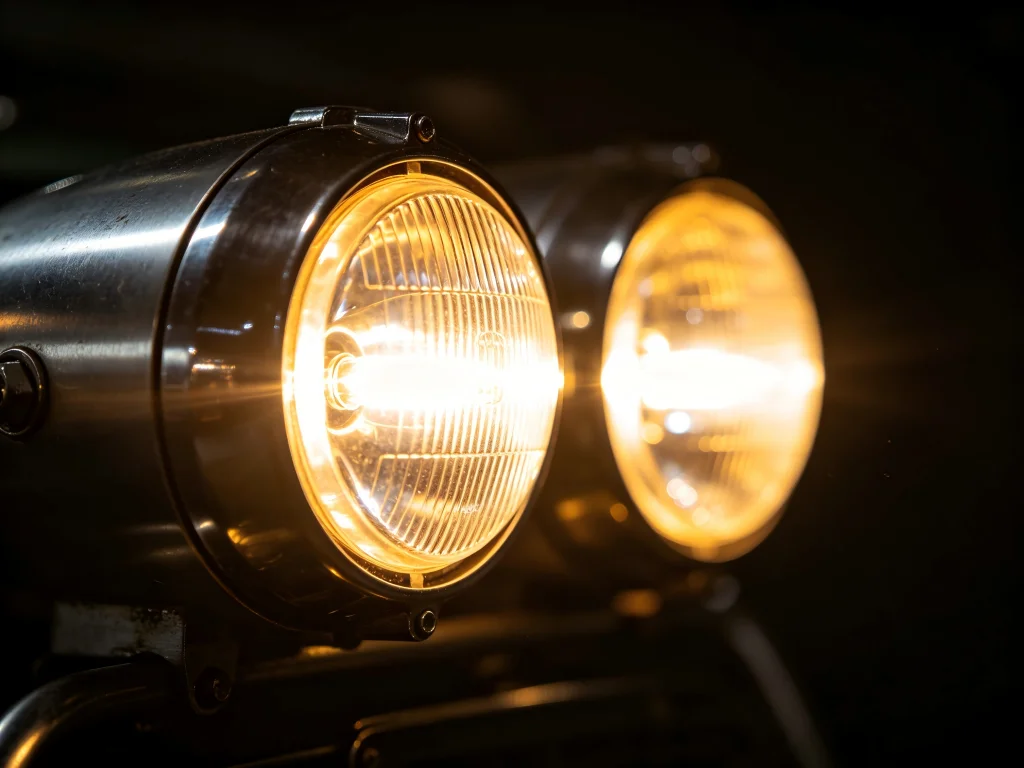
Halogen headlamps remain the most common automotive lighting technology globally. They are affordable and easy to replace. However, their light output is lower than HID or LED alternatives.
A critical consideration for automotive applications: replacing a halogen lamp with an LED in a headlight designed for halogen can cause the beam pattern to fail inspection standards. The optical design of a halogen headlight is calibrated to the precise filament position of the halogen lamp. An LED retrofitted into that housing may produce higher intensity but in the wrong direction.
For this reason, many fleet operators and workshops continue to use halogen lamps for headlight applications where maintaining the original beam pattern is legally required.
Workshop and Industrial Lighting
Halogen shop lamps are valued for their bright, focused illumination and instant full brightness. They provide excellent color rendering for detailed work where color accuracy and visibility are critical.
Key selection factors for workshop applications:
- Brightness and wattage – Match the wattage to the work area size
- Durability – Look for sturdy metal cages or guards to protect the bulb
- Positioning flexibility – Portable lamps with hooks or clamps offer versatility
- Environmental resistance – Weather-resistant models suit outdoor use
Halogen machine lights, designed for fixed positions on industrial equipment, offer die-cast heads, IP65 protection, and articulated arms for precise positioning.
Stage, Studio, and Projection
Halogen lamps remain indispensable in professional lighting environments where color quality cannot be compromised. They serve sales areas, displays, facades, halls, street areas, parking lots, and architectural highlighting.
Projection systems rely on halogen lamps with precise filament positioning and distortion-free quartz bulbs. The 250W G6.35 24V halogen non-reflector lamp, for example, delivers 9000 lumens at 3400K with a CRI of 100.
Energy Efficiency – The Reality Check
The energy efficiency of halogen lamps is modest by modern standards. A typical halogen lamp produces about 20 lumens per watt. An LED of comparable output averages close to 100 lm/W, with some premium models exceeding 200 lm/W.
However, efficiency is not the only metric that matters. For applications with only a few operating hours per year, the relatively low production cost of halogen lamps can outweigh their energy consumption. For applications requiring perfect color rendering or simple dimming compatibility, halogen remains a practical choice despite its lower efficacy.
It is worth noting that halogen lamps are being phased out in many regions due to energy efficiency regulations. Professional buyers should verify the regulatory status of halogen lamps in their jurisdiction before committing to large-scale purchases.
Halogen Lamp Selection Checklist for Professionals
When purchasing halogen lamps for professional applications, consider these factors:
- Voltage compatibility – Confirm whether your system operates at 12V, 24V, 120V, or 230V
- Wattage requirement – Select the lowest wattage that meets your illumination needs to maximize lifespan
- Base type – Identify the correct socket (G4, GY6.35, G9, R7S, E27, etc.)
- Color temperature – Choose between warm white (2800-3000K) and brighter white (3200-3400K) based on application
- Burning position – Some halogen lamps are designed for horizontal or vertical operation only
- Dimmable requirements – Verify that the lamp supports dimming if needed
- Regulatory compliance – Check local regulations regarding halogen lamp usage
- Handling precautions – Always use gloves or a cloth when handling halogen lamps to avoid contamination
Frequently Asked Questions About Halogen Lamps
What is the halogen cycle and why does it matter?
The halogen cycle is a chemical process where evaporated tungsten reacts with halogen gas, forms tungsten oxyhalide molecules, and redeposits tungsten back onto the filament. This prevents bulb blackening and allows the lamp to operate at higher temperatures, improving both brightness and lifespan compared to standard incandescent bulbs.
How long do halogen lamps typically last?
Under ideal conditions, halogen lamps last 1,000 to 3,000 hours. Low-voltage capsule lamps may achieve 2,000 to 2,500 hours. In real-world applications with vibration, temperature swings, and handling contamination, actual lifespan is often shorter.
Why do halogen lamps get so hot?
Halogen lamps convert approximately 80-95% of input energy into heat rather than light. The bulb wall must reach temperatures around 250°C for the halogen cycle to function properly. This is not a design flaw – it is a functional requirement of the technology.
Can I touch a halogen lamp with bare hands?
No. Skin oils create hot spots on the quartz envelope, causing uneven heating and potential failure or shattering. Always handle halogen lamps with clean gloves or use a cloth.
What is the difference between G4, GY6.35, and G9 bases?
G4 and GY6.35 are bi-pin bases for low-voltage halogen lamps (12V or 24V), with pin spacing of 4mm and 6.35mm respectively. G9 is a bi-pin base for mains-voltage lamps (120V or 230V). Each base type is designed for specific fixture compatibility and voltage requirements.
Are halogen lamps more efficient at lower voltages?
Yes. A 12V halogen lamp can reach approximately 20 lumens per watt, compared to roughly 16 lm/W for a 230V halogen. However, this advantage must be weighed against power losses in the required transformer or power supply.
Why do halogen lamps maintain color quality better than LEDs?
Halogen lamps produce a continuous full spectrum with a CRI of 100, matching natural sunlight. LEDs produce light across a narrower spectrum and typically achieve CRIs of 80-95. For color-critical applications, halogen’s spectral continuity remains superior.
Are halogen lamps being banned?
Many regions are phasing out halogen lamps through energy efficiency regulations. The regulatory landscape varies by jurisdiction. Professional buyers should verify local requirements before purchasing.
The Future of Halogen – Niche but Not Obsolete
The halogen lamp will not disappear entirely. It will become a specialized tool for applications where its unique characteristics – perfect color rendering, instant full brightness, simple dimming, and predictable beam patterns – provide genuine advantages that alternatives cannot match.
For automotive applications where beam pattern compliance matters, halogen remains the legally correct choice. For color-critical professional environments, halogen delivers quality that LEDs are still striving to achieve. For applications with minimal operating hours, halogen’s low upfront cost still makes economic sense.
At GTR, we understand that one size does not fit all. Our halogen lamp portfolio spans the full range of wattages, voltages, and base types to serve the diverse needs of automotive, industrial, and commercial customers. Every product is manufactured to precise specifications, with rigorous quality control ensuring consistent performance and reliability.
Whether you need a 12V 20W halogen capsule for a specialized fixture, a 500W halogen for workshop lighting, or a 1000W halogen for industrial heating applications, GTR delivers engineering-grade products you can depend on.
Our technical team can help you select the correct halogen lamp for your specific application – ensuring compatibility, performance, and compliance with relevant standards.
Visit GTR today to explore our full range of halogen lighting solutions. From automotive headlamps to industrial worklights, we have the products and expertise to keep your operation running efficiently.
Don’t settle for generic replacements. Choose GTR for halogen lamps engineered to perform – and built to last.