
Behind every H7 bulb lies a complex web of international standards, precision engineering, and optical physics that most drivers never consider — yet these factors determine whether you see clearly or struggle through every night drive.
The H7 is a single-filament bulb fitting governed by ECE Regulation No. 37, one of the most widely used headlight specifications in European and Asian vehicles. It operates at 12V and 55W, producing approximately 1,500 lumens at 13.2V per ECE spec, and uses a PX26d metal base. But those numbers tell only a fraction of the story.
What really distinguishes a quality H7 bulb from a poor one isn’t visible on the box — it’s hidden in the filament position, the thermal design, the dimensional tolerances, and the optical engineering that transforms raw light into a usable beam. This guide pulls back the curtain on what actually makes an H7 bulb perform — or fail.
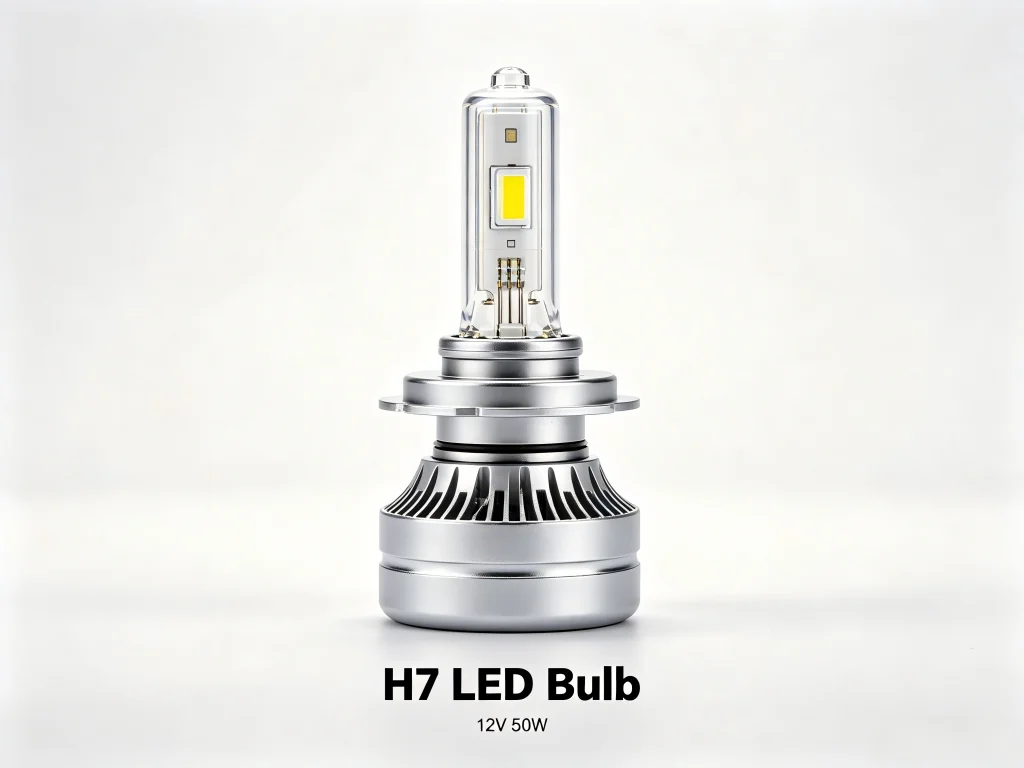
The Engineering That Makes — or Breaks — an H7 Bulb
Most drivers assume all H7 bulbs are essentially the same. They’re not. The differences start at the most fundamental level: how the light is actually produced.
Halogen vs. LED: Two Completely Different Light Sources
A halogen H7 bulb produces light by heating a tungsten filament until it glows — a process that generates significant heat and consumes 55W of power. An LED H7 bulb uses a semiconductor to create light through electroluminescence, drawing 15-30W while producing substantially more light.
This fundamental difference drives everything else. Halogen bulbs are simpler, cheaper, and universally compatible — but they’re also less efficient and shorter-lived. A halogen H7 typically lasts 400-1,000 hours. A quality LED H7 can last 30,000 to 50,000 hours.
But LED technology introduces its own challenges. The semiconductor chips generate heat that must be managed through heat sinks, cooling fans, or advanced thermal materials. Poor thermal management means the LED chips degrade rapidly — brightness drops, color shifts, and the bulb fails long before its rated lifespan.
The engineering trade-off is clear: halogen offers simplicity and guaranteed compatibility; LED offers superior performance but demands better engineering to deliver on its promise.
The Filament Position Problem
Here’s where many aftermarket H7 bulbs go wrong. The filament position — the exact location of the light source relative to the bulb base — is critical for beam focus and cutoff. ECE R37 specifies precise filament positioning limits, checked in specific directions to ensure every approved H7 bulb produces the correct beam pattern.
When an LED replacement places its chips in a different position than the original halogen filament, the beam pattern shifts. Light scatters incorrectly, creating dark spots in your field of view and glare for oncoming traffic. HELLA, a major automotive lighting manufacturer, notes that incorrect H7 bulb insertion or bulbs that allow different mounting positions lead to uncontrolled light scattering.
This is why “1:1 design” matters more than any lumen claim. A bulb that matches the original filament position delivers the beam pattern your headlight housing was designed for — safe, focused, and legal.
Decoding H7 Variants: H7M, H7R, and What They Mean
The H7 designation isn’t always as straightforward as it seems. Several variants exist, each designed for specific applications.
H7M — The Metal-Base Xenon Variant
H7M refers to a metal-base HID (xenon) bulb designed to fit into H7 sockets. These bulbs use xenon gas and an arc discharge rather than a filament, producing 3,000-5,000 lumens from just 35W.
H7M bulbs require a separate ballast to operate — the converter that steps up voltage to ignite the xenon gas. They typically last around 2,000 hours, significantly longer than halogen but shorter than quality LEDs.
The catch? H7M bulbs, like all HID retrofits in halogen housings, often produce poor beam patterns. One Porsche owner reported that H7M bulbs “don’t give a good beam pattern” and were advised to use H7R bulbs instead — shorter and partially masked to cut light scatter.
H7R — Designed for Reflector Housings
H7R bulbs feature a partial shield or mask that reduces upward light scatter. They’re specifically designed for vehicles with reflector-type headlight housings that lack the cutoff shield found in projector systems.
If you’re upgrading a vehicle with reflector housings — common in many older or entry-level models — an H7R bulb may produce better results than a standard H7 by reducing glare for oncoming drivers.
The CANBUS Compatibility Challenge
Modern vehicles use CANBUS (Controller Area Network) systems to monitor bulb status. When you install an LED H7 bulb that draws less current than the original halogen, the vehicle’s computer interprets this as a burned-out bulb.
The result? A dashboard warning light that won’t clear — or worse, the bulb flickering or shutting off completely during driving.
Quality LED H7 bulbs integrate CANBUS drivers that simulate the correct electrical load, eliminating these errors. Budget options often skip this, leaving drivers with persistent warnings.
Some manufacturers offer external CANBUS adapters or resistors as workarounds. These can work, but they add complexity and potential failure points. The cleanest solution is a bulb with built-in CANBUS compatibility — one that communicates properly with your vehicle’s system from day one.
What Real-World Testing Reveals
Independent testing tells a story that marketing materials rarely do. In controlled comparisons, the GTR Lighting Ultra 2 has tested significantly brighter than standard halogen bulbs. Professional drivers who log hundreds of thousands of miles have reported consistent, reliable performance with GTR bulbs in demanding conditions — including heavy-duty trucks where lighting reliability is non-negotiable.
One forum member noted that after testing multiple LED options, “their best results in terms of brightness and beam pattern in a reflector halogen housing was the GTR lighting LED”. This isn’t about brand loyalty — it’s about engineering that delivers where others fall short.
But even quality bulbs can fail if installed incorrectly. Forum discussions reveal common issues: fans that interfere with bulb retention clips, adapters that don’t seat properly, and beam patterns that scatter light in all the wrong places. These aren’t product failures — they’re installation and design mismatches that proper engineering should prevent.
The GTR Difference: Engineering You Can Trust
Founded in 2007, Dongguan Huanyu Ronghai Optoelectronics Co., Ltd. — the company behind the GTR brand — has grown into a premier manufacturer of high-performance LED automotive lighting solutions. With an 18-year track record, a 30,000 m² production facility, and partners in over 80 countries, GTR brings industrial-scale engineering capability to every bulb.
What sets GTR apart isn’t just the scale — it’s the commitment to international standards. GTR products have obtained CE, FCC, RoHS, ISO9001, and ISO14001 certifications, demonstrating compliance with global safety, environmental, and quality requirements.
For drivers in Southeast Asia, GTR has established dedicated agents and distribution networks. This regional presence means faster support, better availability, and products engineered with local driving conditions in mind.
When you choose GTR, you’re not buying a generic bulb — you’re buying decades of manufacturing expertise, certified quality standards, and engineering that has been tested and proven in real-world conditions.
Frequently Asked Questions About H7 Bulbs
What does H7 mean on a bulb?
H7 is a bulb type designation defined by ECE Regulation No. 37. It specifies the base type (PX26d), electrical characteristics (12V, 55W for halogen), and dimensional requirements that ensure interchangeability across vehicles.
Can I use an H7 LED bulb in my halogen headlight?
Physically, yes — many H7 LED bulbs are designed to fit H7 sockets. Legally and optically, it depends. In many countries, LED bulbs are not street-legal in halogen housings unless they have specific ECE approval. The beam pattern may also differ from the housing’s design.
What’s the difference between H7 and H7M?
H7 refers to the standard halogen bulb specification. H7M refers to a metal-base HID (xenon) bulb that fits H7 sockets but requires a separate ballast to operate.
How bright should an H7 bulb be?
A standard halogen H7 produces approximately 1,500 lumens at 13.2V. Quality LED H7 replacements can produce significantly more — some testing has measured 400% to 700% brightness increases over stock halogen.
Why do my H7 bulbs keep failing?
Common causes include poor quality bulbs, improper installation (touching the glass with bare fingers creates hot spots), electrical issues in the vehicle, or using bulbs with inadequate thermal management for your driving conditions.
Are H7 and H11 bulbs interchangeable?
No. H7 and H11 have different bases, connectors, and optical designs. An H7 bulb will not fit an H11 socket.
Your H7 Decision: What Matters Most
You now understand what separates a quality H7 bulb from a poor one. The filament position, thermal management, CANBUS compatibility, and legal compliance matter more than any lumen claim. The engineering behind the bulb determines whether you see clearly — or struggle through every night drive.