
Automotive lighting has come a long way since the early days of dim gas lamps and fragile filaments. What drives this evolution? The simple answer is safety—and the relentless pursuit of better visibility on dark roads. Today’s drivers have more choices than ever, but understanding where xenon headlights fit into the bigger picture requires looking at the full story. This isn’t just a comparison chart. It’s the history of how we learned to see in the dark.
Direct answer: The evolution of automotive headlights moved from simple gas lamps to halogen (1970s), then to xenon HID (1990s), and finally to LED technology. Each generation brought significant improvements in brightness, efficiency, and lifespan—with xenon representing the first true leap from filament-based lighting to gas-discharge technology.
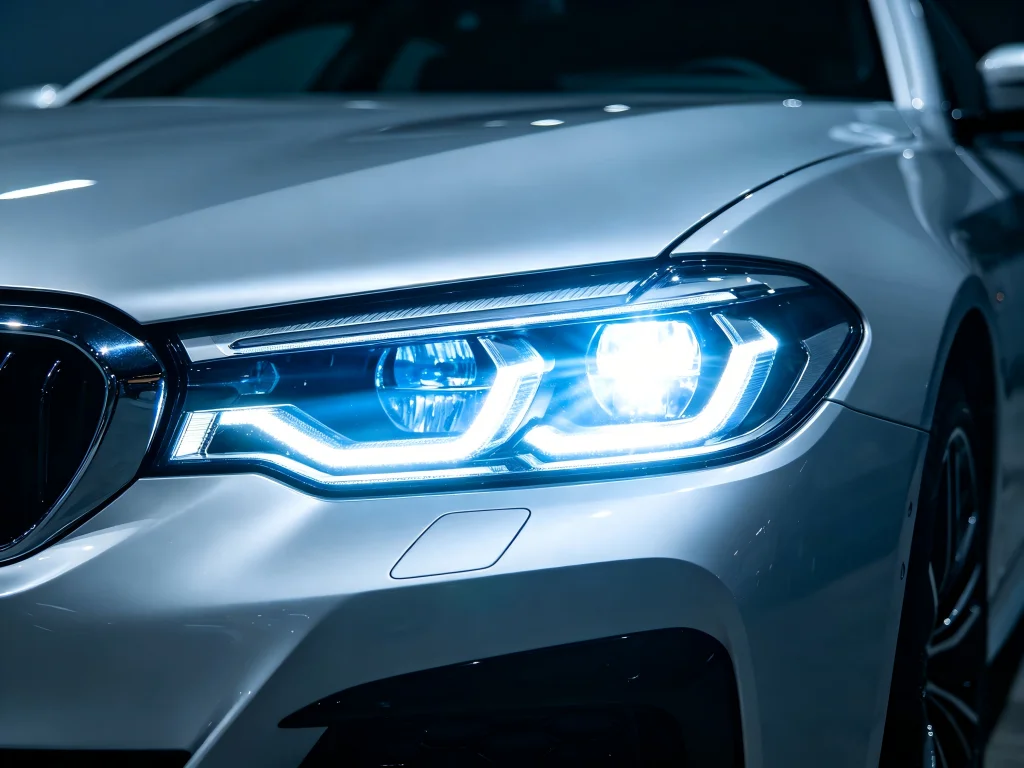
The Halogen Era: A Giant Leap Forward
For decades, drivers made do with sealed beam headlights that were barely adequate for rural roads. Then came halogen.
Halogen headlights emerged in the early 1970s and changed everything. The principle was simple: a tungsten filament sits inside a quartz envelope filled with halogen gas. When electricity heats the filament, it glows—just like a traditional light bulb. But here’s the clever part. As tungsten evaporates from the hot filament, it combines with the halogen gas and gets redeposited back onto the filament. This self-healing cycle allows the filament to run at higher temperatures without burning out quickly.
The result was a major step forward in reliability and precise beam control. Halogen bulbs produce a warm, yellowish light—around 3,200K color temperature—and typically last 500 to 1,000 hours. They remain the most common headlight technology on the road today because they’re affordable and easy to replace. But their limitations are obvious: lower light output, higher energy consumption, and that dated yellow glow that many drivers find inadequate for modern night driving.
The halogen limitation: A typical halogen bulb produces roughly 1,000 to 1,500 lumens of light. That’s enough for city driving, but push beyond well-lit streets and you’ll quickly feel the limits. Your eyes strain. Your reaction times slow. The road ahead becomes a guessing game.
The Xenon Revolution: Light Without a Filament
Xenon headlights—also known as HID (High-Intensity Discharge) lights—represented a genuine technological revolution when they arrived. Developed in Europe in the early 1990s, these systems completely reimagined how a headlight could work.
Instead of a glowing filament, xenon headlights create light through an electric arc. Inside a quartz capsule filled with xenon gas and mercury vapor, two closely spaced electrodes generate a high-voltage spark. An electronic ballast delivers a massive ignition pulse of roughly 25,000 volts to start the arc, then drops to about 85 volts during normal operation. The xenon gas amplifies the brightness and helps the lamp reach operating temperature quickly. Bi-xenon systems, which produce both dipped and main beam light from a single bulb, emerged in 1999. Swivelling bi-xenon lights followed in 2003, and fully adaptive systems—which adjust the beam pattern based on driving conditions—arrived shortly after.
The numbers tell the story. Xenon systems produce roughly three times as much light as halogen bulbs—3,000 to 3,500 lumens—while using only 65% of the energy. The bulbs last 2,000 to 3,000 hours, significantly longer than halogen’s 500 to 1,000 hours. The light itself is different too. Halogen’s distinctive yellow tint gives way to a bluer, whiter light that more closely approximates natural daylight—which helps with visibility and reduces eye strain.
Xenon lamps entered the Chinese automotive market in 2001, and China began manufacturing its own xenon lamps for cars in 2005. Today, xenon technology continues to play a significant role in automotive lighting, and has also found applications in high-power civil lighting.
What this means for you: If you’ve ever driven a car with xenon headlights and noticed how much clearer the road looks, you’ve experienced the difference firsthand. That crisp, white light improves contrast, reduces eye strain, and—crucially—gives you more time to react to hazards.
LED: The New Standard
LED (Light Emitting Diode) headlights represent the latest chapter in automotive lighting evolution. Unlike halogen or xenon, LEDs have no filament and no gas. Instead, they use semiconductors that emit light when electric current passes through them. The result is incredibly efficient, long-lasting light.
LEDs offer several compelling advantages. They last up to 20,000 hours—far longer than xenon’s 3,000-hour maximum. They’re about 90% more efficient than incandescent bulbs and generate less heat. They turn on instantly with no warm-up time. And because they’re small, designers can arrange them in creative patterns that enhance both function and style.
But LED technology has trade-offs. The initial cost is higher. Repairs can be complex because the entire module often needs replacement. And LEDs can be sensitive to extreme temperatures, making effective heat dissipation crucial. LED headlights unveiled in 2007 actually performed worse than xenon in some early applications—the technology has improved dramatically since then.
Perhaps most importantly, not all LED headlights perform equally. The Insurance Institute for Highway Safety (IIHS) evaluates headlight performance based on how far they reach on straight roads and curves. Some vehicles with LED headlights receive only “acceptable” ratings, while certain xenon-equipped models perform poorly. The type of lighting matters, but so does the design of the headlight assembly, the reflectors or projectors used, and how well the lights are aimed.
The Complete Picture: How the Technologies Compare
| Feature | Halogen | Xenon HID | LED |
|---|---|---|---|
| Light Output | 1,000-1,500 lumens | 3,000-3,500 lumens | 3,000-5,000 lumens |
| Color Temperature | ~3,200K (yellowish) | 4,300-6,000K (white to bluish) | 4,000-6,000K (white) |
| Lifespan | 500-1,000 hours | 2,000-3,000 hours | Up to 20,000 hours |
| Energy Efficiency | Lowest (100% baseline) | Medium (35% savings vs halogen) | Highest (90% vs incandescent) |
| Warm-up Time | Instant | 3-5 seconds | Instant |
| Relative Cost | Low | Medium | High |
Sources: HELLA, Cars.com, DailyDriven
The key takeaway: Xenon sits in a sweet spot. It delivers 200-300% more light than halogen while using less energy, at a price point that’s significantly more accessible than premium LED systems. That’s why xenon headlights remain popular in the aftermarket, even as LEDs become more common on new vehicles.
Why Xenon Still Matters in 2026
With LED technology advancing rapidly, you might wonder whether xenon headlights still have a place. The answer is a resounding yes—and here’s why.
First, millions of vehicles on the road today came factory-equipped with xenon headlights. BMW, Audi, Porsche, Mercedes-Benz, and many other premium manufacturers used xenon extensively for nearly three decades. Drivers of these vehicles need quality replacement bulbs that restore original performance. They don’t want to downgrade to halogen, and retrofitting LED can be prohibitively expensive or technically complex.
Second, xenon offers a specific light quality that many drivers prefer. The warm white light—particularly at 4,300K, which is the OEM standard—provides excellent contrast and visibility in varied conditions. Some drivers find the cooler light of LEDs less comfortable for long night drives. It’s a matter of personal preference, but it’s a real consideration.
Third, the cost equation still favors xenon for many drivers. A quality set of xenon bulbs costs a fraction of what a full LED retrofit would run. For drivers who want premium lighting performance without the premium price tag, xenon remains the smart choice.
Fourth, aftermarket xenon conversion kits have become increasingly sophisticated. Modern kits are true plug-and-play solutions that fit into existing headlight housings without modification. They work with both projector and reflector headlights. CANbus-compatible options eliminate warning lights and flickering issues.
But here’s the catch: The quality of xenon components varies dramatically. Cheap bulbs use inferior electrode materials that degrade quickly. They may produce inconsistent color temperatures or fail prematurely. A poorly manufactured bulb can even damage your vehicle’s ballast—a costly repair that could have been avoided with a quality product.
Choosing the Right Xenon Headlight Solution
If you’ve decided that xenon headlights are right for your vehicle—or you’re replacing existing xenon bulbs—here’s what you need to know:
- Identify your bulb type: Xenon bulb fittings begin with “D” (e.g., D1S, D2S, D3S, D4S). Check your owner’s manual or use a bulb finder tool to confirm the exact specification. Different vehicles use different fittings, and they’re not interchangeable.
- Select the right color temperature: 4,300K is the OEM standard—white with a slight yellow tint. 5,000K offers pure white light. 6,000K produces a cool blue-white. Above 6,000K, light output decreases and the bulbs may be illegal in some jurisdictions. For most drivers, 4,300K or 5,000K offers the best balance of visibility and legality.
- Replace in pairs: Xenon bulbs dim over time. Replacing just one creates mismatched light output and color. Always replace both bulbs simultaneously.
- Consider the complete system: Sometimes the bulb isn’t the only problem. Ballasts fail. Wiring degrades. If you’re experiencing flickering, intermittent operation, or error messages, you may need a more comprehensive solution that includes ballasts or harnesses.
- Choose quality over price: A cheap bulb that lasts 500 hours isn’t a bargain when a quality bulb lasts 2,500 hours. Factor in the cost of replacement, the inconvenience of frequent changes, and the potential damage to other components. Quality is actually the cheaper option in the long run.
What Drivers Are Saying
In our years of experience in automotive lighting, we’ve heard from countless drivers who made the switch—or finally replaced their degraded OEM bulbs. The feedback is remarkably consistent.
One driver described the difference as “instant improvement—the road ahead is actually white instead of that sickly yellow I’d gotten used to.” Another noted that “my wife asked if I’d gotten a new car because the lights looked so much better.” A third pointed out something we hear often: “I didn’t realize how bad my old lights had gotten until I saw the new ones. It was a gradual fade I just didn’t notice.”
That gradual fade is the silent danger of xenon headlights. The bulbs don’t fail suddenly like a halogen filament. They dim over thousands of miles, so gradually that your brain compensates. You don’t realize how much visibility you’ve lost until you restore it.
The lesson is clear: If your xenon headlights are more than a few years old, you’re probably not seeing as well as you think you are. The bulb may still work, but its light output has likely dropped significantly from factory-new levels.
Frequently Asked Questions About Xenon Headlight Technology
What does “xenon” mean in headlights?
“Xenon” refers to the noble gas used inside HID (High-Intensity Discharge) headlight bulbs. The xenon gas helps create and amplify the electric arc that produces light, enabling the bulb to reach operating temperature quickly and generate intense, bright illumination.
Are xenon headlights better than LED?
It depends on your priorities. Xenon offers excellent light quality with a warm white beam that many drivers prefer for night driving. LED offers longer lifespan and instant-on capability. Xenon is typically more affordable upfront; LED is more cost-effective over the very long term.
How long do xenon headlights last?
Quality xenon HID bulbs typically last 2,000 to 3,000 hours. However, their light output begins to degrade significantly before they fail. Most experts recommend replacing xenon bulbs around the 1,000-hour mark to maintain optimal visibility.
Can I upgrade my halogen headlights to xenon?
Yes, but you need a complete HID conversion kit that includes bulbs, ballasts, wiring, and sometimes new housings. Simply swapping halogen bulbs for xenon bulbs won’t work—the fittings are different. A proper conversion kit is a plug-and-play solution that fits existing headlight housings without modification.
Why do xenon headlights flicker?
Flickering typically indicates a failing ballast or a poor electrical connection. The ballast provides the high-voltage ignition pulse and steady power needed to maintain the arc. When it fails, the arc becomes unstable, causing flickering. Voltage drops in the vehicle’s electrical system can also cause this issue.
Are xenon headlights legal?
Factory-installed xenon headlights are legal in most countries when they include automatic leveling and cleaning systems as required. Aftermarket retrofits may be subject to local regulations. Always check your local laws before modifying your headlights.
What color temperature should I choose for xenon headlights?
4,300K is the OEM standard—white with a slight yellow tint that provides excellent visibility in all conditions. 5,000K offers pure white light for a modern look. 6,000K produces a blue-white light but may reduce visibility in wet conditions. Higher temperatures decrease light output and may be illegal.
Making the Right Choice for Your Vehicle
The evolution of automotive lighting from halogen to xenon to LED tells a clear story: each generation brought meaningful improvements in safety, efficiency, and driving comfort. Xenon headlights represent a pivotal moment in that story—the first technology to break free from the limitations of filament-based lighting.
Today, xenon remains a compelling choice. It delivers premium lighting performance at a price that’s accessible to most drivers. It’s widely available for a vast range of vehicles. And when you choose quality components, it provides years of reliable, brilliant illumination.
GTR understands this technology inside and out. Our xenon headlight solutions are engineered to meet or exceed OEM specifications, with rigorous quality control that ensures consistent performance across thousands of hours of use. We don’t cut corners on materials. We don’t ship bulbs with inconsistent color temperatures. We don’t leave you guessing about compatibility.
Whether you’re replacing degraded xenon headlights in your BMW, upgrading your Audi’s lighting, or converting your Honda to HID, GTR delivers the performance you expect and the reliability you deserve.
Explore GTR’s xenon headlight solutions at www.rhgtr.in. Because understanding the evolution of headlight technology is one thing—experiencing the difference on the road is another entirely.