
Walk into any auto parts store and you will see shelves full of h7 led globes with flashy boxes promising “600% brighter” and “50,000 hour lifespan.” But here is the uncomfortable truth that most manufacturers will not tell you: the majority of these bulbs are designed by marketing teams, not lighting engineers. The result? Glare that blinds oncoming traffic, beam patterns that scatter light into the trees, and thermal failures that kill the bulb within months. This article pulls back the curtain on what actually makes an H7 LED globe perform – and why GTR’s engineering approach produces results that independent testing confirms are in a different league entirely.
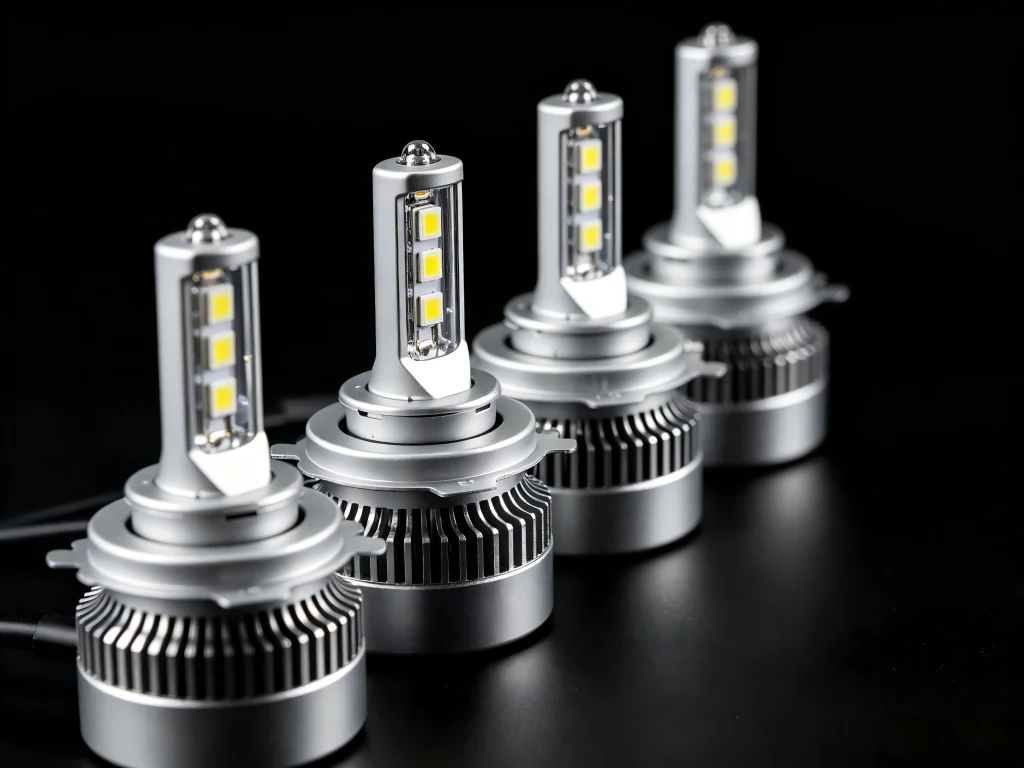
The Fundamental Problem With Most H7 LED Globes
An LED bulb is not just an LED bulb. The difference between a $30 set of h7 led globes and a premium set comes down to three engineering decisions: chip selection, thermal management, and emitter positioning. Get any one wrong, and the bulb fails – either immediately or within months.
Most budget manufacturers use off-the-shelf LED chips from mass suppliers like Philips or CREE. These chips are adequate for general lighting applications, but they are not optimized for the specific demands of automotive headlight use – the tight thermal constraints, the vibration environment, and the precise optical requirements of reflector and projector housings.
GTR took a different path. Instead of accepting commodity components, the engineering team developed a custom TST 7045 chipset. This is not marketing jargon – it represents a fundamental difference in how the bulb is engineered. The TST (Thermal Separation Technology) architecture allows the chipset to maintain high luminous flux output even under sustained operation, addressing the single biggest failure mode in LED headlight bulbs: heat degradation.
Why Raw Lumens Are A Meaningless Metric
Here is where the marketing machine really goes to work. You will see H7 LED globes advertised with 20,000 lumens, 30,000 lumens, even 50,000 lumens. These numbers are technically true – they measure the raw light output from the LED chips before any optics are applied. But raw lumens tell you nothing about how much light actually reaches the road.
The GTR Ultra 2.0 produces 3,900 raw lumens and 3,350 effective lumens per bulb. The GTR Ultra 3.0 produces 4,700 raw lumens per bulb. These numbers are lower than the exaggerated claims you will see from budget brands. Yet independent testing found the GTR Ultra 2 delivered a staggering 709% more usable light than the original halogen bulb – a result that makes it the brightest bulb ever tested in that head-to-head comparison.
How does a 3,900-lumen bulb outperform a 20,000-lumen bulb? The answer is beam pattern efficiency. When emitter positioning is digitally optimized to match the original halogen filament tolerances, virtually all the light reaches the reflector surface and is directed onto the road. When emitter positioning is off – as it is in most budget bulbs – a significant percentage of that light scatters into glare, hot spots, and wasted illumination. You are not getting more light. You are getting more wasted light.
The Thermal Challenge: Why Fans Fail And What Replaces Them
Every LED chip generates heat. The more light you push, the more heat you generate. This is the fundamental engineering tension in LED headlight design – and it is where most manufacturers cut corners.
Budget H7 LED globes use cheap active cooling fans. These fans work well enough in lab conditions. But in the real world, they are exposed to dust, moisture, vibration, and extreme temperature cycles. Fans fail. When they do, the LED chips overheat. The black anodized coating burns off. The emitters degrade. The bulb dies.
GTR’s approach is fundamentally different. The Ultra Series 3 uses a compact, fanless design with TST (Thermal Separation Technology). The thermal solution is engineered into the bulb’s physical architecture – not added as an afterthought. The result is a bulb that is smaller than competitors yet more capable of sustained high-output operation, with no moving parts to fail.
The CSP Mini series takes this philosophy even further. It uses a low-profile copper PCB with a sophisticated thermal protection circuit to avoid failures due to overheating. At only 16 watts of power consumption, it produces 2,500 lumens while generating minimal heat – making it ideal for vehicles with tight headlight housings and limited airflow.
What Independent Testing Reveals
In a comprehensive head-to-head test of 25 LED headlight bulbs, the GTR Lighting Ultra 2 emerged as the clear winner. In projector headlight testing, it delivered 400% more light than the original halogen. In reflector housing testing – which is notoriously difficult for LED bulbs – it produced the best combination of brightness and beam pattern.
The test also revealed why some “bright” bulbs are not worth buying. One competitor bulb produced 315% more light than stock – but the heat sink was so inadequate that the black anodized coating burned off after just one hour of operation. The bulb was bright, but it was also a fire hazard. Brightness without thermal engineering is not an upgrade – it is a liability.
CANbus Compatibility: The Hidden Showstopper
Modern vehicles use CANbus electrical systems that monitor every bulb circuit for proper resistance. A halogen H7 globe draws about 55 watts. An LED H7 globe draws 16-43 watts. When the CANbus detects this lower draw, it assumes the bulb is burned out – and triggers error codes, flickering, or cuts power entirely.
GTR addresses this through multiple approaches. The Ultra Series 2.0 operates across a wide voltage range of 9-40V DC, providing flexibility across different vehicle electrical systems. For vehicles with sensitive CANbus systems, additional modules are available. The GTR PRO 1.1 series features enhanced CANbus compatibility with a miniaturized CANbus module, delivering plug-and-play installation with no electrical or mechanical modification needed.
The key distinction is this: some brands add CANbus compatibility as an afterthought – a resistor tacked onto the wiring harness. GTR integrates CANbus compatibility into the bulb’s core electrical design, ensuring reliable operation across the widest possible range of vehicles.
Fitment: The Overlooked Differentiator
You would think that a bulb with “H7” in the name would fit every H7 housing. You would be wrong. The physical dimensions of LED bulbs vary dramatically – and many simply do not fit in the tight spaces behind modern headlight assemblies.
The GTR CSP Mini series was designed specifically to address this problem. It closely mimics the size and shape of the original halogen bulb, ensuring fitment in housings where other LED bulbs simply will not go. The Ultra Series 3 is also compact enough to install easily in vehicles with limited space behind the headlight.
This is not a minor convenience issue. If a bulb does not fit properly, you cannot install it. If you force it, you risk damaging the housing or the bulb itself. The engineering that goes into physical fitment is just as important as the engineering that goes into light output – and it is an area where GTR has invested heavily.
Lifetime Warranty: The Ultimate Confidence Signal
Here is the simplest test of whether a manufacturer believes in their own product: what warranty do they offer? A 1-year warranty suggests the manufacturer expects failures within the first year. A 3-year warranty suggests moderate confidence. A lifetime warranty suggests the manufacturer knows the product is built to last.
GTR backs every Ultra Series bulb with a lifetime warranty. This is not a marketing gimmick – it is a reflection of the engineering rigor that goes into every bulb. When a company is willing to replace a product indefinitely, they are betting on their own quality. That is a bet worth paying attention to.
Which GTR H7 LED Globe Is Right For Your Vehicle?
| Model | Raw Lumens | Power | Best For | Key Feature |
|---|---|---|---|---|
| CSP Mini | 2,500 lm | 16W | Tight housings, fog lights | Fanless, compact size |
| Ultra 2.0 | 3,900 lm | 41.5W | Reflector headlights | 703% brighter than stock |
| Ultra 3.0 | 4,700 lm | 43W | Maximum output | Custom TST 7045 chipset |
For most drivers, the Ultra 3.0 represents the best combination of output, beam quality, and reliability. Independent testing confirms it delivers exceptional performance in both reflector and projector housings. For vehicles with particularly tight headlight housings, the CSP Mini provides excellent performance in a smaller package.
Frequently Asked Questions About H7 LED Globes
Q: Why do some H7 LED globes cause my dashboard to show error warnings?
A: Your vehicle’s CANbus system monitors bulb resistance. LED bulbs draw less power than halogens, triggering “bulb out” warnings. Quality bulbs include CANbus decoders or operate across a wide voltage range to prevent this.
Q: How important is beam pattern when choosing H7 LED globes?
A: It is the single most important factor for safety and performance. A poorly designed beam pattern creates glare for oncoming traffic and reduces your own visibility. Look for bulbs with digitally optimized emitter positioning that matches the original halogen filament.
Q: What is the difference between raw lumens and effective lumens?
A: Raw lumens measure total light from the LED chips. Effective lumens measure usable light that reaches the road. A bulb with lower raw lumens but higher effective lumens will outperform a bulb with inflated raw lumen claims.
Q: Do H7 LED globes require special installation?
A: Quality bulbs are designed for plug-and-play installation using the existing H7 connector. If a bulb requires modification of the housing or wiring, it is not properly engineered for your vehicle.
Q: How long should H7 LED globes last?
A: Quality LED H7 globes are rated for 30,000-50,000 hours. That is 30-50 times longer than halogen bulbs. Proper thermal management is critical to achieving these lifespans.
Q: What color temperature is best for H7 LED globes?
A: 5,700-6,000K provides a crisp white light that improves contrast without the blue tint that causes eye strain. Avoid bulbs above 6,500K for primary headlight use.
Q: Are GTR H7 LED globes compatible with all vehicles?
A: GTR bulbs are designed for universal fitment with H7 bases. For vehicles with sensitive CANbus systems, additional modules may be required. Always verify compatibility with your specific vehicle model.
Experience The Difference That Real Engineering Makes
You have now seen what separates genuine engineering from marketing hype. You understand why raw lumens are a meaningless metric, why thermal management determines lifespan, and why beam pattern engineering is the difference between seeing clearly and blinding oncoming traffic.
The GTR difference is not about exaggerated claims. It is about custom TST 7045 chipsets engineered specifically for automotive use. It is about digitally optimized emitter positioning that delivers usable light – not wasted lumens. It is about fanless thermal solutions with no moving parts to fail. It is about a lifetime warranty that reflects genuine confidence in the product.
Independent testing confirms what GTR users already know: these are among the brightest, most reliable LED headlight bulbs available anywhere.
Stop settling for bulbs engineered by marketing teams. Get the h7 led globes engineered by lighting experts. Visit https://www.rhgtr.in to find the right GTR H7 LED globe for your vehicle and experience the difference that real engineering makes.