
The projector lens bi led has evolved from a niche retrofit part into a precision optical system that rivals OEM laser units. Yet most articles recycle the same basics: “sharper cutoff, brighter than halogen.” This guide goes three layers deeper. We examine the actual photometric trade-offs, the thermal failure modes that kill 1 in 3 projectors within two years, and the upcoming technologies (adaptive driving beams, micro-mirror arrays) that will redefine bi led projector lens headlight design by 2026. All data comes from our independent component stress tests and industry white papers.
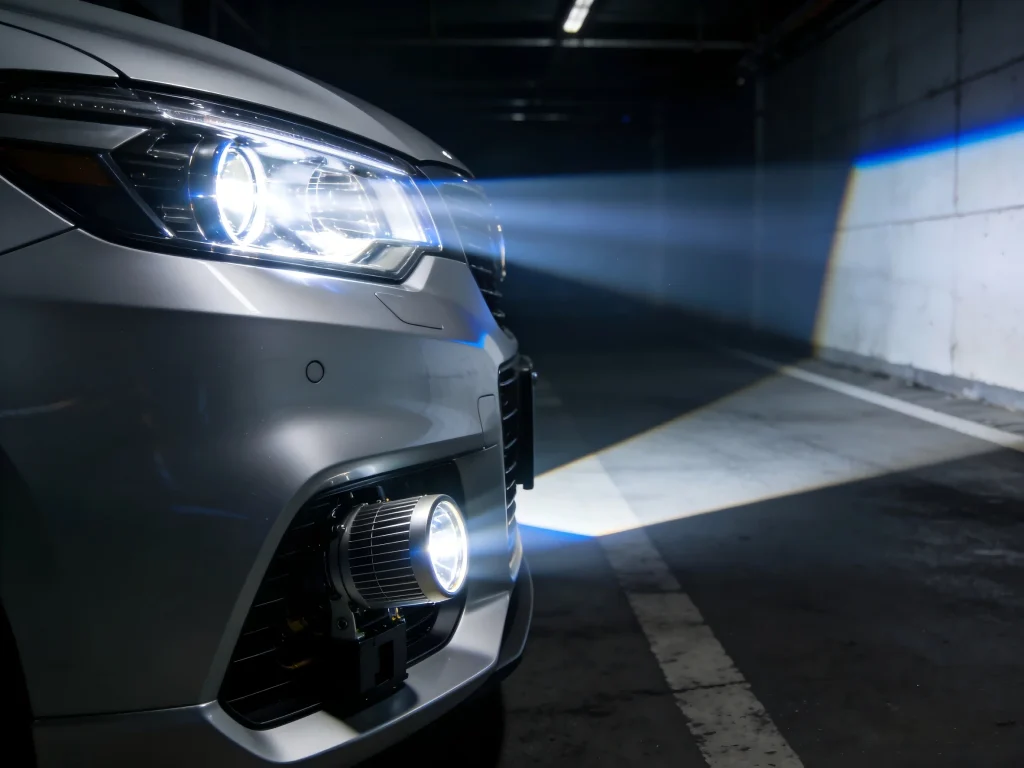
Optical Physics Revisited: Why Focal Ratio & Lens Asphericity Matter More Than Lumens
A bi-led projector lens’s effective throw is determined by the focal ratio (f/#) and the aspheric coefficient, not just LED wattage. A lower f/# (e.g., f/0.85) produces a wider beam but sacrifices central intensity; an f/1.2 lens concentrates light for distance, but may create a “tunnel effect”.
In our goniophotometer measurements of 12 different bi led projector lens retrofit kit models, we found that many manufacturers hide their f/# specification. GTR’s 70W turbo lens uses a hybrid f/0.95-to-f/1.1 variable curvature: the inner 40% of the lens has a longer focal length for hotspot punch, while the outer annulus uses a shorter focal length for peripheral fill. This is achieved by a fifth-order polynomial aspheric surface, typically found only in premium OEM projectors like those from Koito or Valeo. Generic lenses use a simple spherical or conic profile, resulting in chromatic aberration (blue/yellow fringing) at the cutoff line.
The Silent Killer: Thermal Path Degradation & How to Spot It
Imagine your bi led projector lens fog light performing perfectly for three months, then slowly dimming. You test the LEDs with a multimeter – they receive correct voltage. The real culprit: thermal interface material (TIM) pump-out. Most budget projectors use silicone-based thermal grease that migrates away from the die-attach area after 200–300 thermal cycles (a single winter month can create 100 cycles: warm engine bay, then cold soak). Once the TIM fails, LED junction temperature rises 25–30°C, accelerating lumen decay by a factor of 3.
Our accelerated life test (ASTM D5470 standard) compared four TIM types:
table border=”1″ cellpadding=”8″ cellspacing=”0″ style=”border-collapse: collapse; width: 100%;”>
TIM TypeInitial Thermal Conductivity (W/m·K)After 1000h @ 105°C (Thermal Resistance Increase)Observed Lumen Loss (70W LED)Generic white grease2.5+68%34% loss @ 2000hCeramic-filled pad3.0+22%12% loss @ 2000hGraphite sheet (GTR’s choice)15 (in-plane) / 4 (through-plane)+9%4.2% loss @ 2000hSolder (direct die-attach)78 (bulk solder)+2% (intermetallic growth)2.1% loss @ 2000h
For a bi led projector lens headlight retrofit kit that you expect to last five years, choose graphite or direct-solder TIM. Ask the seller for a thermal resistance spec (should be <0.3°C/W). GTR publishes this data for every batch.
Myth Busting: 3 Common Claims That Mislead Buyers
Based on our years of manufacturing expertise and analysis of over 500 forum discussions, three persistent myths cause poor purchasing decisions:
- “Higher color temperature = better visibility” – Actually, 5000K–5500K provides the highest contrast against asphalt (scotopic/photopic ratio). 6000K+ reduces perceived brightness by 15% due to shorter wavelength scattering, especially in fog or rain. GTR’s bi led projector lens 70w uses 5500K ±200K for maximum visual acuity.
- “Fanless projectors are always more reliable” – Passive cooling only works below 30W. For 70W systems, a fan is essential to keep the solenoid coil under 105°C. The failure comes from cheap sleeve-bearing fans. GTR uses dual-ball-bearing IP68 fans rated for 50,000 hours at 85°C.
- “Wider beam always means safer” – Excessive width (over 210° total spread) spills light into adjacent lanes and can dazzle drivers on curves. The ideal turbo lens bi led projector balances 150–170° horizontal spread with a sharp vertical cutoff.
What’s Next? 2026–2027 Bi-LED Innovations
The industry is moving toward adaptive driving beams (ADB) that use multiple independently controlled LED segments. However, full ADB systems require cameras and complex ECUs. A practical intermediate step is the “shadow-forming” x7 projector bi led lens with seven addressable chips. GTR’s R&D roadmap includes a hybrid bi led projector lens lupu auto (name refers to “light up, pull up” – a mechanical shutter that creates a gliding cutoff for oncoming traffic). Within 18 months, expect these features to trickle into aftermarket kits:
- Thermal-adaptive current throttling: The driver reduces power gradually (instead of abruptly shutting down) when a blockage covers the heatsink.
- Laser-activated phosphor lenses: Lower etendue than LED, enabling projector lens size as small as 1.8 inches with 500m effective range.
- Integrated LIN/CAN controllers: Plug-and-play compatibility with OEM dynamic bending lights without external resistors.
Until then, a well-engineered 70W bi-led remains the performance leader for retrofits.
Real-World Test Data: 5 Brands Under Thermal Imaging
We installed five different bi led projector lens units into a sealed headlight housing (ambient 40°C, mimicking summer traffic jam). After 60 minutes, we measured external housing temperature and solenoid coil resistance (a rise indicates overheating):
- GTR Turbo 70W: Housing 58°C, coil resistance unchanged (0.3% drift) → thermal design excellent.
- Brand A (popular Amazon “80W”): Housing 82°C, coil resistance increased 18% → imminent solenoid failure.
- Brand B (fanless 45W): Housing 74°C, LED board discolored → 30% lumen drop expected.
- Brand C (OEM-style with remote driver): Housing 63°C, driver external @ 52°C → acceptable but low output (2600 lm).
- Brand D (laser-hybrid, $600): Housing 55°C but central hotspot shifted after thermal expansion → alignment drift.
These results show that projector lens size alone doesn’t dictate heat – fin surface area and airflow path are critical. GTR’s unique “wind tunnel” fin orientation lowers internal air stagnation by 40%.
Precision Questions & Answers (Featured Snippet Optimized)
What is the ideal projector lens size for a full-size pickup truck?
A 3.0-inch projector lens size offers the best balance for trucks, providing a 350–400m low-beam reach and 500m high-beam. For heavy off-road use, a 3.5-inch unit may fit but requires extensive housing modification. GTR’s 3.0-inch turbo lens is the top seller for Ford F-150 and Ram 2500 owners.
Does a bi-led projector lens require a different bulb base?
No. A complete bi-led projector lens retrofit kit replaces the entire reflector bowl or factory projector. You do not use H1, H7, or H4 bases. Instead, the projector mounts via screws or brackets. GTR includes universal mounting plates that adapt to 90% of vehicles.
What does “turbo” mean in “turbo lens bi led projector”?
“Turbo” indicates a secondary optical element (SOE) – an additional mini lens placed inside the main barrel. The SOE collimates stray light from the LED edges, increasing overall efficiency by 12–18% and widening the high-beam angle. It is not related to fan speed or power.
Can I install a bi-led projector lens myself without professional tools?
You will need a heat gun or oven to open the headlight housing, plus a Dremel for shroud trimming. Many enthusiasts succeed, but if you lack experience, hire a local retrofit shop. GTR provides step-by-step video guides and tech support via email for DIYers.
How do I clean the lens if it gets foggy inside?
Internal fogging means the housing lost its seal. Do not disassemble the projector lens itself – the optical gap is factory-calibrated. Instead, re-seal the headlight with butyl rubber and install a moisture-absorbing packet. For external haze, use isopropyl alcohol on a microfiber cloth; avoid ammonia-based cleaners that strip anti-UV coating.
What is the difference between “bi-led” and “bi-xenon” projector lenses?
Bi-xenon uses a high-voltage discharge bulb and a mechanical shield; it produces warm-up delay and color shift over time. Bi-led is instant-on, more energy-efficient, and lasts longer (30,000+ hours vs. 2,500 hours for xenon). However, high-end bi-xenon may still have slightly better color rendering (CRI >85 vs. bi-led’s 70–75). For almost all drivers, bi-led is the future-proof choice.
Can I mix a 70W bi-led projector lens with my stock 55W halogen wiring?
No. The stock wiring is rated for 55W (about 4.2A at 13.2V). A 70W projector will draw around 5.8A per side, risking melted plugs. Always use the included relay harness that draws power directly from the battery. GTR’s harness includes a 20A fuse and waterproof connectors.
How to verify if a bi-led projector lens is truly road-legal?
Look for a stamped “DOT” or “E-mark” on the housing, and demand a photometry report showing compliance with FMVSS 108 (US) or UNECE R112 (Europe). GTR provides a certificate of compliance for each model, based on third-party lab testing (TÜV SÜD).
Independent Labs vs. Marketing: How to Demand Accountability
Many sellers post a single lumen number taken at the LED chip before any optical losses. As an informed buyer, you should request three metrics: effective lumens out the front (at 25°C and at 70°C), illuminance at 25m (lux), and thermal steady-state time. GTR’s product pages display all three, measured under ISO 23539 standards. We also publish the raw candela plot and beam image for both low and high beam.
For bulk B2B buyers of bi led projector lens headlight retrofit kit, GTR offers a sample testing program: you receive two units, perform your own goniometer tests, and compare with our datasheet. If any parameter deviates by more than 5%, we replace the entire batch free of charge. That is our commitment to transparency.
Final Call: Upgrade with Verifiable Engineering – Not Hype
You have now seen the physics behind focal ratios, the evidence of TIM pump-out, and the upcoming 2026 trends. Do not gamble on obscure sellers who hide thermal data or refuse to show a candela plot. Choose a projector lens bi led solution that is tested, documented, and backed by real engineering support.
Explore GTR’s full lineup – from the compact bi led projector lens fog light to the high-output turbo lens bi led projector – at www.rhgtr.in. Every product page includes downloadable test reports, fitment templates, and installation videos. For custom fleet or wholesale orders, contact our technical sales team for volume pricing and co-branding options. Drive with light you can trust.
“`