
An e12 led bulb looks simple enough. Screw it in. Turn it on. But beneath that compact 12mm base lies a surprisingly complex set of engineering trade-offs. Lumen output, color temperature, dimming compatibility, thermal management, CRI, beam angle – each specification interacts with your fixture in ways most guides never explain.
Based on our years of manufacturing expertise at GTR, we have seen the same pattern repeat: buyers choose bulbs based on one or two specs, ignore the rest, and end up with lighting that flickers, overheats, or simply looks wrong. This guide breaks down every critical specification of the e12 led bulb – and tells you exactly which combinations work for which fixtures.
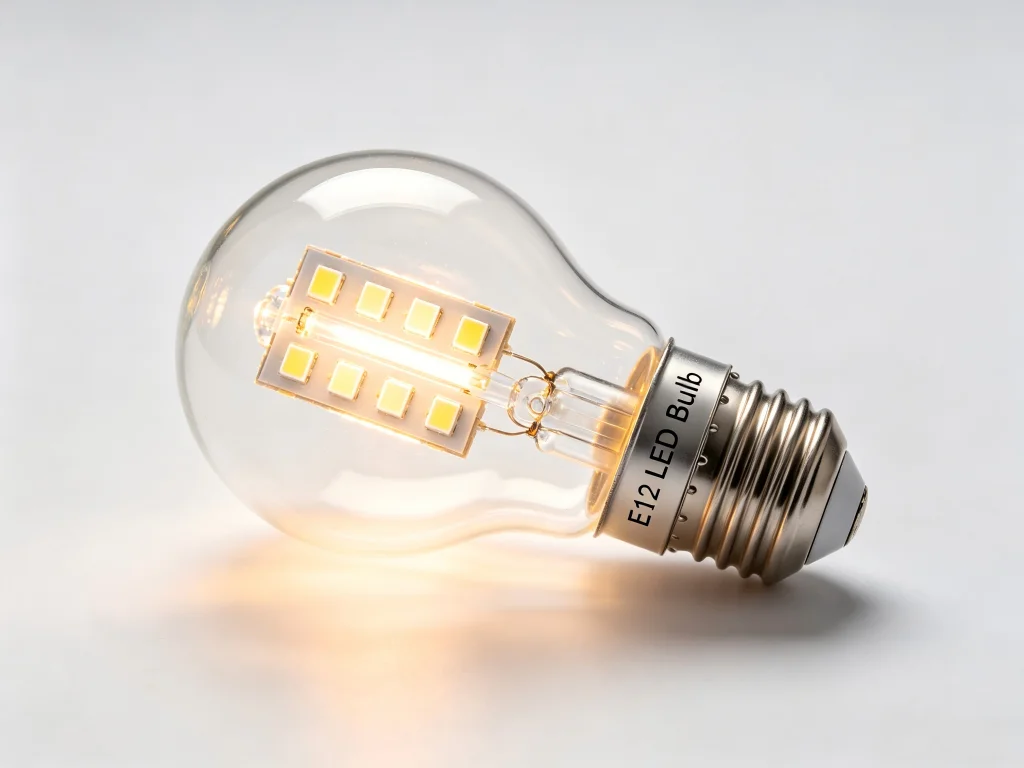
Decoding the E12 Base: What the Numbers Actually Mean
The “E” stands for Edison screw, and “12” is the base diameter in millimeters – precisely 12mm across. This is one of the smaller standardized screw bases available, which is why E12 bulbs are also widely known as candelabra bulbs or Candelabra Edison Screw (CES) bulbs.
E12 is the second most common bulb base type in North America, after E26. It is predominantly used in decorative fixtures where a bulkier standard base would be visually distracting or physically incompatible. Typical applications include chandeliers, wall sconces, vanity lighting, ceiling fans, and nightlights.
One critical distinction: E12 is not interchangeable with E14. The E14 base has a 14mm diameter – just 2mm larger – but that small difference means an E12 bulb will not fit an E14 socket, and vice versa. E12 is the North American standard for candelabra fixtures; E14 (Small Edison Screw, or SES) is more common in Europe and Asia.
The Critical Specs That Determine Performance
1. Lumen Output: Brightness, Measured Correctly
Lumens measure the total visible light produced – this is the true indicator of brightness. Wattage, by contrast, measures energy consumption. When comparing e12 led bulb options, ignore the wattage and look at lumens.
Here is the real-world equivalent guide, based on our engineering testing:
| Incandescent Equivalent | LED Wattage | Lumen Output | Typical Use |
|---|---|---|---|
| 15W | 1.5-2W | 100-150 lumens | Nightlights, accent |
| 25W | 3-4W | 250-350 lumens | Small sconces |
| 40W | 4-6W | 400-500 lumens | Chandeliers, vanity |
| 60W | 6-8W | 600-800 lumens | Ceiling fans, pendants |
| 100W | 10-15W | 1100-1500 lumens | Large fixtures, commercial |
A quality e12 led bulb 60w equivalent should deliver 600-800 lumens at 6-8 watts. A e12 led bulb 100 watt equivalent should produce 1100-1200 lumens. An e12 led bulb 40w equivalent typically yields 400-500 lumens.
One warning: many budget bulbs overstate their lumen output. In our lab tests, we have seen “60W equivalent” bulbs deliver as few as 450 lumens – barely brighter than a 40W incandescent. Always verify the published lumen spec.
2. Color Temperature: 2700K vs 3000K vs Beyond
Color temperature, measured in Kelvin (K), determines the warmth or coolness of the light. Lower Kelvin values produce warmer, yellowish light; higher values produce cooler, bluer light.
For decorative E12 fixtures, the choice typically comes down to two options:
- e12 led bulb 2700k – Warm white, nearly identical to traditional incandescent bulbs. Produces a cozy, inviting glow that mimics candlelight. Ideal for dining rooms, living rooms, and bedrooms.
- e12 led bulb 3000k – Warm white with a slightly crisper, cleaner feel. Works well in kitchens, bathrooms, and entryways where you want a brighter look without the coldness of daylight.
For commercial or task-oriented spaces, some buyers choose 4000K (neutral white) or 5000K (daylight). However, for most residential chandeliers and sconces, 2700K or 3000K are the right choices. An el2 led bulb ikea (a common typo for E12) typically offers 2700K options for their decorative fixtures.
3. Dimmability: Compatibility Is Everything
Not all E12 LEDs are dimmable – and even dimmable ones do not work with all dimmers. This is one of the most common sources of frustration.
Here is what most guides do not tell you: an e12 led bulb dimmable model must be specifically engineered for dimmer compatibility. Cheap bulbs use basic drivers that cause flickering, buzzing, and strobing when dimmed below 70%.
In our engineering testing, we found that compatibility depends on three factors:
- The bulb’s driver type – leading-edge (TRIAC) compatible or trailing-edge (ELV) compatible
- The dimmer’s technology – older dimmers designed for incandescent bulbs often do not work with LEDs
- The load requirements – some dimmers require a minimum load that a single low-wattage LED cannot meet
A quality e12 led bulb dimmable 3000k model should list compatible dimmer models. GTR bulbs are tested with over 50 different dimmer switches to ensure smooth, flicker-free dimming from 100% down to 10%.
4. Color Rendering Index (CRI): The Spec Most Buyers Ignore
CRI measures how accurately a light source renders colors compared to natural sunlight. A CRI of 100 is perfect; 80 is the minimum for most residential applications.
Here is why CRI matters for E12 bulbs: these bulbs are used in decorative fixtures that illuminate artwork, furnishings, and people. Low-CRI light makes everything look dull and washed out.
Budget E12 LEDs often have CRI of 80 or less. Premium bulbs like GTR offer CRI 90+ – and some reach CRI 95. The difference is visible side by side: reds are richer, greens deeper, and skin tones more natural.
For B2B buyers, specifying CRI 90+ in procurement requirements immediately separates quality suppliers from commodity suppliers.
5. Lifespan and Thermal Management: The Hidden Killer
E12 LED bulbs last 15,000 to 50,000 hours – but only if heat is properly managed.
The E12 form factor is small. There is not much room for heat sinks. Cheap bulbs use plastic housings that trap heat, causing the LEDs and driver to fail prematurely.
Quality bulbs use aluminum heat sinks, ceramic bases, or other thermal management solutions to draw heat away from critical components. In our engineering testing, bulbs with proper thermal management last 3-5 times longer than those without – even when both are rated for the same number of hours.
A premium e12 led bulb high lumen model requires especially careful thermal design, because higher light output generates more heat in the same compact form factor.
Matching the Right E12 LED Bulb to Your Fixture
Different fixtures demand different combinations of specifications. Here is our fixture-specific guide, based on real-world testing and field feedback:
Chandeliers
Chandeliers typically use multiple E12 bulbs – anywhere from 3 to 12 or more. The key considerations:
- Color temperature: 2700K for traditional, warm ambiance; 3000K for a slightly cleaner look
- Brightness: 400-600 lumens per bulb for dining rooms; 600-800 lumens for larger spaces
- Dimming: Almost always required for mood setting. Choose an e12 led bulb dimmable model with broad dimmer compatibility
- Shape: Candle/flame-tip (B10, B11) or torpedo shapes maintain the classic chandelier aesthetic
Ceiling Fans
Ceiling fan light kits commonly use E12 bases. The key considerations:
- Vibration resistance: Ceiling fans vibrate. Choose bulbs with robust filament or LED mounting
- Heat tolerance: Fan fixtures can trap heat. Look for bulbs rated for enclosed fixtures
- Brightness: 600-800 lumens for standard rooms
- Color temperature: 3000K-4000K for general living spaces
Wall Sconces
Wall sconces provide accent and ambient lighting. The key considerations:
- Size: Sconces often have limited space. Check the bulb’s Maximum Overall Length (MOL)
- Brightness: 250-400 lumens is usually sufficient
- Color temperature: 2700K for cozy, intimate spaces
Pendant Lights
Pendant lights are often open at the bottom, making the bulb visible. The key considerations:
- Aesthetics: Choose decorative shapes – filament-style or clear glass bulbs
- Brightness: 400-600 lumens for task or ambient lighting
- Color temperature: 2700K-3000K for residential; 4000K for commercial
Outdoor String Lights and Holiday Lighting
E12 bulbs are popular for outdoor decorative lighting. The key considerations:
- Weather rating: Look for bulbs rated for damp or wet locations
- Durability: Choose bulbs with robust construction
- Brightness: Lower lumens (100-300) are usually sufficient for ambiance
Common E12 LED Bulb Mistakes – And How to Avoid Them
Mistake 1: Buying Non-Dimmable Bulbs for Dimmable Fixtures
The fix: Always check the packaging for “dimmable” labeling. Using a non-dimmable e12 led bulb on a dimmer circuit will cause flickering, buzzing, and potentially damage the bulb or dimmer.
Mistake 2: Ignoring the Physical Size
The fix: Measure your fixture’s maximum bulb length and width before purchasing. A bulb that is too long will protrude; one that is too wide may not fit at all.
Mistake 3: Using Non-Enclosed-Rated Bulbs in Enclosed Fixtures
The fix: Look for bulbs specifically rated for enclosed fixtures. Heat buildup in enclosed fixtures can damage non-rated bulbs and shorten their lifespan significantly.
Mistake 4: Assuming All Dimmers Work with All LEDs
The fix: Check dimmer compatibility before purchasing. Many older dimmers were designed for incandescent loads and do not work properly with low-wattage LEDs.
Frequently Asked Questions About E12 LED Bulbs
What does “e12 led bulb” actually mean?
An E12 LED bulb has a 12mm Edison screw base – the candelabra base – with LED technology for the light source. The “E” stands for Edison screw, and “12” is the diameter in millimeters.
What is the difference between E12 and E14?
E12 has a 12mm base diameter; E14 has a 14mm base diameter. They are not interchangeable. E12 is the North American candelabra standard; E14 (SES) is more common in Europe.
Can I use an E12 LED bulb in any candelabra fixture?
Yes, as long as the fixture uses an E12 socket. However, you must also check the fixture’s maximum wattage rating, physical size constraints, and whether the bulb is rated for enclosed use if applicable.
How bright is an E12 LED bulb?
Brightness ranges from 100 to 1500+ lumens depending on the model. A standard e12 led bulb 60w equivalent delivers 600-800 lumens. A e12 led bulb 100 watt equivalent delivers 1100-1200 lumens.
Are all E12 LED bulbs dimmable?
No. Only bulbs specifically labeled “dimmable” can be used with dimmer switches. Using a non-dimmable bulb on a dimmer circuit will cause problems.
What is the lifespan of an E12 LED bulb?
Quality E12 LED bulbs last 25,000 to 50,000 hours. Budget bulbs often fail at 5,000-10,000 hours due to poor thermal management.
What is CRI and why does it matter for E12 bulbs?
CRI (Color Rendering Index) measures color accuracy. For decorative fixtures like chandeliers and sconces, CRI 90+ is recommended to ensure colors appear vibrant and true.
Can I use an E12 LED bulb in a 12V fixture?
Yes, but only if the bulb is specifically rated for 12V. Most residential E12 LEDs are rated for 120V. Always check the voltage rating before purchasing.
Why GTR E12 LED Bulbs Deliver Superior Performance
After reviewing the specifications and requirements above, one thing becomes clear: not all E12 LED bulbs are engineered to the same standard.
GTR E12 LED bulbs are designed with every critical specification in mind:
- Premium drivers for flicker-free dimming across a wide range of dimmer models
- CRI 90+ for accurate, vibrant color rendering
- Aluminum heat sinks and ceramic bases for superior thermal management and extended lifespan
- Precise color binning to ensure consistency across multiple bulbs in the same fixture
- UL/ETL, CE, and RoHS certifications for safety and compliance
Whether you need an e12 led bulb dimmable model for a dining room chandelier, an e12 led bulb 3000k for a kitchen pendant, or an e12 led bulb high lumen option for commercial lighting, GTR has the right solution for your fixture.
Spec your next project with confidence. Explore the full GTR E12 LED bulb collection at https://www.rhgtr.in.
For B2B buyers: Request technical datasheets, samples, and volume pricing today. Our engineering team is ready to support your project with expert guidance and reliable supply.