
Walk through any auto parts store today and you will see shelves full of LED headlight kits. Walk onto any new car lot and you will struggle to find a vehicle that still ships with halogen high beams. The shift is happening faster than most drivers realize. But here is the question that matters: is this just marketing hype, or is LED technology genuinely superior for your high beams?
Direct Answer: LED high beams deliver up to 709% more brightness than halogen bulbs, last 30 to 50 times longer, reach full intensity instantly, and consume significantly less energy—making 2026 the optimal year to upgrade as the technology reaches maturity and prices continue to fall.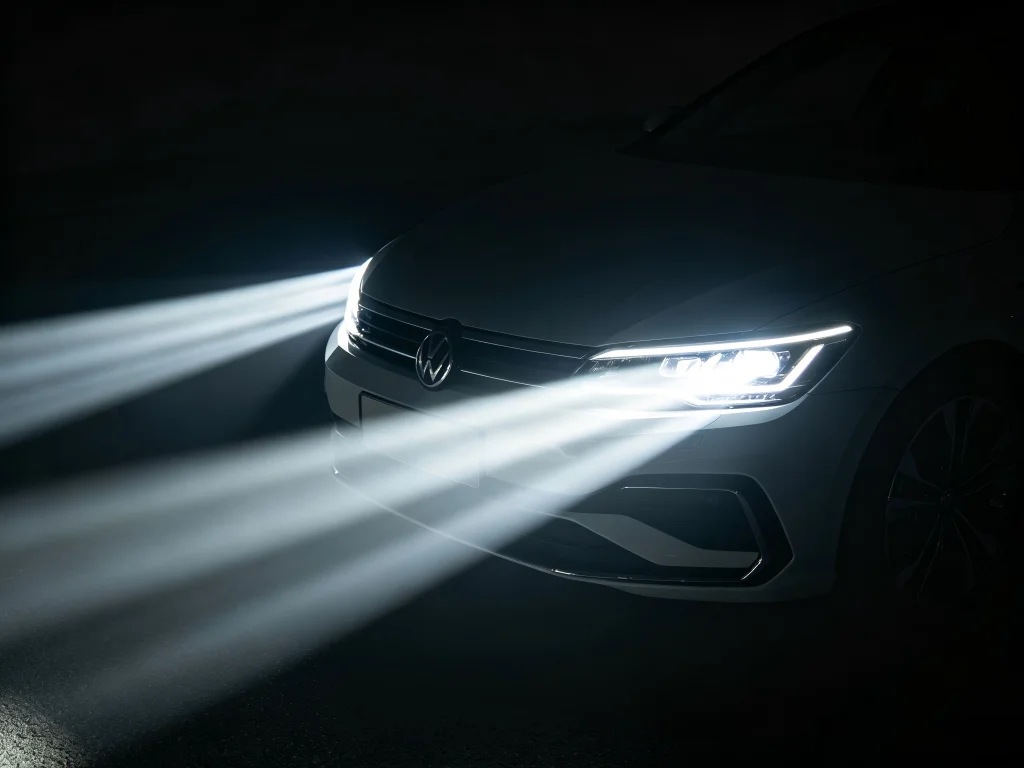
The Halogen Era Is Ending—Here Is Why
Halogen high beams have served drivers for decades. The technology is simple: a tungsten filament heats up inside a halogen gas-filled capsule and produces light. It works. It is cheap. But it is also fundamentally inefficient.
Consider the numbers. A typical halogen bulb produces roughly 1,000 hours of light before the filament burns out. If you drive with your high beams on for two hours each night, that is less than two years of service. The filament is also fragile. Every bump in the road, every pothole, every vibration stresses that filament until it eventually fails.
Then there is the light itself. Halogen high beams produce a warm, yellowish light that struggles to cut through darkness. The color temperature—typically around 3,000 Kelvin—does not provide the contrast your eyes need to distinguish objects quickly at night.
Industry data confirms the shift. Adoption of LED technology for headlamps in the global automotive market has reached full maturity, with adoption approaching the 80% mark. The automotive headlights market was valued at USD 22.35 billion in 2025 and is projected to reach USD 32.41 billion by 2032. LED is not the future—it is the present.
What Makes LED High Beams Different?
The core difference between LED and halogen high beams is how they produce light. Halogen uses heat. LED uses semiconductors. When an electric current passes through an LED chip, electrons recombine with holes within the semiconductor material and release energy in the form of photons—light.
This difference has profound implications for your high beams:
- Instant activation: LED high beams reach full brightness the moment you switch them on. Halogens take a moment to warm up. HIDs take several seconds.
- Directional light: LEDs emit light in a specific direction, eliminating the need for complex reflectors to capture and redirect light. This means more of the light produced actually reaches the road.
- Lower power consumption: LED high beams sip less energy to produce brighter light. For electric vehicles especially, this efficiency matters.
- Exceptional lifespan: High-quality LED high beams can last between 30,000 to 50,000 hours. At four hours of use per day, that is 20 to 30 years of service.
A 2025 study published by the Society of Automotive Engineers of Japan examined the irradiation characteristics of LED versus halogen headlights. The researchers found that when a halogen lamp with appropriate irradiation characteristics was replaced with an LED, the irradiation intensity increased significantly. In plain English: LED high beams are simply brighter.
Beyond Brightness: The Beam Pattern Revolution
Brightness alone does not make a great high beam. Beam pattern matters just as much. A poorly designed high beam might be bright but scatter light everywhere—wasting illumination and potentially blinding other drivers.
This is where LED technology truly excels. LED high beams can be engineered with precise optical control that halogens simply cannot match. The compact size of LED chips allows manufacturers to design optics that shape the beam with surgical precision.
Recent innovations push this even further. At the 2025 SEMA Show, ORACLE Lighting unveiled the world’s first lensless LED headlight, removing a failure-prone component that has been part of headlight design since the 1880s. The design features sealed modular LED emitters with active thermal management, directly addressing consumer complaints about fogging, cracking, hazing, and water intrusion.
Meanwhile, Nichia has expanded its Pixelated Light Source family to include the µPLS Mini and DominoPLS, enabling individually addressable pixel dimming and even symbol projection onto the road. Adaptive Driving Beam (ADB) systems can now create sharp, glare-free cut-outs around oncoming traffic while maintaining full illumination elsewhere on the road. The high beams stay on—they just dim the pixels that would blind other drivers.
These are not science fiction concepts. They are available today. And they represent the direction automotive lighting is heading.
What Independent Testing Reveals About GTR High Beams
Marketing claims are easy to make. Independent testing is harder to fake. This is why third-party evaluations matter when you are shopping for high beams.
BulbFacts, an independent testing laboratory that purchases every product it tests (no freebies, no sponsored content), ran the GTR Lighting Ultra Series 3 through its full 2.1 testing protocol. The results were striking.
In reflector-style headlight housings, the Ultra 3’s low beams reached 1,498 lux—a 302% increase over standard halogen bulbs. The high beams performed even better, peaking at 2,456 lux, an increase of 180%. More importantly, the beam quality impressed the testers: “clean, focused beam with sharp cutoff lines and excellent width. There was minimal scatter, and the hotspot was strong without being blinding”.
In projector-style housings, the Ultra 3 delivered 830 lux on low beam (261% improvement) and 910 lux on high beam (106% improvement). The glare reading came in at 380 lux—comfortably within safe limits for oncoming drivers.
Other independent tests have reached similar conclusions. One review found the GTR Lighting Ultra 2 was almost 400% brighter than stock halogen bulbs. Another named it the brightest bulb tested, coming in at an incredible 709% brighter than stock. Across the board, GTR Lighting products are between two and five times as bright as OEM headlights.
What these tests reveal is that not all LED high beams are created equal. The difference between a well-engineered LED kit and a cheap knockoff is the difference between seeing clearly and being “that driver” with blinding lights.
The Hidden Cost of Cheap LED High Beams
Walk into any discount retailer or browse any budget online marketplace and you will find LED high beams for a fraction of the price of premium kits. They look similar. They promise similar performance. But the reality is very different.
Heat management is the critical differentiator. While LEDs are more efficient than halogens, they still generate heat—and that heat must go somewhere. High-quality LED high beams use sophisticated heat sinks and cooling fans to dissipate thermal energy. Cheap kits cut corners on thermal management. The result? LED chips overheat, degrade faster, and fail prematurely.
Junction temperature—the temperature at the point where the semiconductor connects to the base—is a key factor. If this temperature exceeds design limits, it accelerates the aging process of the LED. High-quality high beams are engineered to manage junction temperature. Cheap ones are not.
There is also the issue of beam pattern. A bright LED with a poorly designed beam is worse than a moderate LED with excellent optics. Cheap LED high beams often scatter light in ways that create glare for oncoming traffic while leaving dark spots on the road ahead. This is not just annoying—it is dangerous.
As one industry observer noted, “Think twice before upgrading to aftermarket LED headlight bulbs” you find cheap online. The National Highway Traffic Safety Administration has stated that “no LED light source is currently permitted to be used in a replaceable bulb headlamp” without proper certification.
What to Look for When Upgrading Your High Beams
If you are ready to upgrade your high beams to LED, here is a practical framework for making the right choice:
- Check your housing type. Reflector and projector housings have different optical requirements. Not every LED kit works well in both.
- Look for independent test data. Third-party testing tells you more than marketing claims ever will. Look for lux measurements, beam pattern analysis, and glare readings.
- Examine the thermal management. A well-designed heat sink or cooling fan is non-negotiable for longevity. If a kit skimps on thermal management, skip it.
- Verify DOT compliance. Department of Transportation compliance ensures the high beams meet minimum safety standards.
- Check the warranty. A strong warranty is a signal that the manufacturer stands behind its product. GTR offers a 2-year warranty on its Carbide Series, for example.
- Read real user reviews. Look beyond the polished marketing. What do actual drivers say about installation, performance, and durability?
Frequently Asked Questions About LED High Beams
Are LED high beams really brighter than halogen?
Direct Answer: Yes. Independent testing shows LED high beams can be 180% to over 700% brighter than halogen bulbs, depending on the specific kit and housing type.
How long do LED high beams last?
High-quality LED high beams typically last 30,000 to 50,000 hours. At four hours of daily use, that is 20 to 30 years of service. Halogen bulbs last roughly 1,000 hours.
Can I just replace my halogen bulbs with LED bulbs?
Technically yes, but the results vary dramatically depending on the housing type and the quality of the LED kit. Not all LED high beams work well in all housings. Check compatibility and look for independent test data before purchasing.
Do LED high beams work in fog?
No headlight type—LED, HID, or halogen—works well in fog when used as high beams. High beams reflect off water droplets and reduce visibility. Use low beams or fog lights instead.
Are LED high beams legal?
DOT-compliant LED high beams are legal for on-road use. However, not all aftermarket LED kits meet DOT standards. Always verify compliance before purchasing.
Why do some LED high beams fail early?
Premature failure is almost always caused by poor thermal management. Cheap kits cut corners on heat sinks and cooling fans, causing the LED chips to overheat and degrade faster than they should.
What is Adaptive Driving Beam (ADB)?
ADB uses pixelated LED technology to keep high beams on while selectively dimming the pixels that would blind oncoming traffic. It is the next evolution of automotive lighting and is already available in premium vehicles.
The Future Is Already Here
The global automotive LED lighting module market is growing at a compound annual rate of 6.5% to 8.5%. Micro LED pixel arrays are being developed with 70,000 to 100,000 pixels per headlight. Adaptive Driving Beam systems are moving from luxury vehicles to mid-range and even entry-level models.
This is not speculation. This is happening right now.
Your high beams are one of the most important safety features on your vehicle. They determine how far you can see, how quickly you can react, and how safely you can drive after dark. Upgrading to LED technology is not about keeping up with trends. It is about seeing clearly, driving confidently, and arriving safely.
GTR Lighting stands at the forefront of this revolution. Independent testing confirms that GTR high beams deliver exceptional brightness, precise beam control, and responsible glare management. Backed by strong warranties and DOT compliance, GTR products represent the gold standard in automotive LED lighting.
The halogen era is ending. The LED era is here. Do not get left in the dark.
Experience the future of high beams today. Visit www.rhgtr.in and discover the GTR difference for yourself.