
You walk into an auto parts store or scroll through Amazon. You see dozens of bulbs labeled “H7.” They all look similar. They all claim to fit your car. You pick one, install it, and something feels wrong. The beam is scattered. The light is too blue. Or worse — your dashboard lights up with an error message and your new bulb won’t even turn on.
Here’s what nobody tells you: the H7 headlight bulb is one of the most precisely engineered components in your vehicle, with tolerances measured in fractions of a millimeter. And most aftermarket replacements completely ignore these specifications.
Based on our years of manufacturing expertise in automotive lighting, we’re going to show you exactly what the H7 standard requires — and why most bulbs on the market fail to meet it.
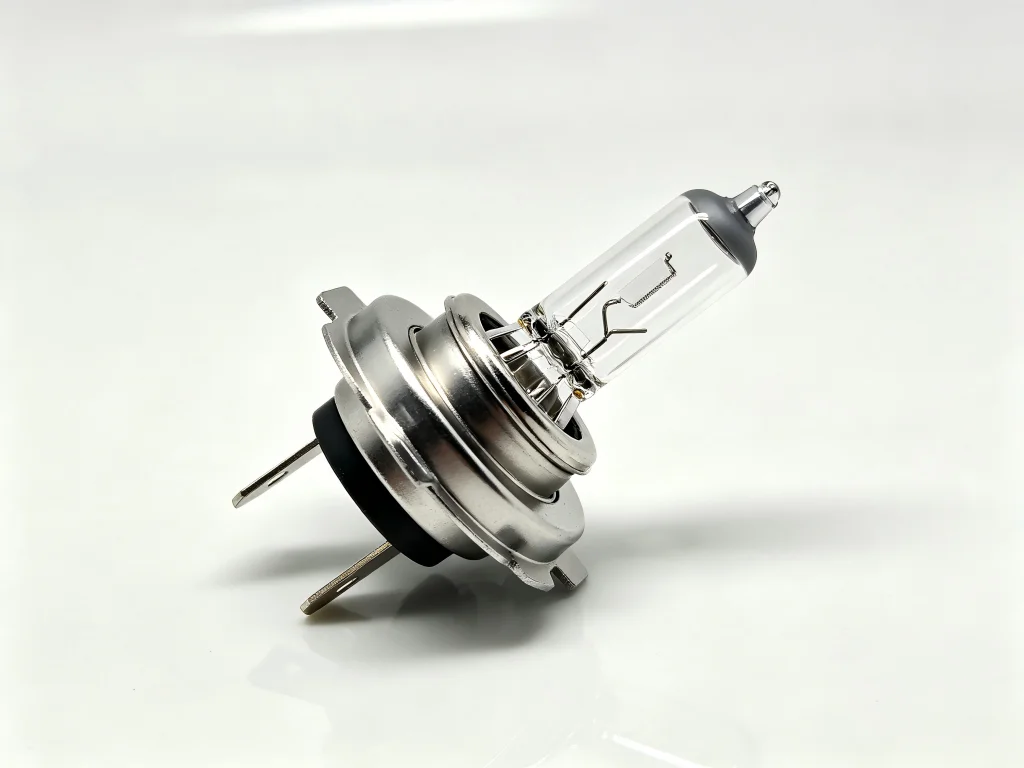
What the H7 Standard Actually Requires
The H7 headlight bulb isn’t just a random designation. It’s defined by the ECE Regulation No. 37 — an international standard that specifies every single dimension, electrical characteristic, and photometric requirement for the bulb to function correctly in any vehicle designed for it.
Here’s what the standard mandates for a 12V H7 bulb:
| Parameter | Specification |
|---|---|
| Nominal Wattage | 55W |
| Test Voltage | 13.2V |
| Nominal Luminous Flux | 1,500 lumens ± 10% |
| Base Type | PX26d |
| Maximum Overall Length | 60mm |
| Light Center Length | 24.89mm |
But here’s the detail that most bulb manufacturers ignore: the filament position tolerance for an H7 bulb is just 0.2 mm. That’s thinner than two sheets of paper. If the light source — whether a halogen filament or an LED chip — is off by even this tiny amount, the beam pattern breaks.
The specification exists for a simple reason: to ensure that every approved H7 bulb fits in every headlight designed for H7 bulbs and produces the correct light beam. When manufacturers cut corners on geometry, they’re not just selling an inferior product — they’re selling a dangerous one.
Why the Wrong Filament Position Ruins Your Headlights
Your headlight housing is an optical system. The reflector is precisely shaped to capture light from a specific point — the filament location — and project it onto the road in a controlled pattern.
When the light source isn’t in the exact position the reflector expects, two things happen:
- The beam becomes too short — If the filament is too far from the reflector, light doesn’t reach far enough down the road. You lose critical visibility at highway speeds.
- The beam creates glare — If the filament is too close to the reflector, light scatters upward into oncoming drivers’ eyes. You become the driver everyone hates.
One driver on a Subaru forum described this exact problem: installed new H7 bulbs, they “fit” in the harness, but the lighting was “extremely dull” despite being brand new. The bulbs met the base specification but failed the geometry requirement.
Another forum member noted that after switching to LEDs, “these will not focus correctly as the light source is differently placed in the bulb, leading to light spread, unfocussed and dazzling to other drivers”. This isn’t a problem with LED technology — it’s a problem with bulbs that don’t replicate the original filament position.
Beyond Geometry: The CANBUS Problem
Even if an H7 headlight bulb gets the geometry right, modern vehicles present another obstacle. Your car’s CANBUS system monitors the electrical load of every bulb. When you install an LED that draws less power than the factory halogen, the system detects this variance and assumes the bulb has failed.
The result? Flickering lights, dashboard error warnings, or bulbs that won’t turn on at all. One BMW owner described the symptoms perfectly: “Your symptoms point to an incompatibility between the car’s bulb monitoring/PWM control and the LEDs you’ve fitted”.
Many manufacturers try to solve this with external resistors or adapters. But these add complexity, create additional failure points, and often require splicing into your vehicle’s wiring. A properly engineered H7 LED bulb should have CANBUS cancellation built directly into the driver circuit — no external boxes required.
The Installation Problem Nobody Warns You About
H7 bulbs are held in place by a spring clip, not a twist-lock mechanism like H11 bulbs. This design is simple but unforgiving. If the bulb isn’t seated perfectly flat against the base of the reflector, the beam will be misaligned.
One driver on an Astra forum described spending 25 minutes on the first bulb and just 5 minutes on the second — simply because the clip wasn’t engaging properly. Another noted that “the bulbs only fit in one way with different size lugs needing to fit in corresponding slots”.
This is where bulb design matters enormously. A bulb that’s physically larger than the factory halogen — common with many LED conversions — won’t seat correctly, no matter how carefully you install it. One Amazon reviewer discovered this the hard way: “The bulb is thicker and won’t fit the socket!!! Ended up filing the socket to make it larger”.
This is why a 1:1 mini-size design isn’t a marketing feature — it’s a functional requirement.
What the Reviews Actually Tell You
Reading through forum discussions and customer reviews reveals a clear pattern. Drivers who buy carefully engineered H7 bulbs report transformative results:
“Both have PERFECT light cut off, won’t blind on coming drivers with stray light. They fit well in the housing… great white light, excellent output, they light up the night!!”
Drivers who buy cheap, poorly designed bulbs report the same problems over and over:
- Flickering and error codes
- Poor fitment requiring modification
- Scattered beams that blind other drivers
- Premature failure within weeks or months
One driver on a Goldwing forum encountered a common issue with fan-cooled H7 LEDs: the fan prevented the spring clip from securing the bulb properly. This isn’t a minor inconvenience — it’s a safety hazard. If the bulb isn’t securely held, it can shift while driving, changing the beam pattern unpredictably.
How GTR Solves These Problems
At GTR, we don’t treat H7 as a generic specification. We treat it as an engineering challenge that requires precision manufacturing and rigorous quality control.
1:1 Dimensional Accuracy
Our H7 headlight bulbs match the exact dimensions of the factory halogen — 60mm maximum length, PX26d base, and critically, the light source positioned within the 0.2 mm tolerance that ECE R37 requires. This means the beam pattern stays focused, the light goes where it belongs, and you don’t blind oncoming traffic.
Integrated CANBUS Compatibility
We build CANBUS error cancellation directly into our bulbs’ driver circuits. No external resistors. No adapters. No wiring modifications. Just plug the bulb into your factory connector and drive — no dashboard warnings, no flickering.
Compact Design That Fits
Our mini-size design fits into factory housings without modification. The spring clip engages properly. The bulb seats flush against the reflector base. Installation takes minutes, not hours.
Engineered for Real-World Conditions
We use automotive-grade components tested to withstand vibration, temperature extremes, and the harsh environment inside a sealed headlight housing. Our bulbs don’t just work when you install them — they keep working.
Frequently Asked Questions About H7 Headlight Bulbs
What is the difference between H7 and H11?
H7 uses a PX26d base with two exposed spade terminals and is held by a spring clip. H11 uses a keyed plastic connector that twist-locks into the housing. They are not interchangeable. H7 bulbs are single-filament and typically used for low beams in European and Korean vehicles.
What is the H7 headlight bulb connector type?
The H7 connector is a two-pin design with spade terminals — sometimes described as a “two-prong” plug. The socket type is PX26d. This is different from H4 (three-prong) or H11 (enclosed plastic connector).
How many lumens should an H7 headlight bulb produce?
According to ECE R37, a 12V H7 bulb must produce 1,500 lumens ± 10%. Quality LED replacements can produce significantly more light while drawing less power, but raw lumen numbers don’t matter if the beam pattern is wrong.
Why does my H7 LED bulb flicker?
Flickering almost always indicates a CANBUS compatibility issue. The vehicle’s computer detects the lower power draw of the LED and pulses power to check if the bulb is present. A quality H7 headlight bulb with built-in CANBUS cancellation eliminates this problem.
Can I install an H7 headlight bulb myself?
Yes, most H7 bulb replacements take 5-20 minutes with basic hand tools. The hardest part is typically accessing the headlight housing and re-engaging the spring clip. A 1:1 designed bulb makes installation significantly easier.
What vehicles use H7 headlight bulbs?
H7 bulbs are common in European and Korean vehicles including Audi, BMW, Volkswagen, Mercedes-Benz, Hyundai, and Kia. Some Japanese models from Mazda, Mitsubishi, and Subaru also use H7. Always verify with your owner’s manual.
Are H7 LED bulbs legal?
In many countries, LED bulbs are only street legal if they carry ECE or DOT certification. Uncertified bulbs may be illegal and can cause dangerous glare. Always choose a certified option designed to maintain the correct beam pattern.
What’s the difference between H7A and H7B?
H7A and H7B refer to the orientation of the alignment tab on the bulb base. If the tab is at the 12 o’clock position, you need H7A. If it’s at 6 o’clock, you need H7B. Check your existing bulb before ordering.
Stop Guessing. Start Seeing.
Your headlights aren’t just about seeing the road — they’re about being seen, and about seeing hazards before they become emergencies. Every time you drive with a bulb that doesn’t meet the H7 specification, you’re compromising that safety.
The H7 headlight bulb standard exists for a reason. When manufacturers ignore the geometry, ignore the CANBUS requirements, and ignore the fitment specifications, they’re selling you a product that can’t possibly work as intended.
GTR builds bulbs that meet the standard — not just on paper, but in real-world performance. Precision-engineered. CANBUS-integrated. 1:1 dimensional accuracy. Built to last.
Visit https://www.rhgtr.in to find the H7 headlight bulb that actually fits your vehicle and performs the way it should. Your night driving deserves nothing less.