
Most drivers judge an H7 LED headlight bulb by one thing: how bright it looks when they first turn it on. That is like judging a car by its paint job. The real story—the one that determines whether your upgrade lasts three years or three months—happens where you cannot see it.
This guide pulls back the curtain on H7 LED headlight bulb technology. We will walk through the engineering decisions that separate a genuine upgrade from a costly disappointment. No marketing fluff. No inflated lumen claims. Just the technical reality of what makes an H7 LED headlight bulb work—or fail—in the real world.
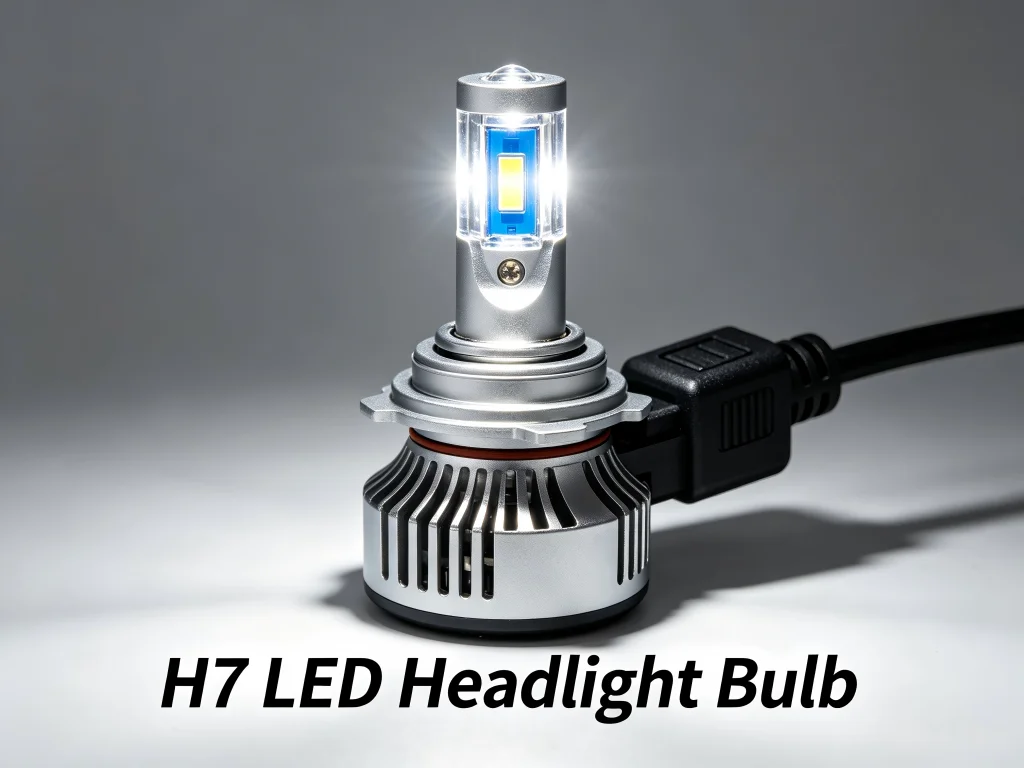
From Filament to Semiconductor: The Technology Shift
Halogen bulbs produce light by heating a tungsten filament to approximately 2,500°C. LED bulbs generate light through electroluminescence—a semiconductor converting electricity directly into photons with minimal heat waste.
This fundamental difference explains everything. A halogen H7 bulb draws 55 watts and produces roughly 1,200-1,500 lumens. Most of that energy becomes heat. An efficient H7 LED headlight bulb draws 16-25 watts while delivering 2,000-3,000 lumens. The LED produces more light with less than half the power consumption.
That efficiency sounds like a pure win. But it creates the single biggest compatibility challenge in the entire H7 LED headlight bulb market.
The CANBUS Compatibility Problem, Explained
Your vehicle’s computer expects to see a 55-watt load on the headlight circuit. When you install an H7 LED headlight bulb drawing 16 watts, the computer detects the discrepancy. It assumes the bulb has failed and triggers a dashboard warning light.
Some manufacturers address this with external resistors that burn off excess power as heat. These resistors can reach 100°C inside your headlight housing. Others use built-in decoding electronics that communicate directly with the vehicle’s computer, simulating the correct electrical signature without generating dangerous heat.
The external resistor approach is cheap to manufacture but expensive for your vehicle in the long run. The integrated decoder approach costs more to engineer but protects your headlight housing from unnecessary thermal stress.
The Installation Reality: What Fits and What Does Not
An H7 LED headlight bulb that cannot fit inside your headlight housing is useless regardless of its specifications. Yet fitment remains one of the most common failure points in LED upgrades.
The original H7 halogen bulb measures precisely 27.5mm from the mounting base to the filament. The bulb body is slim, with no external components. When you replace it with an LED, you are introducing:
- A heat sink (passive fins or an active fan)
- Driver electronics (either integrated or external)
- LED chips positioned to mimic the original filament location
An H7 LED headlight bulb with a 1:1 mini design replicates the original dimensions closely enough that installation takes five to ten minutes per side. The bulb twists into place, the factory connector plugs in, and the dust cover closes without modification.
Bulbs with bulky heat sinks or separate driver boxes often require adapter rings, dust cover modifications, or both. One Mercedes owner described the experience: “The H7 adapters buyers must buy separately from a 3rd party vendor, were poor quality soft metal which bent easily and were impossible to install.”
An H7 LED headlight bulb that requires adapters or external components is not truly plug and play—regardless of what the packaging claims.
Beam Pattern: The Invisible Differentiator
Here is where marketing claims collide with optical physics. Your headlight housing is a precision optical system designed around a specific light source position. Move that light source by even a millimeter, and the beam pattern changes dramatically.
Halogen headlight reflectors and projectors are engineered around a filament positioned exactly 27.5mm from the base. LED chips placed at a different height or angle will scatter light incorrectly. The result: bright spots, dark zones, and glare for oncoming traffic.
Quality H7 LED headlight bulbs position their chips to match the halogen filament location precisely. In projector headlights, well-designed LEDs can actually outperform the original halogen because the focused beam benefits from the LED’s directional light output.
Cheap bulbs ignore this detail entirely. They promise “500% brighter” but deliver light that goes everywhere except where you need it—on the road ahead.
Thermal Management: The Longevity Factor
LEDs generate heat at the semiconductor junction where electricity converts to light. If that heat is not efficiently drawn away, the LED degrades. Brightness drops. Color shifts toward blue or yellow. The bulb fails prematurely.
The thermal challenge is particularly acute for H7 LED headlight bulbs because of the confined space inside headlight housings. There is simply nowhere for heat to go.
Manufacturers use two primary cooling approaches:
- Passive cooling uses aluminum heat sinks with fins to dissipate heat through convection. This approach is silent, reliable, and has no moving parts to fail. However, passive cooling struggles in high-ambient-temperature environments or when airflow is restricted.
- Active cooling uses a small fan to force air across the heat sink. This approach is more effective at removing heat but introduces a moving part that can fail, and the fan generates noise that some drivers find noticeable.
Neither approach is inherently superior. The key factor is whether the cooling system is adequately sized for the bulb’s power output. A 16-watt H7 LED headlight bulb with a well-designed passive heat sink may outlast a 30-watt bulb with an undersized fan.
Reading Between the Lumen Claims
Lumen ratings in the H7 LED headlight bulb market are a mess. Some manufacturers claim 24,000 lumens per set. Others claim 60,000 lumens. These numbers are almost always theoretical maximums measured at the LED chip itself—not actual output from the headlight housing.
Real-world usable lumens from a quality H7 LED headlight bulb typically range from 2,000 to 3,000 per bulb. A halogen H7 produces 1,200-1,500. So even the conservative estimate represents a significant upgrade.
When evaluating lumen claims, ask yourself: can this bulb sustain that output given its thermal design? A bulb that claims 30,000 lumens but dims by 40% after ten minutes of operation is worse than a bulb that delivers 2,500 lumens consistently for its entire lifespan.
Color Temperature: More Than Aesthetics
Color temperature is measured in Kelvin (K). The standard range for automotive LED headlights is 4,300K to 6,500K.
- 4,300K produces warm white light similar to halogen. This color penetrates fog and rain effectively but appears slightly yellow compared to modern LEDs.
- 5,000K-5,750K produces pure white light that balances visibility with comfort. This is the sweet spot for most drivers.
- 6,000K-6,500K produces crisp white light with a slight blue tint. This is the most popular choice for modern headlight upgrades because it mimics daylight and reduces eye strain.
- Above 6,500K shifts into blue and purple. These temperatures reduce usable light output and increase glare. They are purely cosmetic.
The human eye perceives 6,000K light as brighter than 4,300K light even when lumen output is identical. This perceptual advantage is real—but it does not mean higher color temperature is always better. In fog, rain, or snow, warmer light performs better because it scatters less in water droplets.
Common H7 LED Headlight Bulb Issues and Their Causes
| Issue | Likely Cause | What to Look For in a Replacement |
|---|---|---|
| Dashboard warning light | Inadequate CANBUS decoding | Built-in decoder, not external resistors |
| Flickering | PWM (pulse width modulation) from vehicle computer | Advanced decoding that handles PWM signals |
| Bulb turns off after a few minutes | Overheating or CANBUS error | Efficient thermal design, proper decoding |
| Poor beam pattern | LED chips not positioned at 27.5mm from base | Precision engineering, 1:1 halogen replication |
| Dimming over time | Inadequate heat dissipation causing LED degradation | Automotive-grade materials, proper thermal management |
| Does not fit | Bulky heat sink or external driver | 1:1 mini design with integrated driver |
Frequently Asked Questions About H7 LED Headlight Bulb Technology
How long should an H7 LED headlight bulb last?
Quality H7 LED headlight bulbs are rated for 30,000 to 50,000 hours of operation. In real-world use, that translates to 10-15 years of normal driving. Halogen bulbs typically last 500-1,000 hours.
Why do some H7 LED headlight bulbs require external resistors?
External resistors simulate the power draw of a halogen bulb to prevent CANBUS errors. They work but generate significant heat. Built-in decoding is the superior solution.
Can I install H7 LED headlight bulbs in a motorcycle?
Yes, provided your motorcycle uses H7 halogen fittings. The installation process is identical, and the benefits—brighter light, lower power draw, longer lifespan—apply equally to two-wheeled vehicles.
What is the difference between H7 and H4 bulbs?
H7 bulbs have a single filament for either high beam or low beam. H4 bulbs have two filaments in one unit and handle both functions. They are not interchangeable.
Do I need to adjust my headlight aim after installing H7 LED headlight bulbs?
If the bulb positions the LED chips at the exact halogen filament location (27.5mm from base), the beam pattern should match the original. However, checking and adjusting headlight aim after any bulb replacement is always good practice.
Are higher wattage H7 LED headlight bulbs better?
Not necessarily. Higher wattage means more heat, which requires more aggressive cooling. A well-engineered 16-watt H7 LED headlight bulb can outperform a poorly engineered 30-watt bulb while lasting significantly longer.
What does “plug and play” actually mean for H7 LED headlight bulbs?
True plug and play means the bulb connects directly to the factory wiring harness with no adapters, no external resistors, and no modifications to the vehicle. The bulb should fit inside the existing housing with the original dust cover in place.
Why do my H7 LED headlight bulbs flicker when the engine is running?
Flickering often indicates the vehicle’s computer is pulsing voltage to check bulb status. Quality H7 LED headlight bulbs with proper CANBUS decoding handle these pulses without flickering.
Making an Informed Decision
An H7 LED headlight bulb upgrade is not a single purchase—it is a system integration. The bulb must work with your vehicle’s electrical system, fit inside your headlight housing, and deliver light where your headlight optics direct it.
The best H7 LED headlight bulbs are those that disappear into your vehicle. No dashboard errors. No flickering. No fitment struggles. No premature dimming. Just brighter, clearer light that makes night driving safer and more comfortable.
GTR H7 LED headlight bulbs are engineered with this complete-system philosophy. Built-in CANBUS decoding eliminates errors without external resistors. The 1:1 mini design fits factory housings without adapters. Precision chip positioning delivers proper beam patterns. Efficient thermal management ensures consistent brightness over the bulb’s lifetime.
Your headlights are a safety system, not an accessory. Choose the H7 LED headlight bulb that respects that fact.
Visit GTR Lighting — H7 LED Headlight Bulbs Engineered for Real-World Performance