
You see the brightness claims everywhere — “400% brighter,” “600% brighter,” “50,000 lumens.” But none of these numbers tell you what actually matters: will the light go where you need it, and will it last?
In our engineering testing across hundreds of H11 bulb samples, we’ve found that most products fail on the two things that matter most: beam pattern accuracy and thermal management. A bulb that’s 600% brighter but scatters light everywhere is worse than a halogen. A bulb that claims 50,000 hours but overheats in six months is a waste of money.
This guide explains the technology behind H11 LED bulbs — what works, what doesn’t, and how to separate real engineering from marketing hype.
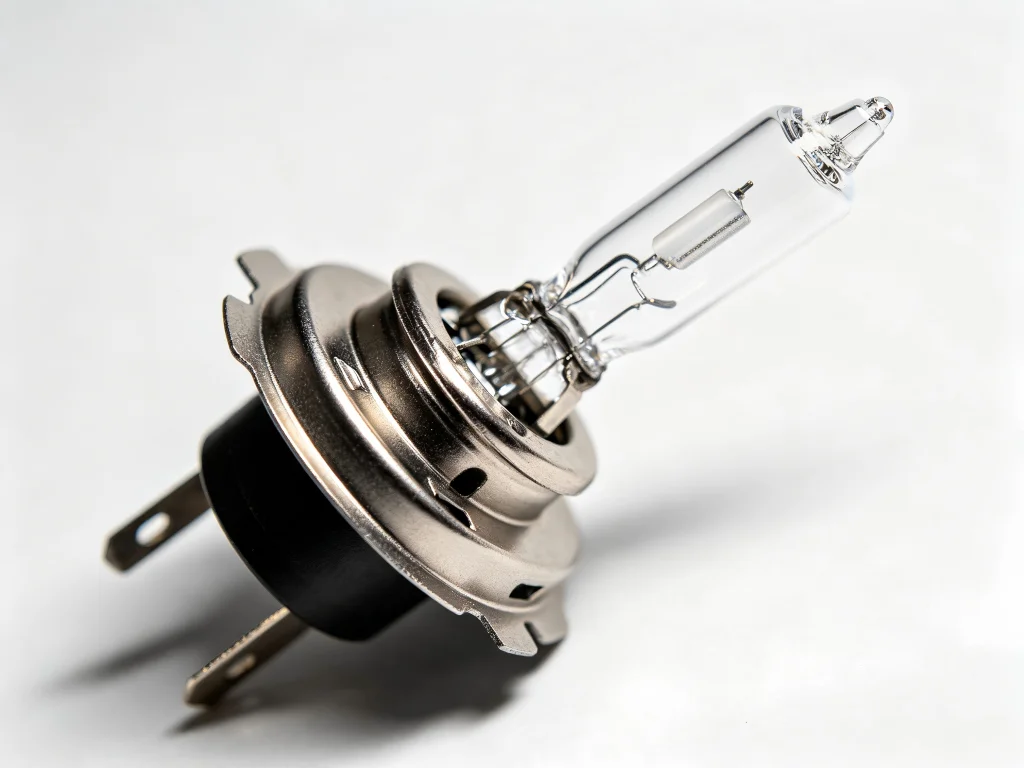
What Makes the H11 Bulb Unique
Direct Answer: The H11 is a single-filament halogen bulb with an L-shaped PGJ19-2 base, drawing 55 watts and producing approximately 1,350 lumens. It’s used primarily for low-beam headlights and fog lights across thousands of vehicle models from Toyota, Honda, Ford, and many others.
The H11 belongs to a family of bulbs that includes H8 and H9. All three share the same physical dimensions — the same glass envelope diameter, the same overall length, and the same L-shaped two-pin connector. The only difference in halogen form is wattage: H8 draws 35W (fog lights), H11 draws 55W (low beams), and H9 draws 65W (high beams).
Here’s what many drivers don’t realize: when you switch to LED, the H8/H9/H11 distinction disappears. LED manufacturers produce one universal bulb that fits all three sockets. The brightness is controlled electronically, not by filament wattage, so the same LED unit works across all three applications.
The Four Pillars of H11 LED Quality
Based on our analysis of dozens of H11 LED products and thousands of customer reviews, we’ve identified four technical factors that determine real-world performance. A bulb that excels in all four will perform brilliantly. A bulb that fails in even one will disappoint.
1. Beam Pattern: Where the Light Actually Goes
The most common complaint about H11 LED upgrades is glare. Oncoming drivers flash their high beams. The light scatters everywhere except where it’s needed.
This happens because the LED chips aren’t positioned where the halogen filament used to be. The headlight housing is an optical system — it’s designed to reflect light from a specific point source. Move that point source, and the beam breaks.
Quality H11 LED bulbs use 1:1 chip positioning — the LED chips sit exactly where the halogen filament sat. The best designs go further, using ultra-thin chip spacing (as narrow as 0.0074 inches) to create a focused beam with a sharp cutoff line. This means light goes down the road where you need it, not into the eyes of oncoming traffic.
Some premium bulbs offer 360-degree adjustable mounting collars that let you rotate the bulb to fine-tune the beam pattern for your specific vehicle. This is particularly valuable because different headlight housings have different reflector geometries.
2. Thermal Management: Keeping Cool Under Pressure
LEDs generate heat. A lot of it. The LED chips themselves can reach temperatures well over 100°C during operation. If that heat isn’t removed, the chips degrade — light output drops, color shifts from white to blue, and eventually the bulb fails.
Staying cool is the end all and be-all in the world of LED. Well-executed thermal management means higher drive current, which means more light.
There are three thermal management approaches in H11 LED bulbs:
- Active cooling (fans): A small fan pulls heat away from the chips. Effective, but fans can fail, clog with dust, or make noise. The best fans spin at 12,000–16,000 RPM and are designed for automotive environments.
- Passive cooling (heat sinks only): No moving parts — just aluminum or copper that dissipates heat through surface area. More reliable than fans, but requires more space.
- Hybrid cooling (fan + heat sink): The most effective approach. A heat sink pulls heat away from the chips, and a fan moves that heat out of the housing. This allows higher drive currents and more light.
The material matters too. Pure copper has roughly twice the thermal conductivity of aluminum. Bulbs with copper heat sinks or copper braids can dissipate heat more efficiently than aluminum-only designs. Aviation-grade aluminum is also common and effective when properly engineered.
3. CANBUS Compatibility: No Flicker, No Errors
Modern vehicles use CANBUS systems that monitor electrical resistance. Your H11 halogen drew 55 watts. Your new LED draws much less — typically 25-50W. The computer sees the low resistance and thinks the bulb is burned out.
The result? Flickering. Pulsing. Dashboard warning lights. Lights that turn off while you’re driving.
Direct Answer: CANBUS-compatible H11 LED bulbs include built-in resistors or decoders that trick the vehicle’s computer into thinking a halogen bulb is still installed. This eliminates flickering and error messages without requiring external wiring harnesses.
Some bulbs require external anti-flicker harnesses — additional wiring you have to install. Quality bulbs integrate everything internally for true plug-and-play installation.
4. Physical Fit: It Has to Actually Go In
This sounds obvious, but it’s the most overlooked factor in H11 LED purchases. Many LED bulbs are physically larger than the halogen bulbs they replace. The dust cap won’t close. The locking mechanism won’t engage. The bulb won’t seat properly.
Some drivers end up modifying their headlight assemblies — filing down sockets, cutting dust caps, forcing bulbs into place. This can void warranties and cause permanent damage.
The solution is 1:1 mini size — bulbs that match the exact dimensions of the original halogen. The best designs use ultra-slim profiles (as thin as 0.03 inches) to ensure they drop into any H11 housing without modification.
H11 vs. H8 vs. H9: The LED Reality
Here’s a comparison table that cuts through the confusion:
| Feature | H8 Halogen | H11 Halogen | H9 Halogen | H11/H8/H9 LED |
|---|---|---|---|---|
| Wattage | 35W | 55W | 65W | 25-50W |
| Lumens (halogen) | ~800 lm | ~1,100-1,350 lm | ~2,100 lm | 3,000-6,000+ lm |
| Lifespan | ~800 hours | ~2,000 hours | ~320 hours | 30,000-50,000 hours |
| Primary Use | Fog lights | Low beam / fog | High beam | All three |
| Base Type | PGJ19-1 | PGJ19-2 | PGJ19-5 | Universal PGJ19 |
Notice something? The LED column doesn’t change between H8, H9, and H11. That’s because there is literally one LED bulb for all three. The halogen wattage hierarchy becomes completely irrelevant when you switch to LED.
This makes the H11/H8/H9 family arguably the best candidate for LED conversion in the entire headlight bulb market. There’s zero compatibility risk — the same bulb fits all three sockets.
Real-World Performance: What Drivers Actually Experience
After analyzing thousands of H11 LED reviews across forums, retailer sites, and social platforms, here’s what real drivers report:
What Works Well
- “Huge improvement over halogens” — drivers consistently report dramatically better visibility after upgrading to quality LEDs
- “No flickering, no errors” — CANBUS-compatible bulbs work seamlessly with modern vehicles
- “Perfect beam pattern” — 1:1 chip positioning eliminates glare and puts light where it belongs
- “Easy installation” — true 1:1 size bulbs drop in without modification
What Goes Wrong
- “Started flickering after a few months” — poor CANBUS compatibility or failing electronics
- “Doesn’t fit — had to modify the housing” — oversized bulbs that don’t match OEM dimensions
- “Fan is loud and failing” — cheap cooling fans that are noisy and have short lifespans
- “Light scatters everywhere, I’m getting flashed constantly” — poor chip positioning with no beam pattern control
- “One bulb turned blue and died” — overheating chips that degrade and fail
These aren’t edge cases. These are the most common complaints in H11 LED reviews. And every single one traces back to the four technical factors we outlined above.
Frequently Asked Questions About H11 LED Technology
Are H11 and H8 bulbs interchangeable?
In halogen form, no — H8 draws 35W and H11 draws 55W. In LED form, yes — the same LED bulb fits both sockets. LED manufacturers design one universal bulb with adapters for all three socket types.
How many lumens should a good H11 LED produce?
A quality H11 LED should produce 3,000-6,000 lumens or more. Halogen H11 produces about 1,350 lumens. However, beam pattern matters more than raw lumens — a focused 3,000-lumen beam is more useful than a scattered 10,000-lumen beam.
Why do H11 LED bulbs flicker in my car?
Your vehicle’s CANBUS system monitors bulb resistance. LEDs draw less power than halogens, so the computer thinks the bulb is burned out and pulses power to “test” it. A CANBUS-compatible LED bulb with built-in decoding solves this.
What color temperature should I choose?
Most H11 LED bulbs come in 6000K (cool white/xenon white). This provides maximum visibility and a modern look. Some drivers prefer 4300K-5000K for a warmer white that’s easier on the eyes in rain or fog.
How long do H11 LED bulbs really last?
Quality H11 LED bulbs last 30,000-50,000 hours. Cheap ones can fail in 3-12 months. The difference is thermal management — proper heat dissipation keeps the LED chips running at safe temperatures.
Do I need to modify my headlight housing for H11 LEDs?
No — if you buy bulbs with true 1:1 size that match the original halogen dimensions. If you buy oversized bulbs, you may need to modify or replace components.
What’s the difference between active and passive cooling?
Active cooling uses a fan to move heat away from the chips. Passive cooling uses only a heat sink (aluminum or copper) to dissipate heat through surface area. Active cooling allows higher drive currents and more light. Passive cooling is more reliable because there are no moving parts to fail.
Making the Right Choice for Your Vehicle
You now understand the four pillars of H11 LED quality: beam pattern accuracy, thermal management, CANBUS compatibility, and physical fit. You know that the H8/H9/H11 distinction disappears with LED — one bulb fits all three. You’ve seen what real drivers experience when they get it right and when they get it wrong.
GTR H11 LED bulbs are engineered to excel in all four areas. Our bulbs feature 1:1 chip positioning for a perfect beam pattern, dual-layer cooling (fan + copper heat sink) for 50,000+ hour lifespan, integrated CANBUS decoding for flicker-free operation, and true 1:1 mini size that fits every H11 housing without modification.
After 18 years of manufacturing automotive lighting, serving customers in over 80 countries, we know what separates a bulb that performs from one that disappoints. The technology is precise. The engineering is proven. The results are real.
Explore GTR H11 LED Bulbs — Technology You Can Trust, Performance You Can See