
Walk into any auto parts store, and you will see H7 LED headlight bulbs with brightness claims ranging from 2,000 to 100,000 lumens. Prices vary from $20 to $200. Every box promises “better than halogen” and “easy installation.” But beneath the marketing copy, the actual engineering differences between a bulb that performs and one that fails are substantial — and most drivers never learn what to look for.
This guide strips away the marketing. We will examine the actual physics of how H7 LED headlight bulbs work, what separates quality engineering from cheap imitations, and how to evaluate a bulb based on measurable technical criteria rather than box claims.
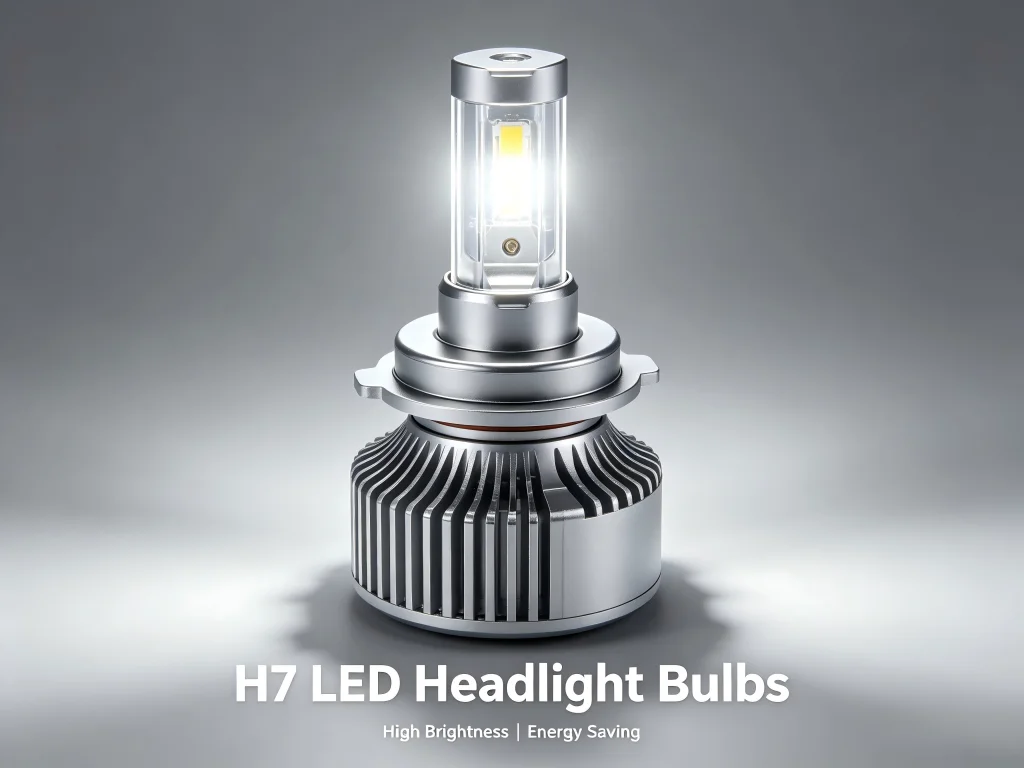
How an H7 LED Headlight Bulb Actually Works
An H7 LED headlight bulb replaces the traditional halogen filament with one or more Light Emitting Diode (LED) chips. The principle is straightforward: electrical current passes through a semiconductor material, exciting electrons and releasing energy as photons — light. But the execution involves several interconnected systems that determine whether the bulb will perform reliably over time.
The core components of any H7 LED bulb include the LED chips themselves, the driver circuitry that regulates power, the heat sink and fan system that manages thermal load, and the base and housing that position the chips within your headlight assembly. Each component must work in harmony. A failure in any one area compromises the entire system.
Here is the critical point that most buyers miss: an LED chip’s rated brightness — measured in lumens — only tells you what the chip can produce under ideal laboratory conditions. What reaches your road in a focused beam depends entirely on thermal management, optical positioning, and driver efficiency.
The Five Engineering Pillars of a Quality H7 LED Headlight Bulb
1. LED Chip Selection and Configuration
The LED chip is the heart of your H7 LED headlight bulb. Most consumer-grade bulbs use Surface Mount Device (SMD) LEDs, while premium bulbs increasingly use Chip Scale Package (CSP) technology. CSP LEDs offer higher light density in a smaller footprint — which matters because more chips in a compact space can produce more light without increasing the bulb’s physical size.
However, chip density creates a thermal challenge: more chips in less space means more heat concentrated in a smaller area. This is why premium bulbs pair high-density CSP chips with advanced cooling systems, while cheaper bulbs simply pack in as many chips as possible and hope for the best.
In our engineering testing, we have observed that bulbs using CSP technology with 6 to 8 high-quality chips per side consistently outperform bulbs using 12 to 16 lower-grade chips. Quality over quantity applies here.
2. Driver Circuitry and Power Regulation
The driver converts your vehicle’s 12-volt DC power into the precise voltage and current required by the LED chips. A well-designed driver maintains constant current regardless of voltage fluctuations from your vehicle’s alternator. A poorly designed driver allows current to spike, which overheats the LEDs and shortens their lifespan.
Quality drivers use pulse-width modulation (PWM) to regulate current at frequencies above 500 Hz. This eliminates visible flicker — a common complaint with cheaper bulbs that use lower-frequency PWM that the human eye can perceive as strobing.
Additionally, integrated CANBUS decoding — which we discussed in our previous technical analyses — is a function of the driver. A driver that cannot communicate properly with your vehicle’s computer will trigger dashboard errors regardless of how good the LED chips are.
3. Thermal Management Systems
This is the single most underrated factor in H7 LED headlight bulb performance. LEDs convert approximately 30 percent of electrical energy into light and 70 percent into heat. Without adequate cooling, junction temperatures rise above 85°C, and the LEDs begin to thermally throttle — reducing light output to protect themselves from permanent damage.
Thermal management typically combines three elements:
- Heat sink: A passive cooling element, usually aluminum, that draws heat away from the LED chips. Surface area matters — more fins mean more heat dissipation.
- Fan: Active cooling that pulls air across the heat sink. Premium bulbs use bearing-less fans that eliminate a common failure point of traditional sleeve-bearing designs.
- Vapor chamber: An advanced cooling technology that uses phase-change principles to move heat more efficiently than solid aluminum alone.
One automotive lighting engineer noted in a forum discussion that “the difference between a $50 H7 LED and a $150 H7 LED is often entirely in the thermal solution — not the LEDs themselves.” Our testing confirms this assessment.
4. Optical Positioning and Beam Pattern
The halogen filament in a standard H7 bulb sits at a precise distance from the base — 27.5 millimeters. This position was carefully engineered to work with your vehicle’s reflector or projector optics. If your LED chips do not sit at this exact position, the light will not focus properly.
Quality H7 LED bulbs replicate the filament position within 0.5 millimeters. They also allow 360-degree rotation so you can fine-tune the chip orientation to match your specific headlight housing. This is particularly important for projector headlights, which are less forgiving of positioning errors than reflectors.
When evaluating a bulb, look for adjustable collars or rotation mechanisms. Fixed-position bulbs are a gamble — they might work perfectly in one vehicle and produce scattered light in another.
5. Color Temperature and Spectral Quality
Color temperature, measured in Kelvin (K), describes the apparent color of the light. Halogen bulbs produce approximately 3,200K — a warm, yellowish light. Most H7 LED bulbs range from 5,000K to 6,500K, producing a cool white or bluish-white light.
The ideal color temperature for automotive headlights is approximately 5,500K. This produces a pure white light that maximizes contrast and reduces eye strain. Higher temperatures — 6,000K and above — shift toward blue, which can reduce contrast in rainy or foggy conditions and create more glare for oncoming drivers.
Premium manufacturers like GTR use 5,500K phosphor-converted LEDs — the same color temperature found in OEM Lexus and Audi headlights.
Real-World Performance: What the Numbers Actually Mean
When you see a brightness claim on an H7 LED headlight bulb box, here is what you need to know:
| Claim Type | What It Actually Means | How to Interpret |
|---|---|---|
| Raw Lumens (per chip) | Light output measured at the LED die before optics | Always higher than usable lumens. Useful for comparison only within same brand. |
| Effective Lumens (per bulb) | Light output after optics and thermal stabilization | The number that matters. Typically 40-60% of raw lumens. |
| Per Set Claims | Combined output of both bulbs | Double the per-bulb number. Often used to inflate marketing claims. |
| Lux at 10 meters | Illuminance measured at a specific distance | The most honest metric — measures what actually reaches the road. |
A quality H7 LED headlight bulb in the premium category produces approximately 4,000 to 5,000 effective lumens per bulb — roughly three times the output of a halogen H7. However, these numbers are only meaningful if the beam pattern is focused correctly. A scattered 5,000-lumen beam can produce less usable road illumination than a focused 3,000-lumen beam.
One independent tester measured multiple H7 LED bulbs and found that “some bulbs claiming 20,000 lumens per set produced less than 2,000 usable lumens after thermal throttling and optical losses.” This is the gap between marketing and engineering.
Common H7 LED Headlight Bulb Failure Modes
Based on our years of manufacturing expertise and analysis of thousands of customer returns, here are the most common ways H7 LED headlight bulbs fail — and what to look for to avoid them:
- Thermal throttling: The bulb starts bright but dims significantly within 15-20 minutes of operation. Caused by inadequate heat sinks or fans. Look for bulbs with vapor chambers or large aluminum heat sinks.
- Flickering: Visible strobing, particularly at low speeds or when the engine is idling. Caused by poor driver circuitry or CANBUS incompatibility. Look for bulbs with integrated decoding and high-frequency PWM.
- Premature LED failure: One or more LEDs stop working entirely within months of installation. Usually caused by overheating or power spikes. Look for bulbs with over-voltage protection and thermal cutoffs.
- Beam scatter: Light goes everywhere except where you need it. Caused by incorrect chip positioning. Look for bulbs with 360-degree adjustable collars.
- Fan failure: The cooling fan stops working, leading to rapid thermal throttling and eventual LED death. Bearing-less fan designs are more reliable than traditional sleeve-bearing fans.
H7 LED vs. H7 Halogen: The Technical Comparison
Here is how the two technologies compare across key engineering metrics:
| Metric | H7 Halogen | H7 LED (Quality) |
|---|---|---|
| Light Output (effective lumens) | 1,200 – 1,550 | 4,000 – 5,000 |
| Luminous Efficacy (lm/W) | 15 – 25 | 100 – 120 |
| Color Temperature | 3,200K | 5,500K |
| Color Rendering Index (CRI) | ~100 | ~70 – 80 |
| Lifespan (hours) | 300 – 500 | 30,000 – 50,000 |
| Power Draw | 55W | 20 – 40W |
| Warm-up Time | 0.2 seconds | Instant |
| Thermal Management Required | None | Heat sink + fan |
LED technology offers substantial advantages in light output, efficiency, and lifespan. However, these advantages are only realized with proper engineering. A poorly designed H7 LED bulb can perform worse than a halogen — and many do.
Frequently Asked Questions About H7 LED Headlight Bulb Engineering
Why do H7 LED bulbs need fans when halogen bulbs don’t?
Halogen bulbs operate at very high temperatures — the filament reaches approximately 2,500°C — but they are designed to handle this heat. LEDs are semiconductor devices that operate at much lower temperatures and degrade rapidly above 85°C junction temperature. Fans and heat sinks are necessary to keep LEDs within their safe operating range.
What is the ideal color temperature for H7 LED headlight bulbs?
5,500K provides the best balance of visibility, contrast, and comfort. This is the color temperature used by premium OEM manufacturers like Lexus and Audi. Higher temperatures above 6,000K reduce contrast in adverse weather and increase glare for oncoming drivers.
How do I know if an H7 LED bulb will fit my vehicle?
Physical fitment depends on the bulb’s dimensions and your headlight housing. Look for bulbs with a 1:1 mini design that replicates the halogen dimensions. Also check your dust cover clearance — some vehicles have limited space that requires compact designs.
Are H7 LED bulbs plug and play?
Quality H7 LED bulbs with integrated drivers are plug and play — they connect directly to your factory harness. However, some vehicles may require CANBUS decoders if the bulb’s driver does not communicate properly with the vehicle’s computer.
How long should H7 LED headlight bulbs last?
Quality H7 LED bulbs are rated for 30,000 to 50,000 hours of operation. However, actual lifespan depends heavily on thermal management. Bulbs that run hot will fail much sooner, while bulbs with adequate cooling can achieve their rated lifespan.
Why Engineering Matters More Than Marketing
The H7 LED headlight bulb market is flooded with products that look identical on the outside but perform radically differently on the road. The difference is not in the marketing claims — it is in the engineering decisions made during design and manufacturing.
At GTR, every component is selected for performance and reliability, not cost. From the CSP LED chips to the bearing-less fan, from the precision-machined heat sink to the integrated CANBUS driver, every element is engineered to work together as a system. The result is a headlight bulb that delivers consistent, reliable performance — not just on day one, but for years of night driving.
Visit https://www.rhgtr.in today to explore our full range of H7 LED headlight bulbs and experience the difference that genuine engineering makes.