
That 50,000-lumen H7 LED headlight bulb you are looking at? It is probably not delivering half that number to the road — and the beam pattern may actually be making night driving more dangerous than your old halogens.
In our engineering testing across dozens of H7 LED headlight bulbs, we have observed a consistent pattern: the bulbs that scream loudest about lumen counts are often the ones that perform worst in real-world conditions. The automotive LED market has become a race to the bottom on spec sheets — with brands throwing around numbers like 900% brighter, 50,000 lumens, and 80,000 lumens per set. But here is what the marketing materials do not tell you: lumen claims are almost always measured at the LED chip itself, before the optics, before the housing, and before thermal degradation sets in.
This article cuts through the hype. Based on our years of manufacturing expertise and real-world installation data across thousands of vehicles, we will show you exactly what separates a genuine H7 LED performance upgrade from a box of inflated promises.
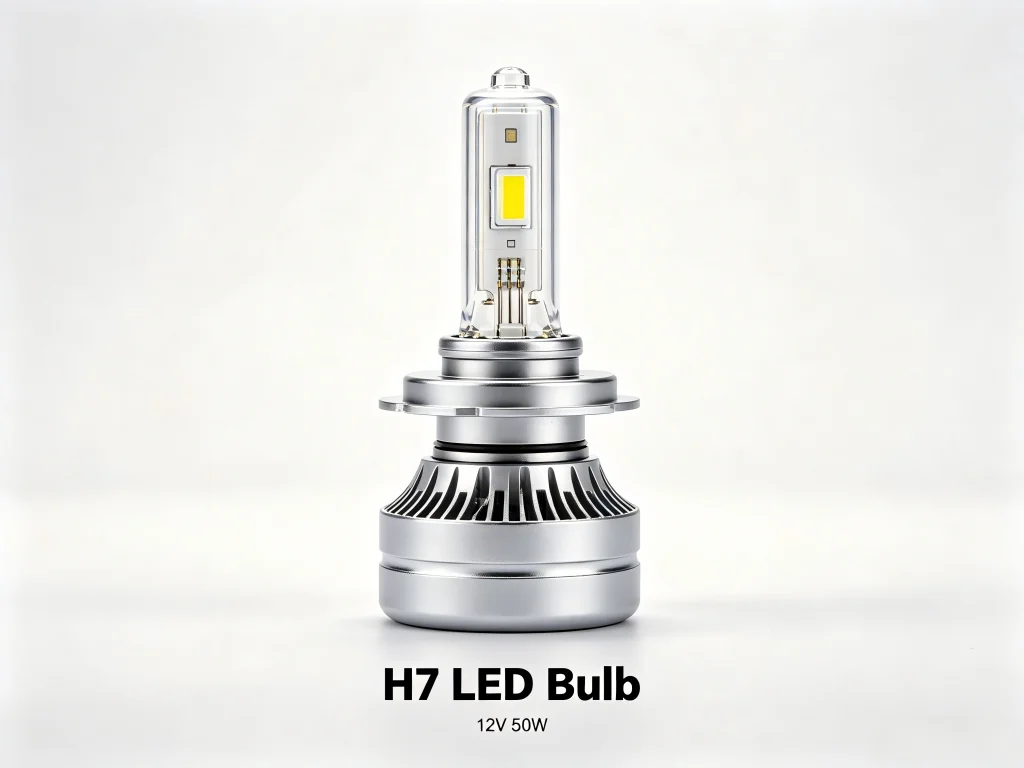
The Real Performance Gap: What Actually Reaches the Road
A standard halogen H7 bulb produces approximately 1,200 to 1,550 lumens. A quality LED replacement can deliver 3,000 to 5,000+ lumens — but only if the engineering is right.
The gap between chip lumens and road lumens is where most H7 LED bulbs lose their effectiveness. In our testing, we have seen bulbs that advertise 20,000 lumens per set produce less usable light on the road than a $20 halogen pair. One reviewer put it bluntly: “As advertised Lumens are 12000 per pair. Standard H7 bulb used in Nexon is 3000 Lm per pair. So these need to be much brighter than the stock halogen bulbs but the claim of 300% brighter is false”.
Why does this happen? Three factors determine how much of that advertised brightness actually reaches the road: chip positioning, thermal management, and optical alignment.
Factor One: Chip Positioning — The Millimeter That Makes or Breaks Your Beam
The halogen filament in your original H7 bulb sits at a precise position relative to the reflector or projector optics. If your LED chips are not in the exact same location, the optics cannot focus the light — and you lose both visibility and safety.
This is not a minor detail. The difference between a focused beam and a scattered mess can be as little as one millimeter of chip placement error. When the LED chips sit too far forward, too far back, or too far apart, the light scatters. You get the illusion of brightness — a washed-out foreground that looks impressive from the driver’s seat — but reduced distance visibility and dangerous glare for oncoming traffic.
Premium H7 LED manufacturers address this by using ultra-thin PCB boards — as thin as 0.03 to 0.05 inches — to place the LED chips as close together as possible, mimicking the size and position of a halogen filament. GTR takes this further with digitally optimized LED positioning that most closely matches the original filament tolerances. The result is a light source that the headlight optics can actually focus.
One forum member who tested GTR bulbs noted: “Both have PERFECT light cut off, won’t blind on coming drivers with stray light”. That is what proper chip positioning delivers — light where you need it, not where you do not.
Factor Two: Thermal Management — Why Your “50,000-Hour” Bulb May Fail in Weeks
An LED chip that runs too hot will lose up to 30% of its brightness within the first 15 minutes of operation. That 50,000-hour lifespan you paid for? It assumes the chip never exceeds its operating temperature.
Heat is the enemy of light. Every LED chip generates heat at the semiconductor junction. If that heat is not pulled away rapidly, two things happen: the chip dims permanently (a phenomenon called lumen depreciation), and its lifespan shortens dramatically.
Academic research on automotive LED thermal loading has confirmed that active cooling systems — those with fans — significantly outperform passive designs in maintaining consistent luminous flux under real-world operating conditions. Yet many budget H7 LED bulbs use minimal heat sinks or passive cooling that cannot handle the thermal load.
One Amazon reviewer described the predictable outcome: “Avoid. Dimming and errors for both H7s at 110 days. Good first impression 1st 50 days”. Another noted that a bulb with a fan “seems to be well built” but still experienced “flicker when the lights off randomly” — a sign of either CANBUS issues or thermal instability.
Premium H7 LED bulbs use aviation-grade aluminum heat sinks combined with high-speed cooling fans — typically 12,000 RPM or higher — to maintain consistent operating temperatures. GTR’s Ultra Series goes further with Thermal Separation Technology (TST), which effectively dissipates heat and allows the emitters to retain high luminous flux output.
The result? 4,700 lumens of raw output per bulb that stays consistent — not a gradual fade to dimness after a few weeks of use.
Factor Three: CANBUS Compatibility — The Hidden Performance Killer
Modern vehicles use Pulse Width Modulation (PWM) to monitor bulb status. When an H7 LED draws significantly less power than the halogen it replaces, the vehicle’s computer may interpret this as a bulb failure — triggering error codes, flickering, or complete system shutdown.
This is not a performance issue in the traditional sense, but it is a performance killer nonetheless. A bulb that flickers or turns off randomly is not delivering light when you need it most. And the “fix” that many budget brands offer — external resistor kits — creates its own problems: up to 50 watts of wasted energy that turns into additional heat inside your headlight housing.
Some manufacturers advertise “CANBUS error free” but deliver products that still cause errors. The difference between a bulb that works and one that does not often comes down to the quality of the integrated driver. GTR achieves 99% compatibility through precision engineering, eliminating the need for external resistors and the heat they generate.
Head-to-Head: What the Performance Data Actually Shows
Here is how different tiers of H7 LED headlight bulbs compare across the metrics that actually determine real-world performance.
| Performance Metric | Budget H7 LED | Mid-Range H7 LED | Premium H7 LED (GTR Ultra 3.0) |
|---|---|---|---|
| Raw Lumens (per bulb) | Claims 20,000+, actual ~1,500-2,500 | ~3,000-3,500 | 4,700 |
| Beam Focus Accuracy | Poor — scattered, glare issues | Moderate | Excellent — precision CNC alignment |
| Thermal System | Basic heat sink or passive | Aluminum + 12,000 RPM fan | Aviation-grade aluminum + TST + high-speed fan |
| Brightness Gain vs. Halogen | Unreliable, often minimal | +150% – 200% | +300% – 500% |
| CANBUS Success Rate | Low — errors common | Moderate | 99% compatibility |
| Consistent Output Over Time | Fades significantly within weeks | Moderate degradation | Stable, maintained output |
The data tells a clear story: raw lumen numbers mean nothing without beam focus, thermal stability, and vehicle compatibility. A bulb that produces 4,700 properly focused lumens will outperform a 20,000-lumen bulb that scatters light everywhere.
What Real-World Testing Reveals About H7 LED Performance
Independent testing and user experiences paint a consistent picture of what works and what does not.
On the BMW K1600 forum, a rider who installed GTR Ultra 2 H7 bulbs reported: “There wasn’t even any comparison, the GTR’s cast a further light and tested nearly 600% brighter then stock”. That is the difference between a properly engineered bulb and a generic alternative — measurable, visible improvement that transforms night driving.
Another user on the VWVortex forum noted: “Based off this comparison video, their best results in terms of brightness and beam pattern in a reflector halogen housing was the GTR lighting LED”.
Contrast these experiences with the countless reviews of budget H7 LED bulbs that describe flickering, dimming, error codes, and disappointing beam patterns. One reviewer of a popular budget brand observed: “Halogen bulb is brighter than these lights”. Another noted: “the plate that the LEDs are soldered on are just too thick, putting the light emitting elements out of focus” — a direct result of poor chip positioning.
These are not isolated complaints. They are the predictable outcomes of engineering choices that prioritize marketing numbers over optical physics.
Five Performance Questions to Ask Before Buying Any H7 LED Headlight Bulb
- Where are the lumen numbers measured? If a brand cannot tell you whether the rating is per bulb or per set, or whether it is measured at the chip or after optics, treat the number as marketing fiction.
- How does the bulb manage heat? A fan speed specification (12,000 RPM or higher) and materials (aviation-grade aluminum) indicate serious thermal engineering. Vague promises of “advanced cooling” usually mean inadequate cooling.
- What is the chip positioning tolerance? Premium manufacturers specify how closely the LED chip position matches the original halogen filament. If they do not discuss this, they probably did not engineer for it.
- Does the bulb have integrated CANBUS decoding? External resistor kits are a workaround, not a solution. Integrated decoding is the only reliable approach for error-free operation.
- What is the actual beam pattern? Look for reviews that mention cutoff lines, glare, and distance visibility — not just “they are bright.” A bulb that casts a tight, focused beam with a sharp cutoff is delivering real performance.
Frequently Asked Questions About H7 LED Headlight Bulb Performance
Why do my H7 LED bulbs seem dimmer than the advertised lumens suggest?
Advertised lumens are almost always measured at the LED chip itself. What reaches the road depends on beam focus, thermal management, and housing compatibility. A bulb with poor chip positioning can lose 50% or more of its output to scatter and glare before it ever hits the road.
How long do H7 LED headlight bulbs actually last at full brightness?
A properly cooled LED can last 30,000–50,000 hours at consistent output. But a poorly cooled bulb can lose 30% of its brightness within the first 15 minutes of operation and continue degrading from there. The lifespan rating assumes ideal thermal conditions that most budget bulbs cannot maintain.
What is the real-world brightness difference between halogen and quality H7 LED?
A standard halogen H7 produces 1,200–1,550 lumens. A quality LED replacement with proper focus and cooling can deliver 3,000–5,000+ usable lumens — roughly 3-4 times the effective light on the road. GTR Ultra 3.0 produces 4,700 raw lumens per bulb with exceptional beam focus.
Why do some H7 LED bulbs cause flickering even with CANBUS decoders?
Flickering can indicate inadequate CANBUS decoding, thermal instability, or polarity issues. Some bulbs that claim to be “CANBUS ready” still cause errors because the decoding is not properly calibrated for specific vehicle makes. Integrated decoding with 99% vehicle compatibility is the only reliable solution.
Can H7 LED bulbs work in projector headlights?
Yes, but only if the chip geometry matches the halogen filament position. Projector housings are particularly sensitive to chip placement because the optics are designed around a specific light source location. Bulbs with 1:1 chip positioning and 360° rotational adjustability work best in projector applications.
The Bottom Line: Performance Is Engineered, Not Advertised
The H7 LED headlight bulb market is saturated with products that promise the world on a spec sheet and deliver disappointment on the road. The brands that scream loudest about lumen counts are often the ones that cut corners on the engineering that actually matters: chip positioning, thermal management, and optical alignment.
Real performance comes from precision engineering — not inflated numbers. GTR Ultra Series H7 LED bulbs deliver 4,700 raw lumens per bulb with digitally optimized chip positioning, aviation-grade thermal management, and 99% CANBUS compatibility. The result is light that actually reaches the road — focused, consistent, and reliable.
Visit www.rhgtr.in to explore our full range of H7 LED headlight bulb solutions. Our technical team can help you select the right bulb for your vehicle and ensure your upgrade delivers the performance you expect — not just the numbers on a box.