
Two sets of H4 headlight bulbs can look almost identical on a product page yet behave completely differently once they are installed in a real headlamp. One may create a focused low beam with useful distance. Another may flood the foreground, scatter light above the intended beam zone, or lose output after twenty minutes of operation.
That is why serious automotive lighting buyers should stop treating H4 bulbs as simple replacement parts. An H4 bulb is one component inside an optical system. The headlamp reflector, light-source position, electrical supply, thermal behavior, mounting accuracy, and beam aim all influence what the driver finally sees.
For drivers, importers, wholesalers, and retrofit specialists, the most useful question is therefore not “Which H4 bulb has the biggest number?” It is “Which bulb keeps producing controlled, usable light after installation?”
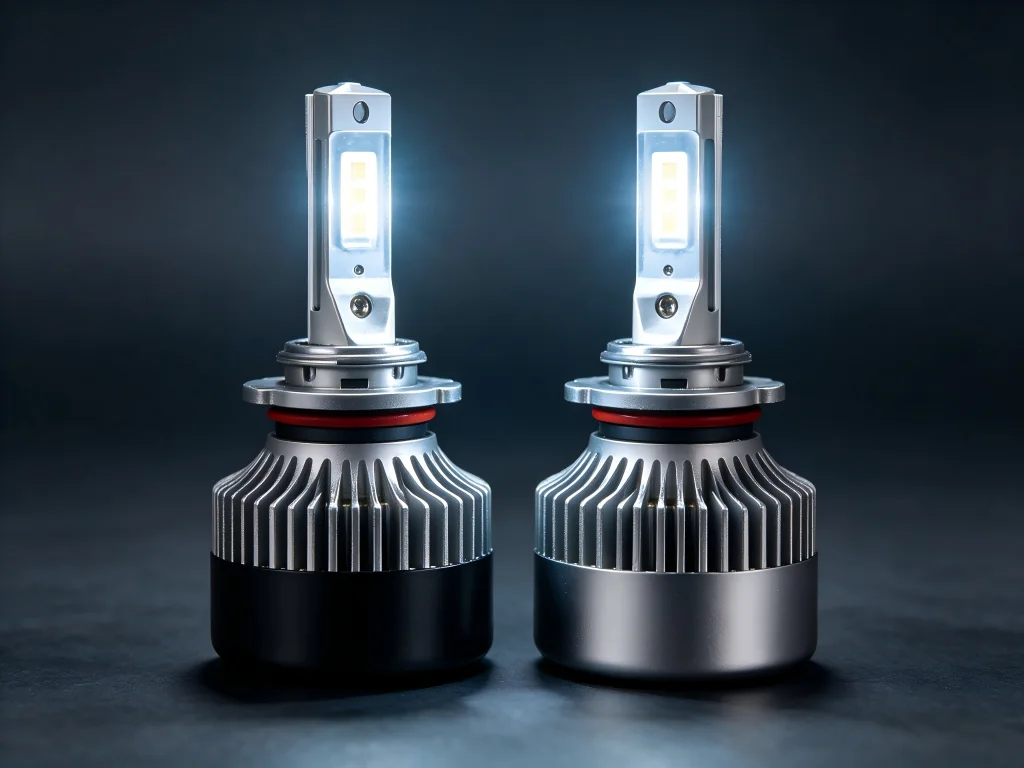
What Makes a Good H4 Headlight Bulb?
A good H4 headlight bulb should place light where the headlamp optics expect it, maintain stable output as temperature rises, switch correctly between low and high beam, fit the housing without modification, and deliver a controlled road pattern. Advertised wattage, color temperature, or lumen claims should never be evaluated alone.
That definition immediately changes how an H4 product should be tested.
A bulb can appear extremely bright when held in open air. That does not prove it will perform well inside a reflector.
A bulb can produce an attractive white color. That does not prove it will illuminate road signs, lane markings, pedestrians, or distant objects effectively.
A bulb can also operate perfectly for the first five minutes and still perform poorly after thermal stabilization.
Real evaluation begins after installation.
The H4 Platform Is More Sensitive Than Many Buyers Realize
H4 headlamp bulbs perform both low-beam and high-beam functions from one lamp position. Because the reflector must form two different beam distributions from the same bulb base, the exact location and shape of the light source become especially important. Small geometric errors can create large changes in the final road pattern.
Traditional H4 halogen lamps use two filaments positioned at controlled locations inside the bulb.
One filament supports the low beam. The second supports the high beam.
The reflector and shield geometry are designed around those positions.
When switching to H4 headlight bulbs LED, the LED emitting surfaces need to reproduce that optical relationship as closely as practical.
This is where many inexpensive conversions fail.
If the LED chips are too large, too far apart, too thick, or positioned at the wrong height, the reflector receives light from a different location than intended.
The result is not simply “less accurate.” It can fundamentally change the beam.
A Better Way to Test H4 Headlight Bulbs
Professional testing should simulate how the bulb will actually be used.
At GTR, we evaluate automotive lighting around the complete working condition rather than relying only on laboratory headline numbers.
Test 1: Reference Beam Comparison
Start with the original or known-good halogen bulb.
Park the vehicle or test headlamp on level ground. Aim the lamp at a flat wall. Mark the major low-beam features and central high-beam zone.
Then install the candidate bulb without changing the headlamp position.
Now compare geometry.
- Is the low-beam distribution still controlled?
- Has the hotspot moved?
- Is more light appearing above the intended beam area?
- Does the high beam remain concentrated forward?
- Are new dark zones visible?
- Has excessive foreground brightness appeared?
This simple comparison often exposes optical weaknesses that cannot be seen from a product photograph.
Test 2: Thirty-Minute Thermal Run
Turn the bulb on and measure performance after it has reached normal operating temperature.
This matters most with LED products.
An LED can produce strong initial output when cold. As junction temperature rises, poorly managed systems may reduce current to protect the components.
That means the bulb you saw at startup may not be the bulb you are driving with half an hour later.
Test 3: Low-Beam to High-Beam Transition
H4 products need to perform two jobs.
Some LED replacements create an acceptable low beam but a weak high beam. Others create large changes in brightness without producing useful additional distance.
A proper test should therefore compare not just whether high beam turns on, but whether it actually extends the driver’s seeing distance.
Test 4: Heat-Soak Fitment
Installation space matters after the headlamp becomes hot.
Inspect the bulb, dust cover, connector, retaining clip, driver module, and surrounding wiring after extended operation.
If the LED heat sink touches soft plastic or if the driver must be compressed awkwardly inside the housing, long-term reliability may suffer.
Why H4 Headlight Bulbs Bright Claims Can Mislead Buyers
The keyword H4 headlight bulbs bright reflects a perfectly reasonable goal. Drivers want to see farther and react earlier.
The problem is how brightness is interpreted.
There are at least four different ideas hiding behind the word “bright”:
| Brightness Metric | What It Describes | Why It Can Mislead |
|---|---|---|
| Raw Lumens | Total emitted light | Does not show where the light lands |
| Peak Intensity | Strength in a specific direction | Can ignore weak surrounding distribution |
| Foreground Brightness | Light close to the vehicle | May look impressive but reduce perceived distance |
| Usable Road Light | Light distributed through the intended beam | Most relevant to real driving but harder to summarize with one number |
The last measurement is usually the one drivers actually care about.
Yet it is often the least emphasized in marketing.
The Hidden Problem With Extremely Bright Foreground Light
Imagine driving on a dark highway.
The first 20 meters in front of the vehicle are extremely bright. The road surface almost glows.
At first, this feels powerful.
But your eyes adapt to that intense foreground illumination. Objects farther ahead can then appear relatively darker.
The result may be shorter practical seeing distance even though the headlamp looks brighter from the driver’s seat.
For this reason, a balanced beam often feels calmer and more effective than a dramatic wall of light near the bumper.
H4 Headlight Bulbs LED: What Actually Matters?
LED technology can offer major advantages in automotive lighting, but only when the product is engineered around the optical system.
Thin Light-Emitting Structure
The physical width of the LED board and the position of the chips influence how closely the light source can imitate the original filament geometry.
Thinner is not automatically better, but excessive thickness can move the emitting surfaces farther away from the intended focal position.
Controlled Chip Placement
A good design should not simply place the largest possible LED package on each side of the board.
Chip size, spacing, orientation, and active emitting area all affect reflector performance.
Stable Driver Electronics
The LED driver must regulate current across normal automotive operating conditions.
Voltage fluctuation, heat, switching behavior, and electrical compatibility can all influence reliability.
Thermal Headroom
A cooling system should not merely prevent immediate failure.
It should keep the LEDs within a temperature range that allows stable output and acceptable component life.
Fan vs Fanless H4 LED: Which Design Is Better?
Neither fan-cooled nor fanless H4 LED bulbs are automatically superior. Fan systems can remove heat efficiently from compact high-output designs, while passive systems eliminate moving components. The better choice depends on thermal load, available installation space, ambient temperature, dust exposure, and the quality of the complete cooling design.
| Cooling Type | Main Advantage | Main Risk | Best Evaluation Method |
|---|---|---|---|
| Fan-Cooled LED | High cooling capacity in compact space | Fan quality and dust exposure | Long-duration heat testing |
| Passive Heat Sink | No moving parts | May require more surface area | Hot-environment testing |
| Heat-Pipe Assisted | Fast heat transfer | More complex construction | Thermal mapping under load |
Why H4 Headlight Bulbs 100W Are Not a Universal Upgrade
H4 headlight bulbs 100W often attract drivers because the higher power rating suggests a stronger beam.
But higher electrical power also means higher current demand and increased heat generation.
This can affect:
- bulb sockets;
- original vehicle wiring;
- switch contacts;
- relay systems;
- reflectors;
- plastic housings;
- headlamp seals.
A standard road-going H4 halogen application commonly uses a 60/55W configuration. Specialty higher-power products exist, but they should never be treated as automatic replacements.
Before using higher-wattage bulbs, verify the vehicle’s electrical capacity and local regulations.
Technical lighting requirements can be reviewed through UNECE vehicle lighting regulations.
White H4 Headlight Bulbs: Style vs Visibility
Many searches for H4 headlight bulbs white are driven by appearance.
A white beam can make an older vehicle look more modern, especially compared with traditional warm halogen light.
But color temperature should not dominate the purchase decision.
A bulb can be very white and still produce poor distance illumination.
A more useful selection order is:
- verify correct H4 fitment;
- evaluate beam geometry;
- check stable operating output;
- confirm electrical compatibility;
- review thermal design;
- then select the preferred color appearance.
This sequence prevents style from replacing function.
H4 Headlight Bulbs OSRAM as a Benchmark
Buyers searching for H4 headlight bulbs OSRAM are often looking for a known reference point.
Established halogen manufacturers are useful benchmarks because their products usually have clear specifications for voltage, power, base type, dimensions, and rated performance.
For a standard H4 halogen design, buyers commonly encounter:
- 12V electrical system;
- 60/55W nominal power;
- P43t base;
- dual-filament operation.
This gives distributors a logical reference when comparing LED alternatives.
Instead of asking whether an LED is “better than OSRAM,” ask which performance category is being compared.
Is it power consumption?
Color?
Road illumination?
Beam pattern?
Service life?
Installation?
Unit cost?
Those questions produce a much more useful purchasing decision than a simple brand-versus-brand headline.
H4 Headlight Bulbs Halfords and Retail Buying Behavior
The search phrase H4 headlight bulbs Halfords reveals another important distinction: urgency.
A consumer with a failed bulb may need a replacement tonight. A nearby retailer is therefore valuable because availability matters more than detailed engineering comparison.
For a professional distributor, however, the buying timeline is different.
The business buyer must think about:
- how many vehicle applications the product covers;
- how many warranty claims it could generate;
- whether future batches remain consistent;
- whether packaging can be customized;
- whether technical data can support sales teams;
- whether the supplier can maintain stable production;
- whether the product fits regional market positioning.
A consumer buys one pair. A distributor may stake an entire product category on one supplier.
What “H4 Headlight Bulbs Near Me” Really Tells Us
The phrase H4 headlight bulbs near me usually indicates immediate replacement intent.
The driver has a problem now.
For local retailers, that makes inventory visibility and vehicle fitment data extremely important.
For manufacturers and distributors, it creates another lesson: H4 remains a replacement-driven product category.
Products should therefore be easy to identify, easy to install, and easy for sales staff to explain.
Complicated fitment creates lost sales.
H4 Headlight Bulbs South Africa: Why Environment Matters
For buyers researching H4 headlight bulbs South Africa, operating environment can become a major product-selection factor.
High daytime temperatures, long driving distances, uneven roads, dust, commercial vehicle usage, and older vehicle populations may place different stresses on aftermarket lighting components.
A product that performs well during a short indoor demonstration should therefore be tested under more demanding conditions.
For warmer and harsher markets, professional buyers should pay particular attention to:
- thermal stability;
- fan durability where applicable;
- dust resistance;
- driver protection;
- connector quality;
- vibration resistance;
- long continuous operating periods.
A Distributor’s 10-Minute H4 Sample Inspection
Before sending a sample to a full laboratory test, an experienced buyer can learn a great deal in ten minutes.
- Check the base. Poor machining or loose tolerances can shift the optical position.
- Inspect the LED board. Look at chip position and board thickness.
- Rotate the bulb gently. Any excessive play may affect alignment.
- Inspect the connector. Thin terminals or weak molding can become warranty problems.
- Examine cable strain relief. Repeated movement should not stress the conductor.
- Measure rear dimensions. Confirm dust-cover clearance.
- Run the bulb. Listen for fan instability or abnormal noise.
- Switch beams repeatedly. Check response and consistency.
- Touch only after safe cooldown. Review how heat is being transferred through the body.
- Compare two samples. Production consistency begins with sample-to-sample consistency.
Why Wholesale Buyers Should Test More Than One Sample
One perfect sample proves almost nothing about mass production.
That lesson is especially important in automotive lighting.
A supplier can produce one strong demonstration unit. Commercial reliability depends on whether hundreds or thousands of bulbs reproduce the same:
- chip position;
- power consumption;
- color temperature;
- beam pattern;
- fan performance;
- mechanical fit;
- driver behavior.
For B2B buyers, consistency is a product feature.
What Real Drivers Usually Notice First
Drivers rarely describe headlight performance using engineering terminology.
They say things like:
“I can finally see the road signs earlier.”
“The light looks brighter but does not reach far enough.”
“The high beam is not much better than low beam.”
“These LEDs were great at first, but after some time they seem weaker.”
“Other drivers keep flashing me.”
“The bulb fits, but I cannot close the dust cover.”
Each statement points to a technical issue.
Distance relates to intensity and beam distribution. Glare relates to optical geometry or aim. Output loss may indicate thermal regulation. Installation difficulty points to mechanical packaging.
That is why customer feedback can be valuable engineering information when it is interpreted correctly.
How GTR Develops H4 Lighting for Real Applications
At GTR, we believe automotive lighting should be evaluated after installation, not just under studio lighting.
Our development process considers the relationship between the light source and the headlamp system, with emphasis on practical aftermarket requirements.
For distributors, wholesalers, retrofit chains, and automotive brands, that means focusing on several connected priorities:
| Development Area | Why It Matters |
|---|---|
| Optical Geometry | Influences beam control and useful road illumination |
| Thermal Engineering | Helps maintain stable LED performance |
| Driver Design | Supports electrical stability and protection |
| Mechanical Fitment | Reduces installation problems and returns |
| Production Control | Helps maintain consistency between batches |
| B2B Customization | Supports different regional brands and sales channels |
Based on our manufacturing experience, successful lighting products rarely win because of one specification alone.
They win because the optical, thermal, electrical, mechanical, and commercial details work together.
FAQ About H4 Headlight Bulbs
Are H4 headlight bulbs both high and low beam?
Yes. H4 bulbs are designed to provide both low-beam and high-beam functions from a single bulb position. Traditional H4 halogen bulbs achieve this with two filaments.
Can H4 halogen bulbs be replaced with H4 LED bulbs?
H4 LED retrofit products are available, but successful installation depends on headlamp compatibility, bulb geometry, available space, electrical behavior, and local regulations.
What is the normal wattage of an H4 bulb?
A common 12V H4 halogen specification is 60/55W. Higher-power and specialty versions exist, but they should not automatically be installed in standard road vehicles.
Do brighter H4 bulbs always let you see farther?
No. Seeing distance depends on beam distribution and intensity in the correct areas. A bulb can create more total light while producing poorer long-range visibility.
Why do some H4 LED bulbs create glare?
Poor LED chip position, oversized emitting surfaces, incorrect bulb orientation, incompatible headlamp optics, or improper headlamp aim can send excessive light into areas intended to remain darker.
Is a white H4 bulb better than a yellow bulb?
Color preference alone does not determine performance. Beam control, intensity, optical compatibility, and weather conditions should be considered before color appearance.
Are 100W H4 bulbs safe?
They may not be suitable for standard vehicle wiring or headlamp housings. Higher wattage increases current draw and heat, so electrical, thermal, and regulatory compatibility should be verified first.
How should wholesalers choose an H4 supplier?
Evaluate optical performance, hot-state output, fitment, electrical stability, batch consistency, warranty support, customization capability, production capacity, and technical communication.
The Best H4 Bulb Is the One That Still Performs on the Road
An H4 bulb should not be judged by what it looks like in your hand.
Judge it after thirty minutes of operation.
Judge it inside the actual headlamp.
Judge the low beam.
Judge the high beam.
Judge the heat.
Judge the fit.
Then judge the specification sheet.
That order prevents one of the most common mistakes in aftermarket lighting: buying impressive numbers instead of reliable road performance.
If you are building an H4 product range for a wholesale business, automotive accessories brand, retrofit chain, or regional distribution network, explore GTR H4 automotive lighting solutions. Share your target vehicle platforms, market positioning, target price level, installation constraints, and performance goals. GTR can help you evaluate and develop an H4 solution designed around real vehicles and real roads rather than marketing numbers alone.