
The best H11 LED bulb should not be chosen under fluorescent store lights, from a product box, or from a five-second garage-wall test. The real verdict comes after sunset. Put the bulb into the correct headlamp, aim the vehicle properly, drive through several road environments, and watch where the light actually goes.
That changes the buying question completely.
Instead of asking, “Which H11 LED has the biggest lumen number?” ask:
“Which bulb helps me identify the road, lane edges, pedestrians, signs, and hazards early without throwing uncontrolled light into other drivers’ eyes?”
This field guide explains how to answer that question.
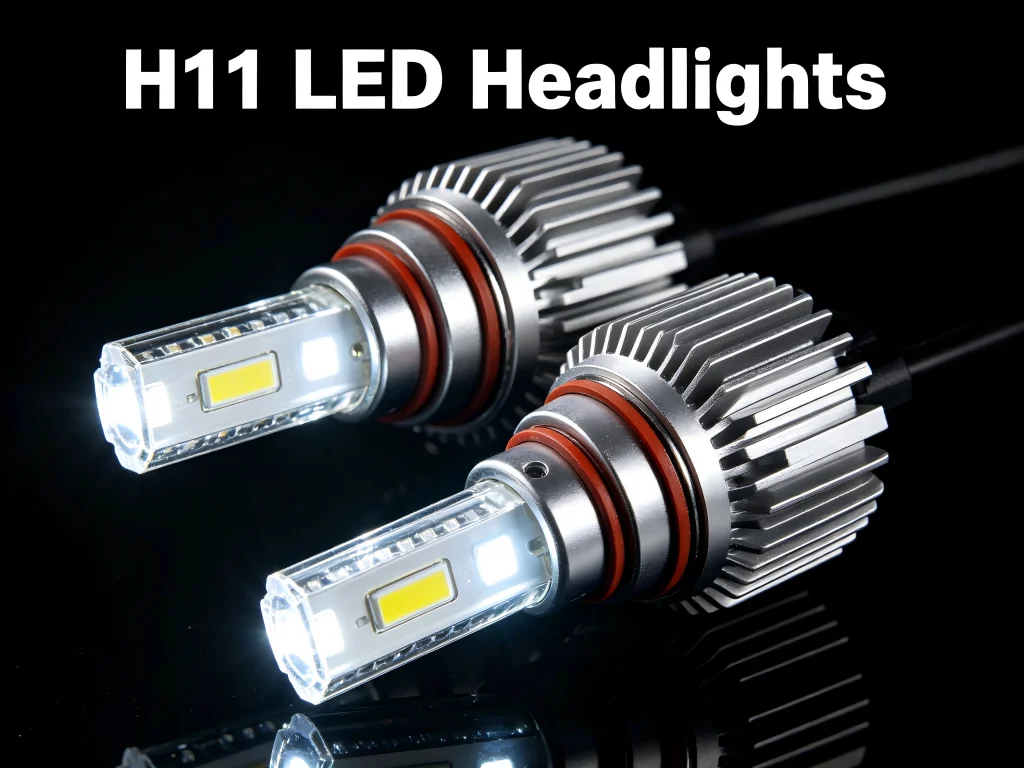
What Makes the Best H11 LED Bulb on a Real Road?
The best H11 LED bulb should deliver useful illumination at driving distance, maintain a controlled beam, work correctly with the intended projector or reflector, remain stable after prolonged use, and fit the vehicle without compromising wiring or headlamp sealing. Brightness alone cannot prove any of those things.
Think of a headlight as a precision optical instrument.
The bulb creates light. The headlamp decides where that light goes.
A strong LED source combined with poor optical alignment could produce a bright-looking beam that performs badly where visibility actually matters.
That is why our preferred evaluation starts outside the laboratory specification sheet and moves onto the road.
The Five-Zone H11 Night Test
One road is not enough to judge an H11 LED.
A bulb can look excellent on a dark residential street yet become uncomfortable in rain. Another may produce a beautiful cutoff against a garage door but leave a weak center zone at highway speed.
For a more useful best H11 LED bulb review, evaluate the light in five different zones.
| Test Zone | What You Should Observe | Warning Sign |
|---|---|---|
| Garage wall | Beam symmetry, cutoff and orientation | Irregular pattern or major left/right mismatch |
| Dark urban street | Lane edges and pedestrian visibility | Very bright foreground but weak distance |
| Highway | Long-range useful illumination | Road disappears beyond the near field |
| Curved road | Side distribution and transition | Dark pockets during steering |
| Wet road | Contrast and reflected glare | Excessive white reflection near the vehicle |
Test Zone 1: The Garage Wall
A wall test is useful, but only as the first step.
Park the vehicle on level ground facing a flat wall. Keep both headlamps the same distance from the surface.
Switch the lights on and look at the overall geometry.
You are not trying to find the brightest white patch.
You are checking whether both lamps behave consistently.
Look for:
- similar vertical height between left and right beams
- a predictable cutoff where the housing is designed to create one
- no strange secondary bright zones high above the main beam
- proper LED orientation inside the housing
- reasonable beam symmetry
If one side looks dramatically different from the other, stop before judging brightness. Installation or bulb orientation could be the real problem.
Test Zone 2: A Dark Urban Road
Now leave the wall.
Drive through a road with minimal street lighting and moderate speeds.
This test reveals something product photos rarely show: foreground bias.
A bulb can flood the first few meters in front of the bumper with intense white light. Your eyes adapt to that bright foreground.
The darker distance may then become harder to perceive.
This creates the illusion of powerful headlights while potentially reducing useful visual reach.
A balanced H11 setup should let you recognize both nearby lane information and objects farther ahead without forcing your eyes to constantly adjust between extreme brightness levels.
Test Zone 3: Highway Speed
Highway testing changes the meaning of “good headlights.”
At higher speed, information farther ahead becomes more valuable because the vehicle covers distance faster.
The question becomes:
How early can you identify something important?
A reflective road sign appearing bright is not enough.
Try to observe darker objects as well:
- road debris
- lane markings
- unlit vehicles
- pedestrians near the shoulder
- changes in pavement
- the beginning of a curve
This is where a correctly focused beam can outperform a visually dramatic but poorly controlled one.
Do Not Judge an H11 LED by Color Alone
A whiter H11 LED can appear brighter because the color is visually different from halogen, but color temperature does not directly measure usable road illumination. Optical focus, beam distribution, contrast, and intensity at useful distances usually matter more than whether the lamp looks pure white.
This distinction matters because many first-time LED buyers compare new cool-white LEDs against old warm halogens while the vehicle is parked.
The contrast is dramatic.
The LED immediately feels more modern.
But visual appearance and driving performance are different tests.
Why Very Cool White Is Not Automatically Better
Many aftermarket LED products use a cool-white appearance because drivers associate it with premium factory lighting.
That does not mean moving farther toward blue automatically improves visibility.
Weather, road surface, optical control, driver preference, and local market expectations can all influence what feels comfortable.
For buyers comparing products, color temperature should therefore come after basic optical performance.
The Finger Test: Is the Light Source Too Large?
Here is a useful way to understand H11 LED optics without becoming an optical engineer.
Hold one finger in front of your eye and focus on something behind it.
Move the finger slightly forward and backward.
The relationship between the object and your visual focus changes.
A headlamp experiences a related problem when the light source moves away from the position around which its optics were designed.
Why H11 LED Chip Placement Matters
The original halogen filament occupies a specific location inside the headlamp.
An LED retrofit replaces that filament with semiconductor emitters.
The closer the LED design can reproduce the useful optical position and shape expected by the housing, the easier it becomes for the reflector or projector to control the light.
A poorly arranged emitter may move light away from the desired focal region.
That can result in:
- blurred hotspots
- unwanted scatter
- dark sections inside the beam
- too much foreground illumination
- reduced useful reach
This is one reason experienced lighting buyers inspect the physical LED architecture instead of evaluating watts and lumens alone.
Best H11 LED Bulb for Projector Headlights: Use the Tunnel Test
Projector owners often search specifically for the best H11 LED bulb for projector headlight.
A projector creates an interesting testing opportunity.
Find a safe tunnel, underground parking structure, or long enclosed wall where the beam can be observed while the vehicle moves slowly.
Watch what happens to the illuminated zone.
What a Good Projector Combination Should Feel Like
The transition between bright and dark areas should appear intentional rather than chaotic.
The central useful zone should remain strong.
There should not be distracting patches moving across the walls as the vehicle travels over minor road changes.
Most importantly, do not confuse a visible cutoff with excellent optical performance.
The projector’s internal shield helps form the cutoff.
The LED still has to place enough useful light in the correct areas beneath it.
Why Two H11 LEDs Can Behave Differently in the Same Projector
Compare two LED designs inside the same headlamp and you may see significant differences even if their advertised wattage is similar.
The reasons can include:
- different chip dimensions
- different emitter height
- different PCB thickness
- different bulb rotation
- different driver power
- different thermal behavior
For this reason, a meaningful best H11 LED bulb for projector headlight review should always identify the headlamp or vehicle being tested.
Best H11 LED Bulb for Reflector Headlights: Try the Oncoming-Car Test
Reflector headlights deserve special care.
The best-looking result from the driver’s seat may not be the best result for everyone else.
After installation and correct aiming, park another vehicle at a safe distance facing your car.
Sit in the other driver’s seat.
Now evaluate your own headlights from the opposite perspective.
This simple exercise can reveal high stray light that is difficult to notice from behind the steering wheel.
Reflector Evaluation Checklist
- Confirm that the LED is installed in the intended orientation.
- Check both sides against a level wall.
- Verify headlamp aim.
- Observe the vehicle from an oncoming driver’s position.
- Drive over small road undulations and repeat the observation.
- Compare the result against the original light source if practical.
The goal is not merely to create more light.
The goal is to create better controlled light.
Why Reddit Users Rarely Agree on the Best H11 LED Bulb
Search for best H11 LED bulb Reddit and you may find one driver praising a particular bulb while another says the same type produced glare or disappointing distance.
That disagreement is not surprising.
Headlamp designs vary enormously.
A bulb tested in one projector does not automatically produce the same output in another projector. The same problem applies to reflector housings.
Vehicle condition also changes the result.
A useful community review should ideally tell you:
- vehicle year and model
- projector or reflector housing
- original bulb type
- whether the headlamp lens is clear or oxidized
- whether the headlights were re-aimed
- how long the bulb has been used
Without that context, “amazing bulb” and “terrible bulb” are incomplete observations.
Before Replacing the Bulb, Inspect the Headlamp
Sometimes the bulb is not the main problem.
This is one of the easiest mistakes to make when searching for the best H11 LED bulb.
If your current headlights feel weak, inspect the complete system first.
Cloudy Outer Lenses
UV exposure and aging can make polycarbonate headlamp covers hazy.
Light must pass through that surface.
If the lens is severely degraded, installing a stronger bulb may not fully solve the underlying optical loss.
Incorrect Headlamp Aim
A perfectly good bulb aimed too low can make highway visibility poor.
A lamp aimed too high can create discomfort for other road users.
Verify aim before declaring the bulb inadequate.
Dirty or Damaged Internal Optics
Older headlamps may suffer from reflector degradation, contamination, or other internal issues.
An LED upgrade cannot restore damaged optical surfaces.
The 30-Minute Test Most Online Reviews Skip
Switching on a new LED and measuring it immediately tells you what happens when the bulb is cold.
Night driving tells you what happens when it is hot.
Those are not necessarily the same condition.
Why Heat Matters
LED systems generate heat that must travel away from the emitting components.
Cooling architecture may use:
- metal heat sinks
- integrated fans
- thermal conduction through the bulb body
- flexible heat-dissipation structures
A useful test is therefore simple.
Observe the light immediately after startup.
Then drive normally for approximately 30 minutes and observe it again under similar conditions.
Professional testing can go much deeper, but this basic comparison reminds buyers to think about sustained performance rather than startup performance.
Fanless or Fan-Cooled H11 LED?
| Situation | Fan-Cooled Design May Help | Fanless Design May Help |
|---|---|---|
| Very compact high-output bulb | Active airflow can support heat removal | May require more passive surface area |
| Dust-cover space | Depends on fan dimensions | Depends on heat-sink dimensions |
| Moving components | Contains a fan | No cooling fan mechanism |
| Noise concern | Quality of fan becomes relevant | No fan noise |
| Final choice | Judge the complete thermal design, not the cooling label alone | |
The market often presents this as a simple fan-versus-fanless debate.
Engineering is rarely that simple.
Best H11 LED Bulb on Amazon: Use the Review Filter
If you search for the best H11 LED bulb on Amazon, product ratings can become overwhelming.
Do not read every review equally.
Filter mentally for reviews that contain diagnostic information.
High-Value Review
“Installed in a 2022 vehicle with projector low beams. Beam remained controlled after aiming. No dashboard error after several months.”
This type of review gives you context.
Low-Value Review
“Insanely bright. Five stars.”
It tells you almost nothing about:
beam distribution, vehicle compatibility, reliability, glare, or sustained performance.
The Four Questions Every Review Should Answer
- What vehicle was the bulb installed in?
- What type of headlamp housing was used?
- How did the beam change?
- How long has the product been operating?
The more of these questions a review answers, the more useful it becomes.
Best H11 LED Bulb Philippines: Test for the Environment
Drivers searching for the best H11 LED bulb Philippines should add two factors to the normal checklist: climate and road environment.
Warm ambient temperatures give cooling systems a tougher job than cooler laboratory conditions.
Heavy rain also changes the driver’s visual environment.
For tropical markets, we would pay particular attention to:
- thermal stability in warm weather
- water-resistant connectors and driver construction
- headlamp sealing after installation
- visibility on wet pavement
- long-term corrosion resistance
- reliability under frequent temperature and humidity changes
Do not compromise the original dust-cover sealing simply to fit an oversized bulb unless the headlamp system has been properly engineered for the modification.
The Rain Test Changes Everything
A headlight that looks spectacular on dry asphalt may feel different during heavy rain.
Wet surfaces reflect light differently.
Road markings, puddles, opposing headlights, and storefront lighting can create a much busier visual scene.
If the foreground becomes extremely bright, your eyes may adapt to that near-field brightness while darker information farther away becomes less obvious.
During a safe wet-road test, pay attention to:
- lane-line visibility
- contrast against dark asphalt
- reflections directly ahead
- comfort from oncoming traffic
- ability to identify objects beyond the brightest foreground area
This kind of real-world observation can reveal differences that a product specification cannot.
Best H11 LED Bulb for Semi Trucks: Think in Hours, Not Minutes
For a passenger vehicle, headlights may run for an hour during an evening commute.
A commercial truck can operate through much of the night.
That changes the priorities for the best H11 LED bulb for semi truck applications.
Commercial Drivers Need Repeatability
The lighting system must behave predictably after hours of operation.
Fleet operators should therefore care about:
- long-duration thermal stability
- vibration resistance
- connector security
- weather resistance
- consistent output between replacement units
- availability of the same specification over time
The most dramatic first-minute output may be less valuable than stable operation throughout an overnight route.
The Dust-Cover Test Nobody Wants to Discover Too Late
You confirm that the vehicle uses H11.
You order the bulbs.
The socket fits.
Then the headlamp dust cover will not close.
This is surprisingly easy to overlook.
An LED assembly may include a heat sink, fan, cable, external driver, or decoder behind the mounting base.
That means electrical compatibility and mechanical compatibility are two separate questions.
Before buying, check:
- space behind the bulb
- heat-sink diameter
- fan clearance
- driver placement
- wire routing
- dust-cover depth
Maintaining the intended sealing of the headlamp is important because moisture and contamination can create problems that extend far beyond the bulb itself.
The Dashboard Test: CANbus, PWM and Flicker
Install the LED, start the engine, and do not immediately drive away.
Watch the system.
Check for:
- bulb-out warning messages
- flicker while the engine is running
- brief flashes when the lamps are off
- one side failing to start
- unexpected behavior during daytime-running-light operation
Vehicle lighting electronics differ between platforms.
This means a product described as CANbus compatible should still be tested in the intended vehicles.
A Better H11 LED Scorecard
After finishing the tests, score the bulb.
| Category | Score 1-10 | What a High Score Means |
|---|---|---|
| Distance visibility | __/10 | Objects can be identified early |
| Beam control | __/10 | Useful light with limited stray output |
| Foreground balance | __/10 | Near field does not dominate the view |
| Side visibility | __/10 | Road edges remain easy to read |
| Heat stability | __/10 | Performance remains consistent |
| Installation | __/10 | Fits without compromising the housing |
| Electronics | __/10 | No unwanted warnings or flicker |
| Wet-road usability | __/10 | Good contrast in difficult conditions |
This scorecard produces something much more useful than a single statement such as “20,000 lumens” or “300% brighter.”
When an H11 Bulb Upgrade Is Not Enough
Sometimes the correct answer is not another bulb.
If a headlamp has poor internal optics, serious lens degradation, limited projector performance, or an unsuitable optical design for the intended conversion, changing the LED may only move the problem around.
Professional retrofit specialists may consider a complete projector-based solution where appropriate.
This is particularly relevant when the target is not merely whiter light but a major improvement in controlled illumination.
Road-use requirements vary by jurisdiction, so vehicle owners and professional installers should confirm applicable lighting rules in their target market. For U.S. regulatory information, see NHTSA.
How GTR Evaluates Automotive Lighting Differently
At GTR, we work from the application backward.
The useful question is not:
“How large can we print the lumen figure?”
The useful questions are:
What vehicle is this product going into?
What optical system does it use?
What environment will it operate in?
How long will it run continuously?
What installation space is available?
What does the distributor’s customer expect from the upgrade?
Based on our automotive aftermarket manufacturing experience, these application details can be more valuable than chasing one headline specification.
For Distributors, One “Best Bulb” May Be the Wrong Strategy
A distributor serving hundreds of vehicle platforms may not need one universal H11 product.
Different customers may require different combinations of:
- compact installation dimensions
- higher thermal capacity
- projector-focused optical geometry
- vehicle electronic compatibility
- market-specific positioning
- commercial-duty durability
A better product line can be built around application groups.
That approach may reduce installation complaints and give sales teams a clearer reason for recommending one model over another.
FAQ About the Best H11 LED Bulb
How do I know whether an H11 LED bulb is actually good?
Test more than brightness. Evaluate distance visibility, beam control, projector or reflector compatibility, heat stability, physical fitment, electrical behavior, wet-road performance, and consistency between both headlights.
What is the best H11 LED bulb for projector headlights?
The right choice depends on the projector. Prioritize correct emitter geometry, strong useful intensity below the cutoff, stable thermal performance, correct bulb orientation, and adequate rear clearance rather than selecting by advertised lumens alone.
What is the best H11 LED bulb for a reflector?
Reflector performance is highly dependent on source geometry. Test the specific LED inside the intended reflector and check the beam from both the driver’s viewpoint and an approaching vehicle’s viewpoint.
Why does my H11 LED look bright but not illuminate far?
The bulb may be putting too much light into the foreground or failing to place enough intensity into the long-range portion of the beam. Incorrect emitter position, orientation, or headlamp aim can contribute to the problem.
Should I trust the best H11 LED bulb reviews on Amazon?
Use them as one source of information, not the final decision. Reviews become far more useful when they identify the vehicle, headlamp type, installation details, beam performance, electronic compatibility, and long-term usage.
Are H11 LEDs good for projector headlights?
They may work well in some projector systems, but compatibility is not universal. The projector was designed around particular optical geometry, so the LED should be evaluated in the actual housing.
What color temperature should an H11 LED use?
Cool-white LEDs are common in the aftermarket, but color temperature alone does not tell you how well the road will be illuminated. Beam distribution, contrast, optical focus, and weather conditions also matter.
Why does my H11 LED flicker?
The vehicle’s electrical monitoring or PWM control may not interact correctly with the LED driver. Depending on the platform, a compatible driver or decoder solution may be necessary.
The Best H11 LED Bulb Is the One That Passes the Road
A product page can tell you wattage.
A box can tell you color temperature.
A seller can tell you lumens.
A garage wall can show you part of the beam.
But the road tells you whether the entire system works.
That is the standard worth using when searching for the best H11 LED bulb.
Evaluate what happens at distance. Watch the foreground. Test the headlamp when hot. Check the opposite driver’s viewpoint. Drive in rain. Verify the dust cover. Watch the dashboard. Match the bulb to the actual projector or reflector.
Only then does “best” start to mean something.
If you are an automotive lighting importer, distributor, retrofit chain, or aftermarket brand, GTR can help you build an H11 lighting range around real applications instead of generic specification claims. Share your target vehicle platforms, projector or reflector applications, climate, price segment, and market requirements with our team. Explore GTR automotive lighting solutions at www.rhgtr.in and develop a product range designed to perform where customers actually judge headlights: on the road.