
Most fog light bulb purchases fail for a boring reason: the buyer matched the base type and stopped there. Wattage, color temperature, beam geometry, and driver behaviour got ignored. Weeks later, the bulb flickers, throws a dashboard warning, or lights up the wrong part of the road.
This piece is not a beginner’s overview. It assumes you already know the difference between halogen and LED and want the details that separate a bulb that works from one that works properly.
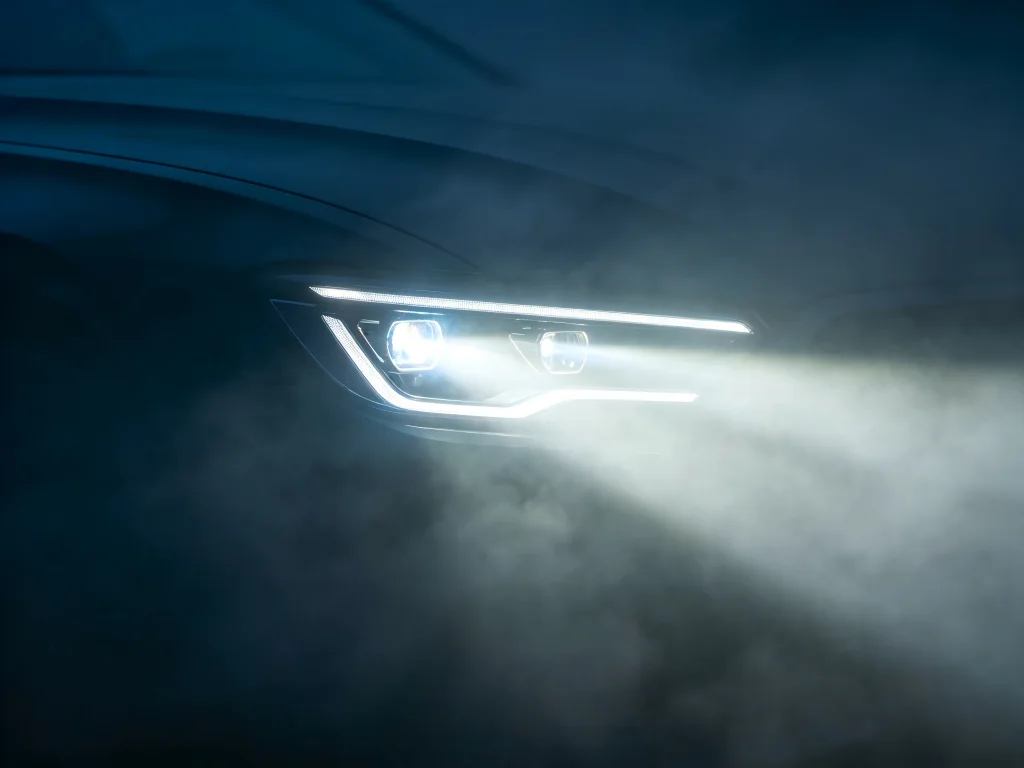
Quick Answer: What Actually Determines Fog Light Performance
Fog light performance depends on five variables: base type, wattage match, colour temperature, light source position relative to the reflector, and driver electronics compatibility. Get any one wrong and the bulb either underperforms, triggers errors, or fails early.
Everything below expands on those five points with the numbers and tolerances that matter.
Wattage Is Not a Brightness Rating
New buyers often assume a higher-wattage fog light bulb for car use will be brighter. In practice, exceeding the OEM wattage is one of the fastest ways to destroy a fog housing.
Fog housings are small. They have limited airflow and thin reflectors. A 55W halogen bulb where a 35W unit belongs raises internal temperature enough to cloud the lens, warp the reflector, and cook the fog light bulb holder. Once the holder deforms, contact becomes intermittent and the bulb flickers even when it is fine.
The safe rule: match OEM wattage for halogen. For LED, wattage is largely irrelevant to output — a 20W LED can outperform a 55W halogen. Judge LED by lumens and beam pattern, not watts.
Colour Temperature: Why 6000K Is Not Automatically Better
Colour temperature is measured in Kelvin and describes the tint of the light, not its intensity. This trips up a lot of buyers.
- 3000K–3500K (warm yellow): Cuts through fog, heavy rain, and snow with less backscatter. This is the traditional fog light range for a reason.
- 4300K–5000K (neutral white): Good balance of visibility and modern appearance. Closest to natural daylight.
- 6000K–6500K (cool white): Looks premium but reflects more light back at the driver in dense fog.
- 8000K and above (blue): Poor actual visibility. Mostly cosmetic. Often illegal for road use.
If you drive in genuine fog, a lower colour temperature performs better even though it looks less impressive in a product photo. This is one of the few cases where the less trendy option is the technically correct one.
Light Source Position: The Spec Nobody Lists
This is the technical gap in almost every competitor article on the subject. A bulb can have the right base, the right wattage, and still produce a useless beam pattern.
Halogen bulbs emit light from a filament at a precise position inside the reflector. The housing’s optics are designed around that exact point. Move the light source even 1–2mm and the beam scatters.
This is why cheap LED fog bulbs often perform badly. The LED chips sit on a flat board, not at the filament’s original position. Without an adjustable collar or an indexed mount, the light source is in the wrong place. Result: glare for oncoming drivers, dark patches on the road, and a beam that no longer cuts under the fog.
When evaluating a fog light bulb LED upgrade, look for adjustable mounting depth or a design explicitly matched to your housing’s focal point. This single detail separates a functional upgrade from a cosmetic one.
Driver Electronics and Canbus Behaviour
Modern vehicles monitor bulb resistance. Swap a 55W halogen for a 15W LED and the computer sees a fault. It may cut power, flash the bulb, or throw a “check fog light” message.
Three ways manufacturers handle this:
- Built-in canbus driver. The bulb simulates halogen load internally. Cleanest solution when done well.
- External anti-flicker module. An add-on resistor or capacitor pack. Works, but adds a failure point and heat.
- No canbus handling. Triggers errors on sensitive vehicles. Common in budget bulbs.
In our bench testing, integrated canbus drivers consistently outperform external modules for reliability, mainly because there are fewer connections to corrode or shake loose.
Fog Light Bulb Size and Cross-Reference Traps
Base types are not always what they appear. Some vehicles use an H11 housing but ship with an H8 bulb from the factory, or an H16 that looks nearly identical to an H8. These near-matches cause real problems.
| Base Type | Typical Wattage | Common Confusion | Consequence of Mismatch |
|---|---|---|---|
| H8 | 35W | Often mistaken for H11 | Overheating, melted holder |
| H11 | 55W | Used where H8 or H16 belongs | Excess heat, shortened housing life |
| H16 | 19W | Visually similar to H8 | Poor contact, intermittent light |
| 9006 | 51W | Confused with 9005 | Wrong beam pattern, glare |
Always verify against the VIN or the stamp on the existing bulb. Visual matching alone is not reliable for fog light bulb size.
Real-World Notes From the Field
A European distributor we work with was receiving returns on a fog light line. The bulbs tested fine on the bench. The problem turned out to be a specific vehicle model where the fog housing sat directly behind a bumper vent. Road spray entered through the vent and reached the bulb base.
The fix was not a better bulb. It was a revised seal on the connector. That kind of problem only surfaces after real-world exposure, which is why we run salt spray and splash testing rather than relying on lab output figures alone.
Another pattern: fleet operators reporting that one side fails repeatedly while the other lasts. Almost always a corroded fog light bulb holder on the failing side, not a bulb defect. Replacing the bulb alone never solves it.
Diagnosing a Fog Light Fault in Order
Before buying a replacement, run this sequence. It saves money and prevents repeat failures.
- Swap the bulb left to right. If the fault follows the bulb, the bulb is bad. If it stays on the same side, the problem is in the holder, wiring, or ground.
- Inspect the holder contacts. Look for corrosion, melting, or a loose fit.
- Check the fuse and relay. A blown fuse can mimic a dead bulb.
- Test voltage at the connector. Low voltage points to a wiring or ground issue.
- Check for moisture inside the housing. Water ingress is a common and often missed cause.
- Confirm the replacement spec against the OEM bulb, not a forum post.
Working in this order avoids the most common waste of money in this category: replacing a good bulb that was never the problem.
Rear Fog Light Bulb Notes
A fog light bulb rear follows different rules than a front unit. It is a signalling lamp, not an illumination lamp. Most use a single filament at a specific wattage, and many vehicles have only one, mounted on the driver’s side.
Two things to watch. First, do not substitute a higher-wattage bulb — the housing is small and plastic. Second, some vehicles monitor rear fog resistance closely, so a random LED substitute may trigger a warning. Match the OEM specification unless you have confirmed compatibility.
Trade and Sourcing Considerations
For importers, the fog light bulb HSN code sits under heading 8539 for electric filament and discharge lamps. LED and halogen variants can fall under different subheadings, and national tariff schedules vary. Misclassification causes customs delays and penalties, so confirm with a broker for each destination market.
Beyond classification, sourcing decisions should weigh driver quality, sealing method, and whether the supplier can provide test data. A supplier who cannot show thermal or vibration results is a supplier you will be renegotiating with after the first returns.
Frequently Asked Questions
Does a higher-wattage fog light bulb produce more light?
Not reliably. Excess wattage raises heat, which clouds lenses and damages holders. Match OEM wattage for halogen. For LED, judge output by lumens and beam pattern instead.
Why does my new LED fog bulb flicker?
Usually a canbus or driver compatibility issue, not a defective bulb. The vehicle detects lower resistance and pulses power. An integrated canbus driver or a compatible anti-flicker module resolves it.
What colour temperature is best for fog?
Around 3000K to 3500K. Warmer light produces less backscatter in fog, rain, and snow. Higher Kelvin values look brighter but reduce actual visibility in poor conditions.
Can I replace a halogen fog bulb with LED directly?
Often yes, if the base matches, the housing has clearance for the driver, and the LED light source sits at the correct focal point. Without those three conditions, performance suffers.
How do I know the correct fog light bulb size?
Check the owner’s manual, read the stamp on the existing bulb, or look up the VIN. Do not rely on visual matching — several base types look nearly identical but are not interchangeable.
Why does one fog light keep failing?
If the fault stays on one side after swapping bulbs, the cause is usually the holder, wiring, or a ground connection — not the bulb. Moisture ingress is another common culprit.
Why GTR Is Built for This Level of Detail
GTR manufactures fog lighting for buyers who care about the specifications most suppliers leave out. Focal position, driver integration, sealing method, and thermal path are engineering decisions we control in-house rather than outsource.
- Optical matching. LED light source positioned to work with OEM reflector geometry, not against it.
- Integrated drivers. Canbus-ready designs that avoid external module failure points.
- Validated sealing. Splash and salt spray testing, not just lab ratings.
- Documented testing. Thermal cycling and vibration data available to distribution partners.
- OEM and private-label capability. Custom specifications, branding, and packaging for regional markets.
If you are tired of returns caused by specs nobody bothered to check, talk to a supplier who checks them first.
Review the full GTR fog light range and request technical data at www.rhgtr.in. Distributors and fleet buyers can request sample units and test reports directly through the site.