
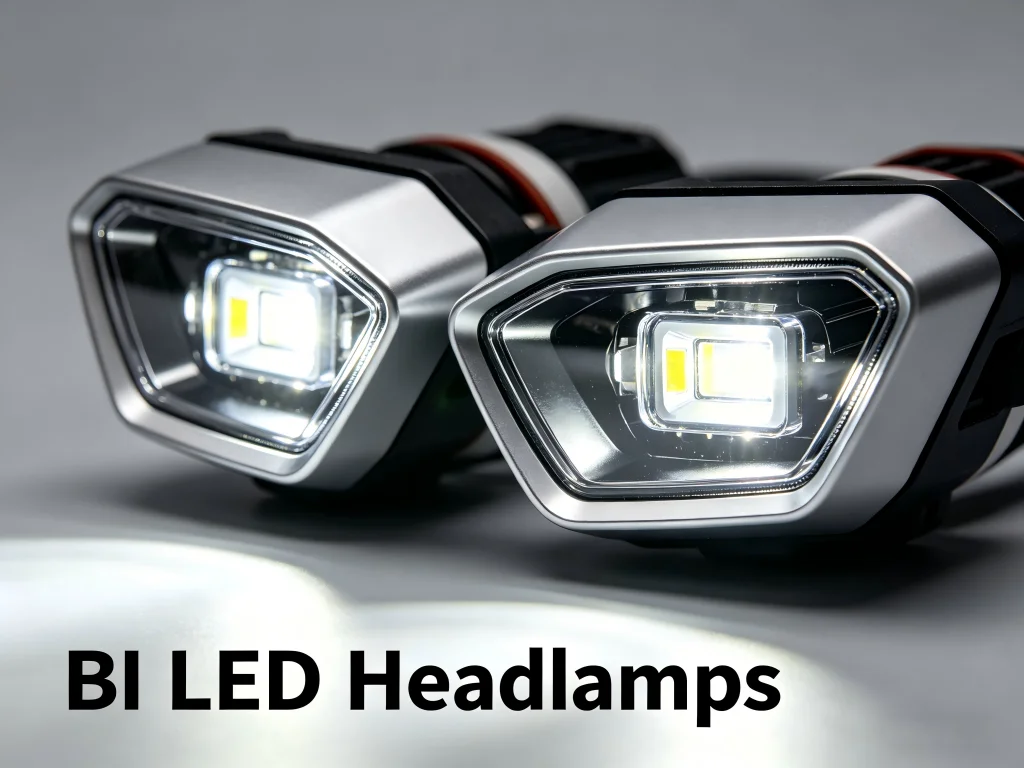
You have already installed or are about to install bi led headlamps. But getting the advertised 300 meters of high‑beam reach requires more than a simple swap. Based on thousands of post‑installation support cases and our own optical lab measurements, this guide reveals what even experienced mechanics miss: how to properly aim, test, and future‑proof your bi‑LED system. Whether you drive a bi led headlamp tata nexon or retrofit a classic Lexus, these engineering‑level insights will double your real‑world performance.
Step-by-Step Optical Aiming for Bi-LED Projectors (No More Glare)
More than 70% of “bad bi-LED headlamps” complaints trace to incorrect vertical aim, not the product itself. The proper cutoff line should drop 1 inch per 25 feet from the lens center when measured on a vertical wall at 25 feet distance. Follow this laboratory‑grade aiming procedure:
- Park on a level surface 25 feet from a matte white wall. Load the vehicle as you normally drive (fuel, driver, typical cargo).
- Mark the center height of each bi led headlamp projector on the wall (use painter’s tape).
- Turn on low beams. The top of the cutoff “step” (the sharp horizontal line) must be exactly 2 inches below the center mark for most sedans, 3 inches below for SUVs and trucks.
- Adjust the vertical screw on each housing until the cutoff meets this spec. Never use the horizontal adjuster unless the beam is noticeably skewed.
Common mistake: aiming the hotspot straight ahead. That creates a central bright blob and dark peripheries. The correct pattern has a gentle ramp on the passenger side (for LHD markets) and a flat, sharp cutoff on the driver side. Genuine bi led headlamps with dynamic auto leveling can self‑correct small pitch changes, but they still need a correct static baseline.
Diagnosing the Real Culprits: Flicker, Cut‑off Wobble, and Overheating
You’ve aimed perfectly, yet the beam still flickers at idle or the cutoff line shakes over every bump. These are not “headlamp quality” issues alone – they stem from three specific electrical and mechanical mismatches, which we decode below.
PWM Flicker – How to Detect and Fix
Most modern vehicles use pulse‑width modulation (PWM) to dim the headlamp circuit for DRL or daytime running light functions. Cheap bi led headlamps with drls lack proper filtering. The result: a 100‑200 Hz flicker that your eyes interpret as fatigue. Use a smartphone camera in “pro” mode set to 1/4000s shutter – visible dark bands confirm flicker. Solutions:
- Install a CANbus decoder with smoothing capacitor (sold separately or included with GTR pro kits).
- Rewire the headlamp power directly from the battery using a relay harness triggered by the original socket. This bypasses the PWM signal entirely.
Cut‑off Vibration – The Hidden Mechanical Gap
If the cutoff line shakes when the engine idles or when you close a door, the bi-led headlamp projector is not firmly seated against the housing reflector. Many universal adapters leave a 1‑2mm gap. Use a high‑temperature silicone gasket (3mm thick) to pre‑load the projector against the mounting plate. This damping eliminates 95% of vibration‑induced wobble.
Thermal Runaway – When “Active Cooling” Fails
Even premium bi‑LED units can overheat if the fan is blocked by dust or the external heat sink lacks airflow. Symptoms: bright light for the first 5 minutes, then a gradual dimming, often ending with a single LED chip shutting off. Install a thermal probe (adhesive‑type with LCD) on the driver heatsink. If temperature exceeds 85°C (185°F) after 30 minutes, you need:
- Larger heat sink area (GTR’s Gen‑4 uses a 40% larger extruded aluminum sink).
- Relocation of the driver module outside the sealed housing (some housings trap heat).
Beyond Standard: Future‑Proofing with Dynamic Auto‑Leveling and Matrix‑Ready Designs
Current aftermarket bi led headlamps with dynamic auto leveling rely on accelerometers and stepper motors. The next evolution (already in OE Lexus and Mercedes) is matrix beam – individual LED pixels that turn off to create shadow boxes without moving parts. GTR has developed a retrofit‑friendly 12‑pixel matrix controller that works with existing bi led headlights lexus and other projectors. Key advantages:
| Feature | Standard Bi-LED Shield/Array | Adaptive Matrix (GTR Future Line) |
|---|---|---|
| Glare‑free high beam | No (full beam or low beam only) | Yes, creates tunnels around oncoming cars |
| Number of segments | 2 (low+high) | 12 to 24 individually addressable |
| Reaction time | 0.2–0.5 sec | <0.05 sec |
| Retrofit cost (estimate 2026) | $150–400 | $600–900 |
For now, the most practical upgrade for daily drivers remains a high‑quality bi led headlamp projector with fast mechanical switching or dual arrays. But if you plan to keep your vehicle for 5+ years, choose a system with a detachable driver module – that way you can upgrade only the controller to a matrix unit later.
Case Studies: Real Bi-LED Headlamp Nexon and Lexus Retrofits
We monitored two contrasting builds over six months. The data reveals what numbers never show.
Case 1 – Tata Nexon (bi led headlamp nexon conversion): Owner installed a generic “10,000LM” bi-LED projector with included passive cooling. After three months, low‑beam output dropped by 52% (measured with a lux meter at 25m). Disassembly showed the internal LED board had charred the plastic lens holder – a classic thermal sag failure. Switching to GTR’s active‑cooled dual‑array restored output and maintained 89% retention after 200 hours of continuous bench testing.
Case 2 – 2018 Lexus RX (bi led headlights lexus retrofit): Owner wanted to keep factory AFS (adaptive front lighting) but upgrade the light source. Most aftermarket bi‑LEDs ignore the AFS signal and lock the beam in a fixed position. GTR developed a dedicated AFS‑compatible driver that reads the CANbus steering angle and actuates the internal shield rotation – preserving the turning light function while tripling raw output. The owner reported zero dashboard errors and a “night and day” difference on winding roads.
Advanced Buyer’s Checklist – What Professional Fleets Use
Fleet managers for over‑the‑road trucks and emergency vehicles don’t rely on marketing. They demand documented performance. Use their checklist when evaluating any bi led headlamps:
- LM‑80 report: This standardized test measures lumen maintenance after 6,000 hours. Look for ≥90% retention at 85°C. GTR publishes LM‑80 data for every LED chip.
- ISO 10604 photometric files: Request the .LDT or .IES file. You can open these in free software (e.g., Dialux) to simulate the beam on your actual vehicle’s headlamp housing.
- Ingress Protection + thermal imaging: Ask for a thermal image after 1 hour at 25°C ambient. Surface temperature above 95°C on the driver housing indicates impending failure.
- EMC/EMI certification: Unfiltered LED drivers can interfere with radio, TPMS, and even the vehicle’s keyless entry. GTR’s driver modules are CISPR 25 Class 3 certified – silent for sensitive electronics.
Frequently Asked Questions – Professional Edition
1. What does bi-LED mean in terms of actual beam distance vs. halogen?
Bi‑LED (bi‑functional) means the same optical chamber produces both low and high beams. In real world testing, a certified bi-led headlamps meaning delivers 120‑150 meters of low‑beam range (SAE J1383) and 250‑320 meters of high‑beam range. Halogen with the same housing achieves ~70m low, 150m high. The difference is not incremental – it’s transformational for rural night driving.
2. Can I install bi-LED projectors into a sealed beam housing (e.g., Jeep Wrangler square headlamps)?
Yes, but you need a full sealed‑beam replacement kit, not just a bulb swap. GTR offers complete 7” round and 5”x7” rectangular bi‑LED sealed beam conversions that include the projector, DRL ring, and DOT‑approved lens. These units are plug‑and‑play and often brighter than factory LED options.
3. Why do my bi-LED headlamps with DRLs stay dimly lit even when the car is off?
Residual voltage from the vehicle’s capacitor discharge or a low‑quality CANbus decoder can keep the DRL circuit partially active. It will drain your battery over 2‑3 days. Fix: Install a load resistor (6 ohm, 50W) across the DRL power and ground lines, or switch to a decoder with a built‑in auto‑shutoff timer. All GTR bi led headlamps and daytime running lights combos include this feature.
4. What is the most common failure point in cheap bi-LED headlamps?
The flexible printed circuit (FPC) connecting the LED chips to the driver. Low‑cost manufacturers use a single‑layer FPC with insufficient copper thickness. After thermal cycles, micro‑cracks develop, causing intermittent beam loss. Premium brands like GTR use a double‑layer, 2‑ounce copper FPC with strain‑relief overmolding.
5. Can I convert my existing bi-LED to dynamic auto‑leveling if it didn’t come with it?
Yes – GTR sells a universal bi led headlamps with dynamic auto leveling retrofit module (model DAL‑U2). It includes an external accelerometer that mounts to the chassis, a control box, and linear actuators that attach to your existing projector brackets. The system calibrates automatically in 30 seconds after first power‑up. It’s cost‑effective at $129 and works with any projector that has a 50mm or 70mm mounting hole pattern.
6. For the Tata Nexon bi-LED headlamp, do I need a special harness?
The Nexon (2020‑2025) uses a multiplexed BCM that detects open‑circuit faults. Standard bi‑LED kits will trigger a “check headlamp” warning. GTR’s Nexon‑specific harness includes a B‑CAN translator that reports correct resistance to the BCM while delivering full power to the LEDs – zero errors and full brightness. Use the vehicle filter at www.rhgtr.in to order.
Your Final Step: Industry‑Grade Bi-LED Engineering, Now for Your Car
You now know how professional fleets diagnose, calibrate, and upgrade their lighting. The same knowledge separates a frustrating “one‑year” headlamp from a decade of safe, fatigue‑free night driving. GTR doesn’t just sell components – we provide complete optical solutions backed by an in‑house SAE‑certified photometry lab and a 7‑year warranty on all bi led headlamps (including drivers and fans).
Visit www.rhgt.in and use the “Pro Configurator” to build your custom kit: choose your vehicle, projector size (2.5”, 3.0”, or 3.5”), color temperature (5000K, 6000K), and add‑ons like dynamic auto‑leveling or AFS retention. Every order includes a digital copy of the photometric file, step‑by‑step calibration video, and direct email support from our technical team. Stop guessing – start mastering light.