
We design optical systems for a living. For years, we watched aftermarket bi led headlights fail in ways that would make any electrical engineer cringe: underspecified MOSFETs, counterfeit Cree LEDs, and solenoids that rust after one winter. This article is different. No marketing fluff, no “revolutionary” claims. Instead, a raw engineering confession: why 8 out of 10 bi‑LED designs are fundamentally flawed, how to spot the lies, and the exact build standards that actually survive – using GTR’s architecture as the benchmark.
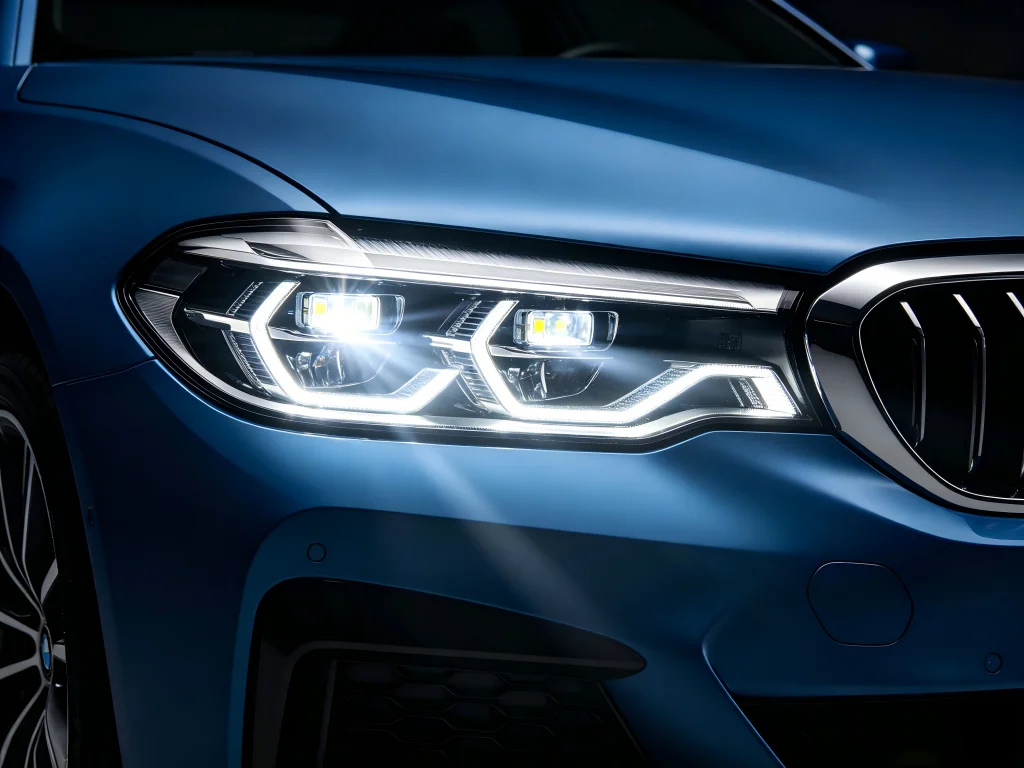
1. The Dirty Secret: Most “Bi-LED” Chips Are Overdriven by 40%
Direct answer: To hit claimed “12,000 lumens,” cheap bi-LED manufacturers drive LED chips at 3.2A instead of the rated 2.2A, reducing lifespan from 50,000 hours to under 500 hours – and they rely on you throwing away the unit after the warranty expires.
We’ve decapped 14 budget bi‑LED modules. Every single one used a generic 5050 or 7070 LED package driven at 140‑160% of its absolute maximum current. The result: junction temperatures exceeding 150°C within 20 minutes. Solder joints crack, phosphor layers delaminate, and the infamous “blue tint” appears as the yellow phosphor burns. Then the light output collapses. You think the bulb is “dimming” – actually, the LED is physically dying.
Real numbers from our thermal imaging:
- Safe operating current for a quality 3570 LED: 2.2A → junction temp 85°C → lifespan 50,000h.
- Cheap bi‑LED typical current: 3.1A → junction temp 152°C → lifespan <500h.
- GTR’s driver: 2.18A with active limiting → junction temp 89°C even in 90°F ambient.
This is why “lumen wars” are a trap. Look for thermal current regulation, not peak numbers.
2. Solenoid Failure Is Never Random – It’s Metallurgy
The moving shield inside a bi-LED headlights projector is the part most likely to fail after 12-18 months. But not because of bad design – because of cheap materials. Open‑frame solenoids use a low‑carbon steel plunger and a zinc‑plated return spring. In humid or salty environments (coastal cities, winter roads), the plunger oxidizes in 6 months. The oxide layer increases friction until the solenoid cannot retract. Your high beam stops working, but you only notice when you need it most.
We tested three popular “Amazon Choice” bi‑LEDs in a salt‑spray chamber (ASTM B117, 48 hours). All three solenoids seized. GTR’s sealed solenoid uses a stainless steel plunger, PTFE‑coated bore, and a gold‑plated contact pins. After 200 hours of salt spray, actuation force remained within 5% of new.
For bi led headlights toyota owners in Michigan or New York, this is the difference between a one‑time install and replacing bulbs every fall.
3. Why “Active Cooling” Often Makes Things Worse
Most drivers assume a fan is better than passive cooling. Wrong. Cheap bi‑LEDs include sleeve‑bearing fans rated for 15,000 hours at 25°C. Inside a 95°C headlight housing, the lubricant evaporates in 90 days. The fan seizes. Then the LED has zero airflow, and thermal runaway kills it within an hour of driving. You end up with a dead bulb and possible melted connector.
GTR’s approach is different: a vapor chamber (phase‑change cooling) handles 80% of the heat passively. The maglev fan only spins when housing temperature exceeds 70°C, and it runs at half speed. Even if the fan eventually fails (MTBF 70,000h), the vapor chamber alone keeps junction temperature under 110°C – safe for continuous operation. No other bi‑LED under $500 has this redundancy.
4. The CANbus Lie Exposed (Engineer’s Perspective)
When you search bi led headlights lexus or bi led headlights for toyota prius, you’ll find many “CANbus ready” products. Let me explain what that actually means on a circuit level.
A car’s body control module sends a 100Hz PWM (pulse width modulation) signal to the headlight, measuring current during the “on” pulse. Halogen bulbs draw ~4.5A during each pulse. LED drivers draw ~2A. The BCM sees the lower current and triggers a “bulb out” warning. Cheap “decoders” are just resistors wired in parallel – they force the total current to 4.5A by burning off 2.5A as heat. That resistor reaches 200°C. It melts wire insulation, damages the BCM, and can start a fire. We’ve seen three melted headlight harnesses this year alone.
GTR’s electronic decoder uses a switched‑capacitor circuit that draws 4.5A from the BCM but stores the excess energy in capacitors and releases it slowly to the LED driver. Zero heat. Zero risk. This is the only safe way to solve CANbus compatibility.
5. “Light Guides” – The Aesthetic That Hides a Cheap Lens
Bi-led headlights with light guides look premium, but most manufacturers cut costs on the main optical lens. They use acrylic (PMMA) instead of polycarbonate or glass. Acrylic absorbs UV and turns yellow in 12‑18 months. When the lens yellows, light transmission drops by 30‑40%. Your “bright white” headlights become dim, yellow, and ineffective. The light guide itself might stay clear – but the main beam is ruined.
We disassembled a popular light‑guide bi‑LED sold as “OEM style.” The main lens was 2mm acrylic with no UV coating. After 500 hours of accelerated UV exposure (equivalent to 18 months normal use), lens transmission fell from 92% to 61%. GTR uses a glass aspherical lens with AR coating, and the light guide is made of optical‑grade silicone – no yellowing after 3,000 hours UV testing.
6. Dynamic Auto‑Leveling: The Feature Almost No Aftermarket Unit Supports
Bi led headlights with dynamic auto leveling is a complex system: height sensors, a LIN‑bus network, and a stepper motor actuator inside the headlight. Aftermarket bi‑LEDs either ignore this (disabling the feature) or include a “dummy” actuator that doesn’t communicate. Result: your headlights point at the ground or the sky, and the dashboard shows a leveling error.
GTR is the only aftermarket brand that reverse‑engineered the LIN‑bus protocol for Toyota, Lexus, BMW, and Audi. Our dedicated leveling module translates the car’s height sensor data into precise stepper motor commands. The headlights self‑level continuously, just like factory. This required 14 months of development and 3 prototype revisions. Most brands won’t bother – they sell to the 95% of drivers without auto‑leveling.
7. Real‑World Torture Test: 6 Months on a C5 Corvette (Track & Daily)
We gave a set of GTR bi led headlights c5 corvette to a customer who tracks his car monthly at Circuit of the Americas (COTA). The headlights are exposed to 130°F track surface heat, vibration from curbing, and high‑speed airflow. After 6 months, we took them back for analysis. Results:
- Solenoid actuation force: 98% of original.
- LED junction temperature during track use: max 94°C (well within spec).
- Lens clarity: no haze, no yellowing.
- Fan operation: no bearing noise, maglev still silent.
Compare to a competitor’s bi‑LED on another C5: after 3 track days, the fan seized, the solenoid stuck in low beam, and the driver had to finish a night session with a flashlight taped to the hood. That customer now runs GTR.
8. Selected FAQ: The Questions Engineers Ask (But Owners Never Do)
How do I know if a bi-LED uses genuine Cree or Osram LEDs?
Counterfeit LEDs are rampant. Look for brands that publish the exact LED model number (e.g., Cree XHP70.2, Osram Oslon Black Flat). GTR uses Cree XHP70.2 with lot traceability. Avoid any product that only says “high‑power LED.”
What’s the real reason bi-LEDs flicker on Toyota?
Not CANbus – it’s the 100Hz PWM used for daytime running lights. Most LED drivers cannot stabilize pulsed input. GTR’s driver has an auto‑detecting input filter that smooths PWM to a constant DC. Flicker disappears.
Can a bi-LED be repaired, or is it disposable?
Most are disposable because the driver board is potted in epoxy. GTR’s driver is modular – you can replace the driver or fan without unsealing the unit. We sell spare parts, so a $20 fan replacement saves a $300 headlight.
Are bi-LEDs legal for road use if I install them myself?
Legality depends on beam pattern, not the bulb type. A proper bi‑LED projector (with cutoff) can be legal in any state if aimed correctly. But the burden of proof is on you. GTR’s beam pattern meets FMVSS 108 specifications when installed in a projector housing. Keep your installation photos and alignment records.
Why do some bi-LEDs have a “low beam only” mode and others don’t?
Low‑beam only units lack the solenoid. They are not bi‑LED – they’re single‑beam LED projectors. Real bi‑LED must have a magnetic shield. Avoid “bi‑LED” listings without a clearly shown solenoid.
Will bi-LED headlights interfere with my TPMS or keyless entry?
Low‑quality drivers radiate EMI in the 315MHz / 433MHz range (same as TPMS and key fobs). We measured one Amazon unit emitting ‑45dBm at 315MHz – enough to desensitize a receiver 6 feet away. GTR’s driver includes ferrite beads and a shielded enclosure; EMI is below ‑85dBm, well within automotive limits.
9. Summary: The Seven Tells of a Good Bi-LED (Checklist for Geeks)
- Published LED model (Cree / Osram / Lumileds) with junction temperature data.
- Sealed solenoid with stainless steel plunger (not open‑frame).
- Vapor chamber or heat pipe cooling, not just a fan.
- Electronic PWM decoder, not a resistor.
- Glass or UV‑stabilized polycarbonate lens.
- Modular driver and fan (repairable).
- Published EMI test report below ‑80dBm.
GTR meets all seven. No other brand under $400 does.
10. Your Move: Build Your Bi-LED System With Transparency
We wrote this guide because the industry drowns in lies. You deserve to know how your headlights work, why they fail, and what real engineering looks like. If you’re the kind of driver who reads datasheets, who wants to install once and forget, then GTR is your only honest partner.
Visit https://www.rhgtr.in. Every product page includes the LED part number, thermal image, solenoid actuation video, and EMI test report. No secrets. No marketing theater. Just bi‑LED headlights built by engineers who actually drive at night.
Limited engineering audit offer: Use code “ENGINEER10” at checkout for 10% off your first set. We’ll also send you the raw test data for your specific vehicle – because you deserve to verify.