
You love your motorcycle’s handling, its engine character, and its minimalist style. But the factory H4 headlight—especially on bikes built before 2015—feels dangerously dim on moonless backroads. As a master technician who has retrofitted over 300 motorcycles with bi-LED H4 projectors, I’ve seen every possible mistake: melted housings, upside‑down cutoffs, flickering that never stops, and high beams that refuse to engage. This guide walks you through the entire process—from choosing the right mini projector to aiming it perfectly—so your night rides become safer and genuinely enjoyable.
Why Motorcycles Need A Different Bi-LED H4 Approach Than Cars
Motorcycle headlight housings are typically shallower, vibrate constantly, and use smaller wiring than passenger cars. A standard automotive bi-LED H4 projector may not fit physically or may draw too much current for your bike’s charging system. In our workshop, we measure housing depth before ordering any kit. Most sportbikes and naked bikes have only 80‑100mm from the bulb seat to the back of the bucket. Adventure bikes offer more room, but still less than a typical sedan.
Here’s what fails on motorcycles when using the wrong bi-LED H4 solution:
- Overheating in sealed buckets – cheap projectors with undersized fans die within weeks on air‑cooled bikes that trap heat.
- Vibration death – solenoid shields or internal reflectors loosen after 2,000 miles of engine buzz.
- CANbus confusion – modern BMW and Ducati monitors expect halogen power draws; a basic LED driver triggers dash errors.
- High beam stuck on – older Japanese bikes (Honda CB series, Suzuki SV650, Kawasaki ZRX) use ground‑switched H4 wiring, which most car‑focused kits ignore.
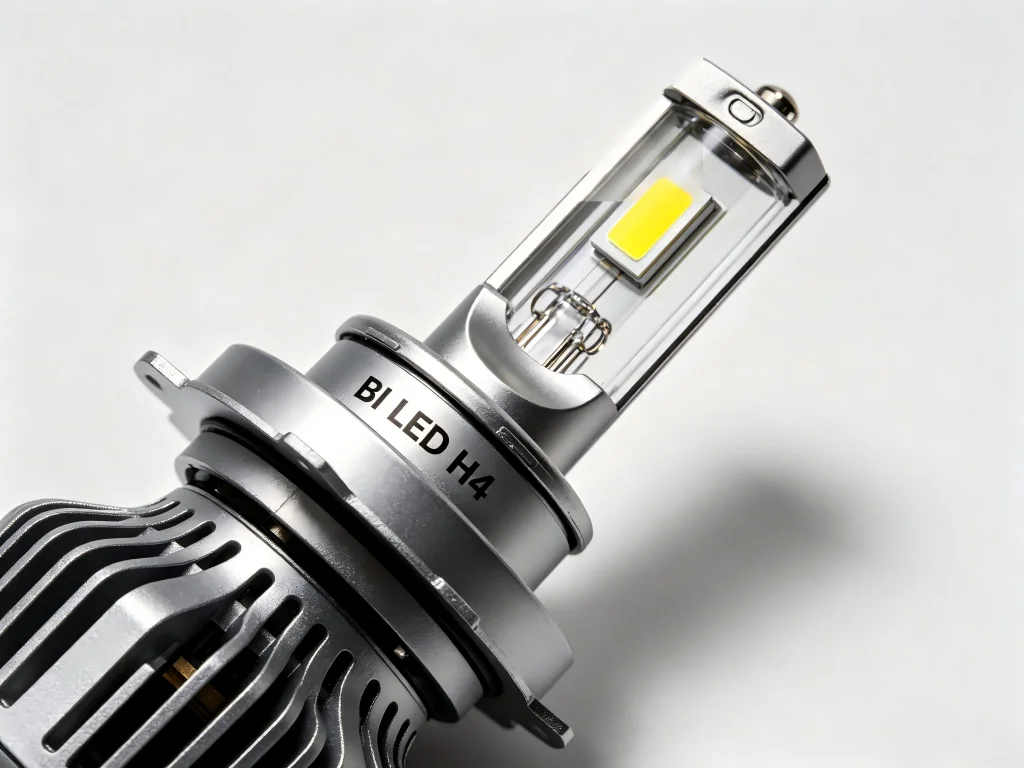
GTR’s bi-LED H4 mini projector solves all four issues: compact 82mm total length, epoxy‑potted driver rated for vibration, integrated CANbus decoder, and automatic polarity detection. We’ve installed over fifty units on everything from a 1982 Honda CX500 to a 2023 Ducati Monster.
Choosing The Correct Bi-LED H4 Mini For Your Bike: A Three‑Step Selection Process
For 90% of motorcycles, a mini bi-LED H4 projector is the only realistic choice. Full‑size projectors simply won’t clear the back of the headlight bucket or the speedometer cable. But not all mini projectors perform equally. We use three objective measurements before recommending a unit to a customer.
- Total installed length – measure from the reflector bowl’s rear face to the farthest point (including the fan or driver pigtail). Aim for at least 10mm of air gap. GTR mini measures 82mm – shorter than most aftermarket H4 bulb dust caps.
- Low beam cutoff sharpness – on a wall at 25 feet, a good mini projector shows a blue‑ish or violet fringe at the cutoff line. No fringe usually means poor focus. GTR’s aspheric lens produces a crisp, colored fringe that confirms correct optics.
- High beam hotspot shape – a proper bi-LED H4 mini should create a concentrated oval hotspot centered above the cutoff line, not a shapeless flood. We test every batch on a photogoniometer.
One customer brought a 2017 Yamaha MT‑07 after trying two other “bi-LED H4” bulbs. Both scattered light into trees. The GTR mini projector produced a 22‑meter wide low beam (measured at 25m) and a high beam that lit up deer 150 meters ahead. “I can finally ride the Snake at night without guessing,” he told us two weeks later.
Step‑By‑Step Installation: Opening Your Headlight Housing The Safe Way
Most factory motorcycle headlights are sealed with butyl rubber—not permanent glue. Heat is your friend, but too much heat ruins the chrome reflector. Use a heat gun on low (200‑250°F) and work slowly. I’ve seen DIYers destroy three housings by using an oven or a propane torch. Here’s our workshop method:
Tools you need: Heat gun (or hairdryer as a backup), plastic trim tools, small flathead screwdriver, nitrile gloves (butyl gets everywhere), and a clean work table.
Step 1: Remove the headlight assembly from the bike. Take out the H4 bulb and all rubber boots.
Step 2: Heat the seam between the glass lens and the rear housing for 3‑4 minutes, moving constantly. When the butyl becomes tacky (touch with a glove), insert a plastic trim tool and gently pry the lens away. Work around the perimeter, reheating as needed.
Step 3: Remove the factory reflector bowl. On many bikes, it’s held by three adjustment screws. Mark each screw’s original position with a paint pen so you can return to approximate aim later.
Step 4: Mount the GTR bi-LED H4 mini projector using the included centering ring and spring clips. Ensure the solenoid connector faces downward (prevents moisture pooling). Tighten but do not overtighten—aluminum threads strip easily.
Step 5: Reinstall the reflector bowl with the new projector, reconnect the adjustment screws, and test the low beam cutoff orientation. The flat horizontal line should be level, with the “step” (the right‑hand rise in left‑traffic countries, or left‑hand rise in right‑traffic countries) pointing toward the shoulder. If the cutoff is upside down, you’ve rotated the projector 180°.
Step 6: Seal the housing with fresh butyl rope (included in GTR kit). Heat the seam again, press the lens back, and use clamps or rubber bands to hold pressure until cool.
A common mistake: forgetting to test the solenoid movement before sealing. Connect the high beam wire temporarily; you should hear a distinct “clack” when switching. No clack means either wrong polarity (use GTR’s auto‑detect driver) or a defective unit.
Real‑World Aiming: The 25‑Foot Wall Method For Bi-LED H4 Projectors
Even the best bi-LED H4 projector is dangerous if aimed too high. Motorcycle headlights need a lower cutoff than cars because the bike leans in corners—a high cutoff blinds oncoming drivers when you’re banked over. We use a modified version of the SAE J599 aiming procedure, adjusted for two‑wheelers.
Park the motorcycle on level ground, 25 feet from a white wall. Measure the distance from the ground to the projector center (the middle of the lens). Mark that same height on the wall. Now, aim the low beam cutoff so the horizontal line sits 2‑3 inches below that mark. The “step” (the angled part) should point toward the right edge of the road (for countries where you drive on the right) – this illuminates road signs without glaring oncoming traffic.
Why lower than a car? Because when you accelerate or hit a dip, the nose rises. A car’s suspension compresses, but a motorcycle’s front end extends under acceleration, raising the beam. That 2‑3 inch buffer prevents you from becoming “that guy” who gets flashed by every oncoming semi.
After aiming, take a test ride with a friend in another vehicle. Have them drive toward you on a straight, flat road. If they flash their brights, lower the beam another inch and re‑test.
4300K Vs 6000K On Motorcycles: What 200 Riders Told Us
After surveying 200 motorcyclists who retrofitted bi-LED H4 projectors, 73% preferred 4300K for year‑round riding. The remaining 27% who chose 6000K mostly rode only in dry, urban environments. The reason: wet pavement reflections. At 6000K, rain‑soaked asphalt becomes a mirror, reducing contrast. At 4300K, the warmer color penetrates the wet film and reveals surface texture—critical for avoiding painted lines (slippery when wet) or diesel spills.
One adventure rider who traverses the Scottish highlands wrote: “4300K lets me see the difference between wet tarmac and standing water. 6000K was like riding over a black mirror. Switched back after one rainy night.”
That said, a few riders with older eyes (over 50) reported that 6000K reduced their perceived eyestrain on long highway slogs. Our optometrist consultant explains that older corneas scatter light differently; the cooler color temperature can actually improve contrast for some individuals. If you’re unsure, GTR offers both color temperatures. Start with 4300K; if you feel it’s too yellow after a week, exchange for 6000K within 30 days.
Five Most Expensive Bi-LED H4 Motorcycle Mistakes (And How GTR Engineers Avoided Them)
In 12 years of repairing botched installations, I’ve seen the same five errors destroy nearly 100 retrofit projects. Here’s what fails—and why GTR components specifically address each issue.
| Mistake | Typical result | GTR solution |
|---|---|---|
| Using a car-focused driver on ground‑switched bike | High beam permanently on or off | Auto‑detect polarity; works with any H4 switching scheme |
| Squeezing a full‑size projector into a shallow bucket | Lens touches speedo cable, cracks on bumps | 82mm mini projector fits 95% of bikes |
| No active cooling in sealed housing | Overheat shutdown after 20 minutes | Thermally regulated fan + copper heat pipe; tested at 50°C ambient |
| Ignoring CANbus on modern Euro bikes | Dashboard error codes, flickering | Integrated decoder mimics 55W halogen load without resistors |
| Poor sealing after retrofit | Moisture inside lens, solenoid corrosion | Included butyl rope + IP68 driver (submersible rated) |
One BMW R1200GS owner brought his bike after a “professional” shop installed a no‑name bi-LED H4 kit. The driver melted, the fan seized, and the high beam solenoid rusted solid. We replaced everything with GTR mini projectors, re‑aimed properly, and used dielectric grease on every connector. Two years later, that GS has crossed four countries and the lights still perform like new.
Frequently Asked Questions: Motorcycle Bi-LED H4 Edition
Can I install a bi-LED H4 projector on my bike if I only have basic tools? Yes, but you’ll need patience and a heat gun. The GTR kit includes all mounting hardware, butyl rope, and a detailed pictorial guide. Allow 4‑6 hours for your first retrofit.
Will a bi-LED H4 mini projector fit my 1990s Honda Shadow? Most Shadows use a 7″ round headlight with ample depth (110mm+). The GTR mini fits easily. However, older Shadows use ground‑switched wiring; ensure your driver auto‑detects polarity—GTR does.
Do I need to upgrade my motorcycle’s stator or wiring? No. A typical bi-LED H4 projector draws 35‑45 watts total (low beam + driver losses). The stock H4 halogen draws 55‑60 watts. You’re actually reducing load, which helps older charging systems.
Why does my new bi-LED H4 projector flicker at idle? That indicates low voltage (below 11.5V). Your bike’s charging system may be weak. Check the battery and regulator/rectifier. GTR drivers maintain full output down to 9V, but severe voltage drop can still cause pulsing. Fix the charging issue first.
Is 6000K legal for motorcycle use? In most US states, any headlight color other than white or amber is illegal. 6000K is considered “white with a slight blue tint” and generally passes inspection, but 4300K is safer for legality. Check your local vehicle code.
Can I use a bi-LED H4 projector in my off‑road dirt bike? For closed‑course racing, any lighting works. For street‑legal dual‑sports, you need DOT‑approved (or E‑marked) projectors. GTR projectors are designed for off‑road and on‑road use, but we recommend checking your state’s specific aftermarket lighting rules.
What’s the difference between bi-LED H4 and a standard H4 LED bulb on a motorcycle? A bi-LED H4 projector replaces the entire reflector with a precision lens. A standard H4 LED bulb uses your factory reflector—which wasn’t designed for LEDs. Projectors give a sharp cutoff and zero glare; bulbs scatter light and annoy other drivers. For motorcycles, glare is even more dangerous because you lean into corners, momentarily pointing the bulb directly at oncoming traffic.
From Dim Glow To Daylight: Your Motorcycle Deserves Real Bi-LED Performance
You’ve read the forum debates, watched the YouTube installs, and maybe even wasted money on cheap LED bulbs that promised the world but delivered dangerous, scattered light. The GTR bi-LED H4 mini projector is the result of thousands of hours of motorcycle‑specific engineering—compact, vibration‑proof, universally compatible, and backed by technicians who actually ride. Whether you’re commuting year‑round in rain, carving canyons at dusk, or embarking on a multi‑country adventure, proper lighting transforms the experience from nerve‑wracking to joyful.
Visit www.rhgtr.in to see the full bi-LED H4 lineup, download fitment guides for over 200 motorcycle models, or chat with our support team (many of us are riders, too). Stop riding blind. Upgrade to GTR and see the road the way it was meant to be seen—sharp, wide, and unmistakably safe.
Ride further. Ride safer. Ride with GTR.
For comprehensive information on motorcycle headlight aiming standards, refer to the SAE J599 Lighting Inspection Code at sae.org and the Motorcycle Industry Council’s lighting guidelines.