
You have read the marketing claims. 800% brighter. 50,000 hours. Plug and play. Then you installed your h4 lamp led bulbs and something felt off. The beam pattern looked wrong. Oncoming drivers flashed you. Or worse—the bulbs flickered and dimmed within months. You are not alone. Across forums like the MG Experience, PakWheels, and FJ Cruiser forums, real drivers are sharing what actually works and what does not. This article collects those voices, cuts through the marketing, and shows you exactly which H4 LED headlight bulbs deliver real-world performance.
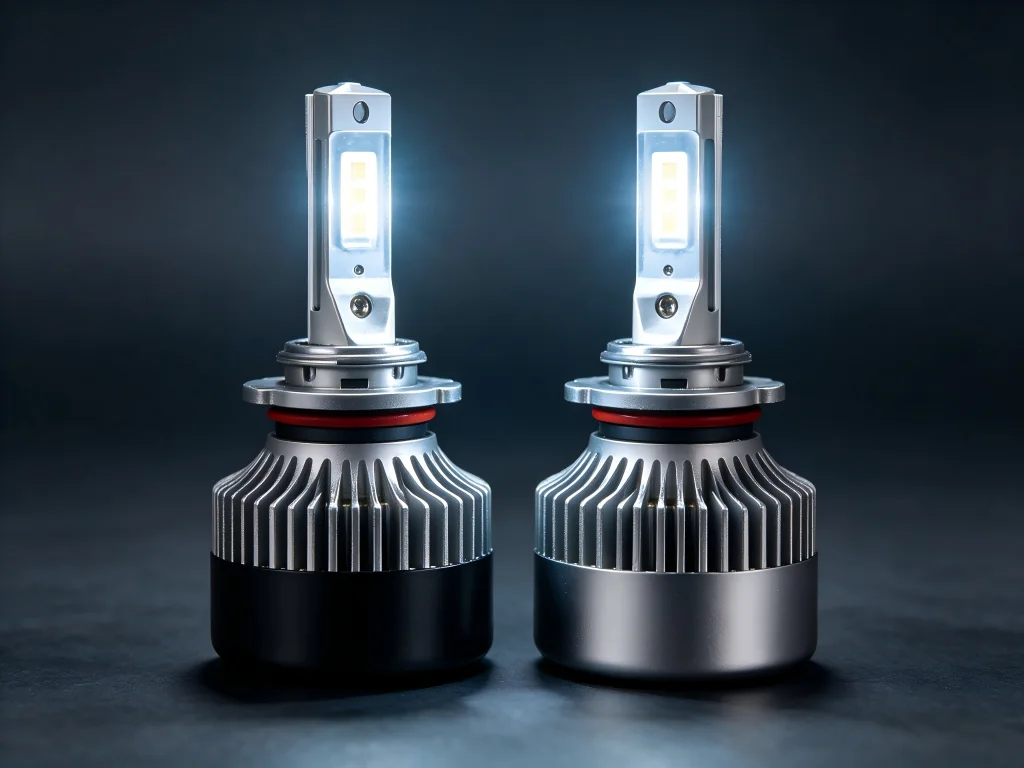
What Drivers Actually Say About H4 LED Headlight Bulbs
The most common complaint about H4 LED headlight bulbs is not brightness—it is beam pattern. Drivers consistently report that cheap LEDs scatter light everywhere except where it needs to go.
One forum member documented their experience with an £8.89 H4 LED bulb: it consumed just 4 watts and looked bright in the workshop, but the beam pattern was “non-existent—a complete spread of light in all directions on dip and main”. Another driver reported that their LED bulbs “focus to LEFT & RIGHT” instead of up and down like halogen, making “both patterns inaccurate”.
These are not isolated incidents. They are the predictable result of putting an LED chip where a halogen filament used to be.
Why Beam Pattern Matters More Than Lumens
Your headlight housing—whether reflector or projector—was engineered around a halogen filament measuring roughly 1.6mm wide. That filament emits light in a predictable 360-degree pattern. LED chips are flat, rectangular, and directional. When the chip position is off by even a millimeter, the beam breaks.
Here is what that looks like on the road:
- Glare. Light scatters upward instead of forward. Oncoming drivers flash their high beams at you.
- Dark spots. The road directly in front stays dark while light spills into trees and ditches.
- Reduced usable distance. You see the sides of the road but not what is 200 feet ahead.
One driver put it bluntly: “Largely, these numbers don’t translate into usable light output numbers anyway because not all the light given out by an emitter goes where it can really be used”.
The Outgassing Problem Nobody Talks About
Here is a failure mode that rarely appears in marketing materials. Many H4 LED bulbs use plastic components that release gases when heated—a process called outgassing. One forum member documented what happened after less than a year with a popular fan-cooled LED: “Within less than a year, my headlight lens and the reflectors are visually grayed inside the housing due to outgassing”.
The haze inside the housing cannot be cleaned without damaging the delicate reflector coating. Your headlight housing is effectively ruined. This is not a bulb failure. This is a housing failure—and replacing the housing costs far more than the bulb did.
One driver who switched to GTR Lighting CSP Minis reported: “No fogging” after a full year of use. The difference is in the materials. Quality bulbs use components that do not outgas under heat.
Fan vs. Fanless: What Real Owners Prefer
Active cooling with fans is common in LED headlight bulbs. But fans introduce moving parts that can fail, collect dust, and become noisy. One driver noted: “They do have a fan, but circulate air through the headlight rather than out the back”. Another reported their high beam failed after about six months of use.
Drivers who have tried both often prefer fanless designs. One owner switched from Morimoto 4.0 (fan-cooled) back to GTR Mini (fanless) and explained: “they fit better without futzing inside the headlight mount and they don’t have a fan”. Another noted: “Also, no fan to fail”.
Fanless cooling relies on heat sink surface area. It is silent. It has no moving parts. And when engineered properly, it dissipates heat effectively without the failure point of a spinning fan.
Real-World Comparison: GTR Ultra 3.0 vs. The Competition
Independent testing by BulbFacts—which buys and tests products without manufacturer incentives—provides objective data. The GTR Lighting Ultra Series 3 scored 6.9 overall, with 1498 lux on reflector low beam (a 302% increase over halogen baseline) and 2456 lux on reflector high beam. Projector performance was also strong: 830 lux on low beam and 910 lux on high beam.
But numbers only tell part of the story. Here is what actual drivers say:
“FWIW the GTR Ultra 3.0 are fantastic. I like the color, which seems even more reflective on road stripes than other LED I have used, beam width is broader than the Morimoto, can’t find any dark spots in the lighting.”
“I can’t say that the 4.0 light output or beam pattern is noticeably better than the GTR Lighting units.”
“The GTR Ultra 3.0 are fantastic. … My Morimoto 3.0 are perfect on low beam, but a bit splotchy on high beam.”
One driver who tested multiple brands summarized: “Expensive isn’t always better, but these had features I was interested in trying”. The features that mattered? Beam accuracy, color temperature around 5700K (less blue than the common 6000K), and adjustability.
The Hidden Costs of Cheap H4 LED Bulbs
That $25 Amazon special might seem like a bargain. But consider what drivers actually experience:
| Issue | What Happens | Real Cost |
|---|---|---|
| Flickering | CANBUS errors, intermittent failure | Frustration, returned bulbs, wasted time |
| Outgassing | Hazed lenses, ruined reflectors | New headlight housing ($200–$800+) |
| Fan failure | Overheating, permanent dimming | New bulbs every 6–12 months |
| Poor beam pattern | Glare, dark spots, unsafe driving | Increased crash risk, traffic tickets |
One driver reported: “My stock H4 bulb died every 4 months. GTR LED went in 2 years ago—still bright, no flicker, no heat at the socket”. Another noted: “Rainy nights are now safe. The white light cuts through fog better than my old halogen H4 bulb”.
The math is simple. A cheap bulb that fails every year costs more over five years than a premium bulb that lasts—and the premium bulb provides better visibility every single night.
What to Look for in an H4 LED Headlight Bulb
Based on real driver experiences and independent testing, here is what separates a good H4 LED headlight bulb from a bad one:
- 1:1 filament positioning. The LED emitters must replicate the halogen filament position within 0.1mm. If the manufacturer does not mention this explicitly, assume they got it wrong.
- Quality thermal management. Fanless designs with adequate heat sink surface area are more reliable than fan-cooled bulbs with moving parts.
- Built-in CANBUS compatibility. External decoders add failure points. Built-in drivers work seamlessly.
- Materials that do not outgas. Plastic components release gases when heated. Quality bulbs use materials that remain stable at operating temperatures.
- Independent test data. Look for third-party testing like BulbFacts, not just manufacturer claims.
Frequently Asked Questions
Why do my H4 LED headlights flicker?
Flickering usually indicates a CANBUS compatibility issue. Your vehicle’s computer expects a certain resistance from the bulb. LEDs draw less power, triggering a “bulb out” warning. Quality bulbs with built-in CANBUS drivers solve this without external decoders.
Are H4 LED bulbs legal for road use?
Not all of them. Some are explicitly labeled “off-road only”. Check DOT/SAE compliance for US roads or ECE approval for European markets before purchasing. Many budget bulbs are not street legal.
How long do H4 LED bulbs actually last?
Quality LEDs can last 30,000 to 50,000 hours. Cheap LEDs often fail within months due to poor thermal management, outgassing, or fan failure. One driver reported their Novsight bulbs failed at month 11 and month 9 respectively.
Will H4 LED bulbs fit in my vehicle?
Most H4 LED bulbs use the standard 9003/HB2 connector. However, check your dust cover clearance. Some bulbs have bulky heat sinks or fan assemblies that do not fit. 1:1 mini designs are more likely to fit without modification.
What color temperature should I choose?
5000K to 6000K (pure white to cool white) provides maximum visibility. 6500K shifts toward blue and reduces usable light in wet conditions. One driver noted that the GTR Ultra 3.0 at approximately 5700K was “not as blue as the 6000K common these days”.
Can I install H4 LED bulbs myself?
Yes, but proper alignment is critical. The bulb must be rotated until the optimal beam pattern is found. If the beam pattern looks wrong, the bulb may need to be rotated or the mounting collar adjusted.
What Real Drivers Recommend
After testing multiple brands, one driver who installed GTR Lighting Ultra 3.0 summarized: “Easily adjusted for focus, light is about 5,700K … Light output as good or better than the Morimoto”.
Another who compared the GTR Mini to alternatives concluded: “If I were sourcing a replacement, I would likely go back to the GTR Mini as they fit better without futzing inside the headlight mount and they don’t have a fan”.
Independent testing confirms what drivers report. The GTR Lighting Ultra Series 3 is “one of the better LED headlight kits we have tested, with strong reflector output, very good projector performance, clean 5100K color, and a high-end price to match”. It has “the kind of overall balance that is hard to find in the LED headlight world”.
Your h4 lamp led upgrade should make night driving safer, not more stressful. Real driver experiences show that beam pattern, thermal management, and build quality matter far more than lumen claims. Choose a bulb that delivers usable light—not just marketing numbers.