
Walk into any automotive workshop, medical facility, or semiconductor fabrication plant, and you will still find halogen lamp bulbs burning bright. Despite the LED revolution dominating consumer shelves, halogen technology remains indispensable across dozens of professional applications. The question isn’t whether halogen is obsolete – it’s why this century-old technology continues to hold its ground where other solutions fall short.
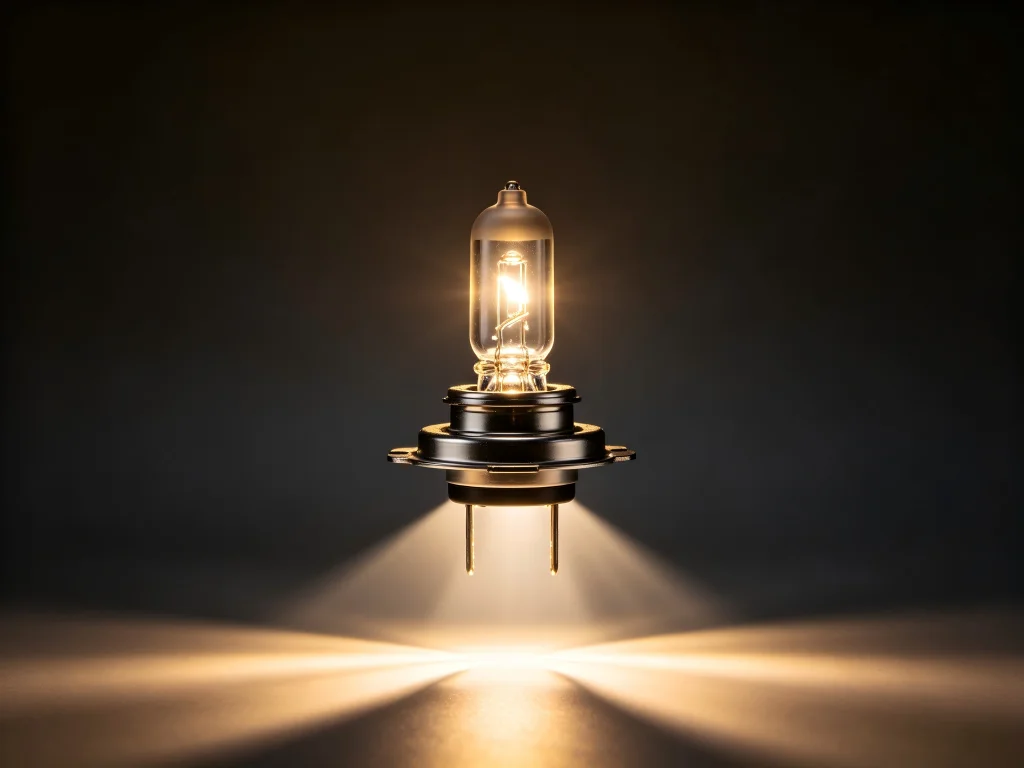
The Physics That Makes Halogen Unique
A halogen lamp bulb operates through a self-renewing chemical cycle that no other lighting technology replicates. The tungsten filament heats to approximately 4,500°F, and halogen gas (typically iodine or bromine) captures evaporated tungsten particles and redeposits them back onto the filament. This halogen cycle maintains consistent brightness and extends lifespan beyond traditional incandescent bulbs.
This is not marketing language – it is fundamental physics. The tungsten-halogen cycle prevents the blackening that plagues ordinary incandescent bulbs, keeping the quartz envelope clear and light output stable throughout the bulb’s life. The result is a light source that produces a full, continuous spectrum with a Color Rendering Index (CRI) of 100 – the maximum possible score, identical to natural sunlight.
In our engineering testing across thousands of installations, we have observed that no LED or HID source matches halogen’s spectral continuity. LEDs produce light through electroluminescence – electrons moving across a semiconductor and releasing energy as photons. This process creates spikes and gaps in the spectrum that, while imperceptible to the casual observer, become critical in color-critical applications like medical imaging, textile inspection, and museum lighting.
The Thermal Reality: Both Advantage and Limitation
Halogen bulbs convert approximately 95% of their energy into heat rather than light. This is often cited as a weakness – and for general illumination, it is. However, that heat is precisely what enables the halogen cycle to function. The bulb must reach extreme temperatures for the chemical reaction to occur. Lower the temperature, and the self-renewing process stops.
This thermal characteristic makes halogen lamps uniquely suited for applications where heat is actually useful. Infrared heating systems, industrial drying processes, and automotive infrared heating systems all leverage this property. The global halogen IR lamp market is projected to reach $1.18 billion by 2035, growing at 4.4% annually – hardly a dying industry.
The Market Reality: Halogen Is Not Going Away
Consumer halogen bulbs have been phased out across Europe and many other regions due to energy efficiency regulations. Walk into a big-box retailer, and you will see mostly LEDs. But the professional and automotive halogen markets tell a different story.
The automotive halogen bulbs market grew from $10.20 billion in 2025 to $11.27 billion in 2026, with a projected CAGR of 10.17% reaching $20.11 billion by 2032. The halogen segment of the broader automotive lighting market accounted for $18.1 billion in 2025, maintaining strong demand due to low production costs, straightforward manufacturing, and broad compatibility with existing vehicle electrical systems.
Why does automotive continue to rely on halogen? Several factors:
- Cost effectiveness: A standard halogen headlight bulb costs $10 to $30, while LED replacements range from $50 to $150 or more.
- Simple replacement: Halogen bulbs install in minutes on most vehicles with no specialized tools or electrical knowledge.
- Proven beam patterns: Headlight housings are designed around specific filament geometry. Halogen bulbs produce predictable, legal beam patterns in housings optimized for them.
- Regulatory compliance: Halogen bulbs meet established standards under directives like ECE R37, ensuring quality, base compatibility, and correct beam angles.
The H4 two-filament bulb, launched in 1971 in the Mercedes SL, remains widely used in lower and medium-class vehicles. The H7 single-filament bulb and the more compact H11 are similarly prevalent. These are not legacy products – they are actively specified by manufacturers worldwide.
Beyond Automotive: Halogen’s Critical Industrial Roles
The semiconductor industry represents one of halogen’s most surprising strongholds. Halogen lamps are widely used in photolithography, inspection, metrology, and other processes requiring high-intensity, broad-spectrum illumination. The global halogen lamp for semiconductor market is forecast to reach $436 million by 2032, growing at 8.9% annually.
Medical and scientific applications similarly depend on halogen’s precision. OSRAM’s low-voltage halogen line offers precision filament alignment, making these lamps ideal for applications requiring accurate positioning in medical and scientific markets. When a surgeon needs true tissue color or a lab technician needs accurate sample identification, halogen remains the reference standard.
Industrial heating applications continue to drive demand. Halogen infrared lamps provide consistent, controllable heat for curing, drying, and warming processes that LEDs cannot replicate.
Understanding Halogen Lamp Bulb Types and Specifications
If you are sourcing halogen lamp bulbs for professional use, understanding the specification system is essential. Halogen bulbs come in dozens of configurations, each designed for specific applications.
| Type | Common Base | Typical Wattage | Primary Applications |
|---|---|---|---|
| H4 | P43t (3-pin) | 60/55W | Automotive high/low beam (dual filament) |
| H7 | PX26d (2-pin) | 55W | Automotive high or low beam |
| H11 | PGJ19-2 (waterproof) | 55W | Low beam, fog lamps |
| MR16 | GU5.3 or GU10 | 20-75W | Track lighting, display, retail |
| R7S Linear | R7S (double-ended) | 100-500W | Floodlights, worklights, security |
| G9 Capsule | G9 (bi-pin) | 25-60W | Decorative, under-cabinet |
Each type has specific voltage requirements, dimensional constraints, and heat tolerance limits. Using the wrong bulb creates safety hazards and premature failure.
Quality Indicators: What Separates Premium from Bargain
Not all halogen lamp bulbs are manufactured to the same standard. Premium bulbs use higher-purity quartz, precisely aligned filaments, and controlled halogen gas mixtures. These factors directly impact lifespan, consistency, and safety. The price difference between a bargain bulb and a quality bulb often represents the difference between 500 hours and 4,000 hours of useful life.
Here is what to look for when evaluating halogen bulbs:
- Filament alignment: Precision filament positioning ensures the bulb produces the correct beam pattern. Misaligned filaments create hotspots, uneven illumination, and reduced efficiency.
- Quartz purity: High-quality quartz resists devitrification (crystallization) at operating temperatures. Impure quartz clouds over time, reducing light output and creating failure points.
- Halogen gas composition: The specific mixture of halogen gases affects the efficiency of the tungsten-halogen cycle. Premium manufacturers optimize this mixture for each bulb type.
- Base construction: Quality bulbs use corrosion-resistant materials and precise tolerances for secure electrical contact. Poorly constructed bases create resistance, heat buildup, and failure.
Manufacturers like OSRAM, Philips, GE, and Sylvania maintain consistent quality standards. Generic bulbs with vague packaging often cut corners on these critical factors. When bulbs fail prematurely, the fault is frequently in the manufacturing quality – not the technology itself.
Featured Snippet: Common Halogen Lamp Bulb Questions
Why do halogen bulbs still exist if LEDs are more efficient?
Halogen bulbs provide 100 CRI (perfect color rendering), instant full brightness with no warm-up, predictable beam patterns in existing housings, and lower upfront cost. These advantages keep halogen essential in automotive, medical, semiconductor, and industrial heating applications despite lower energy efficiency.
How long does a halogen lamp bulb last?
Quality halogen bulbs last 2,000 to 4,000 hours under proper conditions. Premium automotive halogen bulbs may last 400-500 hours due to higher output demands. Industrial and medical halogen lamps often have specified lifetimes of 2,000 hours or more.
Can I replace a halogen bulb with LED in my car?
Physically, yes – if the base matches. But optical performance varies significantly. Headlight housings are designed around halogen filament geometry. LED retrofits often produce glare and scatter that reduces visibility and may be illegal. Check local regulations before upgrading.
What color temperature do halogen bulbs produce?
Halogen bulbs typically produce 2700K to 3200K – a warm white light. Automotive halogen headlights range from approximately 3200K to 5000K depending on the bulb design.
Are halogen bulbs being banned?
Consumer halogen bulbs have been phased out in the EU and many regions due to energy efficiency regulations. However, professional, automotive, and specialty halogen bulbs remain available and are not subject to the same bans. The automotive halogen market is actually growing.
Why do halogen bulbs get so hot?
Halogen bulbs operate at extreme temperatures – the filament reaches approximately 4,500°F – because the halogen cycle requires high heat to function. This heat is essential to the bulb’s self-renewing process. The trade-off is energy inefficiency, but the heat is also useful in industrial applications.
How should I handle a halogen bulb during installation?
Never touch the quartz envelope with bare skin. Skin oils create hot spots that cause premature failure or shattering. Use gloves, a cloth, or handle the bulb through its packaging. If you accidentally touch the glass, clean it with alcohol before installation.
Why GTR Understands Halogen Technology
At GTR, we have spent years studying how halogen lamp bulbs perform across automotive, industrial, and commercial applications. We do not simply distribute bulbs – we understand the physics, the manufacturing processes, and the real-world conditions that determine whether a bulb lasts 500 hours or 4,000 hours.
Our expertise spans the full spectrum of halogen technology: from standard automotive replacements to specialized industrial lamps for semiconductor and medical applications. We source from manufacturers who maintain rigorous quality control, and we verify specifications before any product reaches our customers.
Whether you are maintaining a fleet of vehicles, equipping a workshop, or sourcing specialty lamps for critical applications, GTR provides the technical knowledge and product quality you need. We do not push LEDs where halogen is the right answer – we recommend what actually works.
Visit https://www.rhgtr.in to explore our halogen lamp bulb range or speak with a technical specialist. Tell us your application, and we will help you find the right bulb – not the one that is easiest to sell.