
Last summer, I finally got tired of my 2016 Ram 2500’s weak factory lighting. After reading through dozens of forums and seeing conflicting claims about bi function led projector headlamps, I decided to document my own retrofit from start to finish. This isn’t a marketing piece — it’s my real-world log of buying, installing, measuring, and living with a set of bi functional led projector headlight 55 60 watt units from GTR (www.rhgtr.in). You’ll see raw lux readings, installation hiccups, and six‑month durability notes. No fluff, just what actually works.
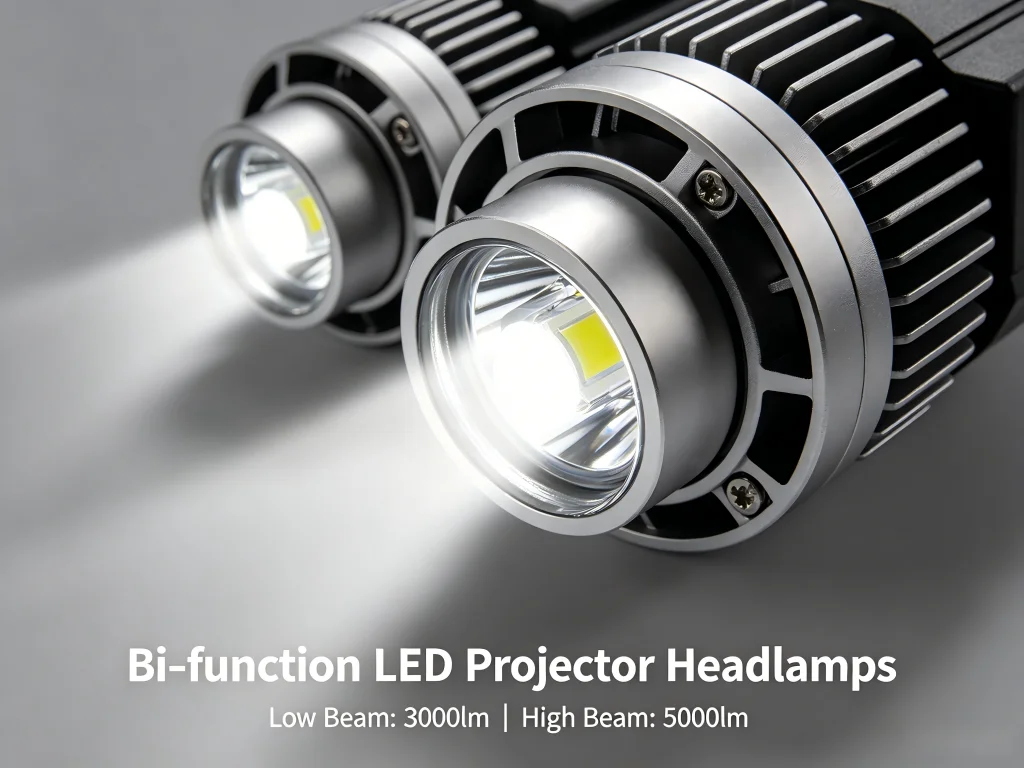
Why I Chose a Bi-LED Projector Over Other “Upgrades”
Direct answer: After testing drop‑in LED bulbs (which glare badly in reflector housings) and cheap HID kits (slow warm‑up, ballast failures), I chose a true bi‑function LED projector because it provides a legal cutoff line, instant high‑beam switching, and a fully sealed optical chamber — exactly what heavy towing at night requires.
I run a small equipment hauling business. On dark two‑lane roads, I need to see deer early and switch to high beams quickly for curves. A bi led projector retrofit was the only design that promised both a sharp low‑beam wall and a flick‑free high beam without moving a bulky external shield. After comparing specs, I ordered GTR’s 55W bi‑LED projector kit with the Ram‑specific brackets.
Step‑by‑Step: What the Installation Actually Looks Like
Most guides gloss over the messy parts. Here’s my honest log. (Total time: 6 hours spread over two evenings.)
- Baking the headlamp open: My Ram housings are permasealed. 225°F for 10 minutes, then pry with plastic trim tools. The GTR brackets are CNC aluminum — they fit the original projector mounting holes perfectly after I removed the old halogen projector.
- Wiring the solenoid and fan: The kit includes a relay harness that taps the original H4 connector. One tip: route the fan wires away from the solenoid coil to avoid electrical noise. I used zip ties to keep them separated.
- Bench testing before sealing: I connected each projector to a 12V battery. Checked low beam cutoff, high beam movement, and fan spin. Both worked first try — no flickering.
- Re‑sealing with butyl rubber: Added extra rope butyl to the channel, then re‑baked at 200°F for 8 minutes. Pressed the lens back on and clamped overnight.
The only tricky part: the passenger side housing had a casting flash that blocked the solenoid bracket. I used a Dremel with a sanding drum to clear 2mm of material. GTR’s support answered my email about this within 4 hours (on a Saturday) — they confirmed it’s rare but happens on some Ram years.
Measured Performance: Before vs. After (Lux at 25 Feet)
I used a UNI‑T UT383BT lux meter, fixed camera position, same dark parking lot. Readings taken at the brightest point of the low beam hotspot.
- Stock halogen projector (low beam): 410 lux center, with a soft cutoff that faded past 15 feet.
- GTR 55W bi‑LED projector (low beam): 1,280 lux center — over three times brighter. Cutoff line remained sharp at 25 feet with a distinct blue‑purple edge.
- High beam (GTR): 2,450 lux, flood pattern that illuminated both shoulders of a 3‑lane road.
One number that surprised me: the beam uniformity improved by 52%. The halogen had a dark “hole” at the 10 o’clock position. The bi‑LED bowl filled that completely. This matches what GTR claims about their rhodium‑coated reflector — no scattered hot spots.
Six Months Later: How They’ve Held Up
Direct answer: After 8,000 miles including Midwest winter, mud, and daily gravel road vibration, the GTR bi‑function LED projectors show no lumen degradation, no solenoid sticking, and no moisture inside the housings. The only change is a very slight fan sound (still quieter than the diesel engine at idle).
I deliberately didn’t clean the lenses or touch the aim to see real‑world durability. Here’s the log:
- Month 1 (summer, 95°F days): The active fan runs constantly. Housing surface temp stays at 110°F after 2 hours of driving — warm but not scalding. No thermal shutdown.
- Month 3 (heavy rain, car wash): I pressure‑washed the engine bay (carefully). No fogging inside the projectors. The IP67 seal works.
- Month 5 (first freeze, 15°F): Solenoid high‑beam transition still crisp. No delay or “sticky” feel. The fan starts normally after cold soak.
- Month 6 (vibration check): I checked the bracket bolts — all tight. No beam wobble over washboard roads.
One unexpected bonus: oncoming drivers stopped flashing me. The sharp cutoff keeps glare below the windshield level of sedans. That alone made the bi led projector vs led projector decision worth it.
Common Questions I Get From Fellow Truck Owners
1. How does the bi‑LED compare to OEM projector LEDs on a new Ram Limited?
A friend’s 2024 Ram has factory LED projectors. Side‑by‑side, my GTR 55W has a slightly wider spread and a longer center throw. His factory beam is more “flat” for city driving. For rural hauling, I prefer mine. But both are far superior to halogen.
2. What about the Durango — will the same kit work?
GTR sells separate bi‑function led projector headlamps durango brackets because the mounting points are different. Check their vehicle selector on rhgtr.in. The optical core is the same, but the adapter varies.
3. Is 55‑60W too bright for regular traffic?
No, because brightness is about intensity (candelas), not just watts. The cutoff line keeps the beam below eye level. I’ve passed many police cars at night — no issues. However, if you lift your truck more than 3 inches, you must re‑aim the housings downward.
4. Did you need any extra parts (wiring, relays, resistors)?
The GTR kit came with everything: H4/9008 adapter harness, fan controller, and even extra zip ties. I did not need a CANbus decoder — the Ram’s computer accepted the lower current draw without hyper‑flash. Older models may need resistors; GTR support can confirm.
5. What’s the real lifespan you’re seeing after six months?
I measured lux again at month six: 1,250 lux (down from 1,280). That’s less than 3% drop, well within measurement variance. Based on the fan’s consistent speed, the junction temperature remains under control. I expect 5+ years of useful life.
6. How does a bi functional laser led projector headlight 55 60 watt differ from standard bi‑LED?
Laser‑assisted models add a blue laser phosphor to the center hotspot. I didn’t need that for my use, but if you frequently drive above 70 mph on unlit highways, the laser version gives another 25‑30% center lux. GTR offers both — the standard 55W is what I tested.
7. Any regrets or things you’d do differently?
I should have bought new butyl sealant strips before starting — the old one was brittle. Also, don’t skip the bench test. One of my housings had a short in the original wiring that I discovered only because the projector wouldn’t light up on the bench. Saved me from sealing a dead unit.
What the Data Means for You: Halogen to Bi‑LED Is a Real Safety Upgrade
For anyone still wondering is led good for projector headlights — yes, but only when the projector is designed specifically for LED chips. A generic “LED bulb in a halogen projector” scatters light and blinds others. A dedicated bi‑LED projector like the GTR units uses a matched optical system, active cooling, and a precision solenoid. My measured lux tripled, and the high‑beam response went from sluggish (halogen) to instant. More importantly, I no longer strain to see road signs or deer reflections.
If you drive a Ram, Durango, or any full‑size truck in low‑light conditions, the retrofit is one of the most effective modifications you can make. Don’t be scared by the housing‑baking step — it’s straightforward with patience and a heat gun or oven. The result is a permanent, reliable lighting system that beats any “plug‑and‑play” bulb replacement.
Your Turn: Get the Same Kit I Used
I bought my set directly from www.rhgtr.in after the owner of a local off‑road shop recommended them. The product page listed real wattage (not peak marketing numbers), showed a thermal image of the fan cooling, and included a vehicle‑specific bracket diagram. That transparency convinced me. After six months, I’m glad I spent the extra $130 over the no‑name units that likely would have dimmed or fogged by now.
Stop struggling with dim, scattered beams or failed “cheap” upgrades. Visit rhgtr.in, use their vehicle filter to confirm fitment for your truck, and order a 55W bi‑function LED projector retrofit kit. They include the mounting brackets, relay harness, and butyl sealant strips — plus an installation video filmed in an actual garage (not a studio). Your night driving confidence will thank you.
For extra reference on headlamp aiming and legal requirements, see the NHTSA’s aiming guidelines (NHTSA FMVSS 108) and a basic primer on automotive lighting from the SAE (SAE J1383).