
The LED bulbs automotive industry is undergoing a transformation that extends far beyond simple brightness upgrades. By 2030, the global automotive lighting market is projected to reach USD 47 billion, with automotive LEDs accounting for USD 4.5 billion of that total . But here is what most drivers and even many industry professionals miss: the shift is not just about replacing halogen with LED. It is about redefining what vehicle lighting actually does.
Direct Answer: The LED bulbs automotive market is evolving from basic illumination to intelligent, software-defined lighting systems. By 2030, Adaptive Driving Beam (ADB) headlights will equip 22.8 million vehicles globally, representing a 23.8% penetration rate, transforming headlights from passive components into active safety systems .
This article examines where automotive LED technology is heading, what regulations are changing, and how these shifts affect everyone from fleet operators to individual drivers.
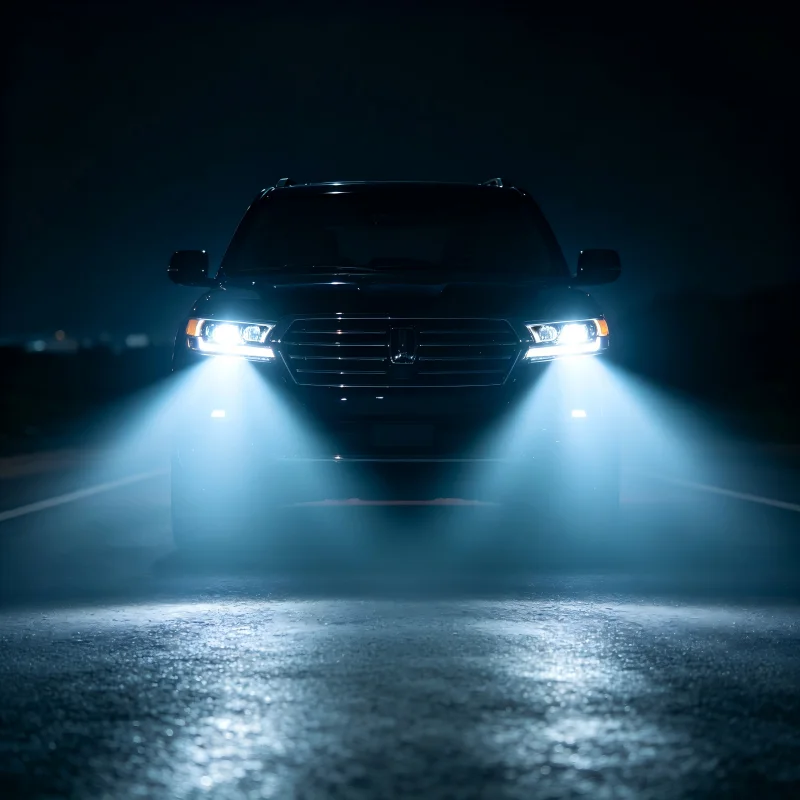
The Technology Revolution: Beyond Brighter Bulbs
For most of the past decade, the LED bulbs automotive conversation centered on one metric: brightness. More lumens meant better bulbs. That era is ending.
Today’s LED automotive lighting is moving toward what industry analysts call “software-defined vehicles” (SDVs) . Lighting is no longer a standalone component. It is becoming an integrated digital system that communicates, adapts, and protects.
Adaptive Driving Beam (ADB): The Headlight That Thinks
Traditional high beams are binary — on or off. ADB headlights are anything but. These systems use arrays of individually controlled LEDs to shape the beam pattern in real time, casting light exactly where it is needed while actively dimming sections that would otherwise blind oncoming traffic.
Europe leads the ADB adoption race, with penetration projected to reach 30.9% by 2030. China follows closely at 29.1% . Major automakers including Volkswagen, Porsche, Audi, Mercedes-Benz, and NIO have already adopted Micro LED headlight technology .
What makes Micro LED ADB headlights revolutionary? Three factors:
- High resolution — Automakers typically demand an average of 20,000 pixels per headlight, with advanced products reaching 70,000–100,000 pixels by 2028–2030
- Active safety features — Including adaptive light carpeting, width-assist, high-alert road risk signaling, and courtesy yield signals
- Weather integration — The system can adjust based on current weather conditions to enhance driving safety
Direct Answer: ADB headlights use individually controllable LED arrays to create a “light carpet” on the road, illuminating hazards, pedestrians, and lane markings while automatically shielding other vehicles from glare. This represents the single most significant safety advancement in automotive lighting since the introduction of the halogen headlamp.
Intelligent Signal Displays: Lighting That Talks
Vehicle lighting is becoming a communication tool. Intelligent signal displays (ISDs) are appearing on vehicles from IM Motors, GWM, Changan, Lynk & Co, and BMW .
These displays can show:
- Pedestrian crossing indicators
- Vehicle malfunction alerts
- Charging status updates
- Hazard warnings
Current regulations restrict animated displays while the vehicle is in motion, but when stationary, these systems offer diverse interactive functions . The technology is advancing toward Mini LED COB technology with pixel pitches of P0.8–P2.5 .
Miniaturization and Design Freedom
Across the Asia-Pacific automotive landscape, lighting is moving from a “parts-and-compliance” function to a core value driver — shaping safety, styling identity, and even how vehicles communicate with people around them . Two themes dominate: energy saving and miniaturization .
Slimmer front and rear modules enable more expressive vehicle design while freeing packaging space — a critical advantage for EV platforms where space is intensely contested . Features like welcome projections, door-area illumination, and dynamic animations are no longer confined to concept cars; they are becoming brand differentiators .
The Regulatory Landscape: What’s Legal and What’s Not
Technology moves fast. Regulations move slower. But when they do move, they reshape entire markets.
Europe: UN Regulation No. 149
UN R149 is the new all-in-one “master rulebook” for vehicle road illumination devices in Europe and participating countries . It replaces multiple older standards — R112 for halogen, R98 for Xenon HID, R19 for fog lamps, and R123 for AFS systems — with one comprehensive regulation .
For B2B buyers and importers, R149 certification offers three critical advantages:
- Wider market access — R149 certification is a passport to the entire European market and many other regions, simplifying inventory and supply chains
- Reduced business risk — Verified R149 E-Mark significantly reduces the risk of shipments being delayed or rejected at customs
- Future-proof inventory — As older regulations are phased out, demand for R149-compliant products will only increase
For legality and safety in Europe, your headlight must display the ‘R149’ code as part of its official E-Mark .
United States: FMVSS 108 and the Aftermarket Reality
The U.S. regulatory environment presents a different challenge. Federal Motor Vehicle Safety Standard 108 makes most aftermarket LED conversions illegal — regardless of what the marketing claims .
Here is the brutal reality: installing LED or HID bulbs in halogen housings violates FMVSS 108 unless the complete assembly meets DOT certification standards . Your headlight housing was engineered for a specific filament pattern. Drop in a different light source and you scatter beams everywhere except where they belong .
Direct Answer: FMVSS 108 requires complete headlight assemblies — not just bulbs — to meet DOT certification standards. Retrofitting LED bulbs into halogen housings is illegal in all 50 states. Compliance requires either factory-installed LED systems or complete DOT-approved replacement housings .
State enforcement varies, but penalties range from $100–$200 fines to failed inspections and liability risks. California, New York, Texas, and Florida actively enforce “excessive glare” statutes .
The Compliance Checklist
Whether you are sourcing for a fleet or upgrading your personal vehicle, verify these points:
- Check for DOT, SAE, or E-Mark markings on the housing — missing markings mean non-compliance
- Perform the wall test — park 25 feet from a flat surface. Legal headlights create a sharp, distinct cutoff line with minimal scatter above it
- Avoid blue-tinted light — anything above 6000K color temperature is typically prohibited for street use
- Beware “off-road only” labels — this is a dead giveaway of non-compliance for street use
Market Dynamics: What the Numbers Tell Us
The global automotive LED market for lighting and display applications faced significant pricing pressure in 2025 due to macroeconomic uncertainty . The market value of automotive lighting LEDs declined to USD 2.929 billion (-3% YoY) in 2025, while the Chinese market dropped to USD 980 million (-6% YoY) .
However, the Asian automotive lighting LED market (excluding China) grew to USD 639 million (+2% YoY) in 2025 . The APAC automotive front lighting LED market is projected to grow from 56.7 million units in 2025 to 59.2 million units in 2030, a CAGR of 0.8% .
What does this mean for buyers? Pricing pressure on LED components is compressing manufacturer margins, but the long-term trend remains firmly upward. The headlight LED market reached USD 1.085 billion in 2025 . By 2030, the automotive lighting and LED markets are projected to reach USD 47.070 billion and USD 4.512 billion, respectively .
Key Supplier Landscape
Major automotive LED suppliers include ams OSRAM, Nichia, Dominant, Lumileds, Seoul Semiconductor, Samsung LED, Stanley, and Everlight . The top ten automotive LED manufacturers are expected to hold approximately 92.6% market share .
For B2B buyers, this concentration means quality and consistency are achievable — but only if you source from suppliers who use these tier-one components and meet the relevant certification standards.
Application-Specific Trends
Commercial Vehicles and 24V Systems
The commercial truck and bus segment is seeing targeted LED innovation. OSRAM recently introduced the TRUCKSTAR H7 LED — the first street-legal H7 LED retrofit lamp for 24V vehicles, offering up to 230% more brightness with a modern 6000K color temperature . For fleet operators, the combination of longer lifespan and lower energy draw translates directly to reduced operating costs .
Off-Road and Adventure Vehicles
The off-road vehicle LED lamp market is valued at approximately USD 905.5 million in 2025 and is projected to reach USD 1.8 billion by 2035, growing at a CAGR of 7.1% . This growth is driven by:
- Growing popularity of off-road and adventure vehicles
- Consumer focus on improved visibility and safety
- Increasing demand for vehicle customization and personalization
- Plug-and-play solutions in the aftermarket
For B2B buyers in the off-road segment, the key differentiator is durability and weather resistance — IP67 or IP68 ratings are increasingly standard expectations, not optional extras.
What This Means for Your Business or Vehicle
Here is the bottom line. The LED bulbs automotive industry is undergoing its most significant transformation since the technology first entered the market. We are moving from “just brighter” to “smarter, safer, and more integrated”.
For B2B buyers and fleet operators, this means three things:
- Compliance is non-negotiable — R149 in Europe, FMVSS 108 in the U.S. The penalties for non-compliance — financial and legal — far exceed the cost of certified products.
- Quality components matter more than ever — As margins compress and competition intensifies, the difference between tier-one components and cheap alternatives becomes a matter of safety and reliability.
- The future is software-defined — Lighting systems are becoming digital platforms. Buyers who understand this now will make better procurement decisions for the next five to ten years.
For individual drivers, the message is equally clear: the cheapest LED bulbs automotive on Amazon are not a bargain. They are a liability. The technology has moved beyond simple bulb replacement. Your vehicle’s lighting system is now part of an integrated safety ecosystem — and it deserves components engineered to match.
Frequently Asked Questions About LED Bulbs Automotive Trends
Are LED bulbs automotive becoming more affordable?
Direct Answer: Yes — but not uniformly. Macroeconomic pressure and China’s localization policies are driving LED prices down, compressing manufacturer margins . However, quality components with proper certification (R149, DOT, SAE) maintain higher price points. The gap between cheap and quality LEDs is widening, not narrowing.
What is the difference between ECE R112 and UN R149?
R112 is the older European standard for halogen headlights . UN R149 is the new all-in-one regulation that replaces R112, R98 (Xenon), R19 (fog lamps), and R123 (AFS) . An LED lamp may need both R149 and R10 approval — the former for the light, the latter for the electronics .
Will ADB headlights become standard in all new vehicles?
ADB-equipped vehicles are projected to reach 22.8 million units by 2030, representing a 23.8% penetration rate . While not universal, ADB is becoming a standard feature in premium vehicles and increasingly available in mid-range models.
How do I know if my LED bulbs automotive are street-legal in the U.S.?
Check for DOT or SAE markings on the complete headlight assembly — not just the bulb. Perform the wall test at 25 feet. Legal headlights create a sharp cutoff line with minimal scatter above it . Avoid bulbs with color temperatures above 6000K or labels reading “off-road only” .
What is the difference between Micro LED and standard LED headlights?
Standard LED headlights use a small number of high-power LEDs. Micro LED headlights use thousands of individually controllable microscopic LEDs, enabling pixel-level beam shaping for ADB functionality . Volkswagen, Porsche, Audi, and Mercedes-Benz have already adopted Micro LED technology .
Is the automotive LED market growing or shrinking?
Both. The market faced a short-term decline in 2025 (-3% YoY) due to pricing pressure . However, the long-term trajectory is strongly upward, with projections of USD 4.512 billion for automotive LEDs by 2030 .
Your Next Move: Sourcing for the Future
The LED bulbs automotive industry is not standing still. Neither should your procurement strategy. Whether you are managing a commercial fleet, running an auto parts business, or upgrading your personal vehicle, the decisions you make today will determine your safety, compliance, and cost structure for years to come.
GTR Lighting stands at the intersection of technology, compliance, and performance. Our LED bulbs automotive use tier-one components, meet or exceed relevant certification standards, and are engineered for the realities of modern vehicle electrical systems.
Visit www.rhgtr.in to explore our full range of LED bulbs automotive — engineered for today’s vehicles and tomorrow’s roads. The future of automotive lighting is here. Make sure your vehicles are ready for it.