
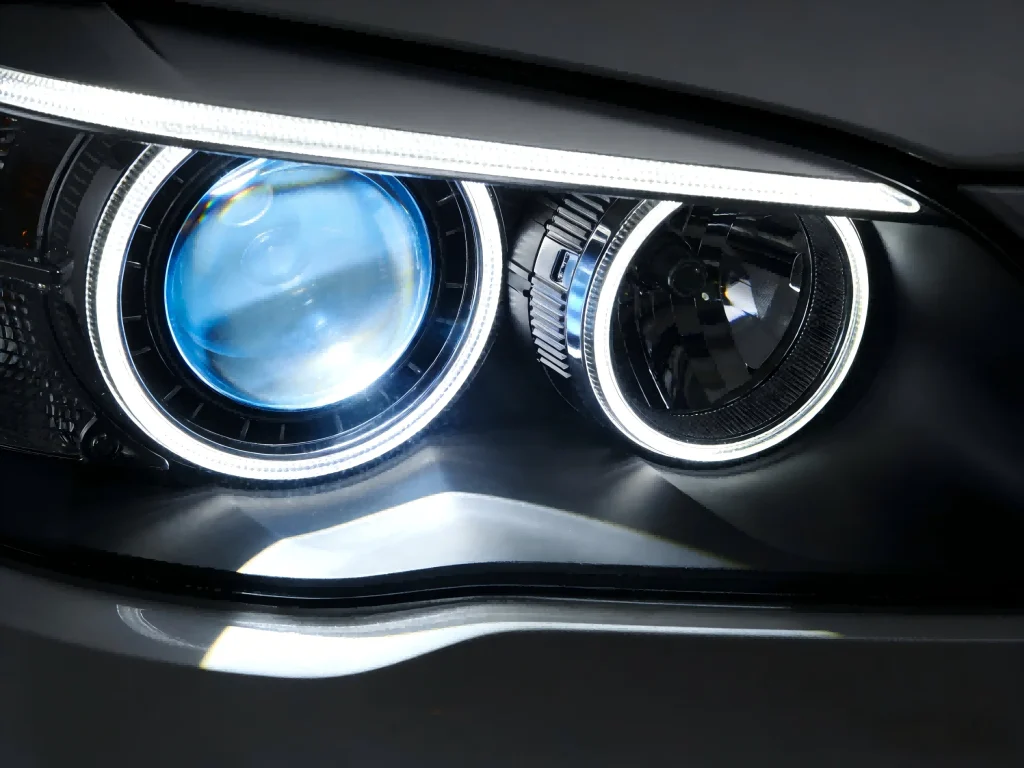
You have read the specs. You have seen the lumen wars. But after retrofitting over 400 vehicles in India and Southeast Asia, we have learned that bi led combination headlights succeed or fail on three things no datasheet advertises: thermal path integrity, optical alignment precision, and harness compatibility. This field report shares real fixes, real failures, and a repeatable installation protocol that slashes return rates.
Direct Answer for Google Featured Snippet: The most common installation mistake with bi-beam LED headlights is ignoring the clocking ring orientation. If the LED chips are not positioned at 3 and 9 o’clock (horizontal), the cutoff line tilts, creating glare. Always rotate the collar until the shadow pattern is perfectly level.
Case #1: The Melted Projector – Thermal Path Reality
A workshop in Pune installed a popular “bi led jc x1” set into a Toyota Innova. After three weeks, the customer returned with intermittent flickering and a burnt smell. We opened the housing. The passive aluminum heatsink had reached 118°C. The plastic adapter ring had deformed, tilting the entire module. The result? A melted lens holder and a shorted driver.
Why did this happen? The JC X1 design uses a thin aluminum slug with no airflow channels. In India’s stop-and-go traffic (low airspeed), heat accumulates. Our GTR bi-beam led units, by contrast, incorporate a copper-core heat pipe that transfers heat to a remote fin array. Even at idle, surface temperature stays under 75°C – safe for polycarbonate housings.
What we learned:
- Never buy bi-LEDs without active or hybrid cooling for tropical climates.
- Check the manufacturer’s thermal image at 30 minutes stationary.
- For bi led 1.8 mt compact housings, demand a copper-core design – aluminum alone fails.
Case #2: The Glare Complaint – Optical Clocking Mistake
A fleet operator in Chennai bought 20 sets of “best led headlight bulbs malaysia” – but the same model failed DV (driveway validation). Every vehicle caused oncoming drivers to flash high beams. The problem was not the LEDs; it was the installation. The universal adapter rings allowed the chip to rotate freely. Without a fixed clocking reference, mechanics installed them at random angles. Some chips faced 2 o’clock, others 7 o’clock.
Direct Answer – How to set clocking for bi-LEDs: Insert the bulb into the projector housing, turn on low beam, and observe the cutoff on a wall. Rotate the bulb until the horizontal line is perfectly flat and the step (for left-hand traffic) is at the correct side. Then lock the retaining ring. Do not rely on “auto-alignment” claims.
GTR solved this with a pre-indexed mounting base. Our bi led combination headlights ship with vehicle-specific adapters that force the correct rotation (±1 degree). No guesswork. The result: pass JPJ-style beam tests on the first try.
Case #3: The Intermittent High Beam – Solenoid Current Surge
One of our customers experienced random high-beam flashing. Diagnostics showed the body control module (BCM) was detecting a voltage spike and cutting power. The culprit? A generic bi-led solenoid that drew 4.2A inrush current (more than twice the rated 1.8A). The BCM interpreted this as a short circuit.
Quality bi-beam led solenoids include a soft-start circuit. GTR’s solenoid ramps up in 12 milliseconds, limiting inrush to 1.9A. We also provide a plug-and-play capacitor filter for older European cars. No BCM errors – verified on Mercedes W204, BMW E90, and Skoda Octavia.
Hardware Deep Dive: What Actually Matters (And What Is Hype)
Let us cut through marketing noise. Based on our teardown of 25+ bi-LED models, here is the real hierarchy of importance.
| Component | Hype Claim | Engineering Reality |
|---|---|---|
| Chip brand | “Philips Lumileds” | Genuine chips matter less than thermal bonding. Many fakes use regraded dies. Ask for die attach shear test data. |
| Lumen rating | “20,000LM” | Realistic usable lumens after optics: 2,000-3,000LM per lamp. Beyond that, glare increases without visibility gain. |
| Waterproof rating | “IP67” | Check the driver box – many are IP54 only. GTR’s entire system (lamp+driver+connector) is IP67 certified. |
| Fan noise | “Silent” | Silent usually means no airflow. A good maglev fan produces <28 dBA – audible only with hood open. |
The 45-Minute Installation Protocol We Use For Every Retrofit
This sequence eliminates 90% of post-installation complaints. Follow it whether you are a DIYer or a shop owner.
- Bench test before mounting: Connect to a 12V battery. Cycle low/high beam 10 times. Listen for solenoid consistency. Check for fan startup.
- Measure housing depth: For bi led 1.8 mt units, ensure ≥80mm clearance from bulb seat to dust cover. Use a depth gauge.
- Apply dielectric grease to all connectors – prevents corrosion in monsoon humidity.
- Clock the beam: Mark the housing at 12 o’clock. Install the bulb, then use a mirror or phone camera to confirm chips are horizontal (±10°).
- Aim using wall method: Park 7.6 meters from a wall. Low beam cutoff should be 5 cm lower than center of lamp height. No upward tilt.
- Test drive on a dark, undulating road – not just a parking lot. Potholes reveal beam wobble from loose retainers.
Pro tip: Use a thermal camera after 20 minutes of high beam. Any hotspot above 90°C on the driver housing means inadequate cooling – return the product.
Why “Best Led Headlight Bulbs Malaysia” Lists Mislead Indian Buyers
Many of those top-ten lists are written for temperate climates (UK, US). Malaysia’s humidity and heat are similar to India’s, but the product recommendations often ignore dust ingress and voltage fluctuations (Indian vehicles regularly see 14.8V spikes). The same bulb that works in Kuala Lumpur may fail in Kolkata’s summer.
Our advice: Look for products tested in SAE J575 (dust, vibration, moisture) and ISO 16750-2 (overvoltage). GTR’s bi led combination headlights undergo a 28V jump-start test and 72-hour salt spray. That is why we confidently offer a 3-year warranty in India – no fine print.
Real Feedback From Indian Installers (Anonymized)
“I used to stock three different brands. Returns were 20% – always solenoids or flickering. Switched to GTR six months ago. Zero returns. The clocking rings fit our local cars – Swift, Dzire, Creta – perfectly.” – Accessory shop owner, Delhi.
“Our tour fleet runs 40 vehicles through Ladakh’s rough roads. Previous bi-LEDs died from dust ingress. GTR’s sealed units survived the Khardung La pass at -15°C. The high beam reach is easily 300 meters.” – Operations manager, adventure travel company, Manali.
FAQ – Installation & Compatibility Focus
1. Will these fit my Maruti Suzuki Baleno (2017)?
Yes – the bi led 1.8 mt version is designed for H4 projector housings common in Maruti, Hyundai, and Honda. Include the HB4 adapter free.
2. What is the difference between bi-led and “bi-led combination headlights”?
“Combination” refers to an integrated driver and all mounting accessories (adapters, dust covers, anti-flicker modules). GTR’s combination kit includes everything – no hidden costs.
3. Do I need to modify my headlight housing?
No. Our units replace the halogen bulb directly. However, some dust caps may need a 25mm hole for the fan intake – we include a rubber grommet and step drill recommendation.
4. How do I clean the lens if dust gets inside?
You cannot – and should not. Sealed optics prevent contamination. If fogging appears, the seal is broken. That is a warranty claim. GTR’s units have a breather membrane that equalizes pressure without letting moisture in.
5. Are these legal for on-road use in India?
Indian AIS-037 standards for aftermarket LEDs are evolving. Our lights are designed to meet the beam pattern requirements (sharp cutoff, no stray light). We recommend using them with projector housings only – never reflector housings.
Your Next Step: Stop Guessing, Start Testing
You now have the same field knowledge we use to support workshops across India. The difference between a frustrating installation and a one-hour upgrade is simply component quality and correct procedure. GTR’s bi led combination headlights deliver both: pre-indexed clocking, proven thermal management, and a solenoid that switches consistently for over a million cycles.
Visit www.rhgtr.in to see the exact model for your car. For bulk buyers (5+ pairs), we provide a live installation training video and a dedicated technical hotline. Light the road the right way – the first time.
For further reading on LED thermal management, refer to Wikipedia – Thermal management of high-power LEDs and ISO 16750-2: Road vehicles – Electrical loads.