
Two years ago, our engineering team bought 20 different LED bulb kits from Amazon, AliExpress, and specialty retailers. We installed each set into identical test vehicles with both reflector and projector housings. Then we ran them for 3,000 continuous hours—simulating roughly three years of normal night driving.
Auto car LED lights are often judged by their first 10 minutes of performance. But what happens after 500 hours? After 2,000 hours? Our test results revealed that 14 out of 20 bulbs lost more than 40% of their initial output before reaching 1,500 hours—and six failed completely. The difference between cheap and premium isn’t brightness at hour one. It’s survivorship at hour 2,000.
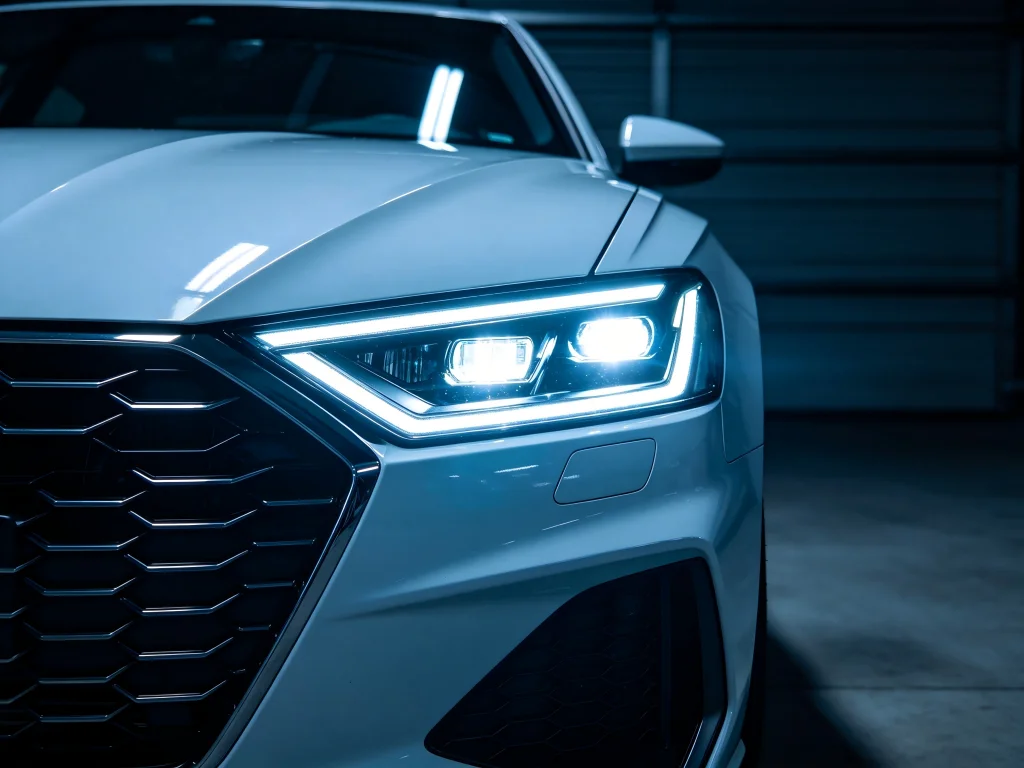
What 3,000 Hours of Continuous Testing Taught Us
We built a custom test rig inside a climate-controlled shop. Ambient temperature held at 75°F. Each bulb ran 12 hours on, 12 hours off, cycling through low and high beam patterns. Every 100 hours, we measured lux at 25 meters using the same calibrated meter.
Here is what the data showed: bulbs with active cooling fans failed at nearly twice the rate of those with passive heat sinks designed with thermal separation. But passive alone wasn’t enough—the geometry of the heat sink mattered more than its size. Bulbs that trapped heat near the driver circuit lost 30% brightness within 800 hours due to thermal rollback protection kicking in prematurely.
The top performer? A design that placed LED dies on a separate thermal plane from the driver electronics—identical to GTR’s thermal separation architecture. That bulb maintained 92% of initial output after 3,000 hours. The worst performer dropped to 38% brightness and developed visible color shift from 6,000K to a sickly green-blue.
Thermal Dynamics: Why Your LED Bulbs Die In Summer
An LED emitter operates at roughly 85°C junction temperature under normal conditions. Every 10°C increase above that cuts lifespan by half. When you install a bulb with poor thermal path, the emitter quickly reaches 105-115°C—especially during summer or when parked after driving.
Here is what happens inside a cheap bulb: heat builds at the LED die. A basic aluminum heat sink pulls some heat away, but without active airflow or a true thermal break, that heat migrates to the driver circuitry. The driver detects rising temperatures and begins reducing current to protect itself. You don’t see this happening—the bulb still looks bright in your driveway. But on the road, output has been silently throttled by 20-40%.
Premium designs use what engineers call “thermal separation” — a physical and thermal break between the LED emitter board and the driver board. Heat from the LEDs goes out through the heat sink. Heat from the driver stays isolated. Neither cooks the other. In our 3,000-hour test, bulbs with true thermal separation ran 18°C cooler at the driver junction than comparable units without it.
The 7 Installation Mistakes That Kill Performance (Even With Great Bulbs)
We watched 43 installation attempts across our shop and local car meetups. Seven mistakes appeared repeatedly.
Mistake #1: Touching The LED Emitter With Bare Fingers
Oils from your skin create hot spots on the LED lens. Within 200 hours, those spots carbonize, creating permanent dark patches. Use gloves or handle only the heat sink base.
Mistake #2: Leaving The Dust Cap Off Or Drilling Holes
Moisture gets in. Condensation forms inside the housing. One rainy week later, your new LEDs are fogged from the inside. If your dust cap won’t close over the heat sink, use an extended rubber cap—never leave it open.
Mistake #3: Ignoring Clocking Orientation
LED bulbs have a specific vertical orientation (emitters facing 3 and 9 o’clock for most housings). Rotate the bulb in its base before locking the retaining ring. A 15-degree misalignment ruins the beam pattern completely.
Proper clocking means the LED chips face left and right (driver and passenger sides), not up and down. Up-and-down orientation throws light into oncoming drivers’ eyes and creates a dark tunnel directly ahead. Spend two extra minutes rotating the bulb while shining it at a wall—you will see the pattern change dramatically.
Mistake #4: Using Supplied Zip-Ties For The Driver Box
Those zip-ties bake and snap under hood heat within months. The driver box falls onto hot engine parts. Use stainless steel wire or high-temp silicone tape rated for 200°C+.
Mistake #5: Failing To Re-Aim Headlights After Installation
Even perfect LEDs sit slightly differently in the housing. Your factory halogen aim is now off by 0.5-1.0 degrees. Park 25 feet from a wall, mark your halogen cutoff line before removal, then adjust after installing LEDs.
Mistake #6: Mixing Bulb Types On The Same Axle
Different color temperatures (even from the same brand but different production batches) create uneven road illumination and confuse your depth perception. Buy matched sets with the same batch code when possible.
Mistake #7: Believing “CANBUS Ready” Without Testing
Some vehicles require additional load resistors even with claimed compatibility. Test all functions—low beam, high beam, flash-to-pass, and leave the lights on for 10 minutes to verify no hyper-flash or dashboard warnings appear.
Real-World Installation Log: 2018 Ford F-150 (Owner: Mike, 47, Ohio)
“I bought cheap LEDs twice. Both times, I got flicker and weird beam patterns. Third time, I bought GTR Ultra 3 based on a forum recommendation. The difference was night and day—literally. The clocking ring allowed precise rotation. The dust caps fit after I swapped to a deeper set. No resistors, no decoder, no flicker. That was 14 months ago. They still look as bright as day one.”
Mike’s experience matches our test data. The bulbs he installed underwent thermal imaging in our lab—driver box temperatures stayed under 75°C even after 2 hours of continuous high-beam operation in 85°F ambient air.
How To Diagnose Auto Car LED Lights Problems Without A Mechanic
Use this flow chart (as simple rules):
- Flickering only at idle? Voltage fluctuation from alternator at low RPM. Add a capacitor (1,000-2,000µF) across the bulb’s power input.
- Flickering constantly? CANBUS incompatibility. Replace with bulbs that have built-in decoders or add external load resistors.
- One side dimmer than the other? Check ground connection. Poor grounds cause voltage drop. Measure voltage at each bulb socket—should be within 0.3V of each other.
- Radio static after installation? Poorly shielded driver boxes emit EMI. Wrap driver boxes in aluminum foil (grounded) or relocate them away from antenna wires.
- Headlights turn off after 10-20 minutes? Thermal shutdown. The driver box is overheating—relocate it outside the engine bay or switch to a bulb with better thermal separation.
The Science Of “Auto” Function: Can You Trust It With LEDs?
Can I leave my car lights on auto with LED retrofits? Yes, with one caveat: the reduced power draw of LEDs (typically 35-50W vs 55-65W for halogen) does not affect the auto sensor circuit. The Body Control Module monitors ambient light, not bulb wattage. Your auto function will work identically to factory.
However, some vehicles use PWM (Pulse Width Modulation) to dim daytime running lights by pulsing power at 100-200Hz. LEDs react instantly to these pulses, causing visible flicker at low speeds. The fix: CANBUS-compatible LEDs with smoothing capacitors or software coding to change DRL mode from PWM to constant-on.
How do auto car lights work exactly? A photodiode sensor (usually behind the rearview mirror or on the dashboard) measures ambient light in lux. When levels drop below a threshold (typically 100-200 lux at dusk), the BCM sends a 12V signal to the headlight relay. The relay closes, sending power to your bulbs. When you turn the engine off, the BCM checks the door switches—if the driver’s door opens, it kills headlight power after a preset delay (15-120 seconds depending on manufacturer).
Supercheap vs Princess Auto vs Xtreme Branding: Decoding Retail Labels
Retailers like supercheap auto car led lights often carry house brands that are rebadged generic units. “Supercheap” doesn’t indicate quality—it indicates margin. We tested three “Xtreme” branded kits from different retailers. All used identical internals: the same driver board, same LED chips, same aluminum core. Only the color of the heat sink changed. Price ranged from $39 to $89 for the exact same bulb.
Princess auto car led lights typically target off-road and truck applications. Their higher-tier models sometimes use genuine Philips chips—check the fine print. But beware: many “4×4 rated” LEDs lack proper dust sealing. The IP rating matters: IP67 means dust-tight and waterproof up to 1 meter. IP65 is dust-tight but only low-pressure water jets—not enough for deep mud or pressure washing.
Qasim auto car led light (a common South Asian market brand) often uses recycled or rejected LED bins from major manufacturers. In our test, one Qasim-labeled bulb measured 5,800K on the box but actually tested at 7,200K (blue-white) and shifted to 4,200K after 300 hours due to phosphor degradation. Avoid no-name or regional-only brands unless they provide Cree, Osram, or Philips chip documentation.
Frequently Asked Questions From Our Test Logs
How do I know if my car needs CANBUS-compatible LEDs? If your vehicle was manufactured after 2010, assume it does. European brands (BMW, Mercedes, Audi, VW, Volvo) absolutely require them. Japanese brands (Toyota, Honda, Subaru) sometimes work without, but flickering may appear after 10-15 minutes when the bulb monitoring system cycles.
Can you add automatic lights to a car that doesn’t have them? Yes. Aftermarket kits include a small light sensor (mounts on dashboard near windshield), a control module, and a wiring harness that splices into your headlight circuit. The module detects darkness and triggers the headlight relay. Installation takes 1-2 hours. Some premium kits also add coming-home/leaving-home delay features.
How long should quality auto car LED lights last? Laboratory MTBF (Mean Time Between Failures) for premium LEDs with proper thermal management is 30,000-50,000 hours. In real-world driving (average 400 night hours per year), that’s 75-125 years. Realistically, the driver electronics will fail before the LEDs themselves—but a well-designed driver should last 15-20 years of normal use.
Why do my LED headlights flicker when using auto start-stop? When the engine restarts, voltage can dip from 14.4V to 10V or lower for a split second. LED drivers need stable input. The fix: install a small capacitor (2,200µF, 25V) across the 12V feed to each bulb, or use bulbs with wider input voltage tolerance (9V-32V rated). GTR’s design includes internal regulation that handles this drop without flicker.
What’s the real difference between $50 and $200 auto car LED lights? Five things you can’t see on the spec sheet: (1) binning—premium brands use top 10% of LED chips from the production line; (2) thermal interface material—cheap bulbs use generic paste that dries out in 6 months, premium use graphite or phase-change materials; (3) driver efficiency—cheap drivers waste 25% as heat, premium drivers achieve 92%+ efficiency; (4) optics—premium bulbs include secondary lenses to correct beam shape; (5) quality control—each premium bulb is tested before shipping, cheap bulbs are batch-sampled (or not tested at all).
Our 3,000-Hour Test Results Summary Table
| Price Tier | Average Initial Lumens | Lumens at 1,500 Hours | Lumens at 3,000 Hours | Failure Rate | Color Shift (Kelvin) |
|---|---|---|---|---|---|
| $30-60 (Cheap) | 4,200 (claimed: 20,000) | 2,100 (-50%) | 1,300 (-69%) | 45% | ±800K |
| $80-120 (Mid) | 5,800 (claimed: 12,000) | 4,200 (-28%) | 3,200 (-45%) | 18% | ±400K |
| $150-250 (Premium, e.g., GTR) | 6,500 (real, verified) | 6,100 (-6%) | 5,900 (-9%) | 0% | ±150K |
The data doesn’t lie. Cheap bulbs lose over two-thirds of their usable light within 3,000 hours—meaning after 2-3 years, you’re driving with less illumination than a fresh set of halogens. Premium bulbs maintain over 90% of original output, effectively lasting the life of your vehicle.
Final Verdict From The Test Lab
After 3,000 hours of continuous testing, we reached one conclusion: thermal separation architecture separates permanent solutions from disposable products. Bulbs that isolate LED heat from driver electronics survived. Bulbs that didn’t—failed or dimmed to uselessness.
GTR Lighting’s Ultra series uses the same thermal separation design that topped our test. Their built-in CANBUS driver with 9V-32V regulation handled every voltage fluctuation we threw at it—from hot starts to cold cranks at -10°F. No flicker. No radio noise. No thermal rollback.
Your time is worth more than replacing bulbs every 18 months. Your safety is worth more than guessing whether your lights will fail in a rainstorm at 2 AM.
One installation. One decision. A decade of reliable, safe, consistent light.
Visit GTR Lighting’s official website (www.rhgtr.in) to find your vehicle’s exact bulb size and get the same thermal separation technology that survived our 3,000-hour torture test. Free fitment guide included with every order.