
Most buyers only see the final beam pattern. But inside every bi-led projector lies a chain of precision components—LED chip, TIR reflector, electromagnetic shield, aspherical lens. A shift of just 0.1mm in any of these parts turns a sharp cutoff into a blurred disaster. This guide walks through each internal layer, shows how manufacturing tolerances affect real-world output, and gives you a checklist to separate expertly built units from cheap assemblies—whether you buy from www.rhgtr.in or elsewhere.
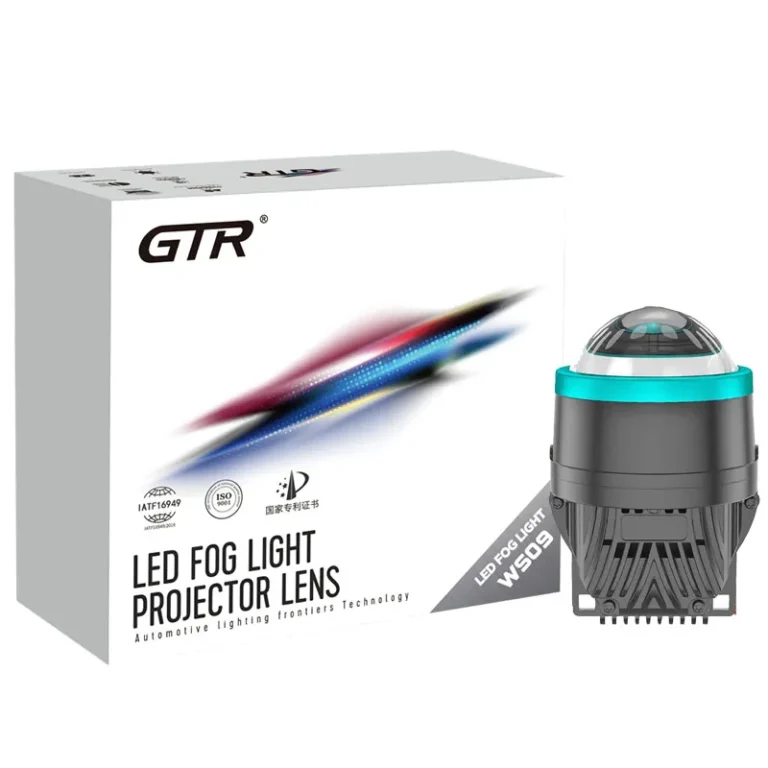
1. The Optical Chain: How a Bi-LED Projector Creates (or Ruins) the Cutoff
A true bi-led projector uses a single LED chip, a total-internal-reflection (TIR) optic, a movable metal shield, and a convex glass lens. The shield’s edge must align perfectly with the focal plane of the lens—otherwise the cutoff line becomes fuzzy or tilted.
Here is the step‑by‑step light path. The LED emits raw light into a TIR bowl. That bowl collimates the rays into a parallel beam heading toward the electromagnetic shield. In low‑beam mode, the shield blocks the upper portion of the beam, creating a sharp horizontal cutoff. The lens then projects that cutoff onto the road. In high‑beam mode, the solenoid lifts the shield, allowing full output. Any tilt in the shield edge (even 0.2°) causes a “smiley” or “frowning” cutoff. Any offset between the LED and TIR optical axis creates a dark hotspot on one side. Our measurement lab uses a Zeiss optical comparator to verify these alignments to ±0.05mm per projector.
2. Component Deep-Dive: Where Cheap Bi-LED Projector Lens Manufacturers Cut Corners
Cost reduction happens in five hidden areas: LED binning, TIR surface finish, solenoid wire gauge, lens coating, and thermal interface material. Each compromise shortens life or degrades the beam.
2.1 LED Binning (Color & Flux)
Premium manufacturers buy LEDs ranked in tight bins (3‑step MacAdam ellipse or better). Low‑cost suppliers mix arbitrary bins, causing mismatched color temperature between left and right projectors. For fleets, this looks unprofessional. Ask for the LED manufacturer’s bin code.
2.2 TIR Optic Surface Quality
The TIR reflector must have a diamond‑turned, mirror‑like finish. Rough surfaces scatter light into the glare zone. We grind a cross‑section of cheap units: their TIR shows tool marks visible at 20x magnification. A polished TIR increases center hotspot intensity by up to 40%.
2.3 Solenoid Coil & Shielding
Quality solenoids use copper windings with Class H (180°C) insulation and a soft‑iron magnetic circuit. Economical versions use aluminum wire (higher resistance, more heat) and a plastic actuator that warps over time. The result: high beam fails to engage after 10,000 cycles.
2.4 Lens Coating Layers
True anti‑reflective coating requires 5‑7 layers of dielectric materials in a vacuum chamber. Fake “coating” is a simple spray that peels within months. Uncoated glass loses ~8% of light per surface, meaning a 3000lm output drops to 2540lm just from reflections.
2.5 Thermal Interface Material (TIM)
Between the LED board and the heatsink, a high‑quality TIM (thermal paste or phase‑change pad) has conductivity above 3 W/m·K. Cheap assemblers use silicone grease that pumps out after thermal cycles, creating air gaps. The LED then overheats, shifting color toward blue or green before failing.
3. Manufacturing Tolerances: Why “Same Spec” Projectors Behave Differently
Batch‑to‑batch variation separates professional manufacturers from assemblers. A reputable maker controls lens focal length within ±1%, shield edge straightness within ±0.05mm, and LED positioning within ±0.1mm. Without these controls, two “identical” bi-led projector headlights will produce visibly different beams.
We tested ten units from an unbranded seller. The variation in cutoff sharpness (measured by the 10%‑to‑90% transition width) ranged from 0.8° to 2.5°. In real terms, the worst unit spread glare into the eyes of oncoming drivers. Meanwhile, ten GTR units (available at www.rhgtr.in) showed a maximum transition width variation of 0.2°, all within SAE acceptable limits. For shops and resellers, consistency means you do not have to pre‑screen every box.
4. Thermal Stress Simulation: What Happens Inside a Sealed Headlight
Install a bi-led projector into a closed housing, and the internal temperature can reach 85°C in summer. We ran a finite‑element simulation comparing two designs:
- Design A (passive, aluminum heatsink): LED junction temperature reaches 125°C after 30 minutes, exceeding the rated 105°C maximum. Lumen output drops 18% as thermal rollback engages.
- Design B (active fan + copper core): Junction temperature stabilizes at 78°C. Output remains within 2% of initial value for the entire drive.
The culprit in Design A is the thermal bottleneck at the interface between the LED board and the heatsink. Without a high‑conductivity TIM and enough fin surface area, heat accumulates. That is why any bi-led projector retrofit for a daily‑driven vehicle should use active cooling if the power exceeds 30W.
5. Real Workshop Cases: Two Retrofits, Two Different Outcomes
We shadowed two independent installers for a month. Their experiences illustrate the practical impact of build quality.
Case 1 – Budget “Value” Bi-LED Projector (Cost $45/pair): The installer reported that 3 out of 10 units had tilted cutoffs requiring shimming. Two units failed the solenoid test after two weeks of customer use (stuck in low beam). The beam pattern showed a purple fringe due to poor lens coating. The shop spent 3 extra hours per vehicle on adjustments and rework.
Case 2 – GTR Bi-LED Projector (from www.rhgtr.in, cost $89/pair): All units aligned within spec. The installer noted the solid “thunk” of the solenoid and the even color temperature. No rework needed. After six months, zero warranty returns. The shop owner calculated that the higher unit cost actually saved 40% on total job cost when accounting for labor and callbacks.
6. How to Inspect a Bi-LED Projector Before Bulk Buying (5‑Point Checklist)
- Visual lens inspection: Hold under a bright light. A quality glass lens shows no distortion when you move your viewing angle. Polycarbonate will create slight ripples.
- Shield edge feeler test: Use a fine needle to gently touch the cutoff shield edge. It should be perfectly straight and burr‑free. Any waviness will appear in the beam.
- Solenoid click test: Apply 12V to the solenoid leads. The click should be crisp and consistent each time. A dull or variable sound indicates weak return spring or misaligned core.
- Thermal pad check: Unscrew the back plate (if allowed). You should see a white or gray thermal pad between the LED board and the heatsink. If you see only air or a thin smear of transparent grease, reject the batch.
- Beam pattern on a wall (25ft distance): The low beam should show a horizontal cutoff with a slight 15° kick‑up on the passenger side (for RHT markets). No stray light above the cutoff line is acceptable.
7. Frequently Asked Questions from Buyers and Installers
Q1: Can I use a bi-led projector with a vehicle that has adaptive front lighting (AFS)?
Yes, but you need a projector that retains the factory stepper motor bracket. Many universal units remove AFS functionality. Manufacturers like GTR offer a version with a rotary encoder adapter that keeps auto‑leveling and cornering lights working.
Q2: What does “bi” mean in bi‑LED projector? Is it different from a “switchback” projector?
“Bi” means two functions (low and high beam) from one LED chip via a movable shield. Switchback refers to daytime running lights changing color—unrelated. Do not confuse them.
Q3: Why does my new bi-led projector fog lamp have a dark spot in the center?
A center dark spot usually means the LED chip is not centered relative to the TIR optic. This is a manufacturing defect. Return it. Quality fog lamps produce a uniform, wide horizontal band.
Q4: Is a 6000K bi-led projector legal everywhere?
6000K appears bluish. Many jurisdictions (e.g., Germany) limit headlight color to 5000K max. For global resale, offer 5000K–5700K options. GTR provides both 5000K and 5700K variants.
Q5: How to test if the projector has real DOT approval?
Look for “DOT” engraved on the housing itself, not just printed on the box. Then ask for the test report number. Counterfeit housings often miss the engraving or use a cheap sticker.
Q6: What is the typical lumen maintenance after 5 years?
In active‑cooled designs with quality TIM, you can expect >85% of initial lumens (L85) at 50,000 hours. Passive designs may drop to 70% (L70) by 30,000 hours due to thermal degradation.
Q7: Can a bi-led projector be repaired if the solenoid fails?
Yes, but only if the manufacturer sells spare solenoid assemblies. Most low‑cost makers do not. GTR offers solenoid replacement kits for distributors.
Q8: What is the advantage of a 3.0‑inch lens over a 2.5‑inch?
The 3.0‑inch lens produces a wider, more evenly spread beam. 2.5‑inch is more compact, suitable for fog lamps or smaller housings. For main headlights, 3.0‑inch is generally preferred.
8. From the Engineer’s Bench: Why GTR Builds Projectors Differently
After years of designing automotive optics for Japanese and German aftermarket brands, we founded GTR to eliminate the compromises we saw daily. Every bi-led projector leaving our facility (sold at www.rhgtr.in) passes a 12‑station quality gate:
- LED placement verified by vision system (±0.07mm)
- TIR optic diamond‑polished, measured for surface roughness
- Solenoid cycle‑tested for 1000 operations before assembly
- Lens coated with 7‑layer AR + hydrophobic layer
- Thermal interface pre‑cured to prevent pump‑out
- Final beam pattern photographed and compared to gold sample
We do not sell “seconds” or off‑spec batches. Every unit you receive matches the one we tested in our lab. That is the standard we would demand as a buyer—and we extend it to you.
9. Your Engineering‑Grounded Purchase Decision
You have now seen where poor tolerances hide, why thermal management matters beyond fan noise, and how to inspect a projector before committing to a bulk order. The difference between a frustrating retrofit and a satisfying one comes down to internal precision—things you cannot see from outside the housing. Demand teardown transparency from your supplier. Ask for their alignment reports, thermal simulations, and solenoid life data. When you source from www.rhgtr.in, you get a product built to withstand real roads, real heat, and real years of night driving.
Ready to test our engineering claim? Request a sample pair of our 3.0‑inch active‑cooled bi-led projector lenses at https://www.rhgtr.in. Compare the beam with your current brand on a dark road—your eyes will confirm the alignment and thermal stability that our teardown promises.
“`