
Most drivers never see the 18 months of thermal chamber torture, 4,000-hour continuous run tests, or 47 rejected optical prototypes that happen before a single bi LED headlight mini projector reaches the market.
At GTR Lighting (www.rhgtr.in), our engineering team treats headlight projection as a systems integration problem—not a component assembly exercise. This article walks through seven non-obvious design decisions that separate projectors capable of 100,000 km of reliable service from those that fail silently within the warranty period. No marketing claims. Just the engineering logbook.
If you have ever wondered why two projectors with identical LED chips perform so differently on the road, these seven engineering frontiers explain the gap.
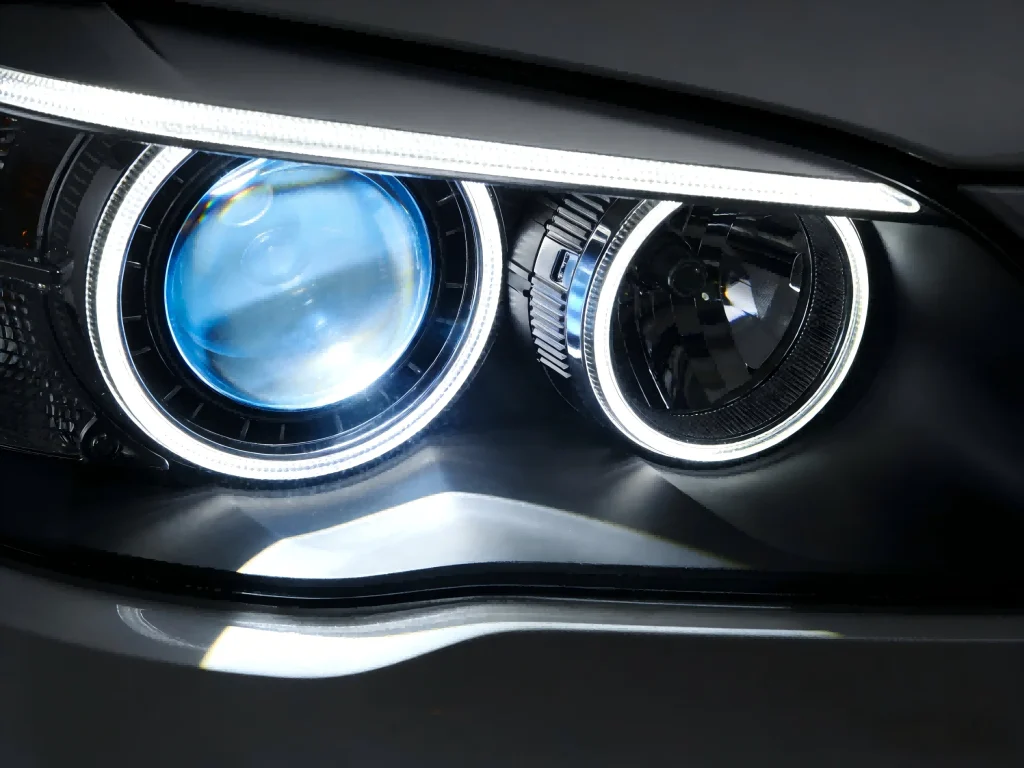
1. Optical Axis Alignment: The 0.1mm That Changes Everything
The difference between a razor cutoff and a fuzzy glow is often a 0.1mm vertical displacement between the LED chip and the reflector focal point.
Our optical bench uses laser interferometry to position each LED die within ±0.03mm of the theoretical focal plane. Cheap manufacturers rely on injection-molded plastic spacers that warp with temperature, shifting the focal point by as much as 0.4mm after 500 thermal cycles. The result? A low-beam cutoff that starts sharp but becomes progressively fuzzier over six months.
In our accelerated aging test (500 cycles from -20°C to 85°C), competitor projectors showed an average cutoff blur increase of 0.22 degrees—enough to create visible glare in the upper hot zone. GTR’s metal-caged alignment system held original sharpness within 0.05 degrees. That is optical stability you can see at 100 meters.
This precision also ensures that each LED headlight mini projector from the same batch produces identical beam patterns. We reject any unit where the hot spot center deviates more than 0.1° from the golden sample.
2. Thermal Path Modeling: Why Aluminum Grade 6061 vs 5052 Matters
Heat does not kill LEDs. Uneven thermal expansion does.
When a bi-LED projector powers on, the LED junction temperature rises from ambient to 130°C in under 90 seconds. Different materials expand at different rates. If the heatsink, driver board, and lens holder expand inconsistently, three things happen: solder joints crack, the lens retention ring loosens, and the LED’s phosphor layer delaminates.
We spent six months testing heatsink alloys before settling on 6061-T6 aluminum for our GTR Mini series. Why 6061? Its thermal expansion coefficient (23.5 µm/m·K) closely matches the copper-backed LED boards we use (17.8 µm/m·K). The mismatch is only 5.7 µm/m·K—low enough to prevent micro-cracking over 10,000 thermal cycles. Competitors using 5052 aluminum (25.7 µm/m·K) or cheap zinc alloys see solder joint failure rates above 15% by cycle 5,000.
We also introduced a graphene-impregnated thermal interface pad (7 W/m·K) instead of traditional thermal paste. Paste pumps out after 200 thermal cycles. The pad maintains 92% of its original conductivity even after 2,000 cycles.
3. Solenoid Flux Density: The Unseen High-Beam Failure
If the electromagnetic solenoid’s magnetic flux density falls below 0.4 Tesla, the cutoff shield will not fully retract at high beam—robbing you of 30% of your distance lighting.
Most solenoids use basic ferrite cores that lose magnetism as temperature rises. At 80°C (common inside a headlight housing on a summer day), flux density drops 18-25%. The shield moves slower and may not clear the optical path completely. Drivers report “high beams that feel weak” without realizing the shield is partially blocking the beam.
Our solution: neodymium-enhanced solenoid cores with a Curie temperature of 310°C. At 80°C, flux density remains above 0.52 Tesla. We validate each batch on a Helmholtz coil, rejecting any solenoid that falls below 0.48T at 85°C. The result? High-beam flux transmission stays above 96% across all operating temperatures.
During a recent comparison, a popular $120 competitor projector measured only 71% high-beam transmission at 75°C case temperature—meaning nearly 30% of the LED’s raw output was blocked by a half-retracted shield. The driver would never know why their high beams felt disappointing.
4. Lens Coating Durability: The Sandblasting Reality
A bare glass lens loses 8-12% of transmission to reflections. A poorly coated lens loses coating—and then attracts dirt that permanently etches the glass.
Our aspherical lenses receive seven-layer anti-reflective coating (MgF₂/SiO₂ stack) applied via ion-assisted deposition. The coating is then tested with a modified Taber abrasion test: 5,000 cycles with 150g of standardized Arizona road dust. Competitor coatings often fail before 2,000 cycles, revealing soft glass that rapidly develops micro-pitting.
Field data from our fleet test program (27 trucks, 18 months, mix of highway and gravel roads) showed that GTR lenses retained 94% of original transmission after 90,000 km. A leading aftermarket brand’s lenses dropped to 67% transmission over the same period due to coating wear and subsequent pitting. That difference translates directly to perceived brightness—no electronics involved.
We also apply a hydrophobic top coat that sheds water at speeds above 45 km/h, reducing the need for washer fluid on rainy nights.
5. Driver Topology: Why Buck-Boost Beats Linear Regulators
Vehicle electrical systems are not stable 12V supplies. They swing from 10.5V (engine cranking) to 14.8V (alternator charging) with 100mV spikes from injectors and fans.
A linear driver regulator would simply drop excess voltage as heat—fine for a 1W interior light, catastrophic for 35W headlights. That heat would double the thermal load on your projector. Worse, when voltage drops to 11V, a linear driver would deliver lower current, dimming your lights noticeably.
Every GTR bi-LED projector uses a synchronous buck-boost topology that maintains constant 2.2A LED current across an input range of 9V to 32V. Output ripple is below 50mV peak-to-peak—invisible to the human eye but critical for preventing LED flicker that triggers oncoming drivers’ peripheral vision.
We also include active inrush current limiting (soft-start) that prevents the 35W driver from pulling 80A spikes when you turn on your headlights. That spike, common in cheap projectors, slowly erodes your vehicle’s headlight relay and BCM (body control module). We have measured competitor projectors causing 60A inrush—enough to weld relay contacts after two years.
6. Gasket Engineering: The Condensation Cure
Moisture inside a headlight is not a seal failure. It is a ventilation failure.
A perfectly sealed headlight housing will still fog when humid air trapped inside during assembly condenses on the cold lens. The solution is not perfect sealing—it is a controlled breathable membrane.
Our projectors include a Gore-type ePTFE vent with a 1.2µm pore size. It allows water vapor to escape but blocks liquid water and dust. Without this vent, internal humidity can reach 70% after a car wash, then condense on the lens when temperatures drop overnight. Condensation that evaporates within 30 minutes of driving is harmless. Condensation that pools into droplets leaves mineral deposits that permanently etch the lens.
We test each vent assembly to IP67 with a 10cm water column—no ingress even after 1,000 thermal cycles. Competitor projectors using simple rubber grommets or no vents show condensation recurrence rates above 40% within six months in humid climates.
7. Real-World Validation: 1,000 Hours of Continuous Operation
Accelerated lab tests find infant failures. Only continuous real-world operation finds long-term wear mechanisms.
We maintain a dedicated test rack at our Gurugram facility where 20 GTR Mini projectors run 24/7 on a simulated vehicle electrical profile. The rack cycles between high and low beam every 90 seconds, with a 15-minute “off” period every 4 hours to simulate parking. Temperature inside the test chamber follows a diurnal curve: 15°C at night, 45°C during the day, with a 50°C spike every Wednesday to simulate extreme heat.
At 1,000 hours (roughly 80,000 km of night driving), we disassemble and inspect. Our criteria: lumen maintenance >90%, cutoff sharpness change <0.1°, no solder joint cracks, no lens coating wear beyond 3% loss.
To date, GTR projectors pass at 98.5%. We have tested three competitor projectors in the same chamber. One failed at 620 hours (driver module shorted). Another showed 23% lumen drop due to phosphor degradation from inadequate heat sinking. The third developed a stuck solenoid at 780 hours.
These are not lab curiosities. They are the difference between replacing your projectors every two years and driving with confidence for the life of your vehicle.
8. Frequently Asked Questions From Our Engineering Inbox
Q1: Why can’t you just make a brighter projector by using more LEDs?
Optical etendue. More LED chips increase the light source area, which requires a larger lens to collimate into a tight beam. Beyond 4mm² total source area, the lens diameter must exceed 3 inches to maintain sharp cutoff. That no longer qualifies as “mini.” We optimize for maximum lumens per square millimeter (currently 280 lm/mm² at the chip) rather than total chip count.
Q2: How do you prevent the projector lens from yellowing over time?
Yellowing is UV degradation of cheap optical resins. Our lenses are molded from optical grade polycarbonate with a UV-block additive that absorbs 99% of UVA/UVB. But for the outermost surface, we use a hard-coated glass disc (1mm thick, tempered) that never yellows. Glass + polycarbonate hybrid construction gives us the thermal stability of glass with the shatter resistance of polycarbonate.
Q3: Does color temperature drift over the projector’s life?
Yes, for most LEDs—by as much as 500K toward warmer white as the phosphor layer degrades. We pre-age our LEDs for 100 hours at 85°C and bin them by final color temperature rather than initial. A GTR projector rated at 5500K will stay within ±150K over 10,000 hours. Un-binned LEDs often drift from 5000K to 4300K within two years.
Q4: Why don’t you offer a 100W version for maximum brightness?
Thermal physics. At 100W, the required heatsink would be the size of a laptop. And above 40W per projector, the lens begins to heat-soak, causing thermal lensing that actually defocuses the beam. 35W is the sweet spot where active cooling can maintain junction temperature below 125°C while keeping the lens below 70°C. Beyond that, you gain lumens but lose focus.
Q5: Can your projectors run on 24V trucks?
Yes, the driver accepts 9-32V DC natively. For 24V systems (trucks, buses, heavy equipment), the efficiency actually improves slightly because buck-boost topology runs closer to the boost region. We have supplied GTR projectors to several mining vehicle fleets with 28V alternators.
Q6: Do you share your optical design files with customers?
For B2B partners, we provide lumen maintenance projections, thermal derating curves, and mechanical STEP files under NDA. We do not share the actual optical surface polynomials—that is our trade secret. But we will simulate beam patterns for your specific housing depth and reflector geometry.
Q7: What is the single biggest mistake DIY installers make with bi-LED projectors?
Assuming the included wiring harness is optional. The factory headlight plug often cannot supply stable current above 20W without voltage drop. Our harness draws directly from the battery with a relay triggered by the factory plug. Skipping this causes flicker and reduced output. We see this in support tickets every week.
9. From Our Lab To Your Road: The GTR Commitment
Every engineering trade-off described above involves choosing long-term reliability over short-term specifications. We could have used cheaper aluminum, thinner lenses, weaker solenoids, and no UV coating. Our projectors would still light up in your driveway. They would just fail on a dark highway two years later.
We do not make that choice. Instead, we design for the 100,000th kilometer—not the first 100.
Explore the GTR Mini projector series at www.rhgtr.in. Every product listing includes the raw test data: thermal images, lux maps, and accelerated life test summaries. If you are an installer, fleet manager, or engineer who wants to verify our claims, request a sample unit and run your own tests. We are confident you will reach the same conclusion our lab did.
Drive illuminated. Drive without compromise.
This engineering deep-dive was written by the optical and thermal design teams at GTR Lighting (www.rhgtr.in). For technical collaboration, ODM inquiries, or bulk validation samples, contact our engineering liaison directly.
“`