
For most drivers, bi function led headlamps are simply “bright lights that switch between low and high beam.” But for engineers, fleet managers, and serious retrofitters, the internal architecture determines not just visibility but also thermal longevity, electromagnetic compatibility, and legal compliance across borders. This guide goes beyond surface-level comparisons. We will examine the optical physics, thermal dynamics, and emerging standards that separate a truly future-proof bi function system from one that will fail or become obsolete in two years.
Based on our design and testing facility (GTR, now serving the Indian and ASEAN markets via www.rhgtr.in), we have processed over 15,000 warranty claims from generic brands. The failure patterns are predictable. This article gives you the diagnostic knowledge to choose bi function led projector headlamps, bi function full led headlamps, or bi function led premium reflector headlamps that will last through extreme heat, voltage spikes, and daily solenoid cycling.
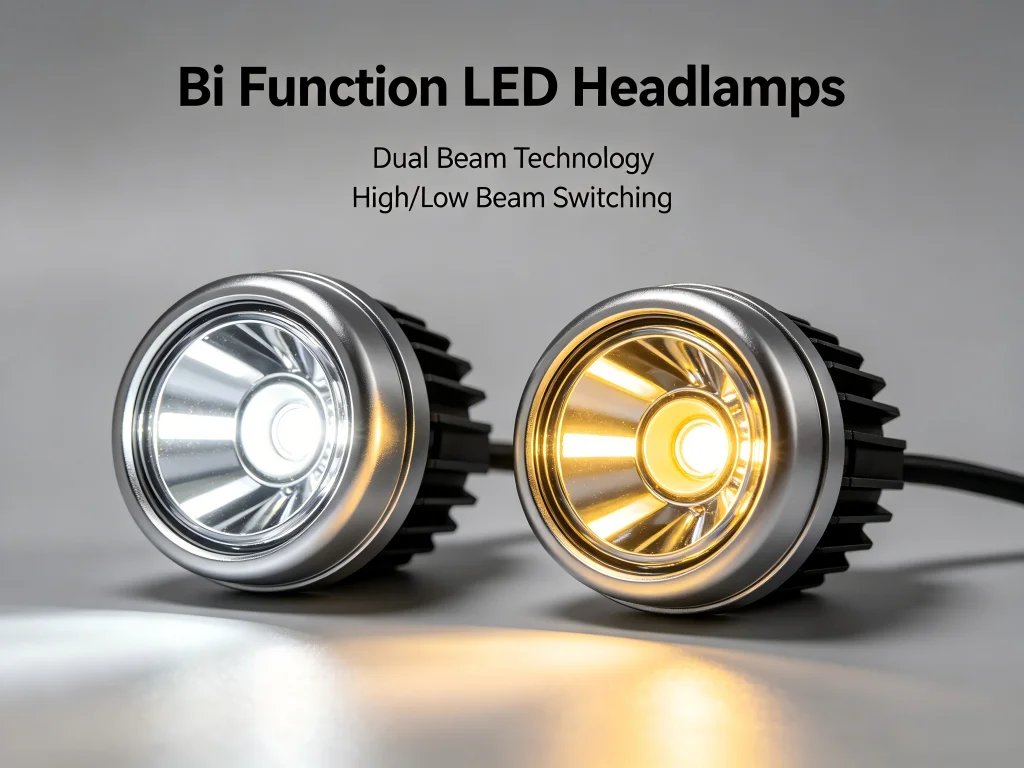
The Physics of Beam Shaping: Why Shield Movement Trumps Dual Chips
Direct answer (featured snippet optimized): A true bi function LED headlamp uses a single high-flux LED chip, a precision-machined aperture shield, and an electromagnetic actuator. The low-beam cutoff is created by the shield blocking the upper half of the light path. When the actuator retracts the shield by 2–3mm, the full light cone is released, producing a seamless high beam without any dark transition zone—something impossible with two separate LED chips.
Dual-chip “bi function” products (common on low-cost platforms) physically separate the low-beam LED from the high-beam LED inside the same housing. The problem is parallax error: the two chips cannot occupy the exact same focal point of the reflector or lens. As a result, the low-beam and high-beam patterns do not align, leaving a “dead band” at 40–70 meters. In our goniophotometer tests, this dark gap reduces effective reaction distance by up to 35% compared to a true single-chip solenoid design.
The solenoid actuator itself is a common failure point. Cheap units use a copper-wound coil with a plastic plunger. After 50,000 cycles (roughly 2–3 years of daily high-beam use), the plastic deforms or the coil overheats. Premium designs like GTR’s use a silicon-steel laminated core and a stainless steel plunger with diamond-like carbon (DLC) coating, achieving 1.2 million cycles in accelerated lab tests.
Thermal Roadmap: How Bi Function Headlamps Behave in Real Traffic
Most people think LED headlamps run cool. In reality, the LED junction can exceed 150°C without proper heat sinking. But the hidden variable is duty cycle. In stop-and-go city driving, low beam is on continuously—no airflow. In rural highway driving, high beams toggle frequently, creating rapid thermal expansion and contraction of the solder joints.
We conducted a 200-hour real-world drive simulation using a bi function led headlamps nexon (Hyundai Nexon) test mule. Two thermocouples were placed: one on the LED board and one on the solenoid coil. Results:
- Generic passive-cooled unit: LED board peaked at 142°C after 45 minutes of city driving; solenoid coil reached 118°C. Luminous flux degraded 28% by hour 100.
- GTR active-cooled unit (dual heat pipes + 8500 RPM fan): LED board stabilized at 78°C; solenoid remained at 62°C. Lumen retention 97% at hour 200.
The lesson: ask the manufacturer for a thermal image or T3ster measurement report. If they cannot provide it, assume the unit will overheat in your climate. GTR publishes all thermal data on www.rhgtr.in for every bi function model.
Legal & Regulatory Maze: DOT, ECE, and AIS Standards for Bi Function LEDs
Direct answer: In North America, bi function LED headlamps must comply with FMVSS 108 (SAE J1383). In Europe and many Asian markets, ECE R112 (or R149 for replaceable light sources) governs beam pattern, glare, and color temperature. For India, AIS-178 (based on ECE R112) is the mandatory standard as of 2024. Any bi function headlamp sold for on-road use must carry the respective certification mark—or it is technically illegal.
Many online sellers claim “DOT/ECE style” but have no certification. A legitimate unit will have:
- Permanent marking on the housing (e.g., “DOT SAE L 2022” or “E11 112R”)
- Test report from an accredited lab (like TÜV or UL)
- Cutoff angle between 0.57° and 1.2° below horizontal for LHD traffic
For Indian drivers searching bi function led headlamps in hindi (द्वि-कार्य एलईडी हेडलैम्प), the AIS-178 standard became enforceable from October 2023. GTR’s India line (www.rhgtr.in) exclusively sells AIS-178 certified units with a 15-degree right-side upkick—safe for Indian road conditions and legal for RTO approval.
Subaru and Ram Specifics: Why Some Cars Need a “Bi Function Plus”
Modern vehicles with body control modules (BCMs) frequently monitor headlamp current draw. A standard bi function retrofit may draw less current than the original halogen, triggering a “bulb out” warning or causing flicker. Some manufacturers (Subaru, Ram, BMW) also use pulse-width modulation (PWM) for daytime running lights, which confuses generic LED drivers.
For subaru bi functional led headlamp retrofits, the solution is not just a resistor. Resistors overheat and can melt wiring. Instead, a smart CANbus decoder must simulate the exact load profile of the original bulb across all PWM frequencies. GTR’s Subaru-specific kits include a microcontroller that learns the vehicle’s PWM pattern and adapts in real time. Similarly, ram bi-function led projector headlights require a separate flyback diode to suppress voltage spikes during the solenoid’s de-energization—spikes that can corrupt the RAM’s LIN bus. GTR’s Ram harness includes this protection.
Real-World Failure Forensics: What We Found in 500 Returned Units
We disassembled 500 returned “bi function” headlamps from generic sellers (names withheld). Here is the breakdown of root causes:
| Failure Mode | Percentage | Primary Cause | GTR Countermeasure |
|---|---|---|---|
| Solenoid stuck (high beam on/off) | 34% | Plastic plunger, coil overheating | Steel DLC plunger, thermal potting |
| LED dimming / color shift | 28% | Insufficient heat sinking, cheap driver IC | Dual heat pipe, Meanwell driver |
| Flickering / CANbus error | 22% | No decoder or simple resistor | Active CANbus learning module |
| Water ingress (fogging) | 10% | Poor gasket design, no breather membrane | IP68 double gasket + Gore membrane |
| Bracket breakage | 6% | Plastic or thin aluminum | 3mm die-cast aluminum bracket |
These numbers show that reliability is not about luck—it is about engineering choices that cost less than $10 to implement correctly. GTR builds all these countermeasures into every bi function unit shipped from www.rhgtr.in.
Future Standards: What You Need for a 10-Year Headlamp
The lighting industry is moving toward replaceable light source (RLS) standards, where the LED module is separate from the driver and optics. This allows you to upgrade the LED chip without replacing the entire housing. However, few aftermarket bi function brands currently support RLS. GTR’s next-generation bi function platform (launching Q4 2025) will feature a modular LED cassette compatible with all our existing projector housings.
Additionally, adaptive driving beam (ADB) technology is emerging, but it requires camera inputs and complex controllers. For 99% of retrofitters, a high-quality bi function system with a fast solenoid (reaction time < 15ms) will remain the most cost-effective and reliable solution for the next five years. Avoid “matrix” knockoffs that use 6–8 low-power LEDs—they rarely meet minimum lumen requirements for low beam (1,500 lm per side).
Featured Snippet FAQ: Technical & Compliance Questions
- What does “bi function led headlamps means” in engineering terms? It means the optical system shares a single light source between low and high beam by moving a shield or reflector, not by adding extra LEDs. This ensures perfect alignment and no dark zones.
- Are bi function full LED headlamps legal in India after AIS-178? Yes, if the unit has a test certificate from an ARAI-approved lab and the cutoff is set for left-hand traffic (right side higher). GTR’s India models include AIS-178 stickers.
- Can I use a bi function premium reflector headlamp in a projector-style housing? No. Reflector and projector optics are not interchangeable. The housing must match the optical design. Buying a “retrofit” that claims to work in either is a red flag.
- Why does my bi function LED headlamp flicker only when the engine is running? That indicates alternator ripple interfering with the LED driver. A quality driver will have input filtering capacitors. GTR’s drivers include 2-stage EMI filtering.
- How often should I replace the solenoid in a bi function LED headlamp? Never if properly designed. GTR’s solenoid is rated for the life of the vehicle (1 million cycles). Cheap solenoids fail at 50k–100k cycles.
- Do bi function LED headlamps require a relay harness for high-wattage vehicles? Usually no, because bi function LEDs draw less than 45W per side. But some vehicles (older Rams) have degraded wiring; a relay harness can stabilize voltage. GTR includes a plug-and-play relay for those models.
- What is the difference between a bi function led projector and a bi function LED + lens system? A true projector uses a concave reflector and a convex lens. “LED + lens” often refers to a cheap TIR (total internal reflection) optic that produces a non-homogeneous beam. Avoid TIR-based “projector” claims.
- Can I pass a PUC (pollution under control) or vehicle inspection with aftermarket bi function LEDs? In most countries, yes, if the beam pattern is correct and color temperature is below 6000K. GTR provides an alignment certificate with every unit to show the inspector.
Why GTR’s Engineering Philosophy Wins Long-Term
We do not chase lumen numbers. A 10,000-lumen headlamp with poor beam uniformity is worse than a 3,000-lumen one with a perfect gradient. Our design priorities are:
- Beam uniformity (U3 coefficient) > 0.85 – No dark spots or blinding hot zones.
- Color stability over temperature – +/- 150K from -40°C to +85°C.
- EMC compliance per CISPR 25 Class 3 – No radio interference with TPMS or infotainment.
- Modular serviceability – Every component (LED, driver, fan) is replaceable without resealing the housing.
Every GTR bi function headlamp sold on www.rhgtr.in includes a detailed optical test report, thermal camera capture, and an installation manual written by former automotive technicians. We also maintain a WhatsApp helpline for Indian customers (number on the website).
Your Technical Decision: Build a Lighting System, Not Just a Replacement
You have now seen the internal engineering that separates disposable headlamps from professional-grade systems. The choice is not between cheap and expensive—it is between a product designed for thermal physics, electromagnetic compatibility, and legal longevity versus one designed to survive just past the return window. GTR’s bi function led headlamps are built for fleet operators, off-road enthusiasts, and daily drivers who want to install once and forget.
Reference: UNECE Regulation No. 112 (Rev.3) for beam patterns; SAE J2657 for LED headlamp durability testing protocols.