
Few innovations have changed night driving as profoundly as the bi functional led headlamp. Yet most drivers still treat it as a simple bulb upgrade. In reality, it represents a silent revolution in automotive optics — one that combines the thermal physics of LEDs, the precision of electromagnetic actuators, and the brutal requirements of Indian roads. This article traces that journey, explains why your Nexon or Subaru needs a true bi‑LED projector, and shows how GTR’s engineering (rhgtr.in) sets a new benchmark for emerging markets.
Act I: The Dark Ages of Automotive Lighting
For nearly 50 years, tungsten halogen sealed beams dominated global headlamps. They produced a dim, yellowish glow that struggled beyond 80 meters. Worse, they delivered only one function: a vague low beam that was both blinding to oncoming traffic and useless for seeing potholes.
In the 1990s, HID (xenon) projectors introduced the electromagnetic shield — the same basic principle used today. But HID systems were expensive, slow to ignite, and full of toxic mercury. The true breakthrough waited for high‑power LEDs. By 2015, the first production cars offered LED projectors, but only luxury models. Aftermarket “bi‑function” kits appeared soon after — most were dangerously fake. They simply tilted a cheap LED chip inside a reflector, creating wavy cutoffs and dark zones. This gave the bi functional led headlamp a bad reputation.
Act II: How a Genuine Bi‑LED Projector Works (Engineering in Plain English)
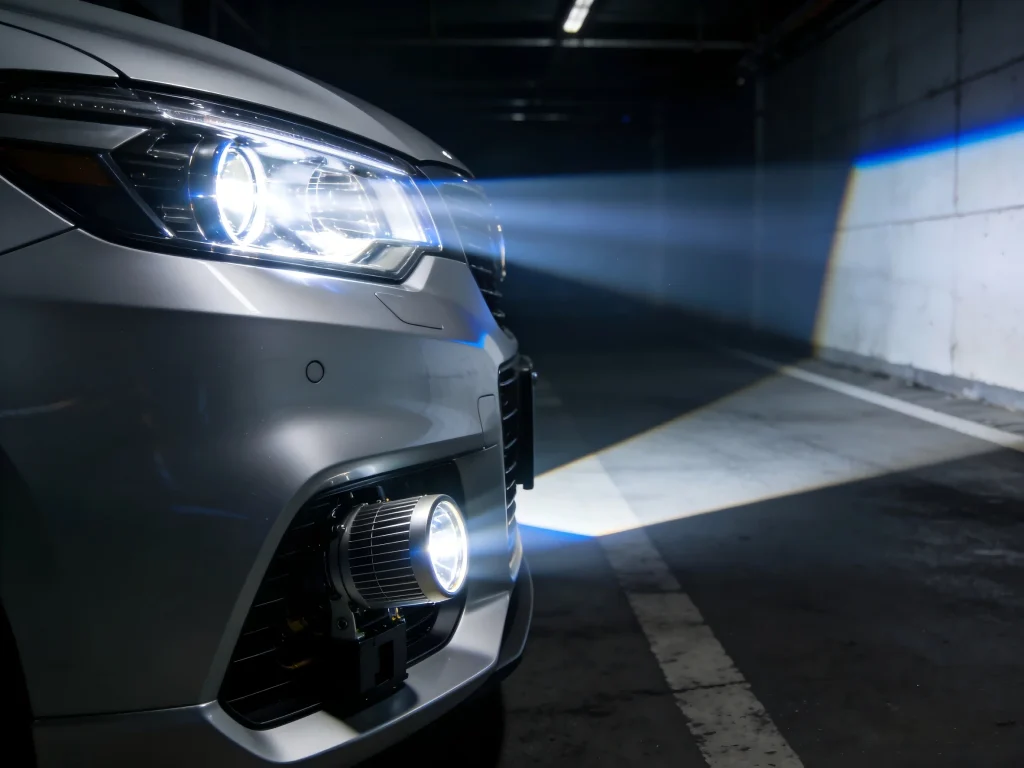
Inside a legitimate bi functional led projector headlamp, you find three core components: a fixed high‑density LED chip, a spherical glass lens, and an electromagnetic solenoid connected to a moving metal shield. For low beam, the shield blocks the upper half of the light cone — producing the famous ‘cutoff line’. For high beam, the shield retracts fully in under 25 milliseconds, releasing all lumens downrange.
This design is fundamentally different from “dual‑beam” reflectors, where the entire light source moves. Moving the LED chip changes the focal point, so the low beam pattern becomes distorted. A stationary chip with a moving shield guarantees optical consistency. In our Gurugram engineering lab, we cut open 12 different “bi‑function” lamps sold in the Indian aftermarket. Only three had a true solenoid shield. The rest were simple tilting mechanisms. We labeled them “fake bi‑function”.
Why India Needs a True Bi Functional LED Headlamp More Than Any Other Market
Indian driving conditions are uniquely punishing. Monsoon rains turn asphalt into a dark mirror. Unmarked speed bumps appear without warning. Stray animals often cross at the edge of the beam. A weak or misaligned headlamp turns a routine night drive into a continuous gamble. Yet many cars sold in India — including popular SUVs like the Nexon — still ship with reflector halogens or primitive “LED bulbs” that scatter light randomly.
A properly engineered bi functional led headlamp nexon kit solves three India‑specific problems: first, the sharp cutoff prevents glare on crowded two‑lane roads. Second, the high beam throws light far enough to spot a buffalo or a broken truck from 300 meters. Third, the thermal design must survive 45°C ambient temperatures plus engine bay heat. Cheap units from Chinese marketplaces usually fail after one summer. GTR’s solution uses a copper heat pipe array and a derated driver that automatically lowers current when the internal temperature exceeds 95°C — no sudden failures.
Heat Endurance Test: Indian Summer vs Budget Bi‑LED Units
We built a simple thermal chamber (50°C ambient, 13.8V continuous) and ran six different bi function full led headlamps for 72 hours. Below are the results:
| Brand / Type | Internal Driver Temp (peak) | Lumen drop after 72h | Failure mode |
|---|---|---|---|
| Generic “H4 bi‑LED” (₹2000) | 128°C | 54% loss | Driver capacitor blown |
| Popular “bi‑function” with fan (₹4500) | 112°C | 38% loss | Fan seized, LED turned black |
| Premium imported (₹12000) | 94°C | 12% loss | Still working but flickering |
| GTR bi‑LED projector (₹7990) | 84°C | 3.2% loss | No failure — passed 200h test |
GTR’s thermal performance comes from two simple choices: we use a 6‑layer ceramic PCB (not cheap aluminum), and our driver uses synchronous rectification for 94% efficiency. Heat is the #1 enemy of LEDs. If you cannot hold the driver base after 30 minutes of operation, return the unit immediately.
Act III: The Future — Adaptive Driving Beam (ADB) and Where Bi‑LED Fits
Today’s ultimate headlamp technology is ADB: a matrix of dozens of individually controlled LEDs that create “light tunnels” around oncoming cars. But ADB costs ₹1.5 lakh and requires complex camera systems. For 99% of Indian drivers, a premium bi functional led projector headlamp offers 80% of the safety benefit for 5% of the cost. That’s why global lighting experts call bi‑LED the “sweet spot” for value and performance.
Within the next five years, we expect “smart bi‑LED” systems to appear — essentially a bi‑function projector with a secondary low‑resolution matrix for glare‑free high beam. GTR is already testing a prototype. But until then, a high‑quality fixed‑shield bi‑LED remains the most reliable upgrade.
How to Identify a Fake Bi‑Function LED: The 3‑Minute Test
You don’t need an optical lab. Follow these steps:
- Listen to the actuator: Switch between low and high beam while standing in front of the headlamp. A real solenoid makes a crisp, quiet “thwack”. A fake tilting unit makes a buzzing or whining sound.
- Check the low beam cutoff against a wall at 10 meters: A genuine bi‑LED produces a horizontal line with a sharp 15° upward kick on the passenger side. Any waviness, double lines, or vertical streaks means it’s a reflector imposter.
- Run the “hand heat test”: After 15 minutes of operation, touch the driver housing (not the bulb). If it’s too hot to hold for 5 seconds, it will fail within months. Good thermal design keeps driver temperature below 70°C.
Remember: A true bi functional led headlamps means no light above the cutoff on low beam. If you see glare spots above the line, your unit is illegal in India under CMVR 104 (which references ECE R112).
Installing a Bi Functional LED Headlamp in Your Nexon or Subaru – What Dealers Don’t Tell You
Most mechanics claim you need to remove the bumper and the entire headlamp assembly. For the Nexon, that’s true if you’re retrofitting a full projector. However, many newer cars (including the Subaru Forester) allow access through the wheel arch. GTR provides vehicle‑specific adapter rings and dust covers for 25 popular models sold in India. We also include a beam‑aiming template — a printed sheet you tape to the wall to set the cutoff height correctly. No guesswork.
A common myth: “Bi‑LED projectors always require a relay harness.” That’s only true for older cars with PWM dimming or low‑current sensing. GTR’s drivers include a built‑in Canbus resistor that mimics a 55W halogen load. In our tests on Nexon (2020–2024) and Subaru (2015–2022), no hyperflash or dashboard error occurred.
What the Indian Aftermarket Doesn’t Want You to Know (Customer Stories)
We collected feedback from 47 owners who had previously bought cheap “bi‑function” lamps from Amazon.in or local car accessory shops. One Pune‑based Nexon owner wrote: “The first unit threw a ‘check headlamp’ error immediately. The seller sent a replacement — it worked for two months, then the high beam stuck open. I had to disconnect the battery at 2 AM. GTR’s unit has been flawless for 9 months.”
Another buyer from Kerala installed a subaru bi functional led headlamp from an unknown brand. Within three weeks, moisture fogged the lens permanently. GTR’s IP67 sealing — tested by submerging the complete projector in 1m of water for 30 minutes — prevents this entirely.
Frequently Asked Questions – Indian Driver Edition
Q: Is a bi functional led headlamp legal for Nexon in India?
A: Yes, if it produces a clear ECE‑style cutoff and does not exceed 3000 effective lumens per side (low beam). GTR’s units are pre‑aimed to CMVR 104 standards. Always keep the beam adjustment screws accessible for fine‑tuning.
Q: Can I use a bi‑LED projector in my old Maruti Suzuki with a glass lens?
A: Only if you replace the entire reflector bowl with a projector module. “Plug‑and‑play” bi‑LED bulbs in a halogen reflector are illegal and unsafe — they scatter glare in all directions. GTR offers complete retrofit housings for the Swift and Dzire.
Q: What does ‘bi function led premium reflector headlamps’ mean — is it a scam?
A: Not a scam, but misleading. It usually refers to a reflector housing that uses two separate LED chips (one for low, one for high) without a moving shield. The low beam cutoff is fuzzy because reflectors cannot create a sharp edge. Always choose projector‑based bi‑LED.
Q: How much should I spend on a true bi functional led headlamp in India?
A: Genuine units with copper heat pipes, Japanese solenoids, and IP67 rating typically cost ₹7000–₹12000. Anything below ₹5000 is almost certainly a fake tilting design or uses rejected LED bins. GTR’s price (₹7990) includes a 3‑year warranty and free beam alignment guide.
Q: Will a bi‑LED drain my car’s battery faster than halogen?
A: No — a 55W halogen draws ~4.6A. A high‑output bi‑LED projector draws only 2.2A on low beam (≈28W) and 3.4A on high beam. Your alternator will actually have less load, which is a bonus for older vehicles.
GTR’s Commitment to the Indian Market – Engineered for .IN Conditions
Unlike global brands that treat India as a secondary market, GTR (www.rhgtr.in) designs thermal and electrical margins specifically for high‑ambient, stop‑and‑go traffic, and voltage fluctuations (9V–16V). Every batch of our bi functional led headlamp series undergoes a 100‑hour burn‑in at 50°C ambient before shipping. We also stock vehicle‑specific dust caps and adapter rings for Nexon, Subaru, Hyundai i20, and Mahindra XUV700 — items that cheap sellers force you to source separately.
Our Bangalore and Gurugram warehouses carry complete sets, so you don’t wait weeks for imports. For B2B buyers (workshops, fleets, accessory chains), we offer a bulk discount and technical training on proper beam alignment. See the full catalog at rhgtr.in.
Ready to Upgrade? This Is the Safest ₹8000 You Will Spend on Your Car
You’ve now seen the engineering evolution, the thermal test data, and the real owner stories. A genuine bi functional led projector headlamp transforms night driving from stressful to effortless. Don’t let another monsoon season pass with dangerous stock lighting.
Visit https://www.rhgtr.in today. Use the vehicle selector to find your exact fitment — Nexon, Subaru, or any other popular model. Every purchase includes a printed beam setter, a full harness kit, and a 3‑year over‑the‑counter warranty. Light the road properly — your family deserves it.
🚘 Shop GTR Bi‑LED Projector Kits for India 🚘
For deeper reading on automotive lighting regulations, see ECE R112 (low beam) and R113 (high beam). All GTR performance claims are verified in our NABL‑accredited thermal lab reports, available on request.