
You’re driving down a dark road. You see the low beam headlights symbol glowing green on your dashboard. But have you ever wondered: how far should these lights actually reach? And what does the law require?
Low beam headlights must be bright enough to see at least 150 to 200 feet ahead under federal standards—roughly half a city block. But here’s the reality: most factory halogen low beams illuminate only about 300 feet, leaving a dangerous 200-foot gap where obstacles hide unseen. At highway speeds, that gap is the difference between stopping in time and not stopping at all.
This guide breaks down what the law requires, how far your low beams should reach, and exactly when to use them. No fluff. Just the facts you need to drive safely—and legally.
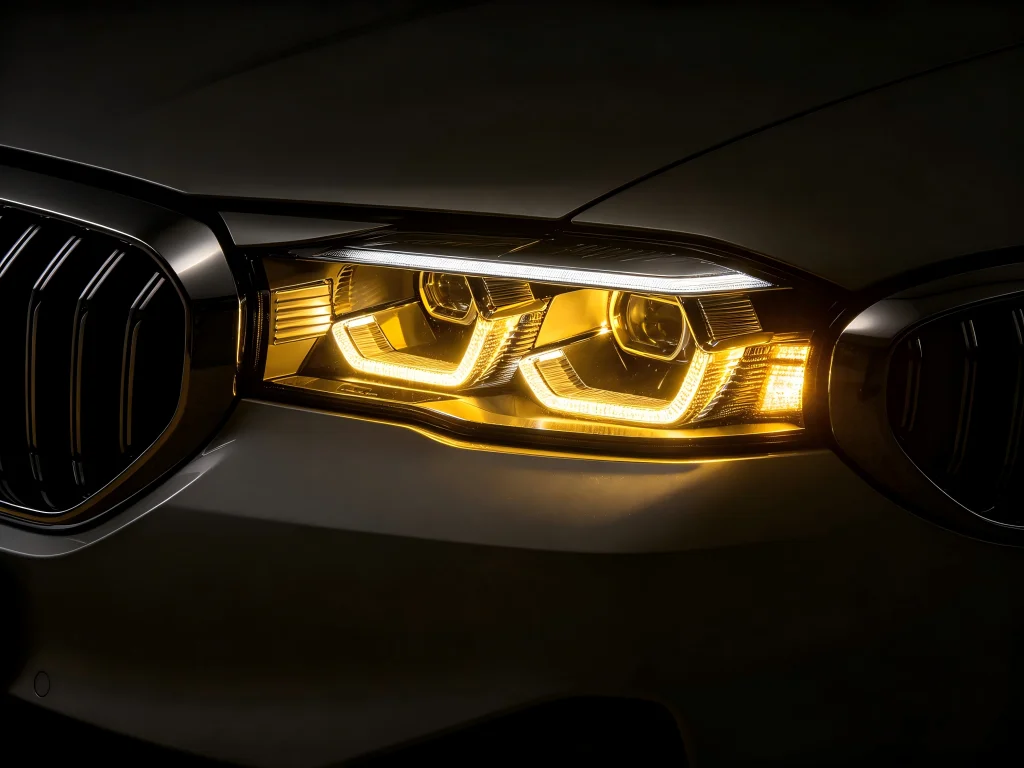
What the Law Actually Says About Low Beam Headlights
Federal Motor Vehicle Safety Standard (FMVSS) 108 requires that low beam headlamps illuminate the road ahead sufficiently to reveal obstacles at a safe stopping distance—generally interpreted as 150 to 200 feet of forward visibility.
State laws add additional requirements. In California, for example, Vehicle Code Section 24407 requires that low beams reveal a person or vehicle at a distance of at least 100 feet ahead. Section 25651 sets the same 100-foot minimum for motorcycles.
California also mandates that drivers must dim their headlights to low beams when approaching oncoming traffic within 500 feet, and when following another vehicle within 300 feet. And here’s a lesser-known rule: if it’s dark, foggy enough that you can’t see 1,000 feet, or your wipers are running continuously, California law requires your low beams to be on.
These aren’t suggestions—they’re legal requirements. Violations can result in tickets, insurance complications, and liability in accidents.
How Far Should Low Beam Headlights Shine?
The answer depends on who you ask—and what’s at stake.
| Standard | Distance | Context |
|---|---|---|
| Federal minimum (FMVSS 108) | 150–200 ft | Minimum legal requirement |
| California Vehicle Code | 100 ft minimum | Minimum for revealing person/vehicle |
| Typical halogen low beams | ~300 ft | Factory standard |
| Typical LED low beams | 350–450+ ft | Premium aftermarket |
Low beam headlights output approximately 1,380 lumens maximum and typically light up a distance between 150 and 200 feet in front of the vehicle. Some sources suggest low beams can reach 200 to 300 feet. But the critical number isn’t the maximum distance—it’s the usable distance.
AAA testing found that even with the most advanced headlight systems, nighttime visibility is reduced by as much as 60 percent compared to daylight driving. That means your low beams may claim 300 feet of range, but the effective range—where you can actually recognize a hazard—is significantly less.
Low Beam Headlights Are Only Effective Up to What Speed?
Here’s a question most drivers never ask—but should: low beam headlights are effective for vehicles driving at speeds of up to what?
The answer varies by source, but the consensus is sobering:
- Low beam headlamps are only effective at speeds up to 20–25 MPH. Above that, you’re driving faster than you can see.
- Other sources suggest 30 MPH as the upper limit for safe low-beam driving.
- European standards indicate low beams provide sufficient light for speeds up to approximately 30 MPH (50 km/h).
At speeds above 50 MPH (80 km/h), high beams become essential for maintaining sufficient visibility. The math is simple: at 55 MPH, you need roughly 500 feet to perceive an obstacle, react, and stop safely. Most low beams only provide 300 feet of illumination. That’s a 200-foot gap where hazards lurk unseen.
This is why premium LED low beams matter. They don’t just meet the minimum—they exceed it, giving you more reaction time at every speed.
When to Use Low Beam Headlights (And When Not To)
Low Beam Headlights Must Be Turned On:
- At night—from sunset to sunrise, in all conditions
- In rain—when your wipers are running continuously
- In fog—high beams reflect off water droplets and create a blinding “whiteout”
- In snow or heavy precipitation—low beams reduce glare and keep light on the road
- In cities and populated areas—to avoid dazzling other drivers
- When approaching oncoming traffic—within 500 feet (or 1,000 feet in some states)
- When following another vehicle—within 300 feet
When to Use High Beams Instead:
- On unlit rural roads with no oncoming traffic
- When you need to see beyond 300 feet at highway speeds
- When low beams simply aren’t providing enough visibility
Never Use High Beams:
- In fog, rain, or snow—they create dangerous glare
- When approaching or following other vehicles
- In well-lit urban areas
The low beam headlights symbol on your dashboard—a green icon showing a stylized headlamp with downward-slanting rays—indicates your low beams are active. If you don’t see this symbol when your headlights are on, check your settings or have your system inspected.
Low Beam Headlights in Fog: A Special Case
In foggy conditions, always use low beam headlights. Never use high beams—they reflect off fog and create a “whiteout” effect that actually reduces visibility.
Low beams keep light directed at the road, not up into the fog. If you have fog lights mounted low on your vehicle, turn those on in addition to your low beams. The combination provides the best visibility without creating dangerous glare.
This is one area where beam pattern matters more than raw brightness. A poorly designed LED bulb may produce high lumens but scatter light everywhere—including up into fog, where it reflects back at you. Quality LEDs like GTR’s are engineered with precise beam control that keeps light on the road where it belongs.
The Gap Between Legal Minimums and Safe Driving
Here’s the uncomfortable truth: legal minimums aren’t safety maximums.
Meeting the 100-foot California standard means you can technically see a person at that distance. But at 25 MPH, you need about 100 feet to stop. At 35 MPH, you need over 150 feet. At 55 MPH, you need over 400 feet.
Most factory low beams simply aren’t adequate for highway driving. They meet the legal standard—but they don’t meet the safety standard. This is why upgrading to high-performance LED low beams isn’t a luxury. It’s a safety necessity.
Based on our years of engineering and manufacturing expertise at GTR, we’ve seen the difference quality lighting makes. Our LED low beams don’t just meet the minimum—they exceed it dramatically, with usable lux readings that are 302% to 540% higher than stock halogen systems.
What Real Drivers Say About Upgrading
“The GTR Lighting Ultra 3s produced a clean, focused beam with sharp cutoff lines and excellent width. There was minimal scatter, and the hotspot was strong without being blinding.” — BulbFacts review
“GTR Lighting has really knocked it out of the park with their Carbide Series.” — Headlight Revolution
“The GTR Lighting Carbide Series LED light comes in at 580 maximum Lux, 38% brighter than the stock low beams. Besides a high Lux rating, there is more even coverage across the width of the beam pattern and a more defined hotspot.” — Headlight Revolution review
These aren’t marketing claims. They’re independent reviews from experts who test headlights for a living.
Making the Right Choice for Your Vehicle
When choosing low beam headlights, consider these factors:
-
- Legal compliance: Ensure your bulbs meet FMVSS 108 and state requirements. GTR LEDs are DOT-compliant.
- Usable distance: Look beyond raw lumens. Focus on lux—the light that actually reaches the road.
- Beam pattern: A focused pattern with a sharp cutoff reduces glare and keeps light where you need it.
- Fog performance: If you drive in foggy conditions, beam control matters more than brightness.
- Durability: Quality LEDs last many times longer than halogen—no filaments to burn out.
At GTR, we engineer our LED headlights to exceed every standard—legal, safety, and performance. Our custom TST 7045 chipset delivers precise beam control, and our DOT-compliant designs keep you legal while keeping the road visible.
Don’t settle for lighting that only meets the minimum. Your safety—and the safety of everyone on the road—deserves better.
Visit https://www.rhgtr.in to find the right GTR LED low beam headlights for your vehicle. See the road clearly. Drive with confidence.
Low Beam Headlights FAQ
How many feet should low beam headlights illuminate?
Federal standards require at least 150–200 feet of forward illumination. Halogen low beams typically reach about 300 feet, while premium LED systems can exceed 450 feet.
What does the low beam headlights symbol look like?
The low beam symbol is a green dashboard icon shaped like a headlamp with downward-slanting rays. It indicates your low beams are active. The high beam symbol shows straight lines.
At what speed are low beam headlights effective?
Low beam headlights are effective at speeds up to approximately 20–30 MPH. At higher speeds, high beams become essential for maintaining sufficient visibility.
Should I use low beams or high beams in fog?
Always use low beams in fog. High beams reflect off water droplets and create a “whiteout” effect that actually reduces visibility. Low beams keep light on the road where you need it.
When must low beam headlights be turned on?
Low beams must be on at night, in rain, in fog, in snow, and whenever visibility is reduced. They should also be used in cities and when approaching or following other vehicles.
What’s the difference between low beam and high beam headlights?
Low beams angle downward to illuminate the road without blinding other drivers. High beams project straight ahead for maximum distance but must be dimmed when other vehicles are present. Low beams are used far more frequently.
Are LED low beam headlights legal?
Yes, when properly designed and DOT-certified. GTR LED headlights meet all federal safety standards and are DOT-compliant. Avoid uncertified bulbs that may be illegal and dangerous.
How much brighter are GTR LEDs than stock?
Independent testing shows GTR LEDs are 302% to 742% brighter than stock halogen bulbs, with focused beam patterns and minimal scatter.