
You made the switch to LED headlight bulbs expecting a dramatic improvement. Instead, you got flickering lights, a dashboard full of error codes, and a beam pattern that seems to illuminate everything except the road ahead. Based on our years of manufacturing expertise and thousands of customer consultations, these are the seven most expensive mistakes drivers make when upgrading to LED headlights for car applications — and exactly how to avoid every single one.
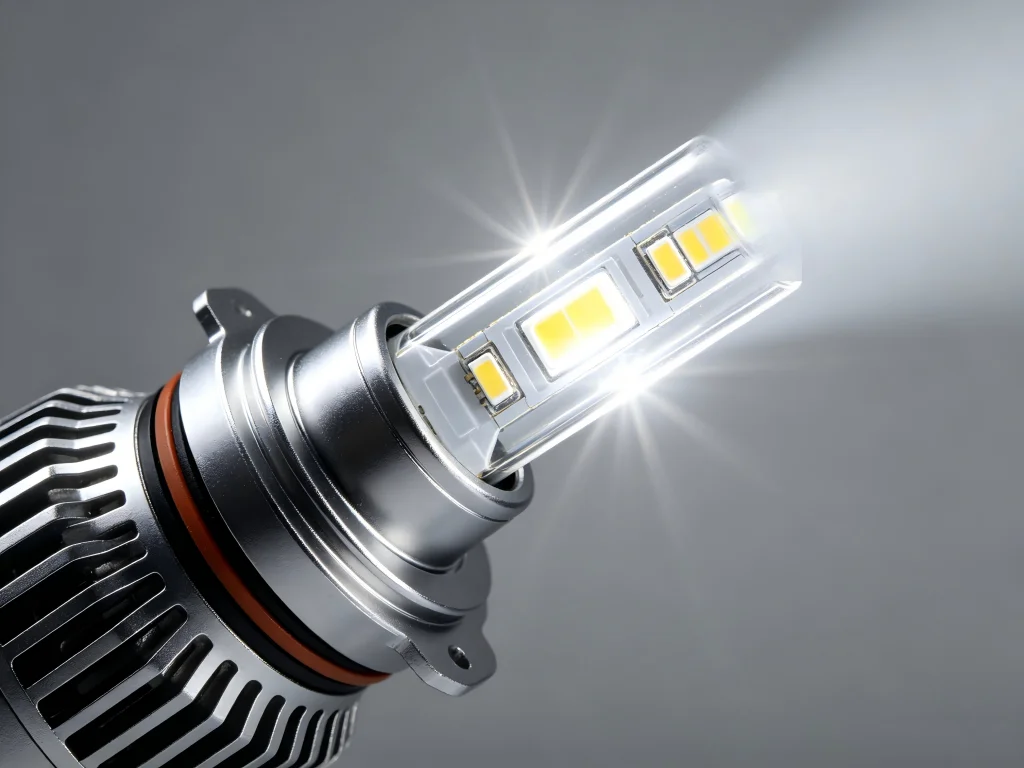
Mistake #1: Chasing Lumens Instead of Beam Quality
The brightest bulb on the spec sheet is often the worst performer on the road. Raw lumens tell you how much light a bulb produces, but they tell you nothing about where that light actually goes. A 10,000-lumen bulb with a scattered beam pattern will illuminate less usable road than a 3,000-lumen bulb with a focused beam.
What matters is lux — the measure of light intensity at a specific point on the road. Independent testing shows the GTR Lighting Ultra 3 delivers 1,498 lux on low beam, a 302% increase over standard halogen, while maintaining a clean, focused beam with minimal scatter. The beam pattern retains a sharp cutoff line that keeps light on the road, not in the eyes of oncoming drivers.
When evaluating any LED headlight conversion kit, ignore the lumen count on the box. Ask instead: does this bulb produce a clean, controlled beam that matches my housing’s optics?
Mistake #2: Ignoring the Housing Type
Your vehicle’s headlight housing — reflector or projector — was engineered around a specific light source geometry. A reflector housing uses the shape of the reflector bowl to direct light from a specific filament position. A projector housing focuses light through a lens from a precise emitter location.
When you drop an LED bulb into that housing, the emitter must be positioned at the exact same location as the original halogen filament. Even a 1mm deviation disrupts the focal point and produces scattered light. The LED headlights vs halogen comparison becomes meaningless if the optical geometry is wrong.
The GTR Ultra 3 addresses this with Philips ZES chips that measure just 1.6mm by 2.0mm — closely matching halogen filament width. This precision engineering ensures the bulb works with your existing optics, not against them.
Mistake #3: Overlooking CANbus Compatibility
Modern vehicles use CANbus networks to monitor bulb status. LEDs draw significantly less power than halogens — typically 15-20 watts versus 55 watts per bulb. The vehicle’s computer interprets this lower power draw as a failed bulb and responds by either cutting power (flickering) or triggering a dashboard warning.
Without proper CANbus compatibility, your LED headlight bulbs will flicker, pulse, or shut off randomly while driving. Some drivers spend weeks troubleshooting this issue, buying external resistors, decoders, and anti-flicker harnesses — only to find the problem persists.
The GTR Ultra 3 integrates CANbus-compatible drivers directly into the bulb body. No external boxes to mount. No extra wires to splice. Just plug-and-play installation that communicates properly with your vehicle’s electrical system.
Mistake #4: Skimping on Thermal Management
LEDs generate heat at the semiconductor level. If that heat is not dissipated efficiently, the bulb reduces its output to prevent damage — a process called thermal throttling. This means your bright new bulbs gradually dim over time, often within the first few months of use.
Budget bulbs often rely on passive cooling alone — a small heatsink with no fan. This works for low-power LEDs but fails under the sustained heat of nighttime driving. Premium bulbs use a combination of high-speed fans, aviation-grade aluminum heatsinks, and copper-core heat pipes for maximum thermal transfer.
The GTR Ultra 3 uses active cooling with a high-speed fan and aviation-grade aluminum heatsink, retaining 87% of its initial brightness after a typical 27-minute drive. That means consistent, reliable performance mile after mile.
Mistake #5: Choosing the Wrong Color Temperature
Color temperature is measured in Kelvin (K). Lower temperatures produce yellowish light; higher temperatures produce bluish-white light. Most LED headlight bulbs fall in the 5,000K to 6,500K range.
Many drivers mistakenly choose 6,500K or higher because it looks “cooler” or more aggressive. But higher color temperatures can reduce contrast and scatter more in rain or fog. The sweet spot for visibility is 5,500K to 6,000K — a pure white light that mimics natural daylight and enhances contrast without being harsh on the eyes.
The GTR Ultra 3 emits a 5,750K color temperature — a crisp, daylight-white beam that reduces eye strain and improves visibility at night. It is bright enough to see clearly but warm enough to maintain contrast in adverse weather conditions.
Mistake #6: Ignoring Installation Fit
Many LED headlight bulbs have large heatsinks or fan assemblies that do not fit through standard dust caps. You wrestle with the locking ring, drop the bulb into the housing, and discover the dust cap won’t close. Or the fan housing hits the back of the headlight assembly, preventing proper seating.
This is not just an inconvenience — it is a safety issue. A bulb that is not fully seated will have incorrect beam alignment, reducing visibility and potentially blinding oncoming traffic.
The GTR Ultra 3 features a compact all-in-one design with the driver integrated directly into the bulb body. The cord exits from the bottom of the fan housing, making it easier to fit into tight spaces and through standard dust caps. Installation takes under 30 minutes with basic hand tools.
Mistake #7: Buying Based on Price Alone
The LED headlight market is flooded with $20 kits that promise the world and deliver nothing but frustration. These budget bulbs use inferior CSP (Chip Scale Package) chips that have weaker bonds between the silicone layer and chip substrate, making them more susceptible to thermal stress over time. They lack proper thermal management. They lack CANbus compatibility. They lack the engineering precision required to work with your vehicle’s optics.
A $20 LED kit that dies in six months and forces you to buy another is not a bargain — it is a waste of money and time. A premium bulb like the GTR Ultra 3 uses Philips ZES chips, active cooling, CANbus-compatible drivers, and durable construction that lasts 30,000 to 50,000 hours. That is 30 to 50 times longer than a halogen bulb and years longer than a budget LED.
As one forum member put it: “By the time you buy four GTR Ultra 3 bulbs, you’re at $650 or more after taxes and shipping, and now you are firmly approaching full-blown housing upgrades that have LED tech and halo lighting built in”. The point is clear: quality costs more upfront but pays for itself in performance and longevity.
Real-World Performance: What the Numbers Say
Independent testing confirms the GTR Lighting Ultra 3 delivers class-leading performance across multiple vehicle platforms. On a 2016-2021 Honda Civic, the Ultra 3 H11 low beam delivered 920 max lux — 475% brighter than stock — while retaining the sharp cutoff line the projector housing was designed to produce. The 9005 high beam measured 3,960 max lux — 742% brighter than stock and the highest reading ever recorded in that housing by the testing team.
In reflector housings, the Ultra 3 produced 1,498 lux on low beam — a 302% increase over halogen — with glare measured at just 380 lux, comfortably within safe limits for oncoming drivers.
These are not marketing claims. These are real measurements from independent testing labs that purchase every product they test.
Your LED Headlight Checklist
Before you buy any LED headlight conversion kit, run it through this checklist:
- Emitter placement: Does the bulb position LEDs to match halogen filament geometry?
- Beam pattern: Does the bulb produce a sharp cutoff with minimal scatter?
- CANbus compatibility: Does the bulb communicate properly with your vehicle’s computer?
- Thermal management: Does the bulb have active cooling for consistent performance?
- Color temperature: Is the bulb in the 5,500K–6,000K range for optimal visibility?
- Installation fit: Will the bulb fit through your dust cap and lock into place?
- Build quality: Does the bulb use premium materials and carry a warranty?
Frequently Asked Questions About LED Headlights
Why do my LED headlights flicker after installation?
Flickering is almost always caused by a CANbus compatibility issue. Your vehicle’s computer monitors bulb power draw. LEDs draw less power than halogens, so the computer thinks the bulb is burned out and either pulses power or shuts it off entirely. A CANbus-compatible driver resolves this by communicating properly with the vehicle’s electrical system.
How long do LED headlight bulbs actually last?
High-quality LEDs can last 30,000 to 50,000 hours under ideal conditions. Real-world lifespan depends on thermal management and operating environment. Poor thermal design causes thermal throttling — the bulb dims itself to prevent damage, reducing effective lifespan significantly.
Do I need projectors for LED headlights?
No — but you need a bulb that matches your housing type. Reflector housings require LEDs that position emitters precisely where the halogen filament would sit. Projector housings require even more precision for a clean cutoff. The GTR Ultra 3 performs exceptionally well in both housing types.
What is the best color temperature for LED headlights?
5,500K to 6,000K is the ideal range. This produces a crisp, daylight-white light that enhances contrast and reduces eye strain. Higher temperatures (6,500K+) may look more aggressive but can reduce contrast and scatter more in rain or fog.
Are LED headlights brighter than halogen?
Yes — significantly, but only if the beam pattern is correct. A quality LED headlight produces 2,400 to 4,000 lumens per bulb compared to 700-1,500 lumens for halogen. However, raw lumens mean nothing if the light is scattered. Beam pattern integrity is what determines whether you actually see better on the road.
Can I install LED headlights myself?
Yes — with the right kit. A plug-and-play LED headlight conversion kit like the GTR Ultra 3 installs in under 30 minutes with basic hand tools. The key is choosing a bulb that matches your vehicle’s bulb size (H11, 9005, H4, etc.) and is designed to fit through your housing’s dust cap.
Stop Making These Costly Mistakes
Your LED headlight upgrade should deliver dramatically better visibility, not endless troubleshooting. The difference between a frustrating experience and a transformative one comes down to engineering — precision emitter placement, effective thermal management, CANbus compatibility, and build quality that stands up to real-world conditions.
GTR Lighting builds every Ultra 3 bulb with these principles in mind. We do not cut corners on chip quality, cooling, or electrical design. We test our bulbs in actual headlight housings, not just on lab benches. And we back every bulb with the confidence that comes from years of manufacturing automotive LED lighting for drivers who refuse to compromise on safety or performance.
Visit www.rhgtr.in to find the right GTR Ultra 3 kit for your vehicle. Stop guessing. Start seeing.