
You are driving on a two-lane highway outside your city. An oncoming truck with non-standard brights blasts through the darkness. Your h4 headlight bulb — halogen or cheap LED — suddenly feels like a candle flickering against a floodlight. You cannot see the pothole three meters ahead. You cannot spot the cyclist without reflectors on the shoulder. This is not a hypothetical. This is every night on Indian roads.
The Indian driving environment is unique. Dense fog in North Indian winters. Unrelenting high-beam abuse from oncoming traffic. Roads with unpredictable surfaces and poorly marked lanes. And a vehicle parc dominated by reflector housings — Maruti Suzuki, Hyundai, Tata — that were never designed for aftermarket LED bulbs.
Yet most H4 headlight bulb advice online comes from American or European sources. They talk about suburban streets and highway cruising. They do not talk about cutting through Meerut in January fog or navigating Bengaluru’s chaotic night traffic. This guide does. It is written for Indian roads, Indian traffic, and Indian vehicles.
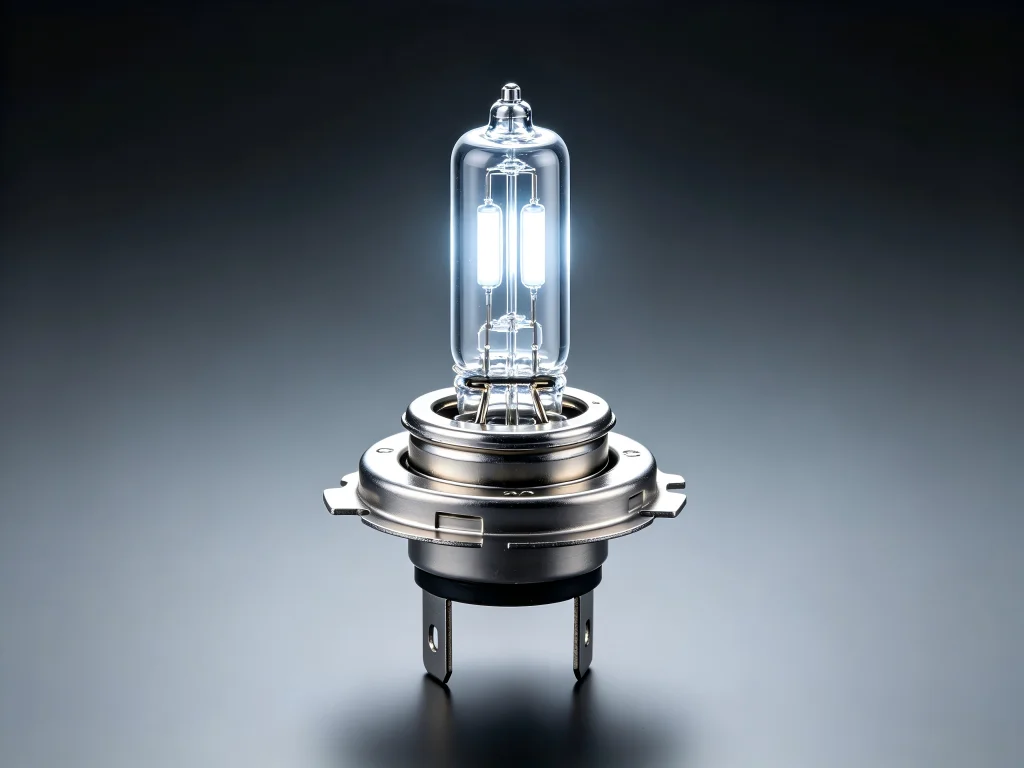
The Three Numbers That Actually Matter for Indian Driving
For Indian roads, the three critical specs are beam pattern accuracy, colour temperature, and CANbus compatibility — not advertised lumens.
Most buyers chase wattage and lumen claims. A typical listing shouts “210W!” or “300W!” and “50,000 lumens!”. These numbers are almost always measured in laboratory conditions that do not translate to road performance. A 72W LED with poor beam control can actually give you worse visibility than a 55W halogen with a proper pattern.
Here is what matters for Indian conditions:
- Beam pattern accuracy in reflector housings: The vast majority of Indian cars — Alto, Swift, Dzire, S-Presso, Ignis — use reflector headlamps. Reflectors are unforgiving. If the LED chip is not positioned exactly where the halogen filament was, the light scatters. A Royal Enfield owner who installed a Nighteye H4 LED put it bluntly: “Stock Halogen bulb focus to upper side for lower beam & bottom side for higher beam, but the LED focus to LEFT & RIGHT which makes both patterns inaccurate”.
- Colour temperature for fog and rain: White LEDs at 6500K are “garbage in fog” according to one S-Presso owner who tested them in real North Indian winter conditions. They light up airborne moisture instead of the road. Warm LEDs at 4300–5000K perform significantly better in fog and rain while still providing good visibility on clear nights.
- Plug-and-play with no electrical modifications: Indian cars often have sensitive electrical systems. A good H4 LED should be “plug-and-play, no relay circus, no warning lights”. If you need to cut wires or add bulky decoder boxes, you are inviting electrical problems down the road.
The Fog Problem: Why 6500K White LEDs Fail in Indian Winters
North Indian winters bring dense fog that can reduce visibility to under 50 metres. In these conditions, the colour temperature of your h4 headlight bulb becomes a safety-critical decision.
Warm light at 3000–4300K has longer wavelengths that penetrate fog and moisture more effectively. Cool white light at 6000–6500K has shorter wavelengths that scatter off water droplets — creating a wall of reflected light that actually reduces your ability to see the road.
One Team-BHP member who tested multiple options in real fog conditions on the Gangetic plains described the difference: “Halogens still behave better when visibility drops to nothing. But these LEDs are a compromise that actually works, instead of looking good in a parking lot”. He settled on 4300K LEDs — warm enough to cut through fog, bright enough to out-perform stock halogens on clear nights.
The lesson: if you drive in fog, avoid 6500K. Choose 4300–5000K. The “cool white” look might impress your friends in the parking lot, but it will not help you see in Meerut in January.
Reflector vs. Projector: Why Your Housing Determines Everything
Your headlight housing type is the single most important factor in whether an h4 headlight bulb LED upgrade will work for you.
| Housing Type | Common in Indian Cars | LED Compatibility | What to Look For |
|---|---|---|---|
| Reflector | Maruti Suzuki, Hyundai, Tata (most models) | Requires 1:1 filament position match | LED chip placement within 0.01mm of halogen filament |
| Projector | Higher-end trims, some aftermarket upgrades | More forgiving; has a cut-off shield | Still needs proper LED chip alignment |
Reflector housings are the most common in India. They were designed around a specific light source: the halogen filament. An Ignis owner who upgraded to Osram H4 LEDs reported that a “well engineered” LED “emits the same pattern as a stock halogen bulb” in his reflector housing. The key words: well engineered.
Cheap LEDs do not have this engineering. One reviewer noted that the NIGHTEYE H4 LED has “LED chip placement very close to a Halogen bulb so provides good beam pattern” — but even then, it “required a little focusing to get the correct beam pattern”. Other cheap LEDs are far worse.
If your car has a reflector housing, do not buy an LED H4 bulb that does not explicitly state its chip placement matches the halogen filament position. And even then, be prepared to rotate the bulb in the housing to find the optimal beam pattern.
The CANbus Problem: Why Your Car Might Reject Your New Bulbs
Modern Indian cars — especially those manufactured after 2015 — often use CANbus electrical systems that monitor bulb power draw. A halogen H4 bulb draws 55W on low beam. An LED H4 bulb draws 20W. The CANbus sees the lower draw and assumes the bulb has failed.
The result? Flickering. Dashboard error messages. Or the bulb simply refuses to turn on.
Some LEDs are marketed as “CANbus ready” — meaning they include internal circuitry to prevent these errors. But even CANbus-ready bulbs may not work on every vehicle. Some Indian cars are particularly sensitive. If your vehicle shows errors after installation, you may need an external decoder or anti-flicker capacitor.
The cleanest solution: choose an H4 LED that is genuinely CANbus-compatible for your specific vehicle. GTR bulbs are engineered with compatibility in mind — designed to work with Indian vehicle electrical systems without requiring additional decoders or wiring modifications.
Real Indian Driver Feedback: The Good, The Bad, and The Ugly
Based on real reviews from Indian drivers who have installed H4 LED bulbs, here is what consistently emerges:
The Good
Drivers who choose warm-temperature LEDs with proper beam control report genuine improvements. One S-Presso owner who installed 4300K LEDs described “roughly 3× the stock halogens” in usable light. An Alto 800 owner reported LEDs made visibility “very clear as compared to my old halogen lights”.
The Bad
Drivers who buy cheap 6500K LEDs with poor beam patterns report disappointment. One Royal Enfield owner discovered the beam pattern was completely wrong for his reflector housing. Another reviewer noted high beam on a cheap LED was “not good at all it feels like phone flash”.
The Ugly
Some drivers report bulbs failing within months. One reviewer who bought a Philips 130/100W halogen upgrade (not LED) had both bulbs fail within six months — even with a relay kit. Another noted that “90% of LED white bulbs sold are of very poor quality and do not produce the brightness mentioned on the package”.
One Miwings customer discovered the hard way that a 2-year warranty is useless if you cannot register it: “no invoice, no protective gloves and no warranty paper”.
The pattern is clear: cheap bulbs fail quickly, produce poor beam patterns, and often leave drivers worse off than they were with stock halogens.
Frequently Asked Questions About H4 Headlight Bulbs for Indian Cars
Is H4 the same as 9003 or HB2?
Yes. H4, 9003, and HB2 are the same bulb with different part numbers. All three share identical dimensions, the same P43t base, and the same specifications. The 9003 designation is more common in North America; H4 is used in Europe, Asia, and India.
What H4 headlight bulb wattage should I choose for Indian roads?
Standard halogen H4 bulbs are 60W high beam and 55W low beam. LED equivalents typically draw 18–25W. Higher wattage halogen bulbs like 130/100W require a relay harness to prevent damage to your vehicle’s wiring and switch.
Why do cheap H4 LEDs fail so quickly in India?
Heat management is the primary issue. Indian summers can exceed 40°C under the bonnet. Cheap LEDs use inadequate heat sinking and thermal management. The LEDs overheat, dim, and fail. Quality LEDs with proper thermal management are designed for these conditions.
Can I use an H4 LED bulb in my reflector housing without blinding oncoming traffic?
Yes — but only if the LED has correct chip placement that matches the halogen filament position. Cheap LEDs with incorrect placement will scatter light and create glare. Even with a good LED, proper alignment is critical.
What colour temperature should I choose for Indian conditions?
For fog and rain, choose 4300–5000K. Avoid 6500K white LEDs in foggy conditions — they scatter off moisture and reduce visibility. For clear night driving in cities, 5000–6000K is acceptable.
Do I need a relay harness for H4 LED bulbs?
No. LED bulbs draw significantly less power than halogens, so a relay harness is not required. If you are upgrading to higher-wattage halogen bulbs (100/90W or 130/100W), a relay harness is essential to protect your vehicle’s wiring.
Why does my H4 LED bulb flicker after installation?
Your vehicle’s CANbus system detects the lower power draw of the LED and interprets it as a bulb failure. This causes power pulsing (flicker). A CANbus decoder or anti-flicker capacitor typically resolves this.
Making the Right Choice for Your Indian Car
Your h4 headlight bulb is not just a replaceable part. On Indian roads — with their unique combination of fog, traffic, and road conditions — it is your primary safety system at night.
Cheap LEDs with exaggerated wattage claims and 6500K colour temperatures might look impressive in product photos. But they will scatter light in your reflector housing, fail to cut through fog, and likely burn out within months.
What actually works? A well-engineered H4 LED with:
- Precise chip placement matching the halogen filament position
- 4300–5000K colour temperature for fog and rain performance
- Proper thermal management for Indian summer conditions
- Genuine plug-and-play compatibility with your vehicle’s electrical system
GTR’s H4 headlight bulbs are engineered specifically for these requirements. Our bulbs feature 1:1 filament positioning for accurate beam patterns in reflector housings. We use premium LED chips with active thermal management designed for high-temperature environments. And our bulbs are genuinely plug-and-play — no relay circus, no warning lights, no wiring modifications.