
The global LED car headlights market isn’t just growing — it’s transforming the entire automotive lighting landscape at an unprecedented pace. Whether you’re a distributor in Dubai, a fleet operator in Kenya, or a retailer in Australia, understanding where this market is heading could be the difference between capitalizing on a boom and getting left behind. Here’s what the data tells us about the state of play in 2026, and how smart buyers are navigating this rapidly evolving space.
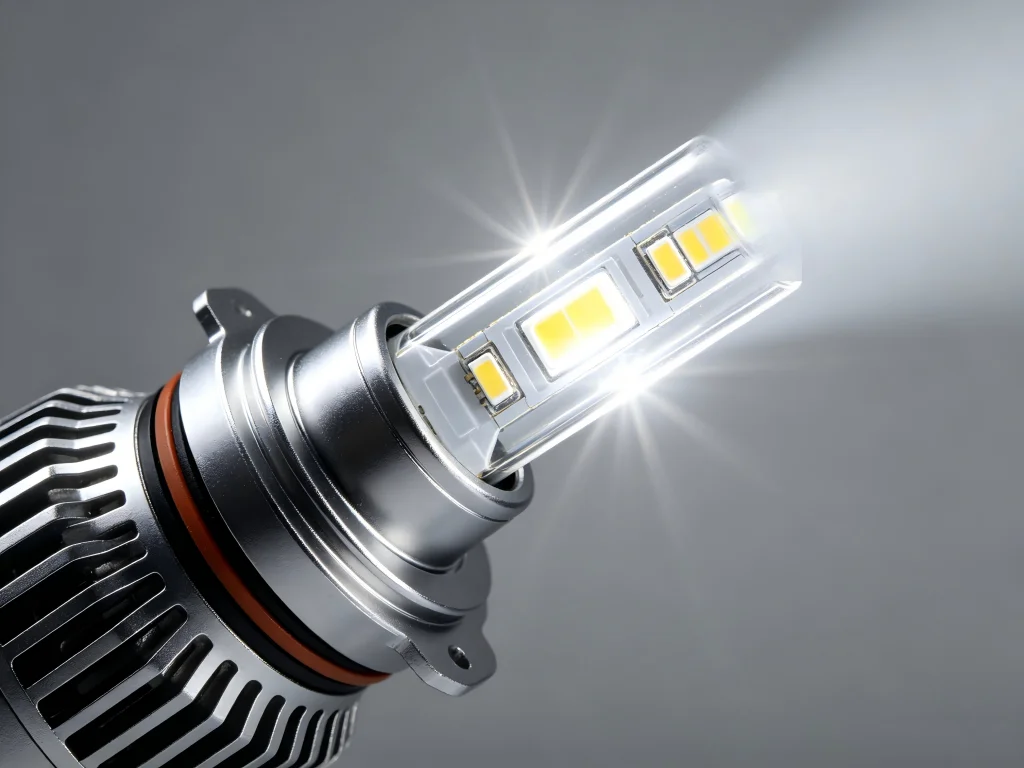
The Numbers Don’t Lie: LED Has Won
The global LED car headlights market was valued at US$8.14 billion in 2025 and is forecast to reach US$12.15 billion by 2032, growing at a CAGR of 6.0%.
That’s just the OEM segment. The aftermarket tells an even more dramatic story. The global automotive LED headlight lamp aftermarket was valued at roughly US$10 billion in 2025 and is projected to hit US$30.6 billion by 2035, expanding at a CAGR of 11.8%. Passenger vehicles dominate this space, holding around 58% of the market share, driven by the surging demand for retrofit and replacement upgrades.
LED lighting now commands approximately 45% to 55% of the total automotive headlamp market, while halogen has dropped to around 30% to 35%. The shift isn’t subtle — it’s a full-scale technological migration. Drivers aren’t just upgrading for aesthetics; they’re demanding better visibility, longer lifespan, and lower energy consumption.
And the momentum is accelerating. The broader automotive LED lighting market is expected to grow from US$21.04 billion in 2025 to US$28.89 billion by 2030. Electric vehicles are a key driver here — LED lighting consumes less power than traditional technologies, making it the natural choice for EVs. With global EV sales reaching 10 million in 2022 and projections pointing to 14 million in 2023, this trend is only gaining steam.
Regional Spotlight: Where the Demand Is Hottest
Not all markets are moving at the same speed. Here’s what’s happening in key regions:
Asia-Pacific: The Manufacturing Powerhouse
Asia Pacific commanded a staggering 68.73% share of the automotive LED package market in 2025 and is advancing at a 17.97% CAGR through 2031. China, Japan, and India together exceed a massive portion of global output. This region isn’t just manufacturing LEDs — it’s setting the pace for the entire industry. The Asia Pacific automotive LED package market is expected to grow from US$1.36 billion in 2025 to US$1.98 billion by 2031.
For buyers in this region, the advantage is clear: proximity to manufacturing means competitive pricing and shorter lead times. But it also means navigating a crowded field of suppliers, many of whom prioritize volume over quality.
Middle East: Premium Demand, Strict Rules
The Middle East and Africa automotive LED lighting market was estimated at US$88.69 million in 2025 and is expected to reach US$144.6 million by 2030. The headlights segment holds the largest share, driven by government policies, energy efficiency concerns, and accident prevention.
But here’s the catch: in the UAE, whiter and brighter headlamps can attract an AED 200 fine under Article 95 of the Federal Traffic Act. This has given buyers more consideration to LED technology, but it’s also created a compliance minefield. Distributors in Dubai and across the GCC need to balance the demand for premium, high-performance lighting with strict regulatory requirements.
The UAE online market for LED headlight bulbs is characterized by high brand fragmentation and intense competition, with a long tail of primarily Asia-based brands competing for market share. No single brand has achieved dominant control — which means there’s a massive opportunity for buyers who can identify and partner with reliable, compliant suppliers.
Africa: Safety-Driven Growth
Traffic deaths in Africa account for about a quarter of the global number of victims, even though the continent has barely 2% of the world’s vehicle fleet. This stark statistic is driving government focus on vehicle safety, and lighting is a critical part of that equation.
Kenya’s LED headlight market is emerging as a key growth area, with rising demand for aftermarket upgrades driven by improving disposable incomes and increasing awareness of safety benefits. For buyers in this region, the challenge isn’t just finding LED headlights — it’s finding products that offer genuine quality and reliability at accessible price points.
Australia: Regulatory Overhaul Underway
Australia has introduced the most significant overhaul of vehicle lighting regulations in decades. The Vehicle Standard (Australian Design Rule) Vehicle Lighting Amendment 2026 (F2026L00854) modernises lighting requirements and introduces four new ADRs specifically designed for LED and modern lighting technologies.
The new rules, which took effect in July 2026, include:
- ADR 101/00 – Light Emitting Diode (LED) Light Sources
- ADR 102/00 – Light Signalling Devices
- ADR 103/00 – Road Illumination Devices (Lamps)
- ADR 104/00 – Retro-Reflective Devices and Markings
These new ADRs don’t replace existing standards but serve as additional certification pathways for manufacturers. For importers and distributors in Australia, this means more compliance options — but it also means staying on top of which standard applies to which product. The changes affect every vehicle category and every lighting component.
As one compliance engineering firm put it, this update aligns Australia with simplified UN regulations. For buyers sourcing LED car headlights for the Australian market, ensuring ADR compliance isn’t optional — it’s the price of entry.
The Quality Gap: What the Data Doesn’t Tell You
Market reports tell you about size and growth. They don’t tell you about the 90% of aftermarket LED kits that fail to deliver on their promises. They don’t tell you about the cheap chips that overheat, the fans that fail after three months, or the beam patterns that blind oncoming traffic.
Here’s what the data actually reveals about quality differentiation:
| Factor | Premium LED Systems | Budget LED Kits |
|---|---|---|
| Beam Accuracy | Matches halogen focal point (Philips ZES or equivalent) | Scattered, unfocused light (Cree XHP or generic chips) |
| Thermal Management | Active cooling with quality fans or advanced passive heatsinks | Inadequate cooling; thermal derating within 20 minutes |
| Electrical Integration | Integrated CANBUS decoding | External resistors (fire hazards) or no decoding |
| Compliance | ADR / E-mark / DOT-compliant where applicable | “DOT approved” claims that don’t mean what you think |
| Lifespan | 15,000–50,000 hours | Often fails within 6–12 months |
The aftermarket segment, estimated at 25–30% of unit volume but only 15–20% of value, is growing at a faster unit pace (12–15% per year) as older vehicles are retrofitted. That means more units moving through the channel — but it also means more cheap, poorly engineered products flooding the market.
The Smart Buyer’s Checklist for 2026
Whether you’re sourcing for a retail chain in Nairobi, a distribution network in Dubai, or an online store in Sydney, here’s how to separate the winners from the also-rans:
- Verify the chip. Philips ZES chips deliver beam accuracy that matches halogen filaments. Cree XHP chips produce raw brightness but poor focus. Know the difference.
- Demand thermal data. Ask for junction temperature ratings and derating curves. If the supplier can’t provide them, they haven’t done the engineering.
- Check CANBUS integration. External resistors are a workaround, not a solution. Integrated decoding is the OEM-grade approach.
- Confirm regional compliance. For Australia, verify ADR 101/00 or 103/00 compliance. For the UAE, understand the AED 200 fine for non-compliant brightness. For Kenya and other African markets, prioritize durability over lumen claims — roads there don’t forgive cheap engineering.
- Test the beam pattern. A proper LED headlight produces a sharp horizontal cutoff and a centered hot spot. If it doesn’t, it’s not a headlight — it’s a glare machine.
Frequently Asked Questions About the LED Car Headlights Market
What is the global market size for LED car headlights in 2026?
The global LED car headlights market was valued at US$8.14 billion in 2025 and is projected to reach US$12.15 billion by 2032. The aftermarket segment alone is valued at roughly US$10 billion.
Which region has the highest demand for LED car headlights?
Asia Pacific commands the largest share at approximately 68.73% of the automotive LED package market, driven by manufacturing output in China, Japan, and India. North America is the fastest-growing aftermarket region.
Are LED headlights legal in Australia?
Yes, but they must comply with the new Australian Design Rules introduced in July 2026. ADR 101/00 covers LED light sources, and ADR 103/00 covers road illumination devices. Aftermarket LED replacements must meet these standards to be road-legal.
Why are LED headlights so expensive in some markets?
Price variation reflects differences in chip quality, thermal management, CANBUS integration, and compliance certification. Premium systems use Philips ZES chips, active cooling, and integrated decoding — all of which add cost but deliver reliability. Budget kits cut corners on these components.
What’s driving the growth of the LED headlight aftermarket?
Key drivers include rising demand for retrofit upgrades, energy efficiency concerns, government regulations on road safety, and the increasing adoption of electric vehicles. The aftermarket is growing at 12–15% per year in unit volume.
What should I look for when sourcing LED headlights for distribution?
Look for verified chip type (Philips ZES for beam accuracy), thermal management data, integrated CANBUS decoding, regional compliance documentation (ADR, E-mark, etc.), and real-world beam pattern testing. Avoid suppliers who can’t provide engineering data.
The Smart Money Is on Quality
The LED car headlights market is projected to create US$21 billion in opportunity through 2035. That’s a staggering number — and it’s attracting everyone from established manufacturers to fly-by-night operators with no engineering capability whatsoever.
The distributors who win in this market won’t be the ones chasing the lowest price. They’ll be the ones who understand that quality, compliance, and reliability are what keep customers coming back. They’ll be the ones who can answer the question: “Why should I buy from you instead of the 50 other brands on the shelf?”
That’s where GTR comes in. We engineer LED headlights with the chips, cooling, and integration that actually work — not just in the lab, but on the roads of Dubai, Nairobi, Sydney, and everywhere in between. We understand regional compliance because we operate globally. We deliver quality because we manufacture with precision.
Ready to source LED headlights that your customers will actually thank you for? Visit GTR at www.rhgtr.in and discover the difference that genuine engineering makes. Because in a US$30 billion market, the real opportunity belongs to those who get the quality right.