
Most drivers searching for h4 led headlamp bulbs are not really looking for another technical specification. They want one thing: to see the road earlier, more clearly, and with less strain after dark.
That sounds simple. The upgrade process is not.
A new H4 LED bulb can transform an older lighting system when the bulb and headlamp work well together. It can also create an impressive white glow without improving useful visibility. The difference often comes down to diagnosis, optical compatibility, heat control, installation accuracy, and realistic testing.
At GTR, we approach an H4 upgrade much like a workshop technician would approach a vehicle fault: first identify the weakness, then choose the correct solution, and finally verify the result under real operating conditions.
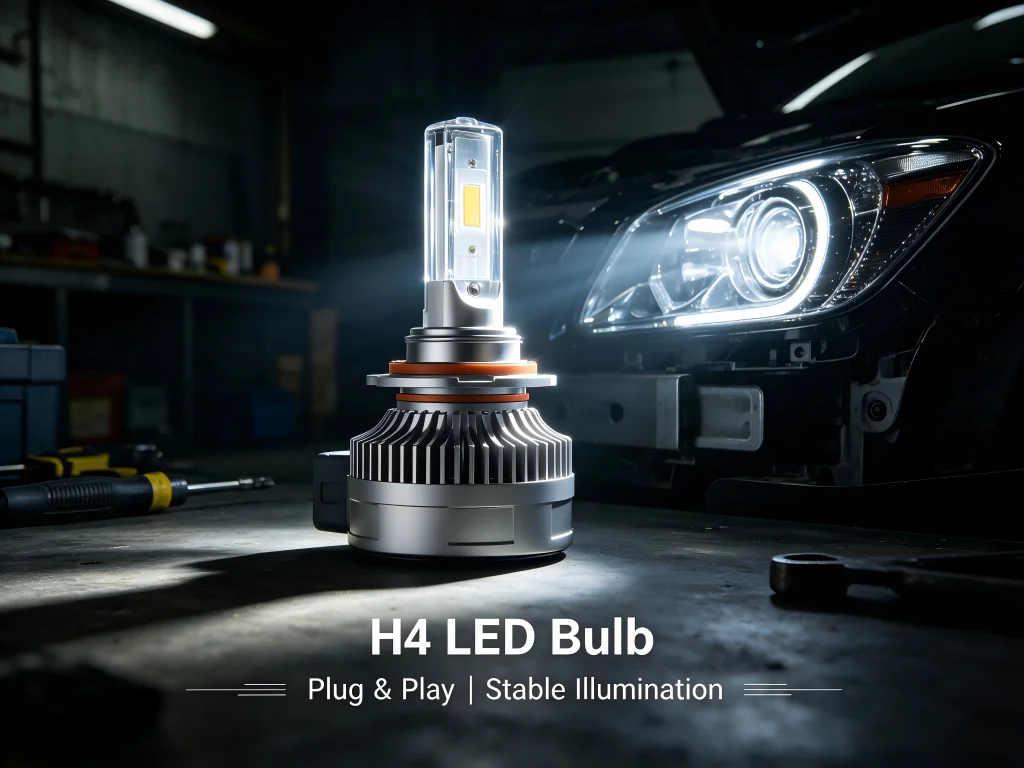
Should You Upgrade to H4 LED Headlamp Bulbs?
You should consider H4 LED headlamp bulbs when your existing H4 halogen system provides weak road illumination and the headlamp housing is in good condition. A suitable LED upgrade may improve brightness, color clarity, and visibility, but the bulb must preserve proper beam distribution and remain compatible with the vehicle.
Before ordering anything, inspect the existing lighting system.
This step can save money because a bulb cannot repair every headlight problem.
If the lens is heavily oxidized, the reflector coating is damaged, the headlamp aim is incorrect, or voltage reaching the bulb is too low, replacing the light source alone may not produce the improvement you expect.
Start with a five-minute headlight diagnosis
Park the vehicle on level ground facing a wall or garage door. Switch on the low beams and look at both the road illumination and the projected pattern.
Then ask these questions:
- Are both headlights equally bright?
- Does one lamp appear yellower or weaker?
- Is the headlamp lens cloudy or heavily scratched?
- Is the beam aimed too low or too high?
- Are there obvious dark sections in the pattern?
- Does brightness change when engine speed changes?
- Does the high beam provide meaningful extra distance?
If the basic headlamp assembly is healthy but the light output remains inadequate, an LED conversion becomes a more logical next step.
Why an H4 Upgrade Is Different From a Simple Bulb Change
An H4 bulb performs both low-beam and high-beam functions, so an LED replacement must reproduce two different lighting states inside optics originally designed around precise halogen filament positions. Small errors in LED placement may change where the reflector sends the light, affecting glare, distance, and beam shape.
This is one of the reasons h4 led headlight bulbs vary so much in real-world performance.
Two products may use similar LED chips and consume similar electrical power, yet produce noticeably different road illumination.
The headlamp reflector does not evaluate wattage or marketing claims. It simply redirects light according to where that light originates.
Think of the reflector as a map
The original H4 filament sits at a designed focal position.
Light leaving that filament reaches different sections of the reflector. Those reflector surfaces then send the light toward specific areas ahead of the vehicle.
Move the light source away from that intended position and the map changes.
The light may still be bright, but it can arrive in the wrong place.
This explains a common aftermarket complaint:
“The LEDs look much brighter when I stand in front of the car, but I cannot see much farther down the road.”
The issue is often distribution, not total light production.
The 7-Zone Road Test for H4 LED Headlight Bulbs
A useful H4 upgrade should not be judged by looking directly at the headlights. Instead, evaluate what happens in several functional zones in front of the vehicle.
| Test Zone | What to Check | Possible Warning Sign |
|---|---|---|
| Immediate foreground | Enough light for lane awareness | Excessively bright foreground |
| Center lane | Strong usable illumination | Large dark center area |
| Left road edge | Controlled side visibility | Excessive stray light |
| Right road edge | Useful shoulder visibility | Weak peripheral illumination |
| Distance hotspot | Concentrated useful intensity | Wide but shallow beam |
| Above cutoff region | Limited unwanted light | Heavy glare |
| High-beam distance | Clear extension down-road | High beam only looks brighter nearby |
This type of evaluation can tell you far more than comparing two bulbs on a workbench.
Step 1: Confirm That Your Vehicle Actually Uses H4
H4 is a widely used dual-filament headlight bulb type, but never purchase based solely on visual appearance.
Check the vehicle handbook, original bulb marking, trusted fitment database, or headlamp label.
This matters because H1, H7, H11, HB3, HB4, and other bulb types can look somewhat similar to an inexperienced buyer while using different bases and functions.
If the vehicle uses H4, you can then evaluate suitable h4 led light bulbs.
Step 2: Measure the Space Behind the Headlight
A halogen H4 bulb is relatively compact.
An LED bulb may add:
- A heat sink
- A cooling fan
- An external driver
- A thicker electrical connector
- Additional anti-flicker components
That means physical compatibility deserves as much attention as electrical compatibility.
The dust-cover problem
Many vehicles use a rubber or plastic cover behind the headlamp to reduce water and dust entry.
If an LED heat sink or fan extends too far backward, the original cover may no longer fit correctly.
Leaving the housing permanently open is rarely a good solution because contamination can enter the lamp and may eventually affect reflectors, lenses, connectors, or adjustment components.
For workshops and distributors, compact design can therefore become a real commercial advantage.
Step 3: Look at LED Source Geometry Before Wattage
A common marketplace buying process goes like this:
20,000 lumens looks good.
30,000 lumens looks better.
40,000 lumens must therefore be best.
Automotive optics do not work that way.
When we review an H4 design, source size and position receive significant attention because they influence how effectively the original reflector can use the available light.
What should an experienced buyer examine?
- Look at the width of the LED board.
- Examine where the LED chips sit relative to the H4 mounting flange.
- Check whether low and high beam emitters are separately positioned.
- Ask for installed beam-pattern photos rather than bare-bulb photos.
- Compare both low and high beam performance.
A carefully positioned light source may outperform a more powerful but poorly positioned design.
Step 4: Understand What Wattage Really Tells You
Wattage measures electrical power consumption. It does not directly measure road visibility.
A bulb consuming more power may generate more light, but it also generates additional heat. If the cooling system cannot remove that heat effectively, the driver may reduce LED current.
This creates an important distinction between startup power and stabilized power.
A specification measured seconds after switching on the bulb may not represent performance after an hour of nighttime driving.
Ask suppliers for stabilized data
If you are buying professionally, request measurements after the bulb has reached normal operating temperature.
You might ask:
- What is the power at startup?
- What is the power after 15 minutes?
- What is the stabilized operating temperature?
- Does the driver reduce current as temperature rises?
- What thermal protection strategy is used?
These questions can reveal far more about engineering quality than an unusually high wattage claim.
Step 5: Check the Cooling Architecture
Heat is one of the most important forces affecting LED reliability.
LED headlights do not operate like halogen bulbs. The LED semiconductor needs heat removed from the chip and transferred through the structure toward the heat sink and surrounding air.
The cooling chain generally looks like this:
LED junction → circuit substrate → thermal interface → metal structure → heat sink → surrounding air.
If any part of that path is poorly designed, heat may accumulate.
Does a fan mean the bulb is better?
No.
A fan can improve heat transfer in a compact package, but its quality matters. Poor bearings, restricted airflow, dust accumulation, or low-grade motors may introduce long-term reliability issues.
Fanless systems remove the moving component but still need sufficient conductive material and surface area.
The best choice depends on total power, available installation space, ambient temperature, and intended operating environment.
Step 6: Do Not Choose Color Temperature by Appearance Alone
Many drivers want the modern white appearance associated with LED lighting.
That is understandable.
However, Kelvin is a color measurement, not a brightness rating.
| Color Temperature | Visual Appearance | Typical Buying Consideration |
|---|---|---|
| 3000K-4000K | Warm / yellow-white | Lower blue content |
| 4500K-5500K | Neutral white | Natural modern appearance |
| 5500K-6500K | Cool white | Common aftermarket preference |
| Above 6500K | Increasingly blue | Appearance becomes a larger factor |
For a road vehicle, visual comfort and useful contrast should come before the desire for the bluest possible light.
Step 7: Test the Beam Before Driving at Full Speed
After installing h4 led headlight bulbs, do not immediately assume the job is complete.
First inspect the pattern on a wall.
Then verify headlamp aim.
Finally, perform a controlled road test where legally and safely possible.
A practical post-installation checklist
- Confirm that both low beams operate correctly.
- Switch to high beam and verify both lamps change function.
- Check for dashboard warning lights.
- Listen for unusual cooling-fan noise.
- Inspect the projected beam for extreme scatter.
- Verify that other drivers are not exposed to excessive glare.
- Recheck output after the bulbs have been running for some time.
The last step is often missed.
A product that looks excellent for two minutes may behave differently once thermal conditions stabilize.
Why Some H4 LED Bulbs Flicker After Installation
H4 LED bulbs may flicker because of unstable voltage, pulse-width-modulated vehicle lighting circuits, bulb-out monitoring systems, poor electrical connections, incompatible LED drivers, or inadequate decoding hardware. The correct fix depends on the vehicle’s electrical system rather than on the LED chips alone.
Modern vehicles may use electronics to monitor headlight operation.
A halogen bulb represents a particular electrical load. An LED conversion can behave differently.
The vehicle may therefore detect what it believes is a failed bulb even when the LED is working normally.
Possible symptoms include:
- Flickering
- Dashboard bulb warnings
- LEDs turning off after startup
- Rapid flashing during self-checks
- Intermittent operation
Professional suppliers should be able to discuss these issues rather than simply describing every H4 LED product as universally compatible.
What If the New H4 LEDs Still Do Not Give Enough Distance?
This situation deserves diagnosis rather than immediately purchasing an even more powerful bulb.
Check the headlamp aim first.
If aim is correct, examine the beam pattern.
If the foreground is extremely bright while distant illumination remains weak, the optical distribution may be too shallow.
If the pattern lacks a useful central hotspot, source positioning may be contributing to the problem.
If one lamp is weaker than the other, interchange the bulbs where practical. This can help determine whether the weakness follows the bulb or remains with the headlamp assembly.
H4 LED Headlight Bulbs South Africa: How to Shop Smarter
Buyers searching for h4 led headlight bulbs south africa often compare local automotive retailers, specialist lighting stores, workshops, and online marketplaces.
Common searches include h4 led headlight bulbs midas, h4 led headlight bulbs midas south africa, h4 led headlight bulbs midas price, and h4 led headlight bulbs takealot.
These searches are highly purchase-oriented.
But price alone gives an incomplete comparison.
Use a three-price calculation
Instead of considering only the shelf price, think about three costs:
- Purchase cost: What do the bulbs cost initially?
- Installation cost: Will fitting require adapters, modified covers, or additional electronics?
- Failure cost: What happens if the bulb fails, flickers, or needs replacement?
This is particularly relevant for professional workshops.
A customer returning three times because of a low-cost bulb can make that bulb more expensive than a higher-quality product purchased at the beginning.
H4 LED Headlight Bulbs Ireland: Check Road-Use Requirements
People searching for h4 led headlight bulbs ireland should also consider whether an LED retrofit is permitted for their specific vehicle and lighting assembly.
Road lighting requirements vary by country and by product approval.
Physical fitment does not automatically equal road legality.
UNECE vehicle lighting regulations provide technical frameworks used across many markets. Buyers researching international requirements can review information from the UNECE Vehicle Regulations portal.
Professional importers should confirm applicable national requirements before selecting products for resale.
Searching “H4 LED Headlight Bulbs Near Me”? Ask These Questions
If you search h4 led headlight bulbs near me, you are probably ready to buy.
Before paying, ask the seller to answer four practical questions:
- Will these bulbs physically fit my headlamp?
- Can you show a low-beam pattern from an installed H4 headlight?
- What happens if my vehicle develops flickering or an error message?
- What warranty applies if a cooling fan or driver fails?
A knowledgeable seller should be comfortable discussing these issues.
Retail Buyers and B2B Buyers Should Not Use the Same Checklist
A retail customer usually needs one pair of bulbs.
A distributor may need 500, 5,000, or considerably more units.
The buying decision therefore changes.
| Requirement | Retail Customer | Distributor / Wholesaler |
|---|---|---|
| Vehicle fitment | One vehicle | Many applications |
| Quality concern | Personal reliability | Batch consistency |
| Packaging | Usually fixed | May require customization |
| Technical support | Basic | Ongoing support may be critical |
| Warranty impact | One replacement | Large-scale return exposure |
| Supply continuity | Low priority | High priority |
This is why serious automotive lighting importers evaluate the factory as carefully as they evaluate the bulb.
The Distributor’s Sample-Test Method
When evaluating a new H4 LED supplier, do not approve a product after testing one bulb in one headlamp for five minutes.
A stronger process uses multiple checks.
Phase 1: Mechanical test
- Inspect bulb dimensions.
- Test retaining clips or rings.
- Check dust-cover clearance.
- Inspect connector accessibility.
Phase 2: Optical test
- Evaluate low beam.
- Evaluate high beam.
- Compare hotspot location.
- Look for excessive stray light.
Phase 3: Thermal test
- Operate bulbs continuously.
- Measure power once temperature stabilizes.
- Observe fan behavior.
- Check whether output drops substantially.
Phase 4: Vehicle compatibility test
- Test several representative vehicle models.
- Check for warning messages.
- Check for flicker.
- Verify physical installation.
Phase 5: Batch consistency check
Compare multiple units rather than relying on one ideal sample.
For a B2B buyer, consistency often determines profitability more than peak laboratory performance.
What Professional Installers Tend to Care About
After years of working with automotive lighting products, one lesson remains consistent: workshops judge a bulb differently from online shoppers.
A customer may ask:
“How many lumens does it have?”
An installer is more likely to ask:
“Will it fit without modification, will the beam be right, and will the customer come back with a problem?”
This difference matters.
The best product for an aftermarket business is not necessarily the one that creates the most dramatic product-page specification.
It is the product that performs consistently after installation.
Why GTR Builds H4 LED Products Around Real Applications
At GTR, automotive lighting development begins with application requirements rather than a single headline number.
Our product development philosophy considers several connected elements:
- Optical source positioning
- Mechanical structure
- Heat-transfer efficiency
- Driver electronics
- Low/high beam switching
- Installation convenience
- Vehicle compatibility
- Manufacturing repeatability
This is particularly important for importers, automotive lighting wholesalers, aftermarket distributors, modification chains, and private-label customers.
A professional customer may need more than an off-the-shelf bulb. Different markets can require different price positioning, packaging, specifications, vehicle applications, and sales strategies.
From one sample to thousands of units
Making one good sample is relatively easy.
Making thousands of units that perform consistently is a manufacturing challenge.
This is where process control becomes important.
Optical position, soldering quality, thermal interfaces, driver components, fan assembly, mechanical tolerance, and final testing can all influence finished-product consistency.
For distributors, controlling these details can reduce field failures and protect dealer confidence.
FAQ About H4 LED Headlamp Bulbs
Can H4 LED headlamp bulbs improve night driving?
Yes, a suitable H4 LED upgrade may improve useful road illumination, whiten the light appearance, and increase visual clarity. Results depend on bulb design, headlamp optics, aim, and installation quality.
Why do LED headlights sometimes create glare?
Glare may occur when LED emitting surfaces do not align correctly with the optical system, when the headlamp is aimed too high, or when the reflector cannot control the replacement light source properly.
Do higher-lumen H4 LED bulbs always shine farther?
No. Long-distance visibility depends heavily on beam intensity and distribution. A very bright bulb can waste light in foreground or stray-light zones instead of concentrating it farther down the road.
How can I tell whether my H4 LED bulb is overheating?
Possible signs include brightness dropping after several minutes, unstable operation, unusually hot drivers, repeated shutdowns, or premature failures. Proper testing should compare cold and thermally stabilized performance.
Can H4 LED headlight bulbs work in motorcycles?
Some motorcycles use H4 bulbs and may accept suitable LED replacements, but available space, electrical output, vibration, heat, beam pattern, and local regulations should be checked before installation.
Why does one LED headlight look brighter than the other?
The cause may be the bulb, headlamp condition, voltage supply, electrical connection, aim, reflector condition, or installation orientation. Swapping bulbs between sides can sometimes help isolate the source of the problem.
Are expensive H4 LED bulbs always better?
No. Price alone does not guarantee optical accuracy or durability. However, extremely low-cost products may compromise driver components, thermal management, mechanical tolerances, or quality control. Compare engineering evidence rather than price alone.
What should wholesalers request before ordering H4 LED bulbs?
Request specifications, dimensions, beam-pattern evidence, thermal data, packaging information, warranty terms, compatibility details, sample testing, and information about production quality control before moving to commercial volume.
Your Next H4 Upgrade Should Start With Evidence, Not Advertising
Choosing h4 led headlamp bulbs becomes easier when you stop asking which box has the biggest number and start asking how the complete lighting system behaves.
Does the bulb fit correctly?
Does it create usable low beam?
Does high beam actually extend viewing distance?
Does output remain stable once the bulb becomes hot?
Will the electronics work with the target vehicle?
Can the manufacturer reproduce that performance across the next production batch?
Those questions matter to a driver. They matter even more to a distributor whose reputation depends on every product sold.
If you operate an automotive lighting wholesale business, headlight retrofit chain, aftermarket parts distribution network, or private-label brand, GTR can help you develop an H4 LED solution around your market rather than forcing your market around a generic product.
Before placing your next bulk H4 LED order, send us the vehicle applications, target country, performance level, positioning, and expected volume you need. Our team can help you evaluate the product from optical performance to installation and production consistency.
Explore professional automotive lighting solutions at www.rhgtr.in and build an H4 LED program designed to keep installers confident, distributors competitive, and customers coming back for the right reason.