
Choosing LED H11 headlight bulbs from a product page is easy. Choosing the right pair after driving through rain, dark rural roads, city traffic, and long highway sections is much harder. A bulb that looks impressive in a photo may feel average on the road, while a more controlled design can make objects, lane markings, signs, and road edges easier to identify.
That is why we prefer to judge H11 lighting by driving tasks instead of marketing numbers.
For drivers, installers, distributors, and automotive lighting buyers, one question matters most: Does this bulb help the driver see useful information earlier and more clearly?
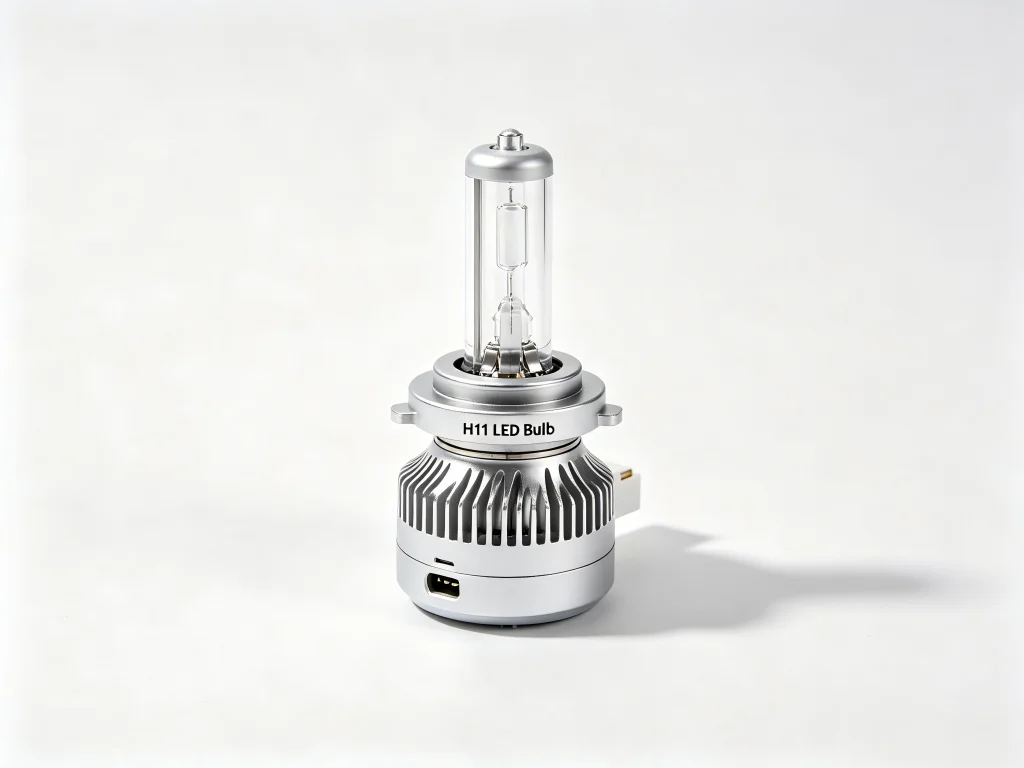
What Makes LED H11 Headlight Bulbs Good for Night Driving?
Good LED H11 headlight bulbs should create a controlled low-beam pattern, place useful illumination at medium and long driving distances, maintain stable output as temperature rises, fit the original housing correctly, and work with the vehicle electronics without introducing flicker, glare, warning lights, or installation problems.
That sounds simple, but each part affects the others.
A more powerful LED may generate more heat. More cooling may require a larger heatsink. A larger heatsink may reduce installation space. A larger LED emitter may generate more light but change the focal point.
Automotive lighting design is therefore a balancing exercise.
The Five-Road Test for H11 LED Bulbs
Instead of testing headlights only against a white wall, we recommend evaluating them through several real driving environments.
Each environment exposes a different weakness.
Road Test 1: Dark Rural Roads
Rural roads quickly reveal whether an H11 low beam has real distance performance.
There are usually fewer streetlights, fewer illuminated buildings, and less ambient light. The driver depends almost entirely on the headlamps.
This is where a weak hotspot becomes obvious.
A bulb may illuminate the first 10 or 15 meters aggressively while leaving the road farther ahead relatively dark.
That creates a misleading impression of brightness.
The foreground looks impressive, yet the driver has less time to detect an animal, broken vehicle, pedestrian, sharp curve, or object farther down the road.
For H11 LED headlight bulbs low beam applications, we look for a gradual and useful distribution of light rather than an excessively bright patch immediately in front of the car.
Road Test 2: Wet Asphalt
Rain changes everything.
Dry pavement reflects light differently from wet pavement. Lane markings can become harder to read. Glare from surrounding traffic increases. Road surfaces may appear darker.
Extremely cool or poorly controlled light can feel less comfortable in these conditions.
A well-designed H11 LED should not depend on raw visual brightness alone.
It should help preserve road contrast.
That means controlled beam placement becomes even more important during bad weather.
Road Test 3: Urban Traffic
City driving tests something different.
There are already many competing light sources:
- street lamps;
- shop signs;
- traffic lights;
- oncoming headlights;
- vehicle brake lights;
- digital advertising screens;
- reflections from wet roads and windows.
In this environment, simply adding more brightness does not automatically make driving easier.
Controlled light becomes more valuable because it helps reduce unnecessary visual clutter.
The headlamp should illuminate the road without flooding surrounding areas with uncontrolled light.
Road Test 4: Highway Driving
At higher speeds, seeing farther ahead becomes increasingly important.
The faster the vehicle moves, the less time the driver has to react after identifying an obstacle.
For this reason, a highway test should focus on how well the low beam supports forward awareness.
Ask yourself:
- Can lane markings be identified clearly?
- Is the road edge easy to follow?
- Does the light remain useful beyond the immediate foreground?
- Do reflective signs become excessively bright?
- Does the beam remain comfortable over long driving periods?
This test often separates a balanced bulb from one designed mainly to impress during short demonstrations.
Road Test 5: Long-Duration Operation
Turn the headlights on and leave them running.
Not for two minutes.
Not for a quick photo.
Run them long enough for the bulb to reach a stable operating temperature.
This exposes thermal behavior.
LED output can change as temperature increases. A weak thermal design may reduce brightness after the bulb heats up.
For professional buyers, this test is especially useful because retail customers judge the product after driving for 30 minutes, one hour, or several hours—not immediately after installation.
Why the Same H11 LED Can Perform Differently in Two Cars
An H11 LED bulb can perform well in one vehicle and poorly in another because the reflector or projector design, focal geometry, electrical system, rear clearance, and headlamp dimensions vary. The H11 socket only confirms the connection type. It does not guarantee identical optical performance across every compatible vehicle.
This is one of the most misunderstood parts of LED retrofitting.
Two vehicles may both use an H11 bulb.
Yet the internal optics can be completely different.
Reflector Headlights
A reflector headlamp uses shaped reflective surfaces to distribute light.
The original filament position strongly influences where that reflected light goes.
If the replacement LED changes the effective source location, the beam can become wider, less focused, or more scattered.
Projector Headlights
A projector system uses a reflector, lens, and internal shield to shape the output.
Many buyers assume a projector automatically produces a good beam with any LED bulb.
That is not always true.
The projector still depends on the light source being positioned correctly relative to the optical system.
Emitter size and orientation can still change hotspot intensity, cutoff sharpness, and light distribution.
A Better Way to Judge H11 LED Performance
| What Buyers Commonly Check | What You Should Check Instead | Why It Matters |
|---|---|---|
| Maximum lumen number | Useful road illumination | Total light does not show where the beam goes |
| How white the bulb looks | Contrast and visual comfort | Whiter does not always mean easier to see |
| Brightness at startup | Brightness after thermal stabilization | Heat can reduce sustained output |
| Star rating | Repeated failure patterns in reviews | Common complaints reveal design weaknesses |
| H11 socket match | Full optical and physical compatibility | Correct connector does not guarantee correct beam |
| CANbus label | Vehicle-specific electrical behavior | No decoder works perfectly in every vehicle |
How to Read H11 LED Reviews More Intelligently
Search behavior shows that many buyers compare H11 LED headlight bulbs Amazon, H11 LED headlight bulbs Walmart, and H11 LED headlight bulbs AutoZone.
Reviews can be useful, but only when you know what to look for.
A five-star comment saying “super bright” tells you very little.
A detailed review saying the bulb fits correctly, maintains a clean cutoff, does not flicker, and remains stable after several months tells you much more.
Look for repeated technical patterns.
Positive Signals
- beam pattern stayed similar to the original bulb;
- installation did not require housing modification;
- no dashboard warning appeared;
- both bulbs had matching color;
- brightness remained stable over long drives;
- fan noise was not intrusive;
- the dust cover could still close properly.
Warning Signals
- “very bright but everyone flashes me”;
- “looked good at first, then became dim”;
- “had to cut the dust cover”;
- “one bulb changed color”;
- “fan failed after several months”;
- “flickers when engine is running”;
- “dashboard says bulb failure.”
These comments reveal much more about design quality than a simple average score.
Does Buying LED H11 Headlight Bulbs Nearby Make Sense?
Searches for LED H11 headlight bulbs nearby and LED H11 headlight bulbs near me usually come from drivers who want an immediate replacement.
Local availability can be useful when a bulb fails unexpectedly.
But urgency creates a common mistake.
Buyers purchase the first H11 LED they find without checking the headlamp design.
Before paying, inspect the original bulb and available installation space.
Then ask the retailer whether the product is intended for your specific vehicle and application.
If possible, keep the original halogen bulbs until the new system has been tested at night.
What Should Peterbilt 579 Drivers Consider?
The keyword H11 LED headlight bulbs Peterbilt 579 deserves separate attention because commercial driving creates different demands.
A truck may spend far more hours operating at night than a typical passenger vehicle.
That makes reliability, heat control, vibration resistance, and electrical stability more important.
Before choosing an H11 LED for a Peterbilt 579, verify the actual headlamp configuration and model year.
Do not rely only on the phrase “fits Peterbilt.”
Check:
- bulb designation;
- connector type;
- rear housing clearance;
- driver compatibility;
- headlight assembly type;
- beam alignment after installation.
Fleet buyers should also consider consistency between batches.
If one replacement looks noticeably different from another, maintenance becomes more complicated.
H11 LED Headlight Bulbs in South Africa
Buyers researching H11 LED headlight bulbs South Africa should consider local driving conditions instead of importing product expectations from another market.
Long intercity routes, dark roads, high ambient temperatures, dust, seasonal rain, and uneven surfaces can place extra stress on lighting systems.
In hotter environments, thermal margin becomes particularly relevant.
A bulb already operating near its thermal limit may become less stable when installed inside a hot engine bay and enclosed headlamp assembly.
For these applications, our preferred evaluation order is:
- beam control;
- thermal stability;
- mechanical fit;
- electrical compatibility;
- vibration resistance;
- consistent color and output.
What About H11 LED Headlight Bulbs at Midas?
Drivers searching for H11 LED headlight bulbs Midas are often trying to combine installation service with product purchase.
That can be a practical approach.
A professional installer may identify fitment or alignment problems that are easy to miss during a home installation.
However, the quality of the final result still depends on the bulb and headlamp combination.
Installation skill cannot completely correct an LED source that is fundamentally mismatched with the optical system.
The 30-Minute H11 LED Evaluation Routine
You do not need a laboratory to identify many common H11 problems.
A basic real-world test can reveal a surprising amount.
- Park on a level surface. Mark the original halogen cutoff on a wall before removing the bulbs.
- Install the H11 LEDs. Confirm that both bulbs lock into the housing correctly.
- Compare the cutoff. Look for large changes, excessive scatter, or uneven left-right patterns.
- Run the lights for 20 to 30 minutes. Observe whether brightness changes visibly.
- Check for electrical problems. Start the engine and look for flicker or warning messages.
- Take a short night drive. Evaluate foreground light, distance illumination, lane visibility, and glare.
- Inspect again afterward. Listen for abnormal fan noise and check whether components became excessively hot.
This simple process is more useful than comparing packaging claims alone.
How GTR Develops H11 Lighting for Real Driving
At GTR, we look at H11 LED lighting as an interaction between electronics, heat, optics, and installation.
Based on our manufacturing experience, optimizing only one specification usually creates compromises elsewhere.
That is why our product development focuses on the complete operating system.
Optical Control
The LED source must work with the headlamp rather than fighting against it.
Emitter placement, board thickness, orientation, and light-emitting area all influence the resulting beam.
Our goal is to create useful road illumination rather than simply maximize visible brightness.
Thermal Engineering
Every increase in LED power creates a thermal challenge.
Heat needs a controlled path away from sensitive components.
That requires coordination between the LED substrate, housing materials, cooling structure, airflow, and driver design.
Installation Architecture
A powerful bulb that cannot fit behind the factory dust cover creates another problem.
Compact dimensions matter.
We consider connector position, heatsink size, fan structure, driver location, wiring, and installation clearance during product development.
Commercial Consistency
For wholesale buyers, performance consistency is often more important than a single impressive sample.
A distributor needs the first pair, the hundredth pair, and the ten-thousandth pair to behave within an acceptable range.
This requires production control, component consistency, assembly accuracy, and testing throughout manufacturing.
FAQ About LED H11 Headlight Bulbs
Are LED H11 headlight bulbs brighter than halogen?
Many LED replacements can produce more light than traditional halogen bulbs, but actual road performance depends on optical compatibility. More total light does not automatically mean more useful visibility.
Can I use H11 LEDs for low beams?
Yes, many vehicles use H11 bulbs in the low-beam position. Confirm the original bulb specification and evaluate the beam pattern after installation because low-beam optics require controlled light distribution.
Do H11 LED bulbs need a CANbus decoder?
Some vehicles work without additional components, while others may show flicker or dashboard errors. The need for a decoder depends on the vehicle’s electrical monitoring system and the LED driver’s design.
Why is one H11 LED brighter than the other?
Possible causes include manufacturing variation, poor electrical connection, driver problems, LED damage, voltage differences, or thermal issues. A quality matched pair should produce similar color and output.
Are expensive H11 LED bulbs always better?
No. Price alone does not guarantee optical performance or reliability. Evaluate beam quality, thermal management, electrical compatibility, fitment, manufacturing consistency, and warranty support.
Can H11 LEDs damage a headlight housing?
A properly designed bulb should manage heat within its intended architecture, but poor installation, oversized components, blocked cooling, or unsuitable products may create problems. Always check installation clearance and operating temperature.
Should H11 LED chips face left and right?
Many two-sided H11 LED designs are intended to position the emitting surfaces horizontally to better reproduce the original filament geometry, but orientation depends on the bulb and headlamp design. Follow the manufacturer’s installation instructions and verify the resulting beam.
How long should H11 LED bulbs last?
Service life depends on junction temperature, driver quality, component quality, cooling performance, operating environment, and usage. Treat extremely large lifetime claims carefully unless they are supported by realistic thermal and reliability testing.
Choose the Bulb You Would Want on a Dark Road
There is a simple way to think about H11 lighting.
Forget the box for a moment.
Forget the headline lumen figure.
Imagine driving at night on an unfamiliar road with no streetlights, light rain, and several hours still ahead.
Which bulb would you choose then?
You would probably want controlled visibility, stable output, reliable electronics, good fitment, and a beam that helps you read the road without creating unnecessary glare.
Those are the same qualities that distributors, retrofit shops, wholesalers, and private-label buyers should prioritize.
If you are evaluating your next H11 LED product line, visit www.rhgtr.in. GTR can support automotive lighting buyers with H11 solutions built around real vehicle applications, optical performance, thermal management, wholesale requirements, and market-specific product development. Choose the bulb that performs after the catalog is closed and the road becomes dark.