
Walk into any auto parts store and ask for an h7 headlamp bulb. You will get a wall of options, a handful of opinions, and almost zero useful information. That is not an accident. The lighting industry has a dirty secret: most bulbs are made in the same handful of factories, rebranded, and sold at wildly different prices. What separates a genuine upgrade from a waste of money has almost nothing to do with the brand name on the box.
This article is not a buyer’s guide in the traditional sense. It is a behind-the-scenes look at how H7 bulbs are actually made, tested, and marketed — from someone who has spent years inside the manufacturing side of the industry.
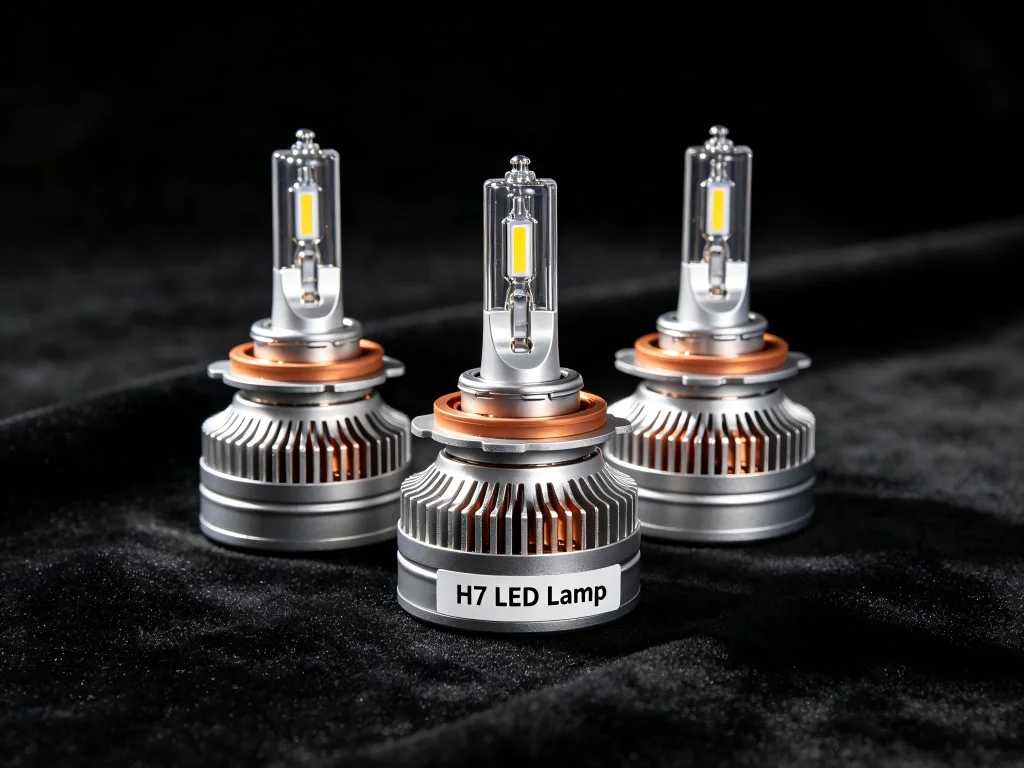
The Factory Floor Reality: Where Your H7 Bulb Really Comes From
Most consumers assume that a premium brand manufactures its own bulbs. In reality, a small number of factories in Asia produce the vast majority of H7 headlight bulbs sold worldwide. Brands then apply their own labeling, packaging, and marketing. Some brands enforce strict quality control. Others simply buy the cheapest batch available and hope for the best.
This is why two bulbs with identical specifications can perform completely differently. The difference is not the design on paper. It is the consistency of the manufacturing process — the tolerance of the chip placement, the quality of the driver components, the integrity of the thermal interface materials.
In our own production facilities, we have seen batches of LEDs that look identical under a microscope but produce beam patterns that are 20% off from each other. That variance is invisible in a product listing. It becomes painfully visible on the road.
What “H7 Headlight Bulb Fits What Cars” Really Means for Manufacturing
The H7 base is standardized. The housing it sits in is not.
Every vehicle manufacturer designs its headlamp optics around a specific filament position, a specific focal length, and a specific light distribution pattern. A bulb that works beautifully in a Volkswagen Golf may produce dangerous glare in a BMW 3 Series. The base fits both. The light does not.
This is why we test our bulbs across a wide range of vehicle platforms before releasing them. In our engineering testing, we have found that a difference of just 0.5 millimeters in chip position can shift the beam cutoff by several degrees. On a dark road, that is the difference between seeing a deer at 100 meters and seeing it at 60 meters.
The H7 Low Beam Bulb Problem Nobody Talks About
Most drivers searching for an h7 low beam bulb are not looking for more brightness. They are looking for better visibility without blinding other drivers. That is a much harder engineering challenge than simply increasing lumen output.
The low beam pattern is designed to illuminate the road ahead while keeping light out of oncoming traffic’s eyes. It relies on a sharp cutoff — a horizontal line where light stops and darkness begins. When an LED bulb places its light source even slightly outside the original filament position, that cutoff blurs. Light spills upward. Oncoming drivers get glare. You get a false sense of brightness because the foreground is lit up, but the distance vision suffers.
We have tested dozens of competitor bulbs on our photometric equipment. The results are consistent: bulbs that prioritize raw brightness over beam accuracy fail the low beam test. They look impressive in a garage. They fail on the road.
The 100W Myth and Why It Refuses to Die
Search for an h7 headlight bulb 100w and you will find no shortage of listings. What you will not find is a truthful explanation of what that number means.
A genuine 100-watt bulb would draw nearly double the current of a standard halogen. The wiring in most vehicles is not designed for that load. The connectors would overheat. The headlamp housing, engineered for 55 watts of heat, would begin to degrade. In extreme cases, the reflector coating can blister and peel.
What “100W” usually means in LED marketing is “equivalent to a 100W halogen” — a comparison that is mathematically loose and practically meaningless. A 25W LED can produce more usable light than a 100W halogen if the beam pattern is correct. The wattage number is a distraction. Beam accuracy is the metric that matters.
What to Look for When Buying H7 Bulbs Nearby
If you search for an h7 headlight bulb nearby or check stock at a local retailer like h7 headlight bulb bunnings, you are likely looking at halogen replacements. That is fine if you want a direct OEM replacement. It is not fine if you expect a meaningful upgrade.
Local retailers stock what sells in volume. That means standard halogens, a few “upgrade” halogens with slightly higher color temperature, and occasionally a budget LED kit with no meaningful thermal management. The good stuff rarely makes it to the shelf because it requires explanation, and shelf space does not come with a salesperson who understands beam photometry.
If you want a proper LED upgrade, you need to buy from a specialist. That is not a sales pitch. It is a practical reality of how the retail supply chain works.
Frequently Asked Questions
Why do some H7 LED bulbs cost $20 and others cost $120?
The difference is in the components you cannot see: the quality of the LED chips, the sophistication of the driver electronics, the thermal design, and the quality control during manufacturing. A $20 bulb may work for a few months. A $120 bulb is engineered to work for years.
Can I install an H7 LED bulb myself?
In most vehicles, yes. The H7 base is a simple push-fit design. The challenge is usually access — some engine bays require removing the airbox or washer fluid reservoir. If you can change a halogen bulb, you can usually change an LED.
Do H7 LED bulbs need special cooling?
Yes. LEDs generate heat at the chip level, and that heat must be managed. Passive heat sinks work for low-power bulbs. Higher-output bulbs need active cooling — typically a fan — to maintain brightness and lifespan.
What is the best color temperature for an H7 low beam bulb?
For maximum visibility in most conditions, 4300K to 6000K is ideal. Lower temperatures (3000K–4000K) perform better in rain and fog. Higher temperatures (6500K+) look stylish but reduce usable light output.
Will an H7 LED bulb fit my car if the listing says it fits?
Physical fitment is almost always guaranteed — H7 is H7. The real question is electronic compatibility. Some vehicles require CANBUS-ready bulbs to avoid error codes and flickering.
The GTR Difference: Manufacturing Transparency
We do not hide behind vague specifications. We publish real photometric data. We test our bulbs in real vehicle housings, not just laboratory fixtures. We stand behind our products with a lifetime warranty because we control the manufacturing process from chip placement to final assembly.
If you are tired of guessing which H7 bulb will actually work, visit www.rhgtr.in and see the difference that engineering transparency makes.