
Most articles about halogen headlight bulbs read like spec sheets. This one does not. What follows is a working notebook from the factory floor, the warranty desk, and the test bench, written for buyers who want to understand what actually happens to a bulb after it leaves the box.
What the Warranty Desk Sees
Roughly seven out of ten halogen headlight bulbs returned as “defective” test within normal specification. The real failures trace back to the vehicle’s electrical environment, not the bulb itself.
That number comes from our own return analysis across automotive and powersports accounts. It is worth sitting with, because it reframes almost every buying decision that follows.
When a driver says a bulb died early, the honest first question is not “which brand?” It is “what voltage did it see, and for how long?” A charging system running at 14.8V instead of 13.8V pushes a filament noticeably harder. Over a year of nightly commuting, that difference alone can cut service life by a third.
Moisture is the second silent killer. A housing with a cracked seal, a missing boot, or a blocked breather lets humid air cycle in and out. The filament survives. The base contacts corrode. Resistance climbs, current drops, output fades, and eventually the bulb simply stops.
The Anatomy Nobody Explains
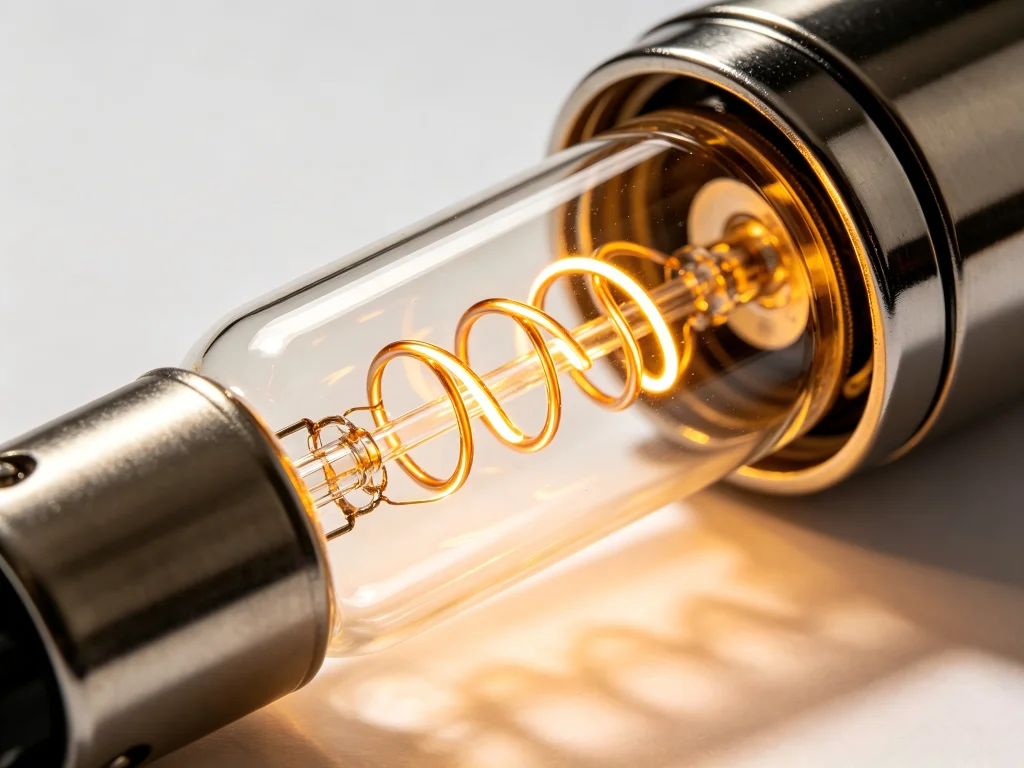
Strip away the packaging and a halogen bulb is a small thermal system with five working parts. Each one fails in a predictable way.
- The filament is tungsten, coiled tight to concentrate light at the focal point. It thins with every thermal cycle. When it finally breaks, it usually takes the filament support with it.
- The halogen fill gas carries evaporated tungsten back to the filament. This cycle slows wear but does not stop it. Gas purity matters, and cheap manufacturing lets contaminants in.
- The quartz envelope must survive extreme heat while staying optically clear. Deposits on the inner wall are the first visible sign of aging.
- The base and contacts carry current and hold alignment. Slight corrosion here quietly steals voltage from the filament.
- The seal where glass meets metal is the hardest joint in the whole assembly. A flaw here means the bulb dies young, often with no visible clue.
Understanding these five parts changes how you read a product listing. Claims about “brighter” or “whiter” are secondary. What matters is whether the manufacturer controls gas purity, seal integrity, and contact plating.
Output Curves, Not Output Numbers
A bulb does not produce a fixed amount of light. It produces a curve.
| Operating Hour | Relative Output (Standard Halogen) | Relative Output (High-Output Halogen) |
|---|---|---|
| 0 (new) | 100% | 100% |
| 100 | 97% | 93% |
| 300 | 90% | 82% |
| 600 | 82% | 70% |
| 1,000 | 75% | Failure likely |
Two lessons live in that table. First, a standard halogen at 600 hours is already producing roughly the light of a much dimmer bulb, yet it still works, so most drivers never replace it. Second, high-output halogens trade life for brightness along a steeper curve. You get more light now and less total light over the ownership period.
This is why our recommendation to fleet clients rarely starts with “buy the brightest option.” It starts with matching the bulb to the duty cycle. A delivery van that runs eight hours a night needs a different answer than a weekend sports car.
Fitment Codes Decoded
H4, H7, H11, and 9005 are not performance grades. They are physical standards.
H4 carries two filaments in one envelope and serves both high and low beam in a shared housing. H7 and H11 are single-filament designs used for one function each, with H11 common in fog and low-beam positions on Asian platforms. 9005 is a right-angle base frequently used for high beams and, on some trucks, fog lights.
Getting the code right is necessary but not sufficient. Two bulbs sharing a code can still differ in filament placement by fractions of a millimeter, which shifts the beam pattern measurably. In projector housings the tolerance is tighter. In reflector housings a misplaced source throws light where it does not belong.
What Buyers Ask Us Most
How often should halogen headlight bulbs be replaced?
Even if they still light up, consider replacing every 12 to 18 months of regular night driving. Output has usually dropped well below new by then.
Do white halogen bulbs actually help visibility?
Rarely. The blue coating that shifts color also filters light. You gain a modern look and lose usable output. In rain, the loss is more noticeable.
Are halogen bulbs still worth buying?
Yes, in specific cases. Vehicles with simple electrical systems, older motorcycles, and drivers in regions where conversions are restricted all remain good candidates.
Why do bulbs from the same pack fail at different times?
Voltage differences between left and right circuits are common, and one housing often runs hotter or seals worse than the other. The bulb is reacting to its environment, not failing randomly.
Can I upgrade output without changing technology?
Sometimes. Restoring lens clarity, cleaning grounds, and fitting a relay harness can recover meaningful light from an existing halogen setup at modest cost.
What kills a halogen bulb fastest?
Oil from bare fingers on the glass, over-voltage from a failing regulator, and vibration from worn mounts. All three are preventable.
Where GTR Sits in This Picture
Our position is straightforward. We manufacture lighting for automotive and powersports applications, and we design around the failure modes described above rather than around a marketing number.
That means seal integrity is validated before cosmetics. It means contact plating is specified for corrosion resistance, not cost. It means every batch is checked for filament placement consistency, because alignment is what determines whether a bulb performs in your housing or fights it.
For distributors, workshops, and fleet operators, we also run OEM and private-label programs with stable specifications across orders. If your business depends on lighting that behaves predictably in the field, that consistency is the product.
A Short Field Checklist
Before your next bulb purchase, do four things. Check charging voltage with the engine running. Inspect both housings for moisture or cracked seals. Clean the lens if it looks cloudy. Then decide whether you are solving a bulb problem or a system problem.
Most drivers are solving the second one without knowing it. Fix the system, and the bulb you choose will finally perform the way it was built to.
Need a lighting supplier who understands what happens after installation? Visit www.rhgtr.in to review GTR’s automotive and powersports range, or talk to our team about OEM programs, fitment questions, and volume pricing.