
Buying h11 led lights should not feel like choosing the biggest number on a product page. A driver wants something much simpler: clearer lane markings, earlier obstacle detection, reliable output in rain, and a beam that does not annoy oncoming traffic. For distributors and retrofit shops, there is another requirement—consistent performance across every box they sell.
This is why the best way to judge an H11 LED upgrade is to start with the road, not the specification sheet. A bulb may advertise impressive brightness yet perform poorly once installed inside a real reflector or projector. The useful question is therefore not “How powerful is it?” but “How much controlled light reaches the right part of the road?”
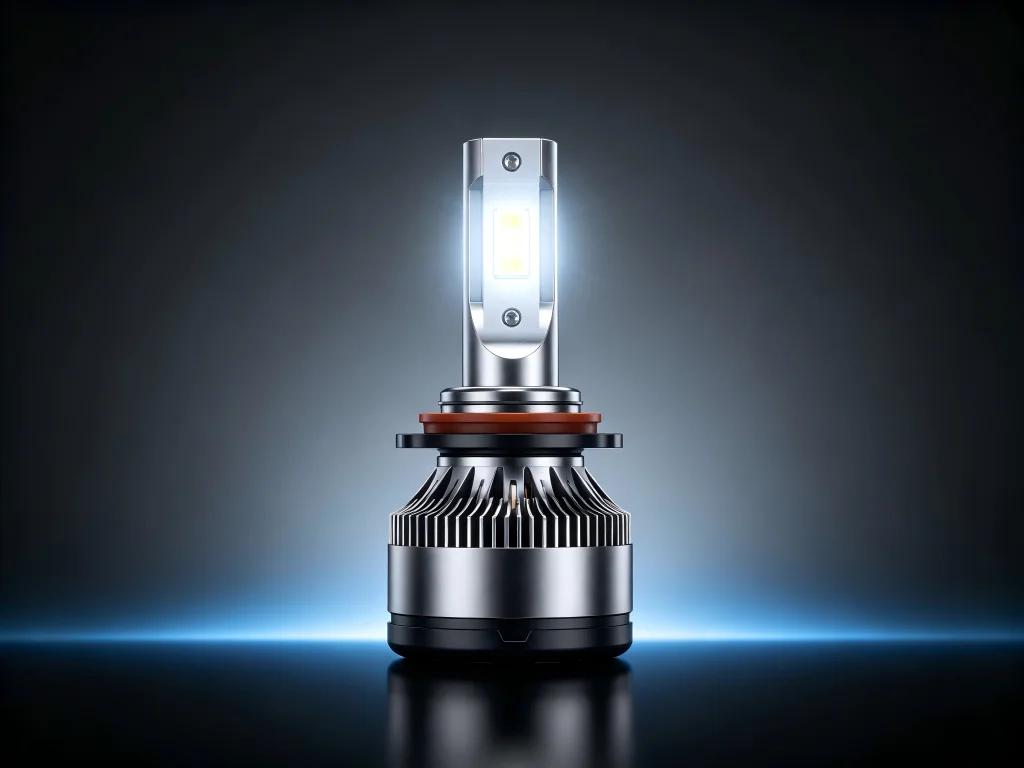
What Makes H11 LED Lights Effective on the Road?
Effective H11 LED lights combine accurate LED chip placement, controlled beam distribution, stable output, efficient cooling, and correct vehicle fitment. When these elements work together, the driver may gain clearer road contrast and better visibility. If one element is poorly designed, additional brightness can create glare or wasted light instead.
Think of the headlamp as an optical system rather than a bulb holder. The bulb creates light, but the reflector or projector decides where that light goes. This relationship explains why two H11 bulbs that look similar on a workbench can produce very different results after installation.
Start With the Driving Situation, Not the Lumen Number
Different roads expose different weaknesses in automotive lighting.
City Driving
Street lighting can hide weak headlight performance. Drivers may assume their headlights are adequate because buildings, signs, and other vehicles provide additional illumination.
The problem becomes more obvious when the same vehicle enters a darker road.
Wet Highways
Rain creates reflections on the road surface and can reduce visual contrast. Excessive foreground brightness may become distracting because light reflected from wet pavement dominates the driver’s field of view.
A controlled beam is therefore especially valuable in poor weather.
Rural and Mountain Roads
These environments usually have fewer external light sources. Drivers depend more heavily on headlamp reach, road-edge visibility, and contrast.
This is where a poorly focused LED upgrade becomes easy to identify. It may flood the area immediately in front of the vehicle while leaving the distance surprisingly dark.
The Optical Geometry Behind H11 LED Light Bulbs
H11 LED light bulbs work best when the LED emitting surfaces are positioned close to the focal location expected by the original headlamp. If the light source becomes too wide, thick, high, or low, the reflector may redirect light incorrectly, creating scattered illumination, dark areas, or excessive glare.
An H11 halogen bulb uses a compact filament. The reflector or projector is engineered around that filament’s location.
LED replacements cannot literally copy a tungsten filament. Instead, engineers try to reproduce its effective light-emitting geometry using LED chips mounted on a thin structure.
Why PCB Thickness Deserves Attention
Imagine placing LED chips on opposite sides of a thick board. The two emitting surfaces become farther apart.
From an optical perspective, the headlamp now sees a larger light source.
A thinner structure may allow the emitting surfaces to sit closer together, which can help approximate the geometry the lamp was designed to use. However, the design still needs enough mechanical strength and thermal conductivity.
Good engineering therefore requires balance rather than pursuing one extreme specification.
Five Performance Zones Every H11 LED Should Be Judged In
| Performance Zone | What to Examine | Why It Matters |
|---|---|---|
| Near Field | Light immediately in front of the vehicle | Too much can reduce distance perception |
| Lane Area | Illumination across the driving lane | Supports lane positioning and surface awareness |
| Road Edge | Light reaching shoulders and roadside areas | Helps identify pedestrians and road boundaries |
| Distance Zone | Useful illumination farther ahead | Provides additional reaction time |
| Glare Zone | Unwanted light above the intended beam | Can disturb other road users |
This evaluation method gives installers and professional buyers a more realistic picture than looking at center-point brightness alone.
Why “Looks Brighter” Is Not the Same as “Sees Better”
Human vision adapts to brightness.
If an LED bulb creates a very bright area close to the vehicle, your eyes adapt to that illuminated foreground. Darker objects farther ahead may then appear less visible by comparison.
This can create the illusion of a powerful headlight without delivering a proportional improvement in useful distance vision.
For this reason, experienced retrofit professionals tend to evaluate beam balance rather than being impressed by an extremely bright hotspot near the bumper.
How Heat Changes H11 LED Performance
An LED produces light efficiently, but not all electrical energy becomes visible light. Heat still has to leave the LED junction.
The thermal path typically moves energy through several stages:
- LED chip to substrate;
- substrate to bulb body;
- bulb body to heat sink;
- heat sink to surrounding air.
A weakness at any stage can raise operating temperature.
Why Professional Buyers Should Care About Thermal Saturation
A newly powered bulb may operate differently from the same bulb after an extended drive.
Once temperature stabilizes, some designs may reduce power to protect internal components. Others may remain relatively stable because the cooling system removes heat efficiently.
That is why our automotive lighting evaluation focuses on sustained output, not merely startup performance.
Fan-Cooled vs Fanless H11 LED Lights
| Design | Strength | Trade-Off | Best Use Case |
|---|---|---|---|
| Fan-Cooled | High heat-removal capability in a compact package | Contains moving components | High-output designs with limited space |
| Fanless | Simple structure and no fan mechanism | May need larger thermal surfaces | Applications where passive cooling is sufficient |
Neither solution is automatically superior.
The correct question is whether the complete thermal system maintains stable temperature under real operating conditions.
Why Search Terms Like “H11 LED Lights Near Me” Can Be Misleading
Consumers often search h11 led lights near me or h11 led lights nearby because they want a quick replacement.
Convenience is useful when a bulb fails unexpectedly. However, buying whatever happens to be available locally may limit the opportunity to compare optical design, thermal structure, vehicle compatibility, and long-term reliability.
The same applies to searches such as h11 led lights AutoZone and Walmart h11 led lights. Retail channels can be practical for individual replacement needs, but the retailer’s name does not automatically indicate which bulb will work best inside a specific headlamp system.
What About H11 LED Lights on Amazon?
The search h11 led lights Amazon gives buyers access to a huge number of options.
That variety creates both choice and confusion.
Many products compete through eye-catching specifications, large lumen figures, high wattage claims, dramatic product photography, and thousands of reviews.
Reviews can be useful, but they should be interpreted carefully because vehicles use different headlamp housings. A bulb that works well in one optical system may behave differently in another.
Use This Quick Filter Before Buying Online
- Verify that H11 is the correct bulb position for your vehicle.
- Check the physical dimensions of the cooling system.
- Look for clear photographs of the LED emitter arrangement.
- Prioritize beam-pattern evidence over package claims.
- Check whether the seller discusses electrical compatibility.
- Review warranty terms and technical support.
H11 LED Lights Sylvania vs Manufacturer-Designed Alternatives
Searches for h11 led lights Sylvania often come from buyers who value a familiar automotive lighting name.
Brand recognition can reduce perceived purchase risk. However, professional distributors evaluate products through a wider commercial lens.
They may need to consider product margin, market positioning, supply stability, packaging, branding, minimum order quantities, model coverage, replacement policy, and technical cooperation.
This is where working with a specialized automotive lighting manufacturer can offer a different type of value.
The B2B Question: Can Your Supplier Reproduce the Same Quality?
For a retail customer, one working pair may be enough.
For an importer, wholesaler, or chain of retrofit stores, consistency becomes the product.
If batch one performs well but batch three changes in color, driver behavior, fan noise, beam focus, or assembly quality, the commercial risk increases quickly.
What a Professional Buyer Should Inspect
- incoming component inspection;
- LED bin consistency;
- assembly tolerances;
- driver testing;
- thermal testing;
- beam inspection;
- aging procedures;
- finished-product inspection;
- packaging consistency;
- warranty handling.
Based on our manufacturing experience, these process details often predict long-term customer satisfaction better than a promotional specification sheet.
Why GTR Builds Around Market Performance
At GTR, automotive lighting development starts with application requirements.
A distributor targeting Southeast Asia may face different road conditions, vehicle models, customer preferences, and pricing structures from a distributor serving Europe, India, or the Middle East.
That means a strong H11 LED product strategy should not stop at choosing a bulb from a catalog.
The product may also require the right brightness positioning, thermal specification, packaging language, branding approach, model portfolio, and sales story for the target market.
For Professional Distribution
GTR can support automotive aftermarket customers that require product sourcing beyond a basic retail transaction.
Depending on project requirements, professional cooperation may involve product selection, OEM/ODM development, packaging customization, private branding, market-specific product combinations, and stable volume supply.
H11 LED Lights for Car: A Pre-Purchase Compatibility Check
Before installing H11 LED lights for car applications, confirm the original bulb specification, available housing space, bulb orientation, electrical compatibility, beam performance, and applicable local rules. An H11-style base may physically fit the socket while still producing an unsuitable beam or electrical response in a particular vehicle.
Use this five-part compatibility check:
- Socket: Is H11 actually specified for the lamp position?
- Space: Will the LED heat sink or fan fit behind the housing?
- Orientation: Can the LED emitters be positioned correctly?
- Electronics: Will the vehicle accept the LED load without errors or flicker?
- Beam: Does the installed bulb produce usable and controlled illumination?
FAQ About H11 LED Lights
Are H11 LED lights good for night driving?
They can be effective when the LED source matches the headlamp optics and the bulb maintains stable output. Beam distribution is usually more important than maximum advertised brightness.
What is the difference between cheap and premium H11 LED bulbs?
Differences may include chip quality, emitter geometry, driver electronics, thermal management, manufacturing tolerances, testing standards, warranty support, and batch consistency.
Why do some H11 LED bulbs create glare?
Glare can occur when LED emitters do not align correctly with the optical focal area, causing the reflector or projector to send light outside the intended beam.
Do H11 LED lights work in projector headlights?
Some may work well, while others may not. Projector performance depends heavily on the relationship between the bulb’s light-source geometry and the optical system.
Can H11 LED bulbs be used in reflector headlights?
They may be physically compatible in some applications, but beam quality should always be checked after installation because reflector designs respond strongly to light-source position.
Why does one H11 LED appear brighter than another with similar watts?
Chip efficiency, driver design, temperature, optical geometry, and electrical operating conditions can all affect actual performance.
Where can I find H11 LED lights for sale?
Consumers can find them through automotive retailers and online marketplaces. B2B buyers may prefer direct cooperation with manufacturers when they require bulk supply, customization, technical support, and private branding.
Are higher-watt H11 LEDs always better?
No. Higher electrical power may create additional light, but it also increases thermal demand. Without efficient optics and cooling, more power does not necessarily create better road visibility.
Choose the H11 LED Your Customer Will Want to Buy Again
For individual drivers, a successful headlight upgrade means clearer, more comfortable night driving.
For automotive wholesalers and retrofit chains, the standard is higher. The product must perform repeatedly, install predictably, generate fewer complaints, and give dealers enough confidence to recommend it again.
That is the difference between simply selling an H11 bulb and building a sustainable automotive lighting product line.
If your business is sourcing h11 led lights for sale and you want more control over beam performance, product positioning, packaging, and supply consistency, explore GTR’s automotive lighting solutions at www.rhgtr.in. Build the product around the road conditions and customers you actually serve, rather than competing only with another lumen number.