
The right H3 LED bulb is not the one with the biggest number printed on the box. It is the bulb that matches the vehicle, lamp housing, weather, driving environment, and expected operating time. A fog lamp used in heavy rain has different needs from an auxiliary light used on a dry highway.
This application-first approach changes how you should evaluate an H3 upgrade.
Instead of asking, “Which H3 LED is brightest?” start with a better question:
“What problem does this lamp need to solve?”
Once that is clear, decisions about color temperature, wattage, chip layout, cooling, dimensions, and electrical compatibility become much easier.
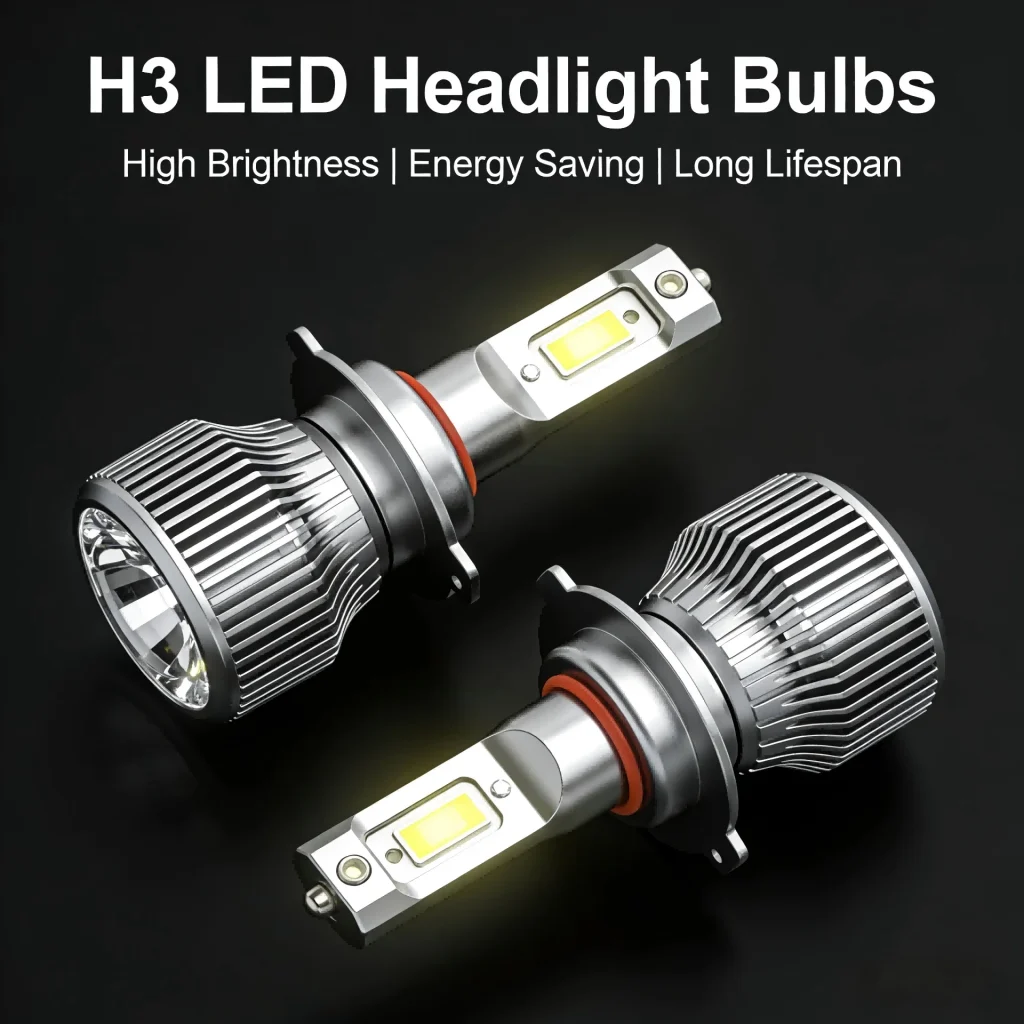
How Should You Choose an H3 LED Bulb?
Choose an H3 LED bulb by matching five factors: lamp application, beam requirement, available housing space, operating temperature, and electrical system. Then compare color temperature, sustained output and cooling. This method is more reliable than selecting a bulb from advertised wattage or peak lumen figures alone.
In our engineering work with automotive lighting, we often see buyers begin with the specification sheet.
We prefer to begin with the vehicle.
That distinction matters.
A bulb does not operate in isolation. It sits inside a reflector or projector, receives power from a vehicle electrical system, operates in a confined environment, and must remain stable during vibration, heat, rain, and long driving periods.
Good lighting performance is therefore the result of system matching.
Scenario 1: You Drive in Fog, Rain, or Poor Weather
For frequent fog or heavy-rain driving, an H3 LED setup should prioritize controlled beam distribution and comfortable visual contrast rather than extreme cool-white output. A yellow or warm-color H3 LED may suit some drivers, but the lamp must still maintain accurate focus and avoid excessive scattered light.
This is where searches for H3 LED bulb yellow usually begin.
A driver may live in an area with frequent rain, morning fog, snow, mountain roads, or wet highways. Under these conditions, excessive uncontrolled light can reflect from moisture and make the scene feel brighter without making important objects easier to identify.
A warmer-color lamp is often preferred for this type of application.
However, color is only one part of the system.
What to Prioritize for Bad-Weather Lighting
- Controlled light distribution: light should stay inside the useful illumination area.
- Moderate color temperature: many drivers prefer yellow or warmer output for adverse weather.
- Stable output: brightness should remain consistent after the lamp becomes hot.
- Good moisture resistance: especially important for lamps positioned low on the vehicle.
- Compact dimensions: fog-light housings often provide limited installation space.
A yellow lamp with poor optical alignment will not automatically outperform a white lamp with excellent focus.
The housing determines how light reaches the road.
Scenario 2: You Want More Visibility on Rural Roads
Country roads create another type of problem.
There may be fewer streetlights, more animals, uneven road shoulders, motorcycles, pedestrians, or unexpected obstacles.
Here, drivers often search for maximum brightness.
This is why terms such as H3 LED bulb 100W attract so much attention.
But a powerful lamp is useful only when the extra light is controlled.
Why More Power Can Create Diminishing Returns
An LED converts electrical energy into light, but not all energy becomes visible output.
Some becomes heat.
As input power rises, the thermal system must remove more heat from the LEDs and driver.
If the cooling system cannot keep up, operating temperature rises. Output may then fall or component life may be affected.
This creates a simple engineering relationship:
Higher power requires higher thermal capacity.
| Driving Requirement | Recommended Priority | Common Buying Mistake |
|---|---|---|
| Dark rural road | Beam reach and stable output | Choosing only by wattage |
| Wet road | Contrast and controlled beam | Choosing very cool color only |
| Long-distance driving | Thermal stability | Testing only initial brightness |
| Compact fog housing | Physical dimensions | Ignoring heat-sink clearance |
| Commercial fleet | Reliability and batch consistency | Buying only on lowest unit price |
For long-distance night driving, a slightly lower-powered bulb that maintains stable output can be more useful than a high-power design that becomes thermally stressed after extended operation.
Scenario 3: Your Original H3 Lamp Has Very Little Space
Compact H3 housings require an LED replacement with enough clearance for the bulb body, heat sink, driver, wires, retaining hardware, and dust cover. A bulb can have the correct H3 base and still fail to fit because LED cooling components often occupy more space than the original halogen design.
This is one of the least glamorous specifications—and one of the most important.
A customer may search for an H3 LED bulb nearby, purchase it from a local store, and discover during installation that the cooling system interferes with the lamp cover or retaining spring.
The product is technically H3.
But the installation still fails.
Measure Before You Order
- Remove or inspect the existing H3 bulb.
- Measure the available depth behind the bulb base.
- Check the diameter available around the heat sink.
- Inspect the original spring clip or retaining mechanism.
- Determine where the external driver will sit.
- Confirm the wiring can be routed without being pinched.
- Check whether the original dust cap can still close.
For wholesalers, these measurements should become part of application mapping.
A slightly more compact bulb may cover more vehicle models and reduce returns.
Scenario 4: You Need a Bulb Today
This explains location-based retail searches such as:
- H3 LED bulb Advance Auto;
- H3 LED bulb NAPA;
- H3 LED bulb AutoZone;
- H3 LED bulb nearby.
These users have high purchase intent.
They may already have a failed fog lamp or be preparing for a road trip and need a replacement immediately.
Retail availability is valuable in this situation.
But urgency should not remove basic compatibility checks.
Before Paying at the Counter, Check Three Things
First, confirm that the original bulb really is H3.
Similar automotive bulb types can appear alike to an inexperienced buyer.
Second, compare the physical dimensions.
The LED unit may be longer than the halogen bulb it replaces.
Third, confirm the intended lamp application.
A product designed mainly for auxiliary lighting may not behave identically in every fog-lamp optical system.
Fast availability is helpful.
Correct fit is better.
Scenario 5: You Are Buying for Canada, Australia, or New Zealand
Keywords such as H3 LED bulb Canadian Tire, H3 LED bulb Supercheap Auto, and H3 LED bulb NZ reveal an important truth about automotive lighting:
Markets are different.
Weather is different.
Vehicle fleets are different.
Road conditions are different.
Customer expectations are different.
Regulations can also differ.
Why Regional Product Strategy Matters
A distributor should not assume that one universal H3 LED SKU is ideal for every country.
For example, a market with frequent rain may have stronger demand for warmer-color fog-light products.
A market with long-distance rural driving may place more emphasis on sustained output.
A market dominated by compact passenger cars may require smaller cooling structures.
A modification-focused market may prefer a higher-performance product range with several color-temperature options.
This is why GTR evaluates automotive lighting from both the engineering and market side.
Scenario 6: You Operate a Workshop or Retrofit Chain
A retail consumer can experiment with one pair of bulbs.
A professional installer cannot afford the same level of uncertainty.
If a workshop installs 20 pairs per week, repeated fitment problems create lost labor time.
If a chain has 40 locations, inconsistent quality can quickly become an operational issue.
Workshop Buyers Should Measure Installation Efficiency
Consider two products.
Product A costs slightly less but requires frequent adapter changes, has inconsistent driver placement, and sometimes prevents the dust cover from closing.
Product B costs slightly more but fits predictably and installs quickly.
The cheapest purchase price may not produce the lowest installed cost.
| Workshop Cost Factor | Why It Matters |
|---|---|
| Installation time | Long installations reduce workshop capacity |
| Fitment problems | Increase technician troubleshooting |
| Warranty replacement | Creates unpaid repeat labor |
| Customer comeback rate | Consumes service time |
| Product consistency | Makes installation easier to standardize |
| Technical support | Helps solve unusual vehicle applications |
For retrofit chains, therefore, product reliability becomes an operational efficiency issue—not simply a lighting issue.
Scenario 7: You Are an Importer or National Distributor
At this level, the definition of a “good H3 LED bulb” changes again.
You are not evaluating one bulb.
You are evaluating a supply program.
The key questions become:
- Can the supplier reproduce the same performance batch after batch?
- Can specifications be adjusted for different markets?
- Can packaging support your local brand strategy?
- Can the supplier handle volume growth?
- Is there a clear quality-control process?
- Can technical data be provided to your sales and installation teams?
- Can several bulb types be combined into one broader lighting portfolio?
This is the point where buying from a professional manufacturer becomes different from simply buying a product listing.
How Do You Read H3 LED Specifications Correctly?
Specification sheets can be useful, but each number needs context.
Wattage
Wattage describes electrical power.
It should be evaluated together with cooling performance and actual operating conditions.
Lumens
Lumens describe luminous output.
But buyers should ask whether the figure represents theoretical chip output, measured bulb output, or stabilized operating output.
Color Temperature
Color temperature influences visual appearance.
Warm or yellow output may suit fog applications, while neutral-to-cool white is popular for general lighting upgrades.
Voltage Range
The driver must operate correctly within the electrical conditions of the intended vehicle.
Cooling System
A fan, aluminum heat sink, heat pipe, copper substrate, or other thermal component should be judged by how effectively the complete design controls temperature.
IP Rating
Where environmental sealing claims are provided, they should relate to the actual product design and test method. Buyers can review the general concept of ingress protection through the International Electrotechnical Commission.
A Better 5-Minute H3 LED Evaluation Method
If you have several samples on your desk, do not begin by reading the packaging.
Start with the product itself.
- Compare the LED source position. Look at where the emitting surfaces sit relative to the original filament location.
- Compare overall dimensions. A compact package often gives installers more flexibility.
- Run the bulbs. Observe output after the system reaches operating temperature.
- Install them in the same lamp. Compare actual beam distribution rather than bare-bulb brightness.
- Inspect construction quality. Look at connectors, wiring, machining, sealing, driver housing and assembly consistency.
This five-step test will usually reveal more about real product quality than a long list of marketing claims.
Why LED Chip Position Matters So Much
Think of the original H3 filament as the starting point of an optical calculation.
The reflector receives light from that point and redirects it forward.
Move the light source, and the reflected rays change direction.
This is why semiconductor quality alone cannot determine headlamp or fog-lamp performance.
A premium chip placed in the wrong position may produce a worse beam than a more modest chip placed accurately.
In our engineering testing, we therefore examine the relationship between chip placement and the lamp’s optical behavior rather than treating the LED package as an isolated component.
Why Sustained Output Matters More Than a 30-Second Test
Online product demonstrations often show a bulb immediately after startup.
That is the easiest moment for an LED to look impressive.
The more revealing test comes later.
After the bulb has operated long enough to build heat, ask:
- Has output changed?
- Is the driver stable?
- Is the fan operating smoothly?
- Has the heat-sink temperature stabilized?
- Does one sample behave differently from another?
For commercial buyers, this type of testing also helps expose manufacturing consistency.
A single good sample proves very little if production units vary substantially.
What Makes an H3 LED Suitable for B2B Distribution?
A distribution-grade H3 LED should offer more than strong initial brightness. It should deliver repeatable production quality, practical vehicle fitment, thermal stability, reliable electronics, clear specifications, manageable warranty risk, and supplier support. For wholesalers, those factors determine profitability long after the purchase order is signed.
This is where GTR’s manufacturing approach becomes relevant.
GTR works in automotive aftermarket lighting with a focus on practical product performance and scalable supply.
Depending on project requirements, professional customers may need:
- OEM or ODM development;
- private-label branding;
- custom packaging;
- regional product combinations;
- technical product selection;
- bulk-order support;
- market-specific automotive lighting solutions.
Our aim is to help distributors build a lighting range that works not only in a catalog, but also in workshops, retail stores, vehicles, and repeat customer orders.
H3 LED Bulb FAQ
How do I know whether my car uses an H3 bulb?
Check the existing bulb marking, vehicle documentation, or a reliable fitment database. Confirm the lamp position as well because one vehicle may use different bulb types for different functions.
Is an H3 LED bulb suitable for fog lights?
H3 bulbs are widely used in fog and auxiliary lighting applications, but suitability depends on the specific lamp housing, physical fit, beam distribution, electrical system, and local rules.
What color H3 LED bulb should I choose?
Yellow or warmer output may appeal to drivers who frequently encounter fog or rain. White output remains popular for general automotive upgrades. Beam quality should remain the first priority.
Does an H3 LED bulb 100W provide twice the brightness of 50W?
No. Electrical power and visible output do not increase in a simple one-to-one relationship. LED efficiency, driver performance, cooling, and optics influence the final result.
Where can I buy an H3 LED bulb nearby?
Automotive parts stores and lighting specialists may carry H3 replacements. Searches such as H3 LED bulb AutoZone, NAPA, or Advance Auto can help locate retail options in relevant markets.
What should I check when buying H3 LED bulbs in bulk?
Evaluate fitment coverage, optical design, sustained output, thermal management, electronics, production consistency, packaging, warranty support, and supplier manufacturing capability.
Why does an H3 LED work in one vehicle but not another?
The same bulb base can appear in different lamp housings. Clearance, reflector geometry, electrical monitoring systems, retaining hardware, and wiring can vary between vehicles.
Are H3 LED replacement bulbs legal everywhere?
No. Vehicle-lighting regulations vary between countries and applications. Buyers should verify the rules that apply in their target market. International regulatory information is available through the UNECE vehicle regulations framework.
Choose for the Road First, Then Read the Box
The smartest H3 LED purchase starts with the driving environment.
Fog requires one set of priorities.
Long rural roads require another.
Compact vehicles create different installation limits.
Workshops need fast, repeatable fitment.
Distributors need stable quality across thousands of units.
That is why there is no single useful answer to the question, “Which H3 LED bulb has the biggest number?”
A better question is:
Which H3 LED delivers the right optical, electrical, thermal, and commercial performance for this application?
If you are building an H3 LED product line for wholesale distribution, automotive modification shops, regional dealers, or your own private-label brand, explore GTR automotive lighting solutions at www.rhgtr.in.
Tell GTR where the products will be sold, what vehicles your customers modify, the weather they drive in, and what price segment you want to target. Instead of selecting another generic H3 bulb from a catalog, build a lighting range around the roads your customers actually drive every night.