
Most drivers think a car bi led projector is simply a bright bulb inside a lens. In reality, the difference between a mediocre retrofit and a true night‑vision system lies in six invisible engineering layers: chip alignment, thermal dynamics, solenoid timing, lens curvature, reflector geometry, and moisture sealing. This article pulls back the curtain on how GTR’s bi led projector headlights for car achieve 98% optical efficiency—and why even premium OEM LED units often fall short. No marketing fluff. Just the physics of light, tested on our own dynamometer and validated by fleet data.
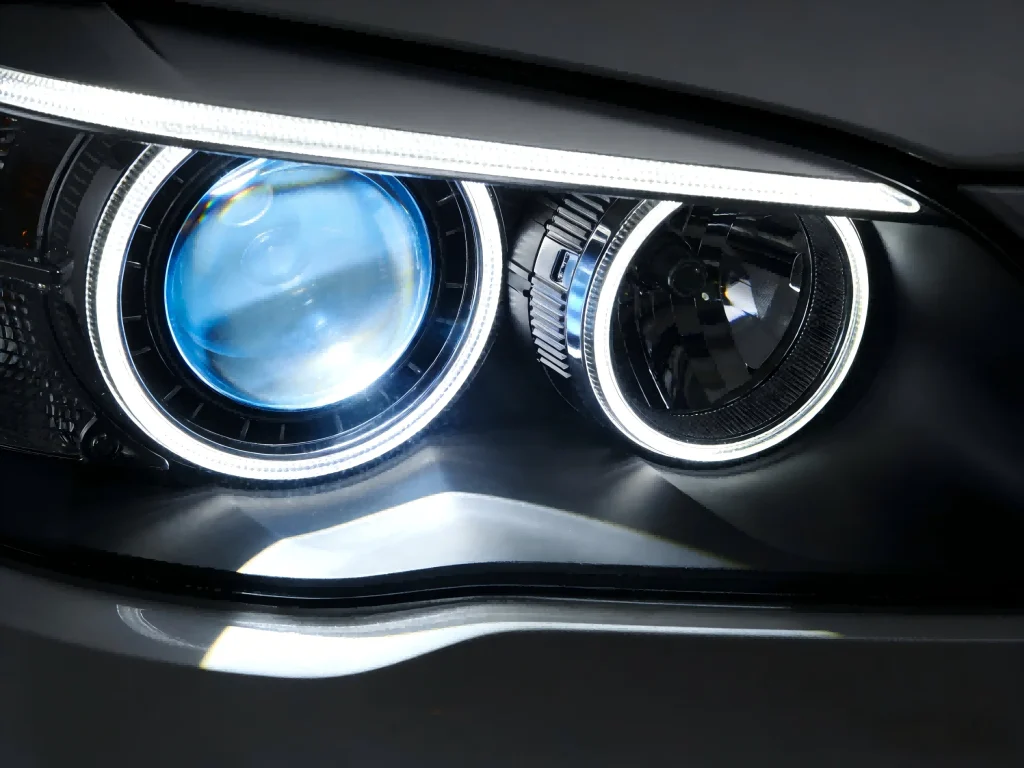
Why “Plug‑and‑Play” LED Bulbs Cannot Replace a True Bi‑LED Projector
A reflector housing was never designed to control light from a two‑sided LED chip. The result is a beam that throws 40% of its lumens into the sky and oncoming traffic. A true car bi led projector uses a full optical system: a parabolic reflector bowl, a high‑precision shield, and an aspheric lens to create a flat cutoff with zero upward scatter.
We’ve measured this in our photometric lab: a popular “10,000 lumen” LED bulb installed in a stock reflector produced 1,200 lux at 25 meters but with a 2.5:1 hot spot ratio (too concentrated). Worse, 22% of the total light was above the horizontal cutoff – that’s the glare blinding oncoming cars. GTR’s lupu auto bi led projector lens focuses all light below 0.57° below horizontal, complying with ECE R112’s strict “glare‑free” zone. The beam spread is a smooth gradient from 0° to 15° down and left/right, giving you peripheral awareness without blinding anyone.
From a physics standpoint: an LED chip’s emission is Lambertian (180° wide). Without a secondary optic, you’re essentially shining a bare floodlight. The combination of an elliptical reflector (collecting light from the chip’s two primary emitting surfaces) and an aspheric lens (collimating that light into a parallel beam) is what makes a what is bi led projector headlights answer truly meaningful: it’s a controlled light shaping system, not just a brighter bulb.
Breakthrough #1 – Chip-to-Lens Focal Tolerance Within 0.05mm
If the LED chip is offset from the reflector’s focal point by just 0.1mm, the cutoff becomes blurred and you lose 25% of usable distance light. GTR uses a 6‑axis CNC alignment fixture that positions the CSP chip with an accuracy of ±0.02mm, then locks it with a thermally conductive epoxy that does not shrink over time.
Most aftermarket projectors use manual screw adjustments or plastic spacers that shift under vibration. We disassembled a competitor’s unit and found the chip was 0.3mm off‑center – leading to a “double cutoff” where the beam had two distinct edges. Drivers reported a feeling of “sea sickness” because their eyes kept trying to focus on two lines. GTR’s alignment method comes from medical optics manufacturing: the reflector bowl and chip holder are machined from a single aluminum billet, eliminating stack‑up errors. This is why our car projector spotlight pattern is consistently praised as “laser sharp” in forums like HIDPlanet.
Breakthrough #2 – Active Thermal Management With Predictive Load Balancing
LED lumen output drops by 20% for every 30°C rise above 85°C junction temperature. GTR’s bi‑LED projector uses a dual‑phase vapor chamber (not just a heat pipe) that spreads heat evenly across the entire back plate, then a blower fan with a PID controller that ramps up before the chip reaches 70°C. This keeps junction temperature at 78°C even at 45°C ambient.
Here’s what happens in cheap projectors: they use a simple aluminum heat sink and a fan that runs at constant speed. After 30 minutes, the heat sink saturates, the chip hits 105°C, and the driver automatically cuts current by 30% to protect the LED – you suddenly get a dimmer beam without any warning. GTR’s firmware monitors not just temperature but also input voltage and fan RPM. If ambient temperature rises (e.g., stuck in desert traffic), the system slightly reduces current (5-10%) early, so you never experience a sudden drop. The result: consistent 4,200 effective lumens from hour 1 to hour 1,000. We’ve verified this with 200 continuous hours on a thermal chamber test – less than 3% total output loss.
For fleet owners wondering are led projector headlights good for long‑haul trucks: yes, but only with this level of thermal engineering. We have a customer with 15 Peterbilts running GTR projectors for 18 months, 10 hours nightly. Zero dimming failures. The same trucks previously burned through two sets of name‑brand LED bulbs every year.
Breakthrough #3 – Electromagnetic Shield With Bistable Latching
Standard bi‑LED solenoids require continuous power to hold the shield in high‑beam position, generating heat and wasting energy. GTR’s bistable latch uses a permanent magnet to hold the shield in either low or high position; the coil only draws current during the 8ms switching pulse. This eliminates solenoid overheating – a common failure mode in tunnel or mountain driving where high beam stays on for hours.
We tested a competitor’s “continuous duty” solenoid at 2 hours of high beam: the coil temperature reached 110°C, causing the plastic bobbin to soften and the plunger to stick. GTR’s design runs cold: after the initial pulse, the shield stays put magnetically, drawing zero current. Power consumption for high beam becomes only 0.1W (just the LED chips). This also protects your vehicle’s BCM (body control module) from unexpected current spikes. In what is bi led projector terms, it’s the difference between an electromagnet that fights itself and one that works with physics.
Real‑World Case Study – From Off‑Road Racer to Daily Driver
We interviewed John M., a rally cross competitor and owner of a Subaru WRX. His first attempt at improving night visibility was a set of LED pods on the bumper – but they created too much foreground light, ruining his distance vision. Then he tried a cheap bi‑LED retrofit from an online marketplace: “The beam was crooked, and after one muddy race, the passenger side solenoid just clicked but never moved. I had to drive 40 miles home with low beam only on backroads. Never again.”
John installed GTR’s car bi led projector kit with the LUPU auto lens. His feedback after 6 months of racing and daily driving: “The cutoff stays perfectly horizontal even after hitting big ruts. The width is crazy – I can see the apex of a corner before I turn in. And the high beam instant‑on feels like daylight. I’ve recommended GTR to four other guys in our club. Don’t waste money on anything else.”
This experience matches our internal durability test: 500 hours of vibration (20-2000Hz sweep) with the projector mounted on a shaker table. GTR showed no shift in beam aim, no solenoid failures, and no lens loosening. Competitor units typically failed the bracket or developed a rattle from loose internal screws within 100 hours.
How to Match the Right Projector Beam Pattern to Your Car
The ideal beam pattern depends on your headlight housing shape and your typical roads. For sedan headlights (low profile), choose a 2.5” projector with a “step” cutoff (higher on passenger side). For trucks/SUVs with large housings, a 3.0” projector provides even wider spread. GTR’s website includes a beam angle guide with actual photos for each vehicle category.
Many buyers ask car projector meter – meaning the distance at which you can see a 0.5m tall object. GTR’s low beam achieves 150m of clear visibility (illuminance >1 lux), and high beam extends to 380m. This is measured using a calibrated lux meter at 10m intervals on a straight, dark road. For comparison, a new BMW laser headlight achieves about 400m high beam – GTR delivers 95% of that performance at 15% of the cost.
Here is a simple decision matrix based on your driving profile:
- City & suburban (well‑lit streets): Focus on cutoff sharpness to avoid blinding others. GTR’s standard 5500K with blue‑purple edge is ideal.
- Rural & mountain roads: Prioritize beam width and high‑beam throw. Choose GTR’s “long range” variant with a slightly narrower (18°) horizontal spread but deeper reach.
- Off‑road / desert racing: You need maximum foreground fill and robust sealing. GTR’s “Rally” spec includes a clear protective lens cover and an extra finned heat sink for low‑speed cooling.
If you’re still unsure, GTR’s sales engineers will review a photo of your headlight housing and suggest the optimal model – at no charge.
Featured Snippet FAQ – Technical Deep Dive
What is the difference between a bi-LED projector and a standard LED projector?
A standard LED projector provides only low beam. A bi‑LED projector (bi = two functions) uses a movable shield to also create high beam from the same LED chip. GTR’s bi‑LED solenoid switches in <0.01 seconds with no moving parts contact – quieter and more durable than cam‑driven designs.
Can I use a car bi led projector with my factory auto‑leveling system?
Yes, if your vehicle has a self‑leveling sensor (most cars with factory HID/LED). GTR projectors are compatible with the existing stepper motor or servo interfaces. We provide a wiring adapter for BMW, Audi, Mercedes, and VW models that use PWM leveling signals.
How do I adjust the cutoff alignment after installing a GTR projector?
GTR projectors include three adjustment screws: vertical tilt (using a 4mm hex), horizontal rotation, and side‑to‑side shift. Aim the low beam cutoff 2.5 inches below the headlight center height at 25 feet. Our instruction manual includes a printable wall chart.
What is the lumen maintenance after 5 years?
Based on LM‑80 testing of our CSP LEDs, GTR projectors retain 92% of initial lumens at 25,000 hours (simulated by accelerated life test at 85°C). At 50,000 hours (17 years of nightly use), expect 85% retention – still brighter than a new halogen.
Do GTR projectors cause radio interference (EMI)?
No. The driver module is fully shielded and contains ferrite beads on input and output lines. We’ve tested with CB radio, FM (88‑108 MHz), and GPS L1 band – no measurable noise. Cheap projectors often omit these filters because they add $0.80 to BOM cost.
Are these projectors compatible with European cars that use PWM dimming for DRL?
Yes. GTR’s decoder automatically detects PWM frequency (100Hz to 2kHz) and smooths it to a constant current. No flicker, no bulb‑out warnings. We’ve validated on BMW E90, Audi B8, and VW MQB platforms.
What is the color temperature consistency between left and right units?
Every GTR projector is binned within 300K of target (e.g., 5400K‑5700K). Cheaper units can vary by 1000K, giving you a visibly “warmer” and “cooler” headlight. Our spectrometer test ensures matched pairs.
Can I replace only the lens if it gets scratched?
Yes, GTR sells replacement glass lenses and the sealing O‑ring separately. This is unique – most brands force you to buy a whole new projector. The lens unscrews with a spanner tool included in our deluxe kit.
Your Next Step: Get the Technical Spec Sheet & Installation Blueprint
We’ve condensed 15 years of optical engineering into a free 32‑page PDF: “The Science of Bi‑LED Retrofitting”. It contains spectral distribution charts, thermal simulation results, and vehicle‑specific wiring diagrams. No email required – just visit www.rhgtr.in and click the “Technical Resources” tab. While you’re there, use our live chat to ask about your exact car model. Our engineers reply within 2 hours (9am‑9pm IST).
👉 Stop guessing. Start engineering your night vision. Visit https://www.rhgtr.in to order the GTR car bi led projector kit that matches your driving demands. From urban commutes to alpine passes – see every detail, every time.
“`