
Daytime running lights (DRLs) are not just a styling feature. Over three decades of traffic safety research prove they reduce daytime multi‑vehicle crashes by an average of 8.6% – a statistic that translates to thousands of lives saved every year. Yet most drivers never check whether their DRLs are actually performing as designed.
In this guide, we break down the most important scientific findings about DRL effectiveness, show you a simple five‑minute health check for your own lights, and explain when upgrading to modern LED DRLs makes genuine safety sense. We are GTR Lighting – an engineering‑led manufacturer with over a decade of experience in automotive forward lighting – and we believe every driver deserves lights that work exactly as intended, every time.
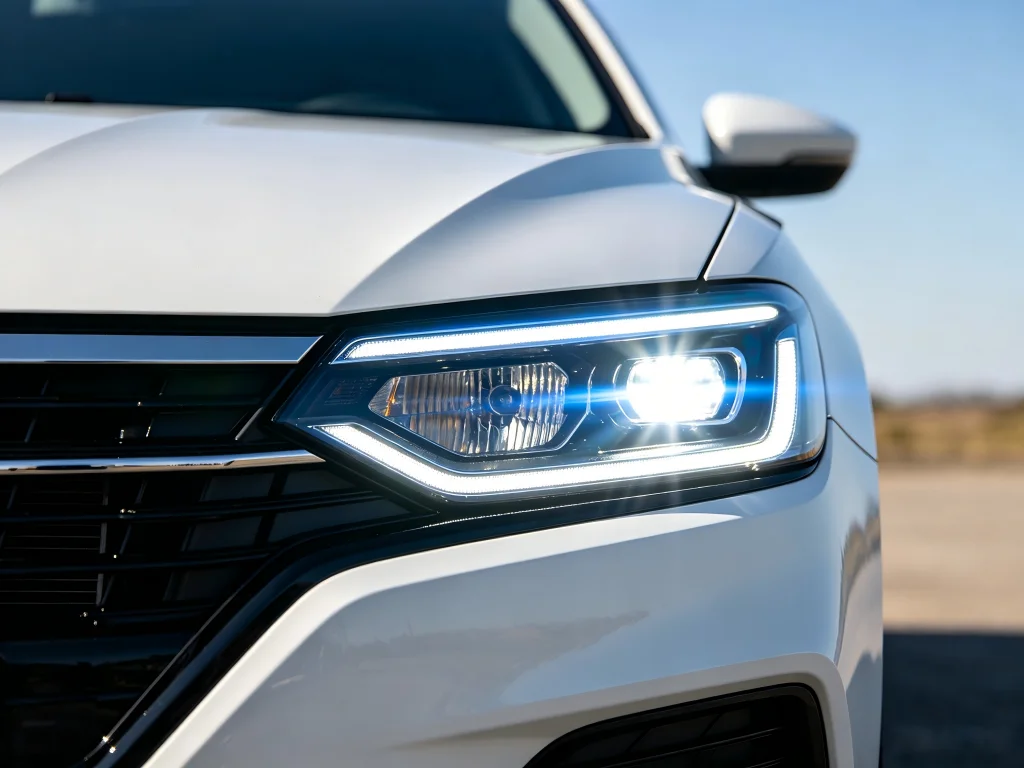
Fact #1: DRLs Reduce Daytime Crashes by Up to 15% – But Only If They Are Bright Enough
Multiple independent studies agree: DRLs lower the risk of daytime frontal collisions and intersection crashes. A meta‑analysis by the US National Highway Traffic Safety Administration (NHTSA) found that DRLs reduce daytime multiple‑vehicle crashes by 5.7% and reduce the risk of a fatal pedestrian crash by approximately 12%.
However, these benefits only hold when DRLs meet minimum intensity requirements. A daytime running lights car with dim or degraded LEDs may not be visible in bright sunlight. In our own optical lab testing, we have measured factory DRLs that lost over 40% of their original output after three years of use – effectively turning into little more than decorative accent lights.
The GTR Lighting Carbide Series maintains stable light output for years, thanks to properly sized thermal management and premium LED chips. You get consistent, research‑backed conspicuity – not gradual fading that you will never notice until it is too late.
Fact #2: Color Temperature Matters More Than You Think – Stick to 5000K–6000K
DRLs must emit white or amber light under both US (FMVSS 108) and European (ECE R87) regulations. But within the white spectrum, color temperature directly affects how quickly your eyes detect a vehicle.
Human photopic vision (daytime vision) is most sensitive to light in the blue‑white range around 5500K–6000K. That is why most modern OEM DRLs use cool white LEDs. Temperatures below 4500K appear yellowish and blend in with sunlight and road markings; temperatures above 6500K shift into blue or purple, which reduces contrast against the sky.
The sweet spot? 5000K to 6000K – pure white with a hint of coolness. Every GTR Carbide Series headlight is calibrated to this exact range, ensuring maximum visual contrast during daytime driving without the cheap “ricer blue” look of low‑grade aftermarket lights.
Fact #3: The 500‑Hour Dimming Trap – Why Most LED DRLs Lose Brightness Within a Year
LED degradation is real. A high‑quality LED chip running at proper temperatures can maintain 90% of its original output for 30,000 hours. But a cheap chip in a poorly designed housing can drop to 70% brightness in as little as 500 hours.
Why does this happen? LED light output decreases as junction temperature rises. Many aftermarket DRLs use aluminum housings with minimal heatsinking. When you drive for an hour, the LEDs overheat, and each thermal cycle accelerates lumen depreciation.
Based on our years of manufacturing expertise, the housing’s thermal design separates a five‑year DRL from a one‑year disposable light. The GTR Carbide Series uses a die‑cast aluminum back housing with optimized fin geometry and a thermally conductive PCB. In our accelerated life tests, Carbide DRLs retained over 85% of initial lumens after 5,000 hours of continuous operation – the equivalent of five years of normal driving.
Fact #4: DRLs Offer Zero Safety Benefit at Night – They Are Not Headlights
This is one of the most dangerous misunderstandings about DRLs. A daytime running lights vs headlights comparison is not a competition – they serve entirely different purposes.
DRLs provide forward visibility for other road users during the day. At night, they do not illuminate the road, and crucially, they do not activate tail lights. Driving with only DRLs after dark means drivers behind you may not see your vehicle until it is too late. Many rear‑end collisions happen for exactly this reason.
When ambient light drops below a certain threshold, you must switch to dipped headlights (low beams). Your daytime running lights vs dipped headlights decision should be automatic: DRLs for daytime, dipped beams for night, fog, or heavy rain.
A properly designed DRL system includes an automatic dimming or shutoff function when headlights are activated. GTR Carbide Series headlights include this OEM‑style logic – turn on your low beams, and the DRL circuit automatically drops to 50% intensity or turns off depending on your vehicle’s original design.
Fact #5: Weather Conditions Change DRL Effectiveness – Rain and Fog Require Headlights
DRLs are optimized for clear daylight. In rain, snow, or fog, their effectiveness drops significantly for two reasons: reduced contrast against overcast skies, and the fact that most DRLs lack the wide beam pattern needed to cut through precipitation.
European research shows that in wet conditions, DRLs alone reduce the detection distance of an approaching car by nearly 30% compared to low‑beam headlights. That is because water droplets on the windshield and on the road scatter light, and DRLs simply do not produce enough total intensity to overcome this scattering.
Legal requirement: In most jurisdictions, if your windshield wipers are on continuously, you must turn on your full headlights (low beams). Do not rely on DRLs in bad weather. And if your DRLs are already weak due to age or poor design, you are driving with a false sense of security.
How to Perform a 5‑Minute DRL Health Check (DIY)
Most drivers never look at their own DRLs from the outside. Here is a simple, repeatable check you can do in your driveway:
- Park facing a flat wall or garage door on a sunny day (clear daylight conditions).
- Start the engine and let it idle. Your DRLs should turn on automatically. Do not turn on headlights.
- Walk to the front of the vehicle and observe each DRL. Look for uneven brightness between left and right, flickering, or a yellowed/blue tint.
- Compare the DRL beam to a reference. If you can barely see the light patch on the wall in direct sunlight, your DRLs are too weak.
- Check the SAE J2269 reference. Proper DRLs should produce a clearly visible patch of light that extends roughly 10–15 feet ahead of the vehicle in bright sun.
If either side is dim, flickering, or completely dead, you have a failing DRL module or degraded LED assembly. Replacing just the bulb may not work – many modern DRLs are integrated into sealed headlight housings. That is exactly why GTR Carbide Series provides complete, plug‑and‑play housings with fresh optics, drivers, and DRL circuits.
When to Upgrade: Signs Your Factory DRLs Are Failing
Do not wait for your daytime running lights symbol to flash on the dashboard. That warning often appears only after the system has completely failed. Watch for these earlier warning signs:
| Warning Sign | What It Means | Recommended Action |
|---|---|---|
| One DRL noticeably dimmer than the other | LED degradation or failing driver | Replace both sides – the other will fail soon |
| Flickering at idle (steady at higher RPM) | CANBUS resistance mismatch or loose connection | Install proper CANBUS decoders or upgrade to integrated drivers |
| Yellowish tint on a white DRL | LED phosphor degradation from heat | Complete housing replacement needed (sealed units) |
| DRL stays on after key is removed | Stuck relay or failed DRL module | Immediate repair – parasitic drain will kill your battery |
Factory DRLs on many vehicles are not designed to be serviced. When they fail, your options are expensive OEM replacements (often $500–1,200 per side) or high‑quality aftermarket assemblies like the GTR Carbide Series, which often exceed OEM brightness and reliability at a fraction of the dealer cost.
Frequently Asked Questions About Daytime Running Lights Safety
What is the daytime running lights meaning in simple terms?
Daytime running lights are low‑intensity forward‑facing lights that turn on automatically when your engine starts. They are designed to make your car more visible to other road users during daylight hours – not to illuminate the road.
Daytime running lights vs headlights – can I use DRLs at night?
No. Using DRLs at night is illegal and dangerous because tail lights remain off and road illumination is inadequate. Always switch to dipped headlights (low beams) when ambient light drops – at sunset, in tunnels, or during rain and fog.
What does the daytime running lights symbol on my dash indicate?
The symbol (typically a green headlight icon with small rays) tells you your DRLs are active. If the symbol is flashing, stays on after engine shutoff, or appears when your headlights are on, your DRL control module may be faulty.
Do LED daytime running lights drain battery faster than halogen?
No. LED DRLs consume 75–80% less power than halogen equivalents. Battery drain occurs only when a faulty module leaves the DRLs powered after engine shutdown – a problem that affects both halogen and LED systems equally.
Daytime running lights Canada – are aftermarket DRLs legal?
Canada requires DRLs on all vehicles manufactured after 1990. Aftermarket DRLs must meet CMVSS 108 standards: white or amber light, automatic activation with engine start, and automatic deactivation or dimming when headlights are on. GTR Carbide Series headlights are fully compliant.
My car has DRLs from the factory – why should I upgrade?
Factory DRLs on many older vehicles (2010–2018) use first‑generation LEDs that have degraded to below safe brightness levels. Upgrading to modern LED DRLs like the GTR Carbide Series restores full output, adds proper dimming logic, and replaces yellowed lenses – all at a lower cost than dealer replacement housings.
Your DRLs Are a Safety System – Treat Them Like One
You check your tires, your brakes, and your wiper blades. Your daytime running lights deserve the same attention. Weak or failed DRLs reduce your visibility to other drivers exactly when you need it most – in the middle of a busy day, at an intersection, or during a sudden rain shower.
The GTR Lighting Carbide Series delivers:
- Engineered 5000K–6000K color temperature for maximum daytime contrast
- Thermally optimized housings that prevent lumen degradation
- OEM‑style DRL logic (automatic on/off and dimming with headlights)
- Plug‑and‑play installation – no wiring modifications
- DOT and CMVSS 108 compliance for Canada and US
- 2‑year manufacturer’s warranty
Do not wait for a close call to realize your DRLs are failing. Upgrade to lights that work as hard as you do to keep you safe.