
You know that blue symbol on your dashboard. You know it means your high beam headlights are on. But do you know exactly when you are legally required to switch them off? Or why using them in the wrong situation could put you — and everyone around you — at risk?
High beam headlights are one of the most powerful safety tools on your vehicle, but they are also one of the most misused. Understanding the legal requirements, proper usage rules, and the technology behind them isn’t just about avoiding a fine — it’s about keeping yourself and others safe on the road.
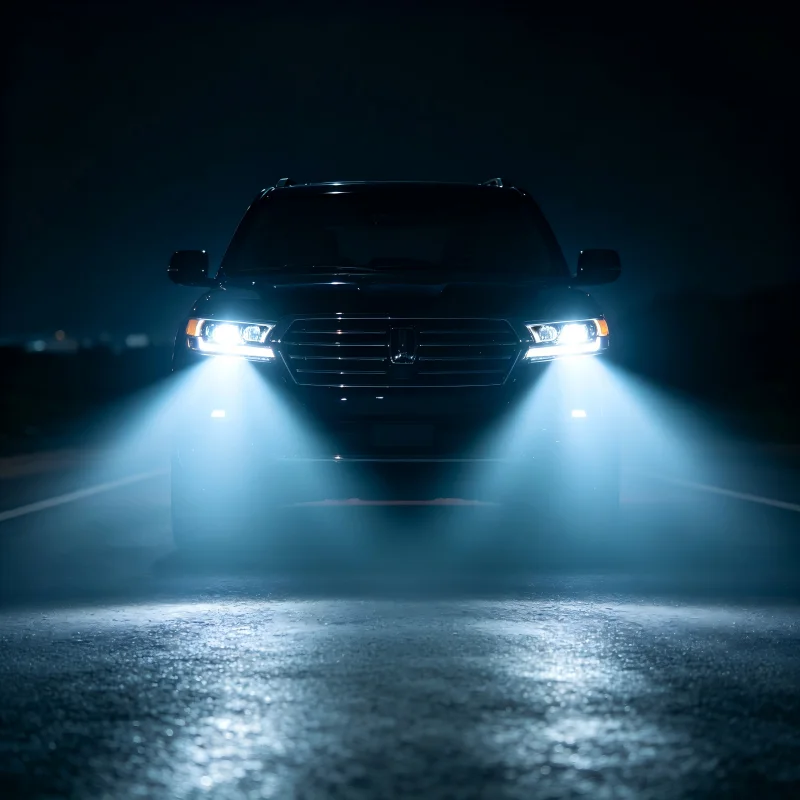
What the Law Says About High Beam Headlights
Most drivers don’t realize that high beam usage is regulated by law in virtually every jurisdiction. These regulations exist for one reason: high beams, when used improperly, create dangerous glare that can temporarily blind other drivers.
In Australia, for example, road rules require drivers to dip their high beams when a vehicle coming toward them is within 200 metres, or when driving 200 metres or less behind another vehicle. In the United States, the National Highway Traffic Safety Administration (NHTSA) sets headlight performance standards under Federal Motor Vehicle Safety Standard (FMVSS) 108, which requires that headlamps provide adequate illumination without causing unsafe glare.
In many regions, the minimum required illumination distance for high beam headlights is 100 metres (approximately 328 feet). Some regulations require high beams to illuminate at least 50 metres ahead. These aren’t suggestions — they are minimum safety standards that your headlights must meet.
Additional headlights — including LED light bars — are typically classified as high beam lights and must comply with the same usage rules. In many places, they must automatically turn off when the high beams are turned off, and a maximum of four additional headlights may be fitted to a vehicle.
Violating these rules doesn’t just risk a fine. In some jurisdictions, improper high beam use carries demerit points on your license. More importantly, it creates real danger on the road.
When to Use High Beam Headlights — And When to Dip
High beam headlights should be used exclusively on unlit roads during darkness when no other traffic is present or approaching.
Here is the practical breakdown every driver should follow:
- Use high beams when: Driving on dark rural roads, highways without street lighting, or any unlit road where visibility is poor and there is no oncoming traffic or vehicles ahead of you.
- Dip your high beams when: An oncoming vehicle is within 200 metres, you are following another vehicle within 200 metres, you are driving in a built-up area with street lighting, or when approaching bends where your lights could dazzle other road users.
- Never use high beams: In fog, heavy rain, or snow — the light reflects off water droplets and reduces your visibility rather than improving it.
One common misconception is that high beams are appropriate in fog because they are “brighter.” In reality, the opposite is true. High beam headlights in fog create a white wall of reflected light directly in front of your vehicle. The moisture in the air scatters the light in all directions, making the fog appear denser and significantly reducing your ability to see hazards.
Using high beams properly is about more than avoiding tickets. It is about understanding that your visibility tool becomes a hazard for others when misused. A driver dazzled by your high beams can’t see pedestrians, animals, or road hazards — and that puts everyone at risk.
Understanding the High Beam Headlights Symbol
Every driver has seen it, but not everyone fully understands what the high beam headlights symbol actually communicates.
The high beam headlights symbol is a blue dashboard indicator that looks like a headlight with straight, horizontal lines radiating outward.
Unlike the green dipped beam symbol — which has downward-slanting lines — the blue high beam indicator specifically means your brightest lights are active and projecting straight ahead. In vehicles with automatic high beam assist, the icon may be accompanied by the letter “A”.
The blue color is intentional. It stands out against the other dashboard indicators, serving as a constant reminder that your high beams are on. When that blue light is on, you are telling everyone around you — and yourself — that you are operating in high beam mode. That should trigger an automatic check: is there oncoming traffic? Is there a vehicle ahead? Am I in a built-up area?
The high beam indicator remains constantly visible while your high beams operate. It’s not just a convenience feature — it is a safety mechanism designed to prevent you from inadvertently dazzling other road users.
How Far Should High Beam Headlights Illuminate?
The distance your high beam headlights should cover is a critical safety metric. It determines how much reaction time you have when a hazard appears.
Properly functioning high beam headlights should illuminate the road 350 to 400 feet ahead — roughly the length of a city block.
At 55 mph (approximately 88 km/h), that gives you roughly four to five seconds of reaction time to identify and respond to a hazard. Low beams, by comparison, typically illuminate only 100 to 200 feet ahead, giving you just two to three seconds of reaction time.
Regulatory minimums vary by jurisdiction. Some require a minimum of 100 metres (328 feet) for high beams. Others set the minimum at 50 metres. But the minimum standard isn’t the safety standard you should aim for. Premium high beam systems can exceed regulatory minimums significantly, providing substantially more reaction time and better hazard detection.
Research has shown that adaptive high beam systems can increase detection distance by over 44%, providing a safety gain of more than 1.27 seconds of additional reaction time. That extra second can be the difference between stopping safely and a collision.
Halogen vs. LED vs. HID — What Actually Delivers?
Your high beam headlights are only as good as the bulbs inside them. And not all bulbs are created equal.
| Feature | Halogen | HID (Xenon) | LED (Premium) |
|---|---|---|---|
| Typical brightness | 700-1,200 lumens | 2,500-3,500 lumens | 3,000-6,000+ lumens |
| Lifespan | 500-1,000 hours | 2,000-3,000 hours | 20,000-30,000 hours |
| Warm-up time | Instant | 5-15 seconds | Instant |
| Energy efficiency | Low | Moderate | High |
| Beam pattern accuracy | Good (if aligned) | Moderate | Excellent (with proper chip positioning) |
Research consistently demonstrates the superiority of LED light sources over halogen and HID options for headlight applications. LEDs deliver higher brightness, dramatically longer lifespans, instant full brightness (no warm-up delay), and better energy efficiency. However — and this is critical — the engineering quality matters enormously.
A cheap LED kit with poorly positioned chips will produce scattered light that hits the treetops and oncoming drivers’ eyes instead of the road ahead. The LED chips must sit in exactly the same position as the halogen filament would. Premium chips like the Philips ZES series measure just 1.6mm x 2.0mm, closely matching the halogen filament width for accurate beam patterns. That’s what delivers usable light — not just raw lumens that go everywhere except where you need them.
When a halogen lamp is replaced with an improperly engineered LED, both the high beam and low beam irradiation directions can fail to meet safety standards. The lesson is clear: LED technology is superior, but only when engineered correctly.
What Real Drivers Experience
Based on feedback from tens of thousands of real installations, drivers who upgrade from halogen to properly engineered LED high beam headlights consistently report transformative differences in night driving confidence.
“I drive a rural route every night for work. With my old halogens, I was constantly straining to see the edges of the road. After switching to properly engineered LED high beams, I can see reflective markers and potential hazards much earlier. It’s not just brighter — it’s actually usable light where I need it.”
“The biggest difference isn’t just the distance. It’s the clarity. The beam pattern is clean and focused. No scatter, no glare. I can actually see what’s on the road ahead instead of just a general bright area.”
“I used to avoid night driving in the rain because my high beams made things worse. Now, with proper LEDs, I actually have usable visibility in wet conditions. The beam cuts through without the reflection effect I got from halogens.”
These aren’t marketing claims. They are the real-world experiences of drivers who made the switch from underperforming high beam headlights to properly engineered LED solutions.
Smart Choices Start With Understanding
High beam headlights are one of the most important safety features on your vehicle. But they only work as intended when used correctly — and when the technology inside them is engineered to deliver usable light, not just raw brightness.
Understanding when to use high beams, when to dip them, and what the dashboard symbols mean is the first step. Choosing properly engineered LED high beam headlights that deliver accurate beam patterns, instant full brightness, and reliable performance is the next step.
GTR’s high beam headlight solutions are engineered with premium LED chips and optimized positioning for specific bulb sizes — delivering usable light exactly where you need it. Not scattered into the trees. Not reflected back at you in fog. On the road ahead, where it matters.
High Beam Headlights — Quick Answers
What does the high beam headlights symbol look like on my dashboard?
The high beam headlights symbol is a bright blue dashboard indicator that looks like a headlight with five straight, horizontal lines radiating outward. Unlike the green dipped beam symbol (with downward-angled lines), the blue high beam indicator means your brightest lights are active.
How far should high beam headlights illuminate?
Properly functioning high beam headlights should illuminate the road 350 to 400 feet ahead — roughly the length of a city block. Regulatory minimums vary, but 100 metres (about 328 feet) is a common standard in many jurisdictions.
Should high beam headlights be used in fog?
No. High beam headlights in fog actually reduce visibility. The light scatters off water droplets and reflects back toward the driver, creating a “white wall” effect. Use low beams or fog lights instead.
When should high beam headlights be dipped?
High beam headlights should be dipped (switched to low beam) when a vehicle coming toward you is within 200 metres, when driving 200 metres or less behind another vehicle, or in built-up areas with street lighting.
What is the difference between high beam and low beam headlights?
High beam headlights project a bright, concentrated beam straight ahead for maximum distance (350-400 feet) and are designed for dark, unlit roads with no traffic. Low beams cast a shorter, wider beam (100-200 feet) angled downward to avoid glare, for everyday driving.
What does “high beam headlights light above the roadway” mean?
This refers to the direction of the high beam projection. High beams are aimed higher than low beams to illuminate a longer distance ahead. However, if aimed too high, they can interfere with oncoming traffic. Properly aligned high beams should light the roadway ahead without creating excessive glare for other drivers.
Visit www.rhgtr.in to find the right high beam headlights for your vehicle.